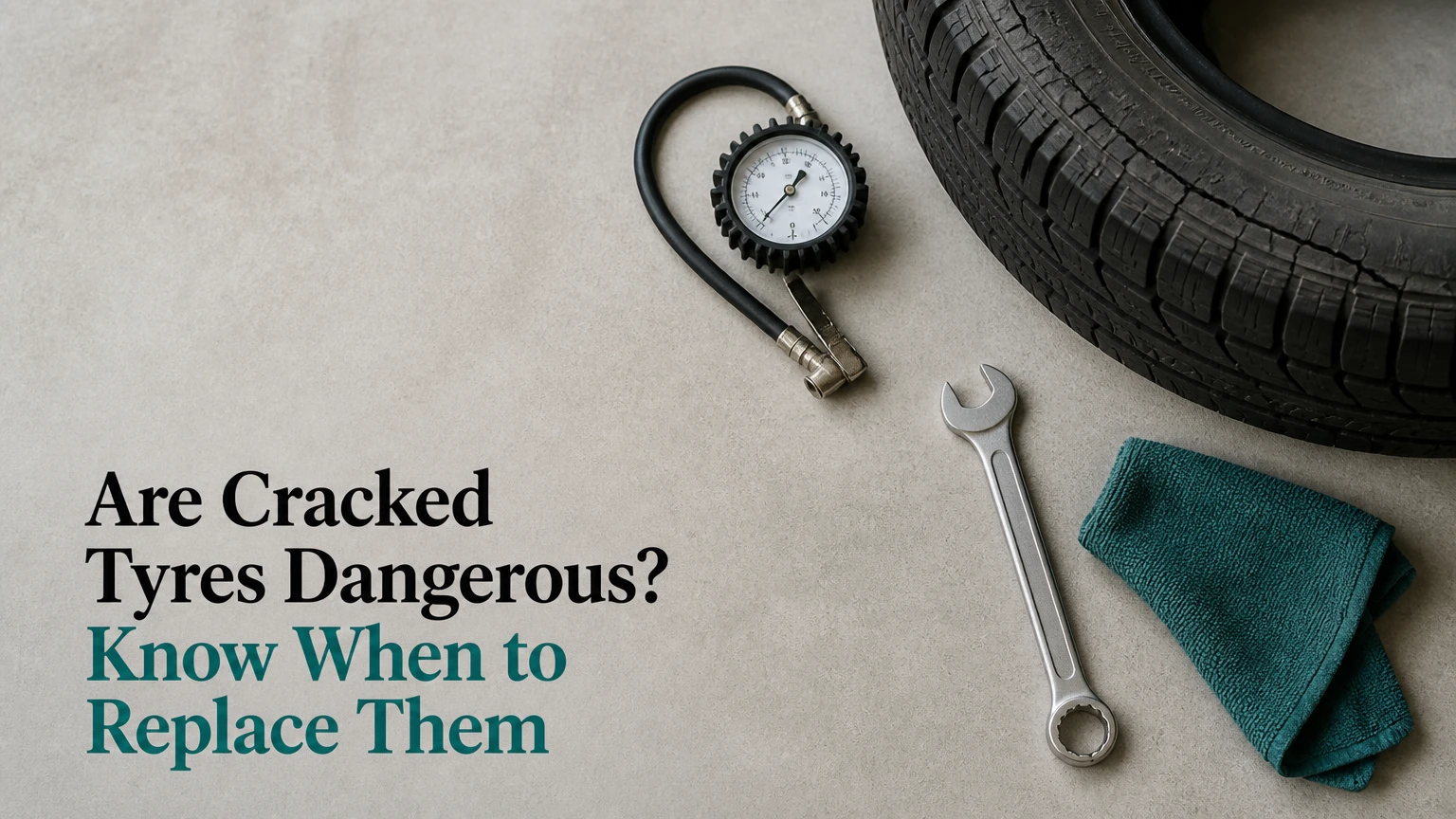
Cracked tyres can be dangerous because cracking may show that the rubber compound and casing have deteriorated. Fine superficial crazing can be an early warning, but cracks that widen, reach the casing, appear on a sidewall or bead, or expose cords make the tyre unsafe and require professional assessment or replacement.
Key Facts at a Glance
- A cracked tyre cannot be made structurally safe with polish, conditioner, sealant, or tyre dressing.
- Sidewall cracks are more concerning than shallow marks confined to a tread groove because the sidewall flexes repeatedly under load.
- Tyre age matters even when tread remains legal; several manufacturers recommend replacement at 10 years from manufacture and inspection from around five years.
- No universal law makes every crack deeper than 1.5 mm illegal; safety decisions depend on location, depth, casing exposure, damage pattern, and local regulations.
- Visible textile, steel, a bulge, a blister, or tread lifting means the tyre should not be driven on.
- Correct inflation reduces casing flex and heat, but it cannot reverse chemical ageing or repair existing cracks.
Are Cracked Tyres Dangerous?
Cracked tyres are dangerous when cracks indicate deterioration beyond the outer surface, particularly on the sidewall, bead, or beneath the tread. Structural damage can reduce the tyre’s ability to contain inflation pressure and transmit braking, cornering, and acceleration forces, increasing the possibility of air loss, tread separation, or a sudden failure.
The danger is not determined by tread depth alone. A tyre with 5-6 mm of tread can still have aged rubber, weakened bonding, or hidden inner-sidewall damage. The National Highway Traffic Safety Administration, or NHTSA, describes tyres as “the only thing between you and the road,” which explains why visible casing deterioration deserves attention even when a tread-wear indicator has not been reached.
Fine lines may remain limited to the surface, especially on a lightly used tyre stored indoors. However, a driver cannot reliably determine structural integrity from one glance, and the inner sidewall often shows damage that is invisible from outside. A tyre professional should inspect any pronounced cracking before a long trip, high-speed journey, heavy load, or towing event.
What does tyre cracking mean?
Tyre cracking, commonly called dry rot or weather checking, means that the rubber surface has developed splits or a network of fine fissures. Cracking often accompanies oxidation, ozone exposure, ultraviolet radiation, heat, age, low use, incorrect pressure, or contact with chemicals.
Cracking does not always mean immediate failure. It does mean the tyre has lost some reserve condition, so its location and progression matter. Surface crazing that remains narrow and stable is different from an opening split that reveals fabric or allows a fingernail to enter deeply.
Why Do Tyres Crack?
Tyres crack because oxygen, ozone, ultraviolet light, heat, and repeated flexing alter the rubber compound over time. Protective additives slow that process, but they are gradually consumed or migrate through the compound, so ageing accelerates when tyres remain hot, exposed, underinflated, or unused.
Modern tyres contain natural and synthetic rubber, carbon black or silica, oils, sulphur-based curing agents, steel belts, textile cords, and protective chemicals. Anti-ozonants and waxes help protect exposed rubber, but they do not create an unlimited barrier. Ozone attacks susceptible double bonds in rubber polymers, while oxygen and heat promote oxidation and hardening.
Regular use is not a cure. Flexing can help some protective waxes reach the surface, but driving also generates heat and mechanical stress. A tyre that is already cracked can deteriorate faster during a heavily loaded motorway trip than while parked.
Common causes of dry rot
| Cause | Typical exposure or condition | Effect on the tyre | Practical response |
|---|---|---|---|
| UV radiation | Outdoor parking for months or years | Surface oxidation and fading | Park under cover or use breathable, manufacturer-approved covers |
| Ozone and oxygen | Urban air, electrical equipment, long storage | Polymer degradation and loss of elasticity | Inspect older or infrequently used tyres annually |
| Heat | Hot climates, underinflation, heavy loads | Higher casing temperature and faster ageing | Set cold pressure to the vehicle placard specification |
| Low usage | Vehicle stationary for weeks or months | Protective additives are not replenished evenly; flat-spot stress can occur | Move and inspect the vehicle, without treating movement as a repair |
| Chemicals | Petroleum products, solvents, aggressive cleaners | Compound swelling, drying, or surface damage | Rinse contamination and avoid solvent-based dressings |
| Physical stress | Kerbs, potholes, overloading, mounting damage | Local cuts, pinches, or casing distortion | Arrange a professional inspection |
An expert inspection should include the inner sidewall, because suspension components and wheel access can hide cracks from a casual outside view. A useful practitioner rule is simple: if a crack is visible from several feet away, feels open with a plastic probe, or appears with a bulge, do not classify it as cosmetic without professional confirmation.
How Serious Are Different Crack Patterns?
Crack location and depth determine seriousness more reliably than colour or tread depth. Sidewall, shoulder, bead, and cracks that extend into a groove require more caution than faint, isolated surface lines on non-structural rubber.
| Crack pattern | What it may indicate | Driving decision | Replacement or inspection action |
|---|---|---|---|
| Fine hairline crazing on upper sidewall | Early weather checking | Avoid high-speed or heavily loaded use until assessed | Book a tyre inspection soon; photograph for progression |
| Open sidewall split | Casing flex damage or advanced ageing | Do not drive on the tyre | Replace; sidewall damage is not safely repairable |
| Cracks at shoulder or tread groove | Ageing, underinflation, impact, or heat | Stop using if cracks widen or reach casing | Inspect pressure, alignment, and internal structure |
| Exposed textile or steel | Structural casing failure | Do not drive | Replace immediately and inspect the wheel |
| Cracked bead near rim | Mounting damage, corrosion, age, or heat | Do not drive if bead rubber is torn or lifting | Replace and check rim condition before fitting |
| Tread blocks lifting or separating | Belt or bond failure | Do not drive | Replace immediately; inspect companion tyres |
Are sidewall cracks the most dangerous?
Sidewall cracks are among the most concerning tyre defects because the sidewall repeatedly bends as the wheel rotates and supports changing vehicle loads. A crack on the sidewall, especially near a bulge, cut, repair, or exposed cord, can progress under inflation pressure and should normally result in replacement rather than repair.
The inner sidewall deserves equal attention. A car parked close to a kerb may show damage only on the outward face, while a tyre that struck a pothole can have a hidden inner-sidewall injury. A professional may need to remove the wheel or use proper lighting to assess the full circumference.
What do cracks between tread blocks mean?
Cracks between tread blocks can result from ageing, ozone exposure, underinflation, heat, or a casing problem. Shallow lines limited to the outer tread surface are less alarming than cracks that open at the groove base, extend laterally, reveal fabric, or accompany tread lifting.
The 1.6 mm tread figure used in many jurisdictions concerns remaining tread depth, not crack safety. Legal tread depth cannot certify the condition of belts, cords, bead rubber, or sidewalls. A tread-depth gauge and a visual inspection answer different questions.
Can You Drive on Cracked Tyres?
You should not drive on a tyre with deep, widening, circumferential, sidewall, bead, or cord-exposing cracks. A tyre with faint surface crazing may be moved carefully to a nearby tyre centre after a professional risk assessment, but a driver should not use a guessed “safe distance” as a substitute for inspection.
Before moving a vehicle, compare all four tyres and the spare. Check for low pressure, bulges, cuts, vibration, uneven wear, tread lifting, and visible casing material. If any cord is exposed, pressure is falling, the sidewall is bulging, or the tyre has separated from the rim, use a spare or arrange mobile assistance.
| Situation | Risk factors | Recommended action | Typical permitted journey |
|---|---|---|---|
| Fine surface lines, stable pressure, no bulge | Older rubber but no visible casing damage | Arrange inspection before normal use | Short, slow trip to a nearby tyre centre only if approved |
| Open sidewall crack | Repeated flexing and pressure containment risk | Replace tyre | Zero distance on that tyre |
| Cracks plus low pressure | Heat and deflection rise rapidly | Do not inflate and continue driving blindly | Use spare or mobile fitter |
| Towing or full payload | Greater load and casing temperature | Replace or obtain professional clearance first | No discretionary journey |
| Cracking on a stored trailer | Long stationary loading and age | Inspect every tyre before use | No highway trip until cleared |
Failure timing cannot be predicted accurately. A shallow mark may remain unchanged for months, while an aged tyre with a deep split can lose pressure during one heat cycle. Load, speed, ambient temperature, inflation pressure, impact history, and casing condition all change the outcome.
How Should You Inspect a Cracked Tyre?
Inspect a tyre when it is cold, on level ground, with the steering turned to expose the front sidewalls. Read the entire circumference of each tyre, including the inner sidewall where accessible, then check pressure with a calibrated gauge and inspect the DOT or date code.
Step 1: Find the tyre date code
A United States DOT identification code usually ends with four digits. The first two digits identify the manufacturing week and the final two identify the year, so “2421” means the 24th week of 2021. Date-code formats and markings vary by market, and the full code may appear only on one sidewall.
Age guidance is not a single worldwide legal rule. NHTSA advises consumers to follow the tyre manufacturer’s replacement guidance, while manufacturers including Michelin and Bridgestone commonly recommend professional inspection from five years and replacement by 10 years from manufacture, regardless of remaining tread. Some vehicle, climate, fleet, and trailer recommendations are shorter.
Step 2: Examine the whole casing
Use a bright light and look for radial cracks, circumferential cracks, bulges, blisters, exposed fabric, cuts, tread separation, bead damage, and uneven wear. Do not bend or puncture the rubber to make a crack appear larger, because manipulation can worsen damage.
Step 3: Check pressure and load conditions
Compare cold pressure with the vehicle manufacturer’s door-jamb or handbook specification, not the maximum pressure moulded into the sidewall. Underinflation creates more sidewall flex and heat; overinflation reduces the contact patch and can make impact damage harsher.
Step 4: Request an internal inspection
Ask a qualified tyre technician to inspect a suspicious tyre from both sides and, when necessary, remove it from the rim. Visual inspection cannot reveal every belt separation, liner defect, or inner-sidewall injury.
What Is the Legal or Inspection Position?
Tyre laws generally specify tread depth, inflation, load, damage, and overall roadworthiness, but they do not use one universal crack-depth measurement. In the United Kingdom, for example, MOT rules assess tyre condition and damage as well as tread, and a dangerous defect can fail an inspection even when tread exceeds 1.6 mm.
A 1.6 mm minimum applies to many passenger-car tyres across the central three-quarters of the tread and around the full circumference in jurisdictions influenced by UK-style rules, but local requirements differ. Some countries use different limits for vehicle classes, winter tyres, motorcycles, commercial vehicles, or specific axle positions.
The often-repeated 1-2 mm or 1.5 mm crack rule is not a universal safety standard. Crack depth alone cannot establish safety because a shallow sidewall split may be more serious than a deeper mark in a sacrificial tread groove. Exposed cords, a bulge, bead damage, or tread separation should be treated as immediate removal conditions.
Can a Cracked Tyre Be Repaired?
A cracked tyre generally cannot be repaired safely because ageing has affected the rubber or casing beyond one puncture site. Puncture repairs address a limited injury in the tread’s repairable zone; they do not restore deteriorated sidewalls, bead rubber, belt bonds, or weather-cracked tread.
Tyre shops may repair certain small punctures after removing and inspecting a tyre, following local standards and the manufacturer’s limits. They should not fill structural cracks with rubber, glue, sealant, or an external patch and return the tyre to service.
Tyre dressing creates a visual finish, not structural recovery. Petroleum-based products and solvent-heavy cleaners can damage some rubber compounds, and glossy products may conceal new cracking during routine checks. Wash contamination away with mild soap and water, dry the tyre, and retain a clear view of its condition.
How Does Tyre Age Change the Decision?
Tyre age raises replacement priority because rubber properties change even when a vehicle travels very few miles. A five-year-old tyre is not automatically unsafe, and a nine-year-old tyre is not automatically sound, but older tyres deserve annual professional inspection and stricter attention to cracking.
| Tyre age from manufacture | Condition check | Typical decision | Important qualification |
|---|---|---|---|
| Under 3 years | Inspect for impact and storage damage | Continue if sound, correctly inflated, and undamaged | Age alone does not guarantee condition |
| 3-5 years | Inspect at routine servicing | Monitor cracking and pressure more closely | Hot climates can accelerate ageing |
| 5-7 years | Professional inspection at least annually | Replace if cracking, hardening, or damage appears | Manufacturer guidance takes priority |
| 8-9 years | Frequent condition checks | Plan replacement even with good tread | Low-mileage use does not stop ageing |
| 10 years or more | Do not rely on visual tread condition | Replace according to common manufacturer guidance | Some manufacturers or applications specify less |
The date code is more useful than the purchase receipt. A tyre may have spent time in storage before fitting, so service age and manufacturing age are not identical. A reputable seller should provide tyres with an appropriate production date and disclose relevant stock-age information.
What Does Cracked-Tyre Replacement Cost?
Typical passenger-car replacement costs range from about £60-£220 or $80-$250 per tyre, excluding unusual sizes, premium run-flat designs, fitting, valves, disposal, alignment, and taxes. SUVs, electric vehicles, performance cars, light trucks, caravans, and motorhomes can cost substantially more.
| Replacement category | Typical price per tyre | Fitting and related cost | Main price driver |
|---|---|---|---|
| Small economy car | £60-£110 | £15-£30 | 13-15 inch size and budget compound |
| Family hatchback or saloon | £80-£170 | £15-£35 | Brand, wet-grip rating, and 16-18 inch size |
| SUV or crossover | £110-£240 | £20-£45 | Reinforced casing, load index, and diameter |
| Run-flat or performance tyre | £150-£350 | £25-£50 | Special casing and low-profile construction |
| Caravan or trailer tyre | £70-£180 | £15-£40 | Load range, seasonal use, and specialist size |
Replacing one tyre may create a tread-depth mismatch, particularly on driven axles and vehicles with all-wheel drive. Ask the installer whether the pair should be replaced, whether the new tyre belongs on the rear axle under local practice, and whether the vehicle manufacturer requires matched rolling circumference.
The replacement tyre must meet or exceed the original size, load index, speed rating, construction type, and seasonal specification. Electric vehicles may require tyres with suitable load capacity and noise or efficiency characteristics, but the vehicle placard remains the starting point.
What About Caravans, Trailers, and Stored Vehicles?
Caravan and trailer tyres often age faster in practical terms because they can remain stationary for months under sustained load, with sunlight and pressure loss affecting the same contact area. Owners should inspect them before every season, verify cold pressure, and replace them according to the tyre and vehicle manufacturer’s age guidance.
A seasonal trailer that has covered only a few hundred miles may still have aged casing rubber. Jacking a trailer to remove load during long storage can reduce flat-spot and compression stress, but the support method must follow the trailer manufacturer’s instructions and remain stable.
Store tyres away from ozone-producing electrical motors, solvents, fuel, direct sunlight, damp ground, and standing water. Covers should block sunlight while allowing appropriate ventilation; airtight wrapping can trap moisture and is not a universal storage solution.
How Can You Prevent Further Tyre Cracking?
You can slow tyre ageing by maintaining placard pressure, reducing ultraviolet exposure, cleaning off chemicals, limiting heat buildup, and inspecting unused vehicles regularly. Prevention cannot reverse existing cracks, so a tyre that has already developed structural splits still needs replacement.
Use this maintenance routine:
- Check cold pressure at least monthly and before long journeys.
- Inspect sidewalls, shoulders, tread grooves, and the inner sidewalls every month.
- Rotate tyres only at the intervals and pattern permitted by the vehicle manufacturer.
- Keep tyres away from fuel, oil, brake cleaner, solvents, and aggressive dressings.
- Park in shade or under cover when practical.
- Record the manufacturing date and photograph visible cracks every few months.
- Obtain annual professional inspection once tyres reach about five years.
- Replace tyres before the manufacturer’s maximum age or sooner if damage appears.
A counterintuitive point matters here: driving a stored vehicle weekly does not “refresh” an aged tyre. Movement can distribute protective compounds and prevent prolonged loading in one position, but it cannot restore polymer bonds that have already degraded.
What Should You Do If a Cracked Tyre Fails?
If a tyre loses pressure or fails while driving, hold the steering wheel firmly, release the accelerator gradually, avoid sudden braking, and guide the vehicle to a safe place. Turn on hazard lights, keep away from traffic, and call roadside assistance rather than attempting a high-speed continuation on a damaged tyre.
A sudden blowout may produce pulling, vibration, noise, or a heavy steering change. Do not sharply countersteer or slam the brakes, because abrupt inputs can turn a tyre failure into a loss of control. After stopping, do not assume the remaining tyres are safe because they are on the same vehicle; inspect all tyres, especially if they share the same age and storage history.
The Bottom Line
Are cracked tyres dangerous? They can be, and sidewall cracks, widening splits, exposed cords, bead damage, tread lifting, bulges, or pressure loss mean the tyre should be replaced rather than monitored. Fine surface crazing is an early warning, not proof of immediate failure, but it warrants a professional inspection before high-speed, long-distance, towing, or heavy-load driving.
Tread depth and tyre age provide useful context, not a safety clearance. Check the DOT date, cold pressure, full casing, inner sidewall, and manufacturer guidance, then fit tyres that match the vehicle’s required size, load index, and speed rating.
Frequently Asked Questions
Can tyres crack even when the car is rarely driven?
Yes. Low-use vehicles can develop weather checking because ozone, oxygen, ultraviolet light, and heat continue to affect rubber while the car is parked. Stationary tyres also carry load in one position for long periods. Annual inspection, correct storage, and replacement based on age and condition matter more than mileage alone.
Is a cracked tyre worse than a bald tyre?
The defects create different risks. A bald tyre has reduced water clearance and braking grip because tread is worn, while a cracked tyre may have weakened casing rubber and pressure containment. Either condition can make a tyre unsafe, and a tyre with both low tread and cracking should be removed promptly.
Should I replace all four tyres if only one is cracked?
Not always, but replacing a matching axle pair is often recommended when one tyre has significant age-related cracking. All-wheel-drive vehicles may require closer rolling-circumference matching, and replacing a single tyre can create tread-depth differences. Follow the vehicle manufacturer’s instructions and obtain a measurement-based recommendation from the installer.
Can tyre pressure cause cracks?
Incorrect pressure can contribute to cracking by changing casing flex, heat, and contact stress. Underinflation is especially harmful because it increases sidewall deflection and operating temperature. Correct pressure can slow additional stress, but it cannot remove cracks caused by age, ozone, ultraviolet exposure, impact, or chemical contamination.
Are small cracks in new tyres covered by warranty?
Possibly, depending on the manufacturer’s workmanship warranty, production date, storage history, and inspection findings. Photograph the tyre, record its DOT code, retain the purchase invoice, and return to the seller before applying any dressing or attempting a repair. A technician must distinguish manufacturing damage from environmental or impact damage.