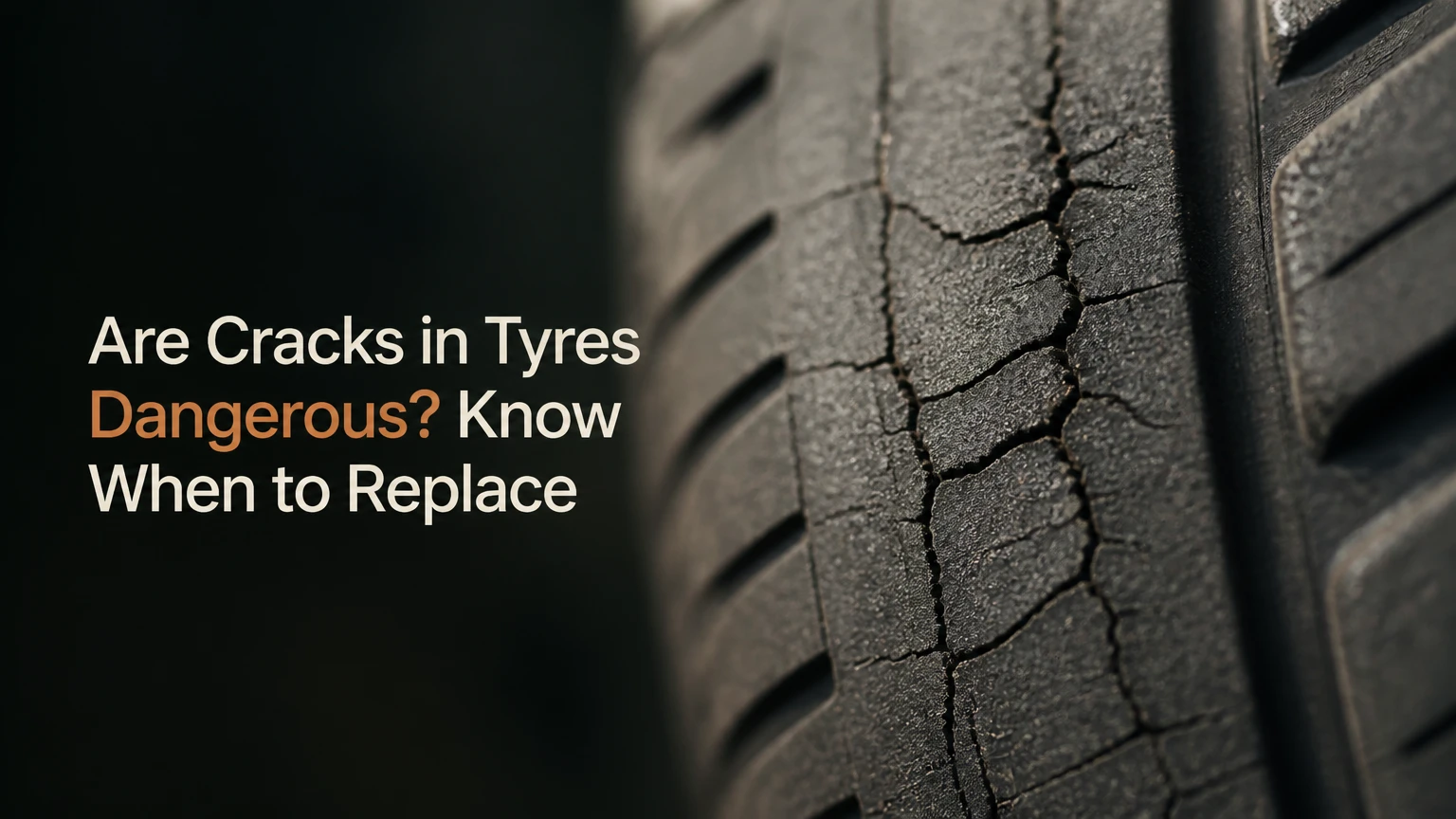
Cracks in tyres can be dangerous when they extend into the sidewall, bead, or structural tread area, or when they appear with ageing, bulges, air loss, or exposed cords. Fine superficial crazing is not automatically an emergency, but no visual check can certify a degraded tyre for a guaranteed mileage or timeframe.
Key Facts at a Glance
- Deep, widening, or sidewall cracks require tyre replacement, not patching or cosmetic treatment.
- Cracks near the bead can compromise the airtight seal and cause a slow leak or bead failure.
- Tread depth does not prove that an old tyre remains structurally safe.
- The four-digit DOT date code identifies the tyre’s week and year of manufacture, not the installation date.
- A bulge, exposed cord, sudden pressure loss, or severe vibration requires stopping and arranging professional assistance.
- Ten years is a widely used maximum service recommendation, not a universal legal limit in every country.
Are Cracks in Tyres Dangerous?
Yes, cracks in tyres are dangerous when they are deep, numerous, widening under normal flex, or located in a load-bearing area. A sidewall split can progress during repeated flexing and heat cycles, while a bead crack can cause air loss; both conditions justify replacement rather than continued road use.
Small, shallow lines confined to the outer surface between tread blocks may result from normal ageing or ozone exposure. They still deserve inspection because the visible rubber is only the outer part of a composite structure containing textile plies, steel belts, and an inner liner.
The practical question is not whether any crack exists. The practical question is whether the crack indicates loss of rubber integrity, air retention, or reinforcement protection. A tyre professional can inspect the inner sidewall, bead, tread base, and casing more reliably than an owner working from the outside.
What does tyre cracking mean?
Tyre cracking, also called perishing or dry rot, is splitting in the rubber compound caused by ageing, oxidation, environmental exposure, or mechanical stress. Cracks may appear on the sidewall, in tread grooves, around the bead, beside lettering, or near the valve area.
“Dry rot” does not mean that the tyre literally dried out like wood. The rubber has lost some of its plasticising and protective compounds, allowing oxidation and repeated deformation to create surface or structural fractures.
How Does Tyre Cracking Develop?
Tyre cracking develops when oxidation and environmental exposure reduce rubber flexibility, after which rolling, inflation pressure, load, and heat concentrate stress around small defects. Repeated stress can enlarge surface fissures and expose the casing to moisture, abrasion, and further chemical degradation.
Tyre compounds contain anti-ozonants, waxes, oils, and other additives. Ozone, ultraviolet light, high temperatures, and incompatible chemicals gradually affect those protective systems. A parked vehicle can age significantly even when its tread has travelled very few miles.
Underinflation adds flexing and heat. Overloading increases casing stress. Long outdoor storage exposes the sidewall to sunlight and weather, while a vehicle stored for months can develop flat-spotting and age-related surface damage without accumulating mileage.
What causes cracks in tyres?
Common causes include age, ozone, ultraviolet radiation, heat, incorrect inflation, excessive load, long-term outdoor storage, and unsuitable cleaning or dressing products. Manufacturing quality and compound design also influence how quickly a tyre develops visible cracking.
| Cause | Typical exposure or condition | Main tyre effect | Owner action |
|---|---|---|---|
| Ageing | 5-10 years from manufacture | Oxidation and stiffness | Check DOT date and manufacturer policy |
| Ozone and sunlight | Outdoor parking for months or years | Sidewall surface fissures | Use shade or opaque covers when parked |
| Underinflation | Pressure below placard value | Extra flex and heat | Check cold pressure monthly |
| Overloading | Load above tyre or axle rating | Casing stress and heat | Keep within vehicle and tyre limits |
| Chemicals | Petroleum solvent or harsh dressing | Compound degradation | Use soap and water only unless approved |
| Inactivity | Weeks or months stationary | Ageing without mileage | Inspect before travel and maintain pressure |
Which Tyre Cracks Are Most Dangerous?
Sidewall, bead, and deep tread-base cracks are more dangerous than isolated hairline crazing on an outer tread surface. Crack location matters because the sidewall flexes heavily, the bead retains air against the wheel, and the tread base connects the visible tread to the belt package.
| Crack location | What to look for | Safety meaning | Normal decision |
|---|---|---|---|
| Outer sidewall | Radial or circumferential splits, peeling, grey rubber | High flex and casing stress | Replace before normal driving |
| Inner sidewall | Cracks hidden behind suspension or brakes | Damage may be more advanced than visible outside | Inspect with a light or professional |
| Tread grooves | Fine lines between blocks | May be superficial if shallow and stable | Professional inspection if widespread |
| Tread base | Deep cracks at block bases or across shoulder | Possible belt or casing deterioration | Replace |
| Bead area | Splits where rubber contacts rim | Seal and bead-unseating risk | Replace and inspect wheel |
| Valve area | Crack around valve or rubber grommet | Slow leak or valve failure | Replace valve or tyre as diagnosed |
Are sidewall cracks dangerous?
Sidewall cracks are dangerous when they are deep, branching, widespread, or visible on both sides of the sidewall. Sidewall rubber cannot be safely patched to restore the casing, and a repair made to the tread does not correct sidewall deterioration.
A tyre sidewall bends with every wheel rotation. High speed, heavy loads, low pressure, hot weather, and pothole impacts increase that movement. Replace a tyre immediately when sidewall cracks open visibly, show lighter internal material, accompany a bulge, or reach the bead.
Are cracks between tread blocks dangerous?
Cracks between tread blocks are not automatically dangerous, but widespread, deep, or widening tread-groove cracks require replacement. Surface crazing can remain limited to the outer compound, whereas cracks that reach the tread base may threaten belt protection and tread retention.
Do not use tread depth as the only test. A tyre can measure above the legal wear limit while its rubber compound has aged. If cracking appears across several grooves, around the shoulders, or on a tyre with an old DOT date, have the casing assessed before highway use.
How Old Can a Cracked Tyre Be?
A cracked tyre has no dependable remaining mileage because crack depth, casing condition, inflation, load, temperature, and storage history vary. Many manufacturers advise increased inspection after five years and replacement around ten years from manufacture, but the tyre maker’s policy and local law control the final recommendation.
The U.S. National Highway Traffic Safety Administration states, “Some tire manufacturers recommend replacing tires six years after the date of manufacture.” That advice illustrates why a universal five-year replacement rule is too simple. Some manufacturers specify six years, while others use ten years as an upper service limit.
The UK’s legal minimum tread depth for most cars is 1.6 mm across the central three-quarters of the tread and around the full circumference, but that figure concerns tread wear, not rubber ageing. Other countries use different legal requirements. A tyre with legal tread can still be unsafe because of cracking.
How do you read a DOT tyre date?
Read the final four digits of the DOT or TIN marking on the sidewall. The first two digits identify the manufacturing week and the last two identify the year, so 2921 means the 29th week of 2021.
The date may appear only on one sidewall. If the outward-facing side has no four-digit suffix, inspect the inward-facing side without placing yourself under an unsupported vehicle. Record the oldest tyre date because four tyres fitted together may have been manufactured in different weeks or years.
Do not confuse manufacture date with purchase date. A tyre sold in 2024 may have been manufactured in 2022, and a spare may have aged while unused in the boot.
Can Cracked Tyres Be Repaired?
Dry-rot cracks, sidewall cracks, bead cracks, and structural tread cracking cannot be safely repaired with a plug, patch, sealant, or rubber conditioner. Puncture repairs address a qualifying injury in the repairable tread zone; they do not rebuild an aged or split casing.
| Condition | Repair suitability | Driving advice | Likely outcome |
|---|---|---|---|
| Nail puncture in repairable central tread | Sometimes repairable after removal | Limit driving until inspected | Internal patch-plug repair |
| Sidewall crack | Not repairable | Do not continue normal use | Tyre replacement |
| Bead crack or air leak | Not repaired with a puncture plug | Arrange inspection or recovery | Tyre and possibly wheel assessment |
| Exposed cord | Not repairable | Zero safe road mileage | Immediate replacement |
| Bulge after impact | Not repairable | Stop driving | Tyre replacement |
| Fine outer tread crazing | No repair usually required | Inspection determines risk | Monitor only if professionally accepted |
Tyre-shine products cannot restore lost elasticity. Petroleum-based products may damage some rubber compounds, and a glossy surface can hide worsening fissures. A product that changes appearance does not restore steel-belt adhesion, casing strength, or airtightness.
How Should You Inspect a Cracked Tyre?
Inspect all four tyres and the spare when they are cold, clean, and safely accessible; allow about 15 minutes for a basic visual check. Look at both sidewalls, the tread grooves, the shoulder, bead edge, valve area, and the surrounding wheel for corrosion or impact damage.
Inspection steps
- Check the pressure first. Compare cold pressure with the vehicle placard, usually found on the driver’s door frame or fuel flap. A low reading can indicate a bead, valve, tread, or puncture problem.
- Clean the rubber. Use water and mild soap, then dry the surface. Mud and tyre dressing can conceal fine splits.
- Read the date code. Record the four-digit DOT week and year code, including the oldest tyre on the vehicle.
- Use a bright light. Turn the steering to expose the front inner sidewalls, but never crawl beneath a vehicle supported only by a jack.
- Inspect without forcing the crack open. Look for gaps, flakes, cords, belts, bulges, or cracking that crosses the sidewall or shoulder.
- Check for related symptoms. Uneven wear, repeated pressure loss, vibration, pulling, and thumping can indicate a separate or additional defect.
- Arrange professional confirmation. Ask the fitter to inspect the inside casing and bead, especially when cracks are widespread or the tyre is older than five years.
A thumb-flex test can reveal an obvious split, but it cannot prove a tyre is safe. Do not press aggressively, insert a tool, scrape the rubber, or drive a suspect tyre to a shop at motorway speed.
What signs mean stop driving now?
Stop driving and arrange a mobile tyre service or recovery when a tyre has exposed cords, a bulge, a large sidewall split, rapid pressure loss, a detached tread section, or severe vibration. These conditions can worsen rapidly under heat and load.
A slow leak also needs prompt attention. Repeatedly inflating a tyre does not correct the defect, and driving below the recommended pressure increases casing flex. If the tyre is hot, damaged, or visibly distorted, do not remove the valve core or attempt a roadside repair.
Should You Replace One Cracked Tyre or Two?
Replace the damaged tyre when the matching tyre is relatively new, has comparable tread depth, and the vehicle manufacturer permits that arrangement. Replace tyres in axle pairs when the opposite tyre is similarly aged, worn, or mismatched, because unequal grip can affect braking and handling.
All-wheel-drive vehicles need extra care. Some manufacturers specify a maximum tread-depth difference between tyres, often around 2-4 mm, but the permitted difference varies by drivetrain and model. Consult the owner’s manual before replacing one tyre on an AWD vehicle.
| Replacement situation | Usual action | Reason | Extra check |
|---|---|---|---|
| One recent tyre, one isolated defect | Replace one if approved | Matching age and tread remain close | Match size, load, speed rating |
| Two tyres on one axle are old | Replace axle pair | Balanced grip and wear | Put better tread on the rear where advised |
| AWD with 2-4 mm allowable difference | Follow manufacturer limit | Driveline tolerances vary | Confirm manual or dealer specification |
| Four tyres aged or cracked | Replace all four | Common compound ageing | Check alignment and inflation |
| Temporary spare is old | Replace or inspect spare | Spare may exceed service age | Check date and pressure |
Fitment also requires the correct tyre size, load index, speed rating, construction, and seasonal specification. After replacement, balancing, valve replacement, TPMS servicing, and wheel-alignment checks may be appropriate.
How Much Does Cracked Tyre Replacement Cost?
Typical replacement costs range from about $80-$250 or £60-£200 per passenger-car tyre, with premium, performance, run-flat, SUV, and commercial tyres costing more. Fitting and balancing commonly add $15-$40 per tyre, while TPMS parts or programming may add $10-$60 where required.
| Cost item | Typical US range | Typical UK range | What changes the price |
|---|---|---|---|
| Economy car tyre | $80-$130 | £60-£100 | Size and local competition |
| Mid-range car tyre | $120-$190 | £90-£150 | Brand, wet grip, warranty |
| Premium or run-flat tyre | $180-$350+ | £140-£280+ | Construction and size |
| Fitting and balancing | $15-$40 | £12-£30 | Mobile versus workshop service |
| TPMS valve or service | $10-$60 | £10-£45 | Sensor type and programming |
| Four-tyre replacement | $380-$1,500+ | £280-£1,200+ | Vehicle, brand, and alignment |
These are typical market ranges, not a quote. Ask whether disposal, valves, balancing, taxes, mobile attendance, and TPMS programming are included. A puncture repair may cost less, but it is not an alternative to replacing a cracked casing.
Are Cracked Tyres Worse on Trailers, Caravans, and RVs?
Cracked tyres are particularly risky on trailers, caravans, and RVs because those vehicles often sit unused, carry high static loads, and travel long distances after months of storage. Inspect the tyres before every major trip, including the inner sidewalls and spare.
Trailer tyres can age out with substantial tread remaining. Exposure to sunlight, incorrect inflation, axle overload, and long stationary periods all increase risk. Follow the tyre and vehicle manufacturer’s service guidance rather than relying on a mileage-only schedule; many trailer specialists recommend replacement around five or six years.
| Use case | Main added risk | Pre-trip action | Replacement approach |
|---|---|---|---|
| Daily commuter | Heat and repeated flex | Weekly pressure check | Replace structural cracks immediately |
| Weekend car | Long stationary periods | Inspect before each trip | Cover from sunlight and verify age |
| Caravan | High load and seasonal storage | Check all inner sidewalls | Follow maker age guidance |
| Utility trailer | Overload and curb impacts | Check load rating and pressure | Replace cracked or bulged tyres |
| RV or motorhome | Heavy axle load and low mileage | Weigh axles if uncertain | Use manufacturer service limit |
A tyre cover can reduce ultraviolet exposure, but it does not reverse existing oxidation. Covers must be removed before driving and should not trap moisture against a dirty tyre.
How Can You Prevent Tyre Cracking?
Prevent tyre cracking by maintaining placard pressure, avoiding overload, storing vehicles away from ultraviolet light, cleaning with mild soap, and inspecting the complete casing. Prevention slows environmental ageing but cannot make an old or structurally damaged tyre serviceable.
Use these maintenance rules:
- Check pressure at least monthly and before heavy loads or long trips.
- Keep tyres away from solvents, fuels, brake cleaner, and petroleum-based dressings.
- Park in shade or use breathable, opaque covers for long storage.
- Keep tyres clean and remove salt, mud, and chemicals.
- Inspect the spare because unused tyres still age.
- Rotate tyres according to the vehicle manufacturer’s schedule.
- Record manufacture dates and replacement dates.
- Have alignment and suspension faults corrected when wear is uneven.
One counterintuitive point matters: driving a stored car occasionally does not “replenish” lost anti-ageing chemicals. Movement distributes flex and may prevent some flat-spotting, but it cannot reverse oxidation or repair cracks.
Common Mistakes When Judging Cracked Tyres
Mistake 1: Checking tread depth only
A tread gauge measures remaining tread, not casing elasticity, belt adhesion, bead condition, or sidewall integrity. Treat tread depth and age-related damage as separate safety checks.
Mistake 2: Assuming a parked tyre is low risk
Low mileage reduces wear but does not stop ozone, ultraviolet, heat, or calendar ageing. A spare that has never touched the road may be older and more brittle than the tyres in use.
Mistake 3: Inspecting only the outer sidewall
The inner sidewall can develop damage near hot brakes or suspension components. Ask a fitter to inspect the inside when the vehicle is raised safely.
Mistake 4: Driving to the tyre shop
A visibly damaged tyre may fail during the trip. Use a mobile fitter or recovery service when cords, bulges, bead damage, or rapid pressure loss are present.
Mistake 5: Treating a flex test as certification
A crack that stays closed during hand pressure is not necessarily shallow inside the casing. Visual tests identify warning signs; they do not replace professional inspection.
FAQ
Can I drive slowly on tyres with small cracks?
Only a tyre professional can decide whether minor surface crazing remains acceptable, and no fixed “safe for three to twelve months” period applies. Avoid high speed, heavy loads, and long trips until inspection, especially when the tyre is older, the cracks are widespread, or pressure is changing.
Do tyre cracks fail an MOT or vehicle inspection?
They can. Inspection rules differ by country, but deep sidewall, bead, exposed-cord, bulge, and structurally significant tread damage commonly fail safety inspections. In the UK, legal tread depth is separate from condition requirements, so a tyre can have 1.6 mm or more and still be rejected.
Can tyre pressure cause sidewall cracks?
Low pressure can accelerate sidewall cracking because the casing flexes more and generates additional heat. Correct pressure may reduce further stress, but it cannot reverse existing cracks. Check the cold pressure against the vehicle placard, not the maximum pressure moulded into the tyre sidewall.
Are white or grey lines on a tyre always dry rot?
White or grey lines can indicate oxidation, surface abrasion, dried cleaning residue, or compound ageing, so colour alone does not diagnose dry rot. Clean the tyre with mild soap and inspect for fissures, widening, flakes, bulges, and exposed reinforcement.
Should I replace cracked tyres before winter?
Replace structurally cracked tyres before winter because cold temperatures reduce rubber flexibility and wet roads increase the consequences of poor grip. A tyre with superficial, professionally assessed crazing may receive a different recommendation, but winter travel is a poor time to gamble on uncertain casing condition.
Is a ten-year-old tyre automatically illegal?
A ten-year-old tyre is not automatically illegal everywhere, but many manufacturers recommend removal by that age and some recommend earlier replacement. Legal status depends on jurisdiction, tread, visible condition, vehicle rules, and inspection standards. The tyre manufacturer’s age limit is the safest controlling reference.
The Bottom Line
Are cracks in tyres dangerous? Deep, widening, sidewall, bead, tread-base, or cord-exposing cracks mean the tyre should be replaced, while fine surface crazing requires an age-and-condition inspection rather than a guaranteed lifespan claim. Check the DOT date, pressure, inner sidewall, tread, and bead, then stop driving and arrange recovery for any bulge, exposed cord, severe vibration, or rapid air loss.


