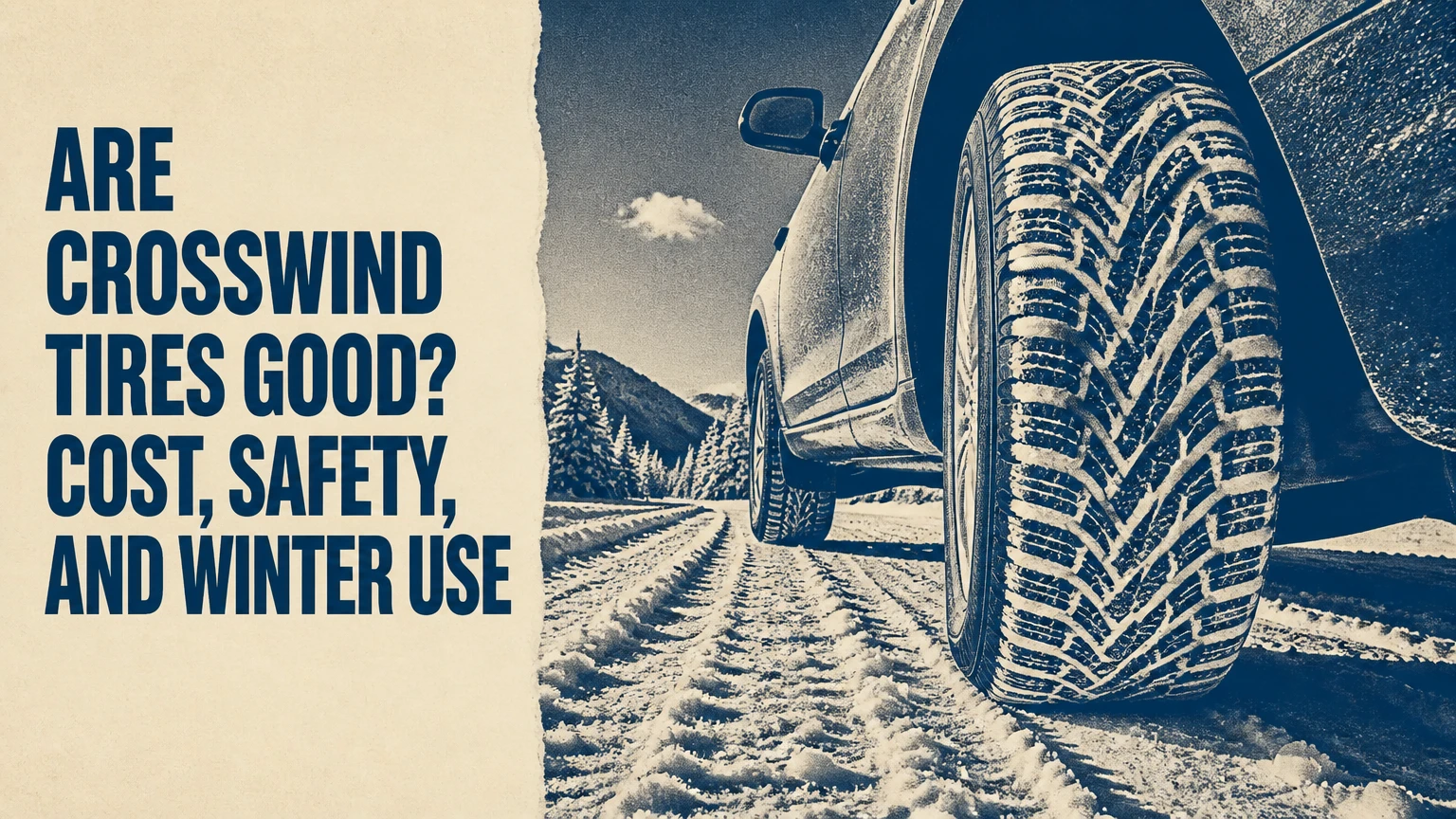
Crosswind tires are generally a reasonable budget choice for commuting, ordinary highway travel, and moderate climates when the exact model matches the vehicle’s required size, load index, and speed rating. Crosswind tires cost less than premium alternatives, but they usually provide less wet-braking margin, winter traction, steering precision, and independently documented performance.
Key Facts at a Glance
- Crosswind is an entry-level tire brand associated with Shandong Linglong Tire and distributed in North America through TBC Brands.
- Typical Crosswind tire prices range from about $65-$160 each before mounting, balancing, taxes, and disposal fees.
- Passenger and highway models commonly advertise approximately 50,000-55,000 miles, but actual life depends on alignment, inflation, rotation, climate, and driving.
- Crosswind all-season tires are intended for moderate weather and light snow, not regular ice, deep snow, or severe winter service.
- A 3PMSF symbol is the relevant severe-snow certification; an M+S marking alone does not establish severe-winter performance.
- Crosswind tires can suit value-focused drivers, but premium tires generally offer stronger wet braking, more consistent handling, and better test documentation.
Are Crosswind Tires Good for Daily Driving?
Crosswind tires are good enough for many daily drivers when low purchase cost matters more than maximum wet-weather grip or precise handling. A commuter traveling on maintained roads in a warm or temperate region can receive acceptable ride comfort and ordinary all-season performance from the appropriate Crosswind model.
The qualification matters because “good” is not a single tire attribute. A tire can be comfortable and inexpensive while still stopping farther in heavy rain than a premium competitor. Crosswind is therefore best evaluated as an economy product, not as a direct performance substitute for Michelin, Goodyear, Continental, Bridgestone, or Pirelli.
Crosswind tires make the most sense on an older sedan, compact crossover, work vehicle, or high-mileage commuter where replacing four tires at a lower upfront price prevents continued driving on worn rubber. They make less sense when the vehicle is powerful, heavily loaded, driven aggressively, or used regularly in snow and freezing temperatures.
Who makes and distributes Crosswind tires?
Crosswind tires are associated with Shandong Linglong Tire Co., a Chinese tire manufacturer, while TBC Brands handles North American brand and distribution support. The factory and production location can vary by model and size, so the DOT identification code on the tire is more reliable than assuming every Crosswind tire came from one plant.
TBC Brands describes Crosswind within its portfolio of replacement-tire brands. Retail listings commonly identify Crosswind passenger, performance, highway, all-terrain, and mud-terrain products. “Tier 3” is an informal retail and industry shorthand for an economy brand; it is not a federal safety grade or a legal classification.
The relevant safety requirement is compliance with applicable Federal Motor Vehicle Safety Standards, not brand tier. Compliance establishes a legal baseline, while independent testing, compound development, casing construction, warranty administration, and retailer support influence the ownership experience above that baseline.
How Do Crosswind Tires Perform in Rain and on Dry Roads?
Crosswind tires generally provide adequate dry-road commuting and acceptable water evacuation, but their wet braking and emergency handling should not be assumed equal to premium tires. Circumferential grooves and open shoulder channels can move water from the contact patch, yet tread geometry cannot eliminate the effects of worn rubber, incorrect pressure, standing water, or a hard budget compound.
A deep groove helps create an escape path for water. It does not guarantee short stopping distances. Wet grip also depends on silica content, tread compound temperature behavior, contact pressure, tread stiffness, road texture, and the vehicle’s anti-lock braking calibration.
The practical rule is simple: reduce speed more in heavy rain and replace the tires before the legal wear bars if wet-weather confidence has deteriorated. NHTSA states, “Tires are the only part of your vehicle that make contact with the road.” That contact patch is small, so tire condition has a direct effect on braking and directional control.
What should you expect from highway handling?
Crosswind highway tires usually prioritize a quiet ride, straight-line stability, and low purchase price over sharp steering response. Softer sidewalls can absorb expansion joints effectively, but they may also produce slower turn-in, more body movement, or a vague sensation during quick lane changes.
A five-rib highway tread, solid center rib, or computer-optimized block sequence can reduce pattern noise. Those features do not prove that a specific tire has the shortest stopping distance. Drivers who regularly travel at interstate speeds should pay particular attention to speed rating, maximum load, inflation pressure, and vibration after installation.
Do not confuse a tire’s maximum speed rating with a recommendation to drive at that speed. A properly maintained H-rated tire may be suitable for a vehicle requiring H rating, while an S- or T-rated replacement may not meet the vehicle manufacturer’s specification.
Which Crosswind Model Should You Choose?
The correct Crosswind model depends on vehicle type, road surface, seasonal weather, and load requirements. HP010 Plus and other passenger all-season products fit ordinary cars, UHP products target sportier sedans, H/T products suit paved-road SUVs and pickups, A/T products handle gravel and mild trails, and M/T products target mud rather than quiet commuting.
| Crosswind model family | Typical application | Common listed warranty | Main design emphasis | Principal limitation |
|---|---|---|---|---|
| HP010 Plus | Passenger cars and compact cars | 50,000 miles | Center-rib stability and all-season commuting | Not a severe-winter tire |
| All-Season UHP | Sport sedans and larger wheels | Model and size dependent | Responsive tread and rim protection | More road sensitivity and less snow ability |
| H/T or H/T 2 | SUVs, CUVs, and light trucks | 50,000-55,000 miles | Highway stability and lower tread noise | Poorer loose-surface traction than A/T tires |
| A/T | Gravel, rural roads, and light trails | About 50,000 miles on listed applications | Open lugs and stone ejectors | Louder ride and weaker ice performance |
| M/T | Mud, deep dirt, and loose terrain | Usually no mileage warranty | Wraparound shoulders and open voids | Noisy, less efficient, and weak on wet pavement |
Warranty mileage is not identical across every size or retailer listing. Verify the actual product page, the warranty booklet, and the manufacturing date before purchase.
Do ply ratings make Crosswind truck tires heavy-duty?
A 10-ply rating describes load-carrying strength in a standardized classification sense, not necessarily ten physical layers of casing material. A light-truck tire must still match the vehicle’s required load range, tire pressure, wheel size, and axle capacity.
A higher load range can improve resistance to deflection under cargo, but it may also create a firmer ride. Installing a tire with an unsuitable load index can compromise handling, clearance, or legal load capacity. Read the door-jamb placard and owner’s manual before relying on a retailer’s “10-ply” description.
How Long Do Crosswind Tires Last?
Crosswind tires typically last about 40,000-60,000 miles in ordinary service, although that range is a planning estimate rather than a guarantee. A vehicle with correct alignment, monthly pressure checks, rotations every 5,000-7,500 miles, and moderate driving can approach its warranty mileage, while neglected or heavily loaded tires may wear out much sooner.
Treadwear warranties usually apply only when the owner follows specific conditions. Those conditions can include documented rotations, maintaining the correct pressure, using the correct tire size, and presenting the original purchase record. A warranty does not cover every tire that simply reaches a low tread depth.
| Driving and maintenance pattern | Typical usable mileage | Likely time for 12,000 miles per year | Main wear risk |
|---|---|---|---|
| Correct alignment, regular rotation, mixed commuting | 45,000-60,000 miles | 3.75-5 years | Age before tread exhaustion |
| Highway-heavy driving with correct inflation | 50,000-60,000 miles | 4.2-5 years | Shoulder wear from underinflation |
| City driving, potholes, frequent braking | 35,000-50,000 miles | 2.9-4.2 years | Irregular wear and impact damage |
| Misalignment or worn suspension | Under 15,000-30,000 miles | 1.25-2.5 years | Feathering, cupping, or one-sided wear |
| Heavy loads, towing, or aggressive cornering | 25,000-45,000 miles | 2.1-3.75 years | Heat, shoulder stress, and rapid tread loss |
Tires also age even when the tread appears usable. The Tire Industry Association and major vehicle manufacturers commonly advise inspection as tires age, and many manufacturers recommend replacement around six years from service or ten years from manufacture, depending on their policy. Check the tire maker and vehicle maker guidance rather than using mileage alone.
What do Crosswind tires cost?
Crosswind tires typically cost $65-$160 each before installation, with a four-tire set costing approximately $260-$640 in tire-only pricing. Mounting, balancing, valve stems, taxes, tire disposal, road-hazard coverage, and TPMS service can add roughly $80-$240 to a four-tire purchase, depending on location and shop.
| Purchase example | Tire-only range | Typical installation additions | Approximate total |
|---|---|---|---|
| Four compact-car tires | $260-$360 | $80-$160 | $340-$520 |
| Four midsize-sedan tires | $300-$480 | $90-$180 | $390-$660 |
| Four SUV highway tires | $380-$640 | $110-$220 | $490-$860 |
| Four light-truck all-terrain tires | $440-$720 | $120-$240 | $560-$960 |
A cheap tire can become expensive if it wears quickly or produces repeated balancing and alignment expenses. Compare cost per expected mile, not only the checkout price. For example, a $320 set lasting 40,000 miles costs about 0.8 cents per tread mile before service costs; a $600 set lasting 60,000 miles costs about 1.0 cent per mile, while potentially providing better wet-weather performance.
Are Crosswind Tires Suitable for Winter?
Crosswind all-season tires are suitable for occasional light snow in moderate climates, but they are not the right primary choice for frequent ice, deep snow, or sustained temperatures near freezing. Severe-winter drivers should choose a tire with the Three-Peak Mountain Snowflake, or 3PMSF, symbol and consider dedicated winter tires where ice and packed snow are common.
The 3PMSF symbol indicates that the tire met a standardized severe-snow traction test. It does not mean the tire is an ice tire, and it does not guarantee short stopping distances on polished ice. An M+S marking alone is a broad tread designation and should not be treated as equivalent severe-snow certification.
Cold weather changes rubber flexibility. An all-season compound can lose useful traction as temperatures fall, especially when the surface is wet, icy, or polished by traffic. Crosswind A/T tread may look aggressive in snow, but open lugs cannot compensate for a compound that lacks winter certification or for limited ice grip.
Who should avoid Crosswind tires?
Avoid Crosswind tires when your highest-risk driving involves mountain passes, frequent black ice, high-speed wet roads, performance cornering, or heavy towing. Drivers carrying passengers in severe winter regions should prioritize documented snow and ice performance over a lower purchase price.
Crosswind tires remain a reasonable option for a second vehicle, mild-climate commuter, or rural driver who encounters gravel but little deep mud. The decision changes when a tire failure, long wet stop, or loss of winter control would have severe consequences.
How Do Crosswind Tires Compare With Premium Tires?
Crosswind tires usually win on upfront cost, while premium tires generally win on wet braking consistency, steering precision, treadwear predictability, and the amount of independent test data available. The difference is most important during emergency maneuvers, heavy rain, cold weather, and the later part of the tread’s life.
There is no universal performance gap for every Crosswind model and every premium tire. Tire size, vehicle calibration, test surface, temperature, and tread depth change results. A retailer review can describe comfort or value, but it cannot replace controlled braking and handling tests.
| Decision criterion | Crosswind economy tire | Premium all-season example | Practical consequence |
|---|---|---|---|
| Four-tire purchase price | About $260-$640 before services | Often $500-$1,000 or more | Crosswind reduces initial cash outlay |
| Mileage warranty | Commonly 50,000-55,000 miles on selected models | Often 60,000-80,000 miles | Premium may cost less per expected mile |
| Wet braking documentation | Limited independent data for many SKUs | More published comparison testing | Premium choice is easier to evaluate |
| Steering response | Comfortable, sometimes soft | Generally more precise | Premium suits quick lane changes and spirited driving |
| Severe-snow qualification | Verify by individual SKU; often absent | Available on selected all-weather models | 3PMSF status must be checked directly |
| Road-noise target | Quiet-focused highway patterns available | Model-specific, often refined | Both can be comfortable, but tread design matters |
| Retailer and warranty support | Depends heavily on seller and TBC terms | Broader dealer networks for major brands | Premium claims and replacement may be simpler |
The best comparison is not brand against brand. Compare exact tire size, load index, speed rating, 3PMSF status, warranty exclusions, manufacturing date, and test evidence.
How should you compare Crosswind with another budget tire?
Compare another budget tire by verified specifications and ownership support rather than by tread appearance. Check the same size, load index, speed rating, UTQG markings, warranty mileage, country of manufacture, date code, retailer return policy, and availability of replacement tires.
The UTQG treadwear number is not a direct mileage promise because manufacturers assign and certify ratings under a comparative system. It can help compare tires within a category, but it should not be read as “600 equals 60,000 miles.”
An independent test from a recognized publication is more useful than a review that reports only subjective ride impressions. If no controlled test exists, a reputable installer’s warranty policy and a fresh DOT date become more important.
What Should You Check Before Buying Crosswind Tires?
Check fitment, age, winter certification, warranty conditions, and installed price before ordering Crosswind tires. The vehicle door placard supplies the required cold inflation pressure and often the original size, while the tire sidewall supplies size, load index, speed rating, and date information.
Use this buying checklist:
- Confirm the complete size, such as 225/65R17, rather than matching diameter alone.
- Match or exceed the original load index and speed rating unless the vehicle manufacturer permits another specification.
- Confirm whether the exact SKU has M+S or 3PMSF marking.
- Inspect the four-digit DOT date code; the first two digits identify the production week and the final two identify the year.
- Ask whether the quoted price includes mounting, balancing, valve stems, TPMS service, disposal, and taxes.
- Read the mileage warranty’s rotation and documentation rules.
- Check that all four tires come from a compatible product line and have closely matched tread depth.
- Plan an alignment if the previous tires showed edge wear, feathering, or a steering-wheel offset.
A tire manufactured several years earlier may still be legally saleable, but older inventory reduces the time available before age-based replacement. Request recent production when the price difference is small.
What Problems Can Occur After Installation?
The most common post-installation problems are vibration, uneven wear, pressure loss, pulling, and noise. These symptoms usually indicate a balance, wheel, fitment, alignment, or inflation problem rather than proving that every Crosswind tire is defective.
How do you fix vibration from Crosswind tires?
Fix Crosswind tire vibration by checking inflation and lug torque first, then requesting a conventional balance, wheel inspection, and road-force balance if vibration persists. A steering-wheel shake at 55-70 mph commonly points to imbalance, radial force variation, a bent wheel, poor bead seating, or incorrect mounting.
Use this escalation sequence:
- Verify all four pressures against the door placard.
- Return to the installer and request a balance check.
- Ask the shop to inspect the wheel for bends and confirm bead seating.
- Request road-force measurement if ordinary balancing does not correct the shake.
- Check for a separated belt, unusual bulge, or impact damage.
- Obtain a second inspection if the original shop cannot identify the cause.
Do not accept a continuing highway vibration as normal for a budget tire. Vibration can accelerate suspension wear and make the vehicle less stable.
Why do Crosswind tires wear unevenly?
Crosswind tires wear unevenly when toe, camber, inflation, suspension condition, or rotation intervals are incorrect. Inner-edge wear usually points toward alignment or suspension geometry, center wear often indicates overinflation, and both shoulder edges commonly indicate underinflation.
A tread-depth gauge costs about $5-$15 and can reveal a problem before it becomes visible. Measure across the inner, center, and outer tread grooves, recording differences greater than about 2/32 inch as a reason for professional inspection.
A counterintuitive maintenance rule is that rotating a tire cannot repair existing alignment damage. Rotation only redistributes future wear; it does not restore rubber already scrubbed from one shoulder.
Who Should Buy Crosswind Tires?
Crosswind tires suit budget-focused commuters, owners of older vehicles, and drivers in mild climates who accept economy-level performance. Crosswind tires are a poor fit for severe-winter drivers, enthusiastic cornerers, frequent towers, and anyone who places maximum wet-weather stopping margin above purchase price.
| Driver situation | Crosswind recommendation | Better decision rule |
|---|---|---|
| 12,000-mile annual commuter in a mild climate | Reasonable choice | Prioritize correct fitment and recent date code |
| Rideshare or fleet vehicle | Potentially economical | Compare cost per mile and downtime risk |
| Mountain or snow-belt resident | Usually avoid all-season versions | Select 3PMSF all-weather or winter tires |
| Sport sedan owner | Conditional | Choose only if steering precision is secondary |
| Pickup used for towing | Model-specific | Match load range, pressure, and axle requirements |
| Gravel-road rural driver | A/T may fit | Accept noise and verify wet-pavement behavior |
Economy tires are most defensible when the alternative is continuing to drive on bald, aged, mismatched, or damaged tires. They are less defensible when a slightly higher purchase price buys a verified severe-winter rating or materially stronger wet-road performance.
Frequently Asked Questions
Are Crosswind tires made in the USA?
Crosswind tires are associated with Shandong Linglong Tire, and many listings identify production in China or other Linglong manufacturing locations rather than the United States. The exact origin can vary by size and model, so read the sidewall and DOT code on the tire you are buying instead of relying on the brand name.
Do Crosswind tires have a mileage warranty?
Selected Crosswind passenger, highway, and all-terrain models carry listed warranties around 50,000-55,000 miles, while mud-terrain products commonly have no mileage warranty. Coverage depends on the exact SKU and requires compliance with conditions such as rotation records, correct inflation, and proof of purchase.
Are Crosswind tires noisy?
Crosswind highway and passenger tires can provide acceptable highway noise because their tread blocks and rib patterns target ride comfort. All-terrain and mud-terrain versions are inherently louder because open voids and larger lugs create more impact and air movement, especially as they wear.
Can Crosswind tires be used on an AWD vehicle?
Crosswind tires can be used on an AWD vehicle only when the size, load index, speed rating, construction, and rolling circumference meet the vehicle manufacturer’s requirements. AWD systems can react poorly to substantially mismatched tread depths, so replace tires as an axle set or follow the manufacturer’s replacement procedure.
Should Crosswind tires be rotated?
Crosswind tires should generally be rotated every 5,000-7,500 miles, or according to the vehicle and tire manufacturer’s schedule. Keep receipts and service records because mileage-warranty claims may require documented rotations, and inspect alignment whenever the tread develops feathering, cupping, or one-sided wear.
The Bottom Line
Are Crosswind tires good? Crosswind tires are a sensible low-cost option for ordinary commuting in moderate weather when the exact tire fits the vehicle and the driver accepts economy-level wet and winter performance. They are not the best choice for severe snow, frequent ice, aggressive handling, or maximum emergency-braking confidence.
Choose the model by application, verify the load and speed ratings, inspect the DOT date, price the complete installation, and compare the warranty conditions. If those checks fit your situation, Crosswind can deliver useful value. If winter traction or wet-road safety margin dominates the decision, spend more on a 3PMSF all-weather or dedicated winter tire from a product with stronger independent testing.


