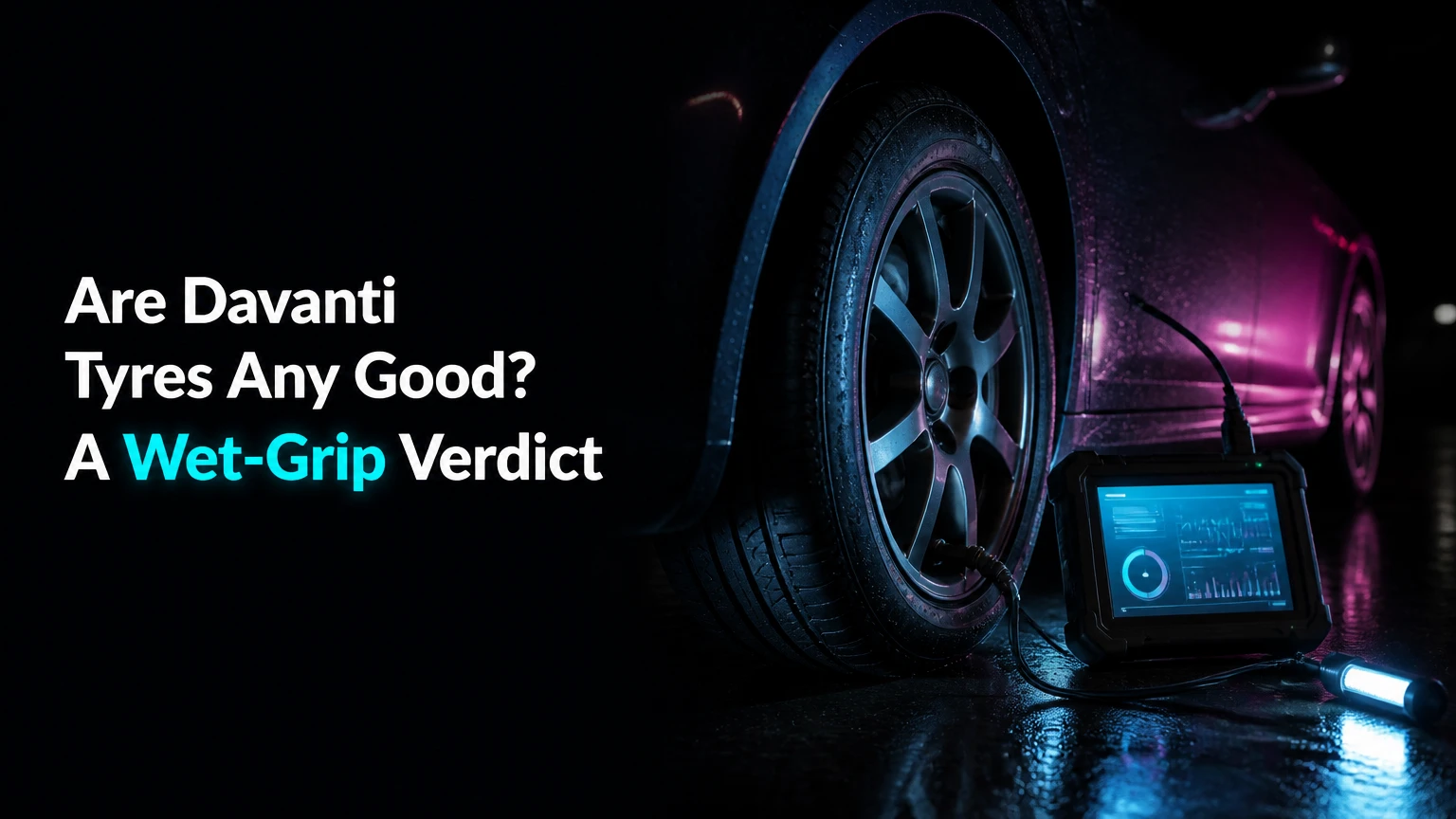
Davanti tyres are a reasonable mid-range choice for everyday drivers who want quiet, comfortable tyres at a lower price than Michelin or Continental. Davanti tyres generally perform acceptably in dry conditions, but independent test evidence and user reports indicate weaker wet braking and less predictable limit handling than leading premium or upper-mid-range alternatives.
Key Facts at a Glance
- Davanti is a UK-owned tyre brand launched in 2015 and positioned in the mid-range market.
- Davanti tyres are typically cheaper than premium brands, but the price gap against Kumho, Falken, and Toyo can be small.
- Davanti’s strongest everyday qualities are low cabin noise, comfortable road manners, and dry-road value.
- Wet braking and wet cornering are the main reasons to choose a stronger rival when the price difference is modest.
- Davanti’s Accidental Damage Guarantee can reduce replacement costs after qualifying pothole or kerb damage.
- The best Davanti model depends on vehicle type, tyre size, axle requirements, weather, load, and driving style.
What Kind of Brand Is Davanti?
Davanti is a UK-owned tyre brand headquartered in Newton-le-Willows and introduced in 2015. The company markets tyres designed in the United Kingdom and Europe, while production has primarily been associated with Chinese manufacturing partners and Industry 4.0 factories. Buyers should check the individual tyre’s sidewall and retailer listing rather than assume every model has the same production origin.
Davanti occupies the space between anonymous budget tyres and established premium manufacturers. That positioning matters because “mid-range” describes the expected balance of price, refinement, testing, compound development, and quality control, not a uniform performance grade across every model.
The brand’s Accidental Damage Guarantee is a significant differentiator. It can make a Davanti tyre financially attractive for drivers who regularly encounter potholes, kerbs, or poor urban roads, although guarantee terms, registration requirements, approved-dealer rules, and exclusions must be checked at purchase.
Are Davanti tyres premium or budget?
Davanti tyres are mid-range tyres, not premium tyres and not the lowest-cost budget products. The brand usually offers better refinement and product support than an anonymous budget tyre, while premium brands generally retain an advantage in wet braking, high-speed stability, compound consistency, and progressive handling.
A useful buying rule is to compare Davanti with the actual alternatives available in the required size. A Davanti DX390 priced at £62 may be good value if a comparable premium tyre costs £95, but a Kumho or Falken at £68 could offer a stronger performance compromise for only £6 more per corner.
How Good Are Davanti Tyres in Everyday Driving?
Davanti tyres are usually adequate for commuting, school runs, urban driving, and moderate-speed motorway travel when correctly sized and inflated. They tend to prioritise comfort and noise reduction over sharp steering response, so normal drivers may find them pleasant even though controlled tests expose weaknesses at the limit.
The difference becomes clearer during emergency braking or rapid wet-road direction changes. A tyre that feels completely satisfactory at normal speed can still stop several metres later than a stronger competitor from the same speed, and that difference can determine whether a hazard is avoided.
Tyre Reviews test summaries have described the Davanti DX640’s behaviour with the phrase “abrupt limit handling.” That does not mean the tyre is automatically unsafe in ordinary use. It means the transition from available grip to sliding can be less progressive, giving the driver less warning when cornering aggressively on a wet road.
Davanti performance by driving situation
| Driving situation | Davanti suitability | Main benefit | Main limitation |
|---|---|---|---|
| Urban commuting at 20-40 mph | High | Low cost and comfortable ride | Wet emergency braking remains model-dependent |
| Motorway driving at 60-70 mph | Moderate | Low noise and stable cruising | Premium tyres offer greater wet-weather margin |
| Fast wet-road cornering | Low to moderate | Predictable at conservative speeds | Abrupt breakaway reported on some models |
| High-power rear-wheel drive | Low | Lower purchase price | Wheelspin and wet limit behaviour require care |
| Fleet or multi-car use | Moderate to high | Guarantee and availability | Consistent model selection is essential |
Which Davanti Tyre Should You Choose?
The DX390 suits conventional family cars, the DX640 suits larger or sportier vehicles, the Protoura Sport targets higher-performance fitments, the Alltoura 4 Seasons addresses year-round use, and the Terratoura A/T targets pickups and light off-road driving. Model selection matters more than the Davanti badge alone.
Never select a tyre solely because the diameter matches. The replacement must meet the vehicle manufacturer’s required size, load index, speed rating, construction, and any marked approval such as BMW *, Mercedes MO, or Audi AO where applicable.
| Davanti model | Typical vehicle | Primary design | Practical assessment |
|---|---|---|---|
| DX390 | Ford Focus, VW Golf, family hatchback | Touring road tyre | Quiet, comfortable, strongest fit for ordinary commuting |
| DX640 | Nissan Qashqai, BMW 3 Series, larger saloon | SUV and sporty road use | Stronger dry response, less convincing wet limit behaviour |
| Protoura Sport | Performance cars with 18-inch-plus wheels | Ultra-high-performance road use | Quiet for its class, but wet testing is a concern |
| Alltoura 4 Seasons | Hatchbacks and crossovers | All-season, winter-biased compound | Useful in occasional snow, weaker wet braking than leaders |
| Terratoura A/T | Ford Ranger, Land Rover, pickup | All-terrain, 3PMSF-rated | More capable on loose surfaces, noisier and less road-focused |
Is the Davanti DX390 good?
The Davanti DX390 is a sensible budget-conscious touring tyre for a small or medium family car used mainly on paved roads. Its asymmetric tread pattern is intended to balance noise reduction, rolling resistance, comfort, and ordinary dry-road grip, but buyers should not treat it as equivalent to a Michelin Primacy or Continental PremiumContact.
The DX390 makes most sense when all four tyres are being replaced and the vehicle has modest power. Correct inflation is particularly important because under-inflation increases shoulder wear, steering effort, heat generation, and fuel consumption.
Is the Davanti DX640 good?
The Davanti DX640 is better suited to SUVs, crossovers, and larger saloons than the DX390 because its tread design uses four longitudinal grooves for water evacuation and its construction supports larger fitments. Dry braking and steering response can be satisfactory, but wet limit handling is the principal reservation.
The DX640 is a reasonable choice for a Nissan Qashqai or similar vehicle driven conservatively. It is a less convincing choice for a 300 bhp rear-wheel-drive BMW, where throttle application and wet cornering place much higher demands on the rear axle.
Is the Davanti Protoura Sport good?
The Davanti Protoura Sport is an ultra-high-performance road tyre aimed at larger wheels and faster cars. The model offers low measured or perceived road noise and acceptable dry-road performance, but Tyre Reviews test information places its wet handling among the weaker results in its comparison group.
A Protoura Sport buyer should compare current prices with Falken, Kumho, Hankook, Goodyear, and Continental in the exact required size. A small saving is difficult to justify when the alternative provides more progressive wet behaviour for a performance vehicle.
Is the Davanti Alltoura 4 Seasons good?
The Davanti Alltoura 4 Seasons is suitable for drivers who want one tyre throughout the year and occasionally encounter cold weather or light snow. Its winter-biased compound and all-season tread can provide more cold-weather traction than a conventional summer tyre, while its 3PMSF status indicates it passed the relevant severe-snow performance threshold.
The 3PMSF mark does not make the Alltoura 4 Seasons a dedicated winter tyre. Compared with the Michelin CrossClimate 2, the Davanti model has a weaker reputation for wet braking, so drivers covering high annual mileage in heavy rain should compare test results rather than rely on the snow symbol.
How Much Do Davanti Tyres Cost?
Typical fully fitted Davanti prices range from about £60-£65 for a 205/55 R16 DX390 to £100-£120 for some 19-inch SUV or performance applications. Retailer, location, load rating, speed rating, seasonal promotions, valve replacement, disposal fees, and wheel alignment can change the final invoice.
The relevant comparison is total fitted cost, not the online tyre price. A £5 fitting charge, £2 disposal fee, new valve, and optional alignment can add £20-£50 to a four-tyre purchase.
| Size and use | Davanti example | Typical fitted price | Comparable alternative |
|---|---|---|---|
| 205/55 R16 family car | DX390 | £60-£65 | Kumho HS52, about £54-£75 |
| 225/45 R17 sporty hatchback | DX640 | £75-£80 | Falken Ziex, about £80 |
| 235/55 R18 crossover | DX640 | £90-£110 | Hankook, about £115-£140 |
| 255/45 R19 SUV or saloon | DX640 or Protoura Sport | £100-£120 | Continental, about £160-£190 |
Davanti’s advertised 30-40% saving against premium tyres is plausible for some sizes, but it is not universal. Mid-range competitors can erase much of that difference during promotions, so obtain at least three fitted quotes for the exact specification.
Does the Accidental Damage Guarantee Make Davanti Worth Buying?
Davanti’s Accidental Damage Guarantee can make the brand worthwhile for pothole-prone urban driving, but it does not turn a weaker-performing tyre into a premium one. The guarantee is a financial benefit that should be assessed separately from wet grip, braking, mileage, and handling.
The published schedule commonly reduces replacement support as tread wears: a tyre with more than 7 mm remaining may qualify for a 100% replacement, while lower tread bands receive smaller discounts. Exact eligibility depends on the current Davanti terms and the dealer’s claim process.
| Remaining tread condition | Published replacement contribution | Buyer implication |
|---|---|---|
| More than 7 mm tread | 100% replacement | Strongest protection early in tyre life |
| 7-6 mm tread | 75% discount | Partial support after measurable wear |
| 6-4 mm tread | 50% discount | Replacement cost remains significant |
| 4-2 mm tread | 25% discount | Limited financial value near replacement point |
| Below stated eligible threshold | Terms-dependent | Confirm current exclusion before claiming |
How do you claim the Davanti guarantee?
Take the damaged tyre to the approved Davanti dealer from which it was purchased, provide proof of purchase, and ask the dealer to inspect whether the damage is accidental and unrepairable. The dealer normally verifies tread depth, tyre condition, age, serial information, and whether the damage falls within the guarantee terms.
Keep the receipt, guarantee documentation, and photographs of severe pothole damage. A puncture caused by a nail may be repairable and therefore handled differently from a sidewall tear, while illegal tread, incorrect pressure, racing damage, vandalism, and poor maintenance may be excluded.
How Do Davanti Tyres Compare With Alternatives?
Davanti is strongest when the purchase price and accidental-damage cover matter more than maximum wet performance. Kumho, Falken, and Toyo often provide a more balanced mid-range alternative, while Michelin and Continental remain the safer premium reference points for buyers who value wet braking and refined handling above initial cost.
No brand wins every tyre-size comparison. EU tyre-label values, independent tests, vehicle fitment, and current retail pricing should decide the purchase.
| Brand tier | Example brands | Typical price position | Wet-weather expectation | Best buyer |
|---|---|---|---|---|
| Budget | Linglong, Centara, Triangle | £45-£60 in 205/55 R16 | Variable, often limited reserve | Minimum purchase price |
| Mid-range | Davanti, Kumho, Falken, Toyo | £55-£85 | Model-dependent, often stronger than budget | Value-focused commuter |
| Upper mid-range | Hankook, Uniroyal, some Falken lines | £70-£105 | Generally more balanced | Frequent motorway driver |
| Premium | Michelin, Continental, Goodyear | £90-£140 | Strongest average wet and high-speed reserve | Maximum safety margin |
Davanti versus Kumho
Kumho is often the closest practical alternative because pricing can overlap with Davanti while independent tests frequently give Kumho models a more rounded wet-weather performance. If the Kumho quote is within £10 per tyre, the extra cost can be justified for frequent rain, motorway mileage, or a heavier vehicle.
Davanti may still win on accidental-damage cover if the comparable Kumho product offers no equivalent protection. Compare the guarantee value with the likely replacement risk rather than assuming the cheapest invoice is the lowest ownership cost.
Davanti versus Michelin
Michelin generally offers stronger wet braking, progressive handling, compound development, and high-speed consistency, but a complete set can cost £100-£300 more depending on size. Michelin becomes the rational choice for high annual mileage, powerful cars, severe weather, or drivers who want the greatest braking reserve.
Davanti remains rational for a low-mileage family car when the budget is tight and the driver accepts conservative wet-road speeds. The two brands do not provide the same performance margin.
What Are Davanti Tyres Not Good For?
Davanti tyres are not the best choice for track use, repeated fast wet-road driving, powerful rear-wheel-drive cars, or drivers who regularly tow near the vehicle’s maximum permitted weight. The issue is not that every Davanti model fails in these conditions, but that the available margin and handling progression can be weaker than alternatives costing slightly more.
Drivers in regions with frequent standing water should pay particular attention to wet-grip label ratings and independent wet braking tests. A tread pattern with four grooves can evacuate water effectively at normal speeds, but aquaplaning resistance also depends on width, inflation, tread depth, road surface, speed, and water depth.
What does the tyre label tell you?
The UK and European tyre label provides wet-grip class, rolling-resistance class, external noise value, and sometimes a snow or ice icon. Wet-grip classes are comparative, not a guarantee of a particular stopping distance in every vehicle or weather condition.
A difference in label class should not replace an independent test, because braking results vary with tyre size and vehicle. Check load index and speed rating first, then compare wet grip, rolling resistance, noise, warranty, and fitted price.
How Long Do Davanti Tyres Last?
Davanti tyre life cannot be stated as one reliable mileage figure because annual distance, alignment, torque, pressure, road surfaces, driving style, vehicle weight, and axle position dominate wear. A typical touring tyre may last roughly 20,000-35,000 miles in mixed use, but that range is a planning estimate, not a manufacturer guarantee.
Performance tyres, heavy SUVs, aggressive geometry, and under-inflation can reduce life substantially. Replace tyres before the legal minimum becomes the only consideration when tread is uneven, cracked, damaged, or noticeably degraded in wet grip.
Measure tread across the inner, centre, and outer grooves. A tyre showing 5 mm in the centre but 2.5 mm on the shoulder has an alignment or pressure problem, not a healthy 5 mm remaining.
Why Are Davanti Tyres Vibrating?
Davanti tyre vibration usually results from wheel imbalance, tyre uniformity variation, a bent wheel, incorrect bead seating, or uneven wear rather than from the brand alone. Vibration appearing at 50-70 mph should be inspected promptly because continued driving can accelerate suspension and tyre wear.
Ask the fitter to check radial and lateral run-out, bead seating, wheel damage, balance weights, and tyre pressure. Road-force balancing can identify a tyre and wheel combination that conventional balancing does not resolve.
Use this diagnostic sequence:
- Confirm all four pressures against the vehicle placard.
- Inspect for bulges, flat spots, scalloped tread, and shoulder wear.
- Rebalance the affected axle.
- Swap front and rear only if the vehicle and tyre rotation rules permit it.
- Check alignment and suspension joints if vibration or uneven wear remains.
Do not use a vibration complaint to infer that every Davanti casing is defective. The same symptom can come from a pothole-bent alloy wheel or worn track-rod end.
What Mistakes Should Buyers Avoid?
The most expensive Davanti buying mistakes involve specification, axle matching, and wet-weather expectations rather than the headline price.
- Mixing unrelated models on one axle: Fit identical tyres across each axle unless a qualified technician confirms an acceptable alternative.
- Ignoring load index: An SUV or electric car may require a higher load rating than the cheapest matching size.
- Choosing the wrong speed rating: A tyre must meet the vehicle maker’s requirement, even if the lower-rated version costs less.
- Treating 3PMSF as a winter guarantee: The symbol indicates severe-snow qualification, not premium wet braking.
- Running low pressures: Check pressures monthly and before heavy loads; shoulder wear and heat rise quickly under inflation.
- Buying by tread depth alone: Compound age, storage conditions, alignment, and wet performance also affect value.
- Discarding the receipt: Proof of purchase may be required for the accidental-damage claim.
A useful practitioner rule is to spend more on the tyres fitted to the driven axle when replacing only two, then place the tyres with deeper tread on the rear where possible, subject to the vehicle manufacturer’s instructions. Rear-axle grip helps resist oversteer, which is harder for many drivers to correct.
Which Drivers Should Buy Davanti Tyres?
Davanti tyres suit a driver who owns a modest family car, covers ordinary urban and suburban distances, drives within legal speeds, and values a lower purchase price with accidental-damage protection. They can also suit a fleet when consistent supply and predictable replacement support matter.
A driver should choose Kumho, Falken, Hankook, or a premium brand when the price difference is small relative to the vehicle’s value or annual mileage. Frequent motorway travel, heavy rain, high power, towing, and demanding cornering all strengthen the case for a more capable alternative.
| Driver profile | Recommended decision | Suitable Davanti choice | Better alternative condition |
|---|---|---|---|
| City commuter, 8,000 miles yearly | Buy if price leads | DX390 | Upgrade if Kumho costs £5-£10 more |
| Family SUV, mixed roads | Compare carefully | DX640 | Choose Hankook for frequent motorway rain |
| Performance-car owner | Usually upgrade | Protoura Sport only at a large saving | Michelin or Continental for wet handling |
| Rural driver with occasional snow | Consider all-season | Alltoura 4 Seasons | Dedicated winter tyres for regular snow |
| Pickup owner on mixed surfaces | Check load and terrain | Terratoura A/T | BFGoodrich for severe off-road work |
FAQ
Are Davanti tyres safe to use?
Davanti tyres can be safe when they carry the correct specification, have no damage, maintain legal tread, and remain properly inflated. Safety is not identical across models, however, and drivers should expect less wet-weather reserve from some Davanti products than from premium competitors.
Are Davanti tyres noisy?
Davanti touring models such as the DX390 are generally designed for low noise and comfortable cruising. Actual cabin noise depends on tread pattern, road surface, vehicle insulation, wheel size, pressure, and wear, so a quiet result on smooth asphalt may not apply to coarse motorway surfaces.
Are Davanti tyres good for BMW cars?
Davanti tyres can fit some BMW models if the size, load index, speed rating, run-flat requirement, and manufacturer approval are correct. For a powerful rear-wheel-drive BMW driven quickly in rain, a tyre with more progressive wet handling, such as a suitable Michelin, Continental, or Hankook, is usually the safer choice.
Should I fit Davanti tyres to the front or rear?
When replacing two tyres, follow the vehicle manufacturer’s instructions and ask the fitter to assess the existing pair. In many conventional vehicles, placing the tyres with deeper tread on the rear helps maintain rear stability in wet conditions, but mixed tyre models and four-wheel-drive systems require specific professional advice.
Do Davanti tyres have a mileage warranty?
The Accidental Damage Guarantee is not the same as a guaranteed mileage warranty. It addresses qualifying accidental damage under stated conditions and typically reduces support as tread wears; it does not promise a fixed number of miles or cover ordinary wear.
Where are Davanti tyres made?
Davanti tyres are associated with UK and European engineering and primarily with production in China, although manufacturing arrangements can vary by model and over time. Check the tyre sidewall, production information, and current Davanti or retailer documentation for the specific tyre being purchased.
The Bottom Line
Are Davanti tyres any good? Yes, Davanti tyres are good enough for value-focused everyday driving, particularly on family cars used in town and suburban conditions. They are not the strongest choice for maximum wet braking, fast cornering, powerful sports cars, or severe weather.
Buy Davanti when the fitted price is meaningfully lower, the specification is correct, and the accidental-damage guarantee has real value for your roads. Choose Kumho, Falken, Hankook, Michelin, or Continental when a small additional payment buys stronger wet performance, more progressive handling, or greater high-speed reserve.