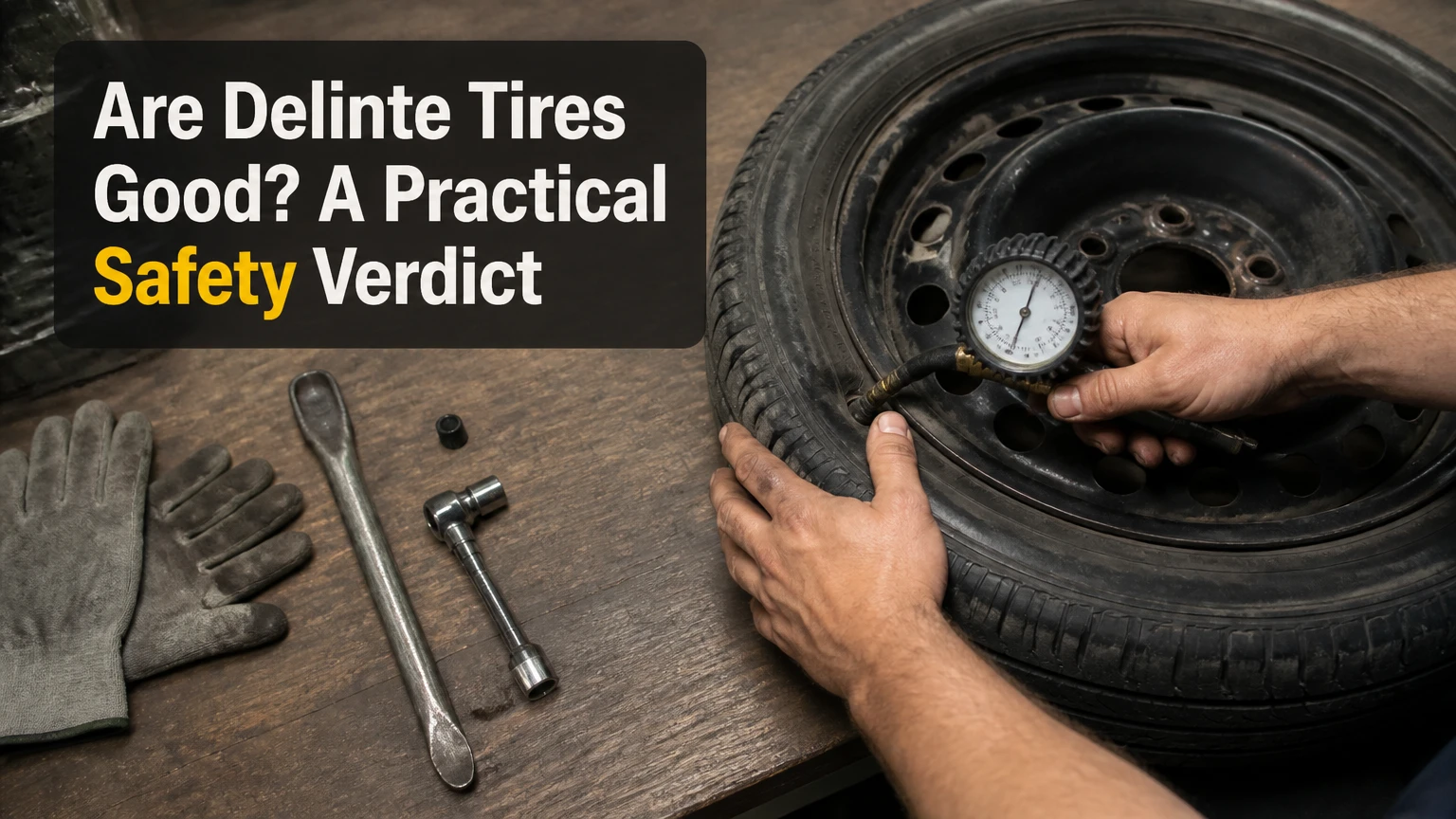
Delinte tires are acceptable budget tires for low-mileage drivers in mostly dry climates, but they are not a strong choice for frequent rain, snow, high-speed highway travel, or maximum emergency-braking performance. Delinte’s main advantage is a low purchase price; its main compromise is less independently documented wet-weather performance than established mid-range and premium brands.
Key facts at a glance
Delinte is a budget tire brand associated with Qingdao Sentury Tire Co., a Chinese tire manufacturer.
Typical advertised retail pricing is about $55-$110 per passenger tire and $130-$210 for larger truck and off-road sizes.
Delinte’s strongest value proposition is basic dry-road transportation at a low upfront cost.
Wet braking, hydroplaning resistance, winter traction, and performance consistency deserve more scrutiny than marketplace star ratings.
Selected passenger models may carry approximately 40,000-55,000 miles of limited treadwear coverage, but the warranty is model-specific.
A Delinte tire is only appropriate when its size, load index, speed rating, construction, and service condition match the vehicle.
What Are Delinte Tires?
Delinte is a mass-market budget tire brand launched in 2009 and associated with Sentury Tire. The brand sells replacement tires for passenger cars, crossovers, SUVs, light trucks, and custom applications, with product lines that emphasize low pricing and aggressive styling.
“Budget” describes market position, not an automatic safety failure. A properly sized, undamaged, correctly inflated Delinte tire can provide usable transportation, particularly for a secondary vehicle or short urban commute. The important distinction is that a low price does not prove equivalent braking, wet cornering, noise control, or wear performance against Michelin, Bridgestone, Continental, or comparable premium products.
Independent test coverage also varies significantly by model. A review of one Delinte tire cannot automatically establish the performance of every DH, DS, D, or Bandit product.
Who makes Delinte tires?
Qingdao Sentury Tire Co. manufactures Delinte tires. Sentury’s wider brand portfolio has included Landsail and other replacement-tire labels, while Delinte occupies the value-focused side of the market.
The country of manufacture is less useful than the actual tire specification and evidence. Tire quality depends on the model, factory production, compound, casing, quality control, age, storage, and vehicle application. A Chinese-made tire is not automatically unsafe, and a premium brand is not automatically suitable if the tire is overloaded, underinflated, or seven years old.
Are Delinte Tires Good for Everyday Driving?
Delinte tires can be reasonable for everyday driving when everyday driving means moderate speeds, predictable roads, limited annual mileage, and mostly dry or warm weather. They are a weaker value when the driver routinely encounters heavy rain, standing water, mountain snow, long interstate trips, or emergency maneuvers.
The practical question is not whether Delinte tires can roll safely in normal conditions. Most new tires can. The better question is how much safety margin the tire retains when pavement becomes wet, cold, uneven, or suddenly obstructed.
A typical budget passenger tire may save $30-$100 per tire compared with a recognized mid-range alternative. That saving matters on an older vehicle, but it should be weighed against shorter service life, weaker wet performance, and the cost of replacing a tire early because of irregular wear or damage.
What do Delinte tires do well?
Delinte tires generally compete on four concrete attributes:
- Purchase price: Passenger sizes often appear around $55-$110 per tire before mounting, balancing, disposal fees, taxes, and alignment.
- Dry-road usability: Touring and performance patterns can provide predictable steering for ordinary acceleration and cornering on clean, dry asphalt.
- Appearance: Wide shoulders, directional grooves, and low-profile sizes suit custom wheels and budget truck builds.
- Application range: The catalog includes touring, ultra-high-performance, all-terrain, rugged-terrain, and mud-terrain patterns.
Ride comfort is model-dependent. A touring tire with a taller sidewall is normally more forgiving than a low-profile D7 Thunder or an aggressive Bandit pattern, whose stiff casing and large tread blocks can transmit more impact and noise.
What are Delinte tires not good for?
Delinte tires are not the prudent default for drivers who prioritize the shortest wet stopping distance, frequent winter travel, quiet luxury-car refinement, or documented performance across many independent tests. Aggressive tread appearance also does not make a tire suitable for deep snow, towing, or sustained high-speed use.
That limitation is especially important on heavy vehicles. A large SUV or pickup transfers more energy during braking, and a tire with an inadequate load index can overheat or suffer casing damage even when the tread looks new.
How Do Delinte Tire Technologies Translate to Road Performance?
Delinte advertises features such as D-Tech silica compounds, Qirin Scale Technology, randomized pitch sequencing, and 3D high-density siping. These features describe design intentions, such as tread stiffness, water evacuation, noise reduction, and additional edges in light slush, but manufacturer technology names do not replace independent braking or handling measurements.
Silica can influence wet grip and rolling resistance, while siping can create additional biting edges. Neither feature guarantees strong performance because the complete result depends on compound formulation, groove volume, tread stiffness, casing design, vehicle weight, temperature, and remaining tread depth.
The same principle applies to noise. Randomized tread pitches can reduce repetitive harmonic sound, but a large-block all-terrain or mud-terrain tread will usually remain louder than a touring pattern.
Which Delinte tire families are available?
| Delinte family or model | Primary vehicle use | Tread category | Main trade-off |
|---|---|---|---|
| DH2 | Sedans and compact cars | All-season touring | Low price, limited independent wet-performance evidence |
| DH7 | Compact crossovers and SUVs | Touring all-season | Comfort-oriented pattern, not a dedicated winter tire |
| D7 Thunder | Cars with larger wheels | Ultra-high-performance style | Dry-road appearance, potentially firmer ride and higher noise |
| DS2 Powerline | Passenger cars and highway applications | Summer or performance-oriented fitments | Stronger dry-road focus than severe-weather capability |
| DS8 Desert Storm II | SUVs, trucks, and custom builds | Asymmetric performance | Aggressive styling, model-specific wet behavior |
| DX10 Bandit A/T | Light trucks and SUVs | All-terrain | More trail ability, more road noise than touring tires |
| DX12 Bandit R/T | Pickups and off-road builds | Rugged-terrain hybrid | Compromise between highway manners and trail traction |
| DX9 Bandit M/T | Mud-focused trucks | Mud-terrain | Deep-void traction, high noise, weak winter-road refinement |
The Three-Peak Mountain Snowflake symbol, or 3PMSF, is relevant only when it appears on the exact tire being purchased. The symbol indicates that the tire met a standardized severe-snow traction test; it does not mean the tire equals a purpose-built winter tire on ice or cold wet pavement.
How Safe Are Delinte Tires in Rain?
Delinte tires may be adequate in light rain at moderate speeds, but wet-road performance is the principal reason to choose a better-documented mid-range or premium tire when the budget allows. Water depth, speed, tread depth, inflation pressure, and temperature can change the outcome more than the brand name alone.
Tire Reviews has published Delinte model test information, including results involving the DS2. The supplied comparison indicates that a Delinte DS2 finished 26th in a summer braking test and needed a dry stopping distance about 5.5% longer than the leading premium competitors in that test. That result applies to the tested model and conditions, not every Delinte tire.
Online customer ratings are useful for identifying noise, vibration, and fitment complaints, but they are not controlled wet-braking tests. A customer may rate a tire five stars because it cost $70 and survived 10,000 dry miles. That experience does not measure stopping distance in a 50-mph downpour.
How should you drive Delinte tires in heavy rain?
Reduce speed before standing water, increase following distance, avoid abrupt steering, and check inflation pressure when the tires are cold. Do not “fix” a wet-grip limitation by lowering pressure, because underinflation increases heat, shoulder wear, fuel consumption, and loss of control risk.
Replace a passenger tire when tread reaches 2/32 inch, the legal minimum in many US jurisdictions, and consider earlier replacement around 4/32 inch when regular rain is expected. Shallower grooves evacuate less water, so a tire can remain technically legal while losing valuable hydroplaning margin.
Practitioner rule: if a vehicle is used for long commutes in a region with frequent rain, spend the extra money on wet-tested tires before spending it on alloy-wheel appearance.
Are Delinte Tires Good in Snow and Ice?
Delinte tires are not a universal winter solution. An all-season Delinte tire can provide limited traction in light snow when new, but drivers who regularly encounter packed snow, ice, freezing temperatures, or mountain passes should use certified winter tires or a highly capable severe-snow all-weather tire.
Siping helps create edges, yet rubber compounds also harden as temperatures fall. An all-season tread may have acceptable dry handling in October and noticeably reduced grip on cold pavement in January. The 3PMSF mark improves confidence for severe-snow conditions, but it does not certify ice braking.
Bandit A/T models may suit gravel, dirt, and occasional snow when the exact size carries the 3PMSF symbol. Bandit M/T tires are designed around mud evacuation, not quiet winter commuting. Large voids can reduce the number of rubber edges contacting a hard, icy surface.
How Long Do Delinte Tires Last?
Delinte tire life varies by model, alignment, inflation, vehicle weight, driving style, climate, and storage. Selected passenger models are advertised with limited treadwear warranties of roughly 40,000-55,000 miles, while aggressive mud-terrain models may have no mileage warranty.
A warranty is not a promise that the tire will last its mileage rating. Treadwear coverage normally requires regular rotation, documented maintenance, even wear, and a claim made before the usable tread is gone. The owner may still pay a prorated replacement amount, mounting charges, taxes, and disposal fees.
| Use case | Typical annual mileage | Delinte buying implication | Inspection interval |
|---|---|---|---|
| Secondary commuter car | 5,000-8,000 miles | Low price can outweigh a shorter service life | Every 5,000-6,000 miles |
| Daily mixed driving | 12,000-15,000 miles | Compare warranty and expected replacement cost | Every 5,000 miles |
| Highway-heavy driver | 18,000-25,000 miles | Wet performance and heat resistance matter more | Before every long trip |
| Light-truck work use | 15,000-30,000 miles | Load range and casing condition take priority | Monthly and before hauling |
| Weekend off-road vehicle | 2,000-6,000 miles | Tread design may matter more than mileage warranty | Before and after trail use |
The National Highway Traffic Safety Administration advises drivers to inspect tire condition and pressure because tires are the vehicle’s only road contact. That basic fact matters more with value tires, whose low cost can encourage owners to postpone rotations, alignment work, or replacement.
How Much Do Delinte Tires Cost?
Delinte tires typically cost about $55-$110 each for ordinary passenger applications and $130-$210 each for larger truck, SUV, and off-road sizes. A complete installed set commonly costs $280-$560 for passenger tires or $600-$1,000 for larger truck tires after mounting, balancing, fees, and taxes.
| Tire application | Typical tire price | Typical installed set | Cost factors |
|---|---|---|---|
| Compact sedan, 15-16 inch | $55-$85 | $280-$400 | Mounting, balancing, disposal, tax |
| Midsize sedan, 17-18 inch | $70-$120 | $350-$540 | Larger wheels and alignment needs |
| Crossover, 18-20 inch | $95-$160 | $500-$760 | XL construction and SUV fitment |
| Light truck all-terrain | $130-$190 | $650-$900 | Load range, size, balancing |
| Mud-terrain, 20 inch or larger | $160-$210 | $800-$1,000 | Heavy casing and specialty mounting |
Check the delivered price rather than the listed tire price. A low online price can disappear after road-hazard coverage, installation, shipping, valve stems, TPMS service, and alignment.
What does the Delinte warranty cover?
The warranty depends on the model and seller. Selected highway and passenger products may include limited treadwear coverage, while some mud-terrain products carry no mileage guarantee; defect coverage also has time, tread-depth, and proof-of-purchase conditions.
Before ordering, obtain the written warranty for the exact model and size. Confirm whether it covers workmanship defects, uniformity, road hazards, prorated treadwear, free replacement, rotation requirements, and the retailer’s claim process. A seller’s product page is not a substitute for the manufacturer’s current warranty document.
How Do Delinte Tires Compare With Alternatives?
Delinte is usually the lowest-cost option in this comparison, but a mid-range tire often provides a better balance when wet roads, annual mileage, or replacement inconvenience matter. Premium tires command more money because their compounds, casings, quality-control systems, warranties, and independent test records generally provide more evidence and safety margin.
| Brand tier and example | Typical passenger price | Best fit | Main reason to consider it |
|---|---|---|---|
| Delinte DH2 | $55-$110 | Dry-climate budget commuting | Lowest upfront cost |
| Kumho all-season | $85-$145 | Mixed daily driving | Mid-range balance of cost and wet use |
| General all-season | $95-$160 | Highway and family vehicles | Broad replacement-market support |
| Hankook all-season | $105-$175 | Frequent commuting and rain | Stronger mid-range positioning |
| Michelin all-season | $150-$240 | High-mileage, safety-focused use | Premium development and test coverage |
| Bridgestone all-season | $145-$230 | Long-term mainstream ownership | Premium network and broad fitments |
Prices are typical retail ranges, not quotes, and vary by size, retailer, rebates, and region. The comparison should always use identical size, load index, speed rating, and seasonal category.
Is a cheaper tire still cheaper over time?
A cheaper tire is not necessarily the lowest-cost tire over its service life. For example, a $320 installed Delinte set replaced after 30,000 miles costs about 1.07 cents per mile before maintenance, while a $520 set lasting 55,000 miles costs about 0.95 cents per mile.
That calculation is illustrative, not a Delinte durability test. Actual life depends on the vehicle and wear pattern. The useful method is:
Total tire cost per mile = purchase and installation cost minus resale value, divided by usable miles.
Add the cost of rotations, alignments, premature damage, and lost time if the vehicle is especially important for work or family travel.
Which Drivers Should Buy Delinte Tires?
Delinte tires make the most sense for a budget-conscious driver whose vehicle is older, lightly used, correctly maintained, and driven mainly on dry urban roads. They are a poor fit for anyone who would rather pay more upfront than compromise wet-weather margin.
| Driver situation | Delinte suitability | Better decision | Reason |
|---|---|---|---|
| Short local commute under 8,000 miles yearly | Conditional fit | DH touring model after inspection | Low annual use limits wear savings |
| Frequent rain and standing water | Weak fit | Hankook, General, Kumho, or premium tire | Wet margin deserves priority |
| Interstate driving above 70 mph | Weak fit | Independently tested highway tire | Heat, stability, and braking matter |
| Regular snow and ice | Poor fit unless exact tire is 3PMSF | Dedicated winter or severe-snow tire | All-season tread has cold-weather limits |
| Weekend truck trails on a budget | Conditional fit | DX10 or DX12 for the actual terrain | Match tread to mud, gravel, and road use |
| Heavy towing or commercial hauling | Poor default | Commercial-grade tire with verified load data | Casing and load capacity are safety-critical |
What should a commuter check before buying?
A commuter should verify the vehicle placard size, load index, speed rating, production date, retailer warranty, and local installation support. The vehicle placard inside the driver’s door, not the maximum pressure molded into the sidewall, determines the recommended cold inflation pressure.
Do not replace only two tires on a front-wheel-drive car without asking the installer where they will be placed. In many replacement situations, the newer tires go on the rear axle to reduce oversteer risk, but the shop should follow the vehicle and tire manufacturer’s guidance.
What should a truck owner check?
A truck owner should match load range, load index, maximum axle load, wheel width, clearance, and intended terrain. A tire that looks aggressive may be unsuitable for towing if its load rating, speed rating, or pressure requirement does not meet the truck’s placard and axle limits.
DX10 A/T is the sensible starting point for mixed pavement and trail use. DX12 R/T suits a driver who accepts more noise for more loose-surface traction. DX9 M/T is a specialized mud tire, not a general-purpose replacement for a quiet highway tire.
What Problems Do Delinte Tire Owners Report?
Common complaints associated with budget tires include road noise, irregular wear, vibration, rapid tread loss, and disappointing wet grip. These symptoms do not prove a manufacturing defect because alignment, wheel damage, inflation, suspension wear, and improper balancing can produce the same result.
| Symptom | Likely causes | First diagnostic action | Typical remedy |
|---|---|---|---|
| Steering-wheel vibration at 55-75 mph | Imbalance, bent wheel, tire uniformity issue | Road-force balance and wheel inspection | Rebalance, repair wheel, or warranty-evaluate tire |
| Cupping or heel-toe noise | Alignment, worn shocks, rotation neglect | Inspect tread and suspension | Alignment, suspension repair, rotation |
| Shoulder wear | Underinflation or incorrect alignment | Measure cold pressure and toe | Correct pressure and alignment |
| Sliding in rain | Speed, shallow tread, cold compound, water depth | Check tread depth and pressure | Slow down and replace near 4/32 inch in rainy climates |
| Sidewall bulge | Impact damage or casing failure | Stop driving and inspect immediately | Replace tire, do not patch sidewall |
| TPMS warning | Low pressure, sensor fault, temperature change | Measure all four tires manually | Inflate to placard pressure and diagnose sensor |
A vibration that remains after balancing requires further diagnosis. Do not assume every vibration is normal for a budget tire, especially if it appeared after a pothole strike or tire installation.
How should Delinte tires be maintained?
Rotate tires about every 5,000-6,000 miles unless the vehicle or tire manufacturer specifies another interval, and check cold pressure monthly. Inspect for cuts, bulges, exposed cords, embedded objects, uneven wear, and cracking before long trips.
Confirm the DOT date code on the sidewall. Tires age from manufacture, not from the day of installation, so an old warehouse tire can have less remaining service life than its tread appearance suggests. Replace any tire with structural damage, severe cracking, or an unrepairable puncture.
Expert maintenance rule: alignment is a tire purchase decision. Spending $90 on an alignment after installation can protect several hundred dollars of tread and prevent the false conclusion that the tire brand itself failed.
What Are the Biggest Buying Mistakes?
The most expensive mistake is selecting by price and tread appearance without comparing the exact specification. A low-cost tire can become unsafe or uneconomical when its load index is wrong, its production date is old, or its seasonal category does not match local conditions.
Avoid these errors:
- Treating marketplace ratings as safety tests. Ratings combine price satisfaction, delivery, appearance, noise, and personal expectations.
- Buying a winter-looking tread for icy roads. Large grooves do not replace a cold-weather compound.
- Ignoring the load index. A tire that fits the wheel can still be under-rated for the vehicle.
- Mixing unrelated patterns. Different tread designs can alter handling balance, especially on wet roads.
- Skipping an alignment after uneven wear. New tires cannot correct worn suspension or incorrect toe.
- Buying old inventory. Check the four-digit DOT date code before installation.
- Assuming a mileage warranty applies universally. Confirm coverage for the exact Delinte model, size, and seller.
One counterintuitive point matters: the cheapest tire is often least defensible on a vehicle that carries children, drives long distances, or travels in rain. Those uses increase the value of braking margin even when annual mileage is modest.
The Bottom Line: Are Delinte Tires Good?
Delinte tires are good enough for a narrow use case: budget transportation, moderate speeds, limited mileage, sound vehicle maintenance, and mostly dry conditions. Delinte tires are not the best choice for frequent wet-weather driving, snow and ice, high-speed highway use, towing, or drivers who prioritize the strongest independently documented safety performance.
Choose Delinte when the exact tire meets the vehicle’s size and load requirements, the production date is recent, the warranty is clear, and the savings are substantial. Choose a reputable mid-range or premium alternative when the vehicle is essential, the climate is wet, or the cost of one emergency stop matters more than the initial purchase price.
Frequently Asked Questions
Are Delinte tires reliable?
Delinte tires can provide reliable basic service when correctly fitted and maintained, but reliability differs by model and use. Check pressure monthly, rotate near 5,000-6,000 miles, monitor irregular wear, and inspect the DOT date. A tire used on rough roads, a heavily loaded truck, or frequent rain needs a larger safety margin than a lightly used commuter tire.
Are Delinte tires noisy?
Touring models such as the DH2 are generally intended to provide quieter road manners than aggressive truck patterns, but noise depends on tread design, vehicle insulation, pavement, inflation, and wear. Bandit R/T and M/T tires normally produce more hum than passenger touring tires because their larger blocks and voids move more air and impact the road differently.
Are Delinte tires worth it for a used car?
Delinte tires can be financially sensible for a low-value used car if the vehicle will be driven locally and the tires meet its specifications. Do not use low price to justify fitting an under-rated tire or postponing suspension repairs. A mid-range tire may be better value if the car will travel 15,000 or more miles annually.
Can I mix Delinte tires with another brand?
Mixing brands is possible only when size, load index, speed rating, construction, and seasonal category are compatible, but it can change handling balance. Avoid mixing different tires across the same axle. Follow the vehicle manufacturer’s guidance, and ask a tire professional to evaluate tread-depth differences before fitting a partial set.
How do I know when to replace a Delinte tire?
Replace a Delinte tire at 2/32 inch tread, and consider replacement around 4/32 inch if heavy rain is common. Replace immediately for a sidewall bulge, exposed cords, severe cracking, or an unrepairable puncture. Also inspect age, because tread depth alone cannot reveal rubber degradation or internal casing damage.
Are Delinte Bandit tires suitable for daily highway use?
Delinte Bandit A/T tires can serve daily highway drivers who also use gravel roads or moderate trails, but they will usually create more noise and may reduce ride comfort compared with touring tires. Bandit R/T and M/T patterns are increasingly specialized, so they make sense only when their off-road traction justifies the highway compromises.