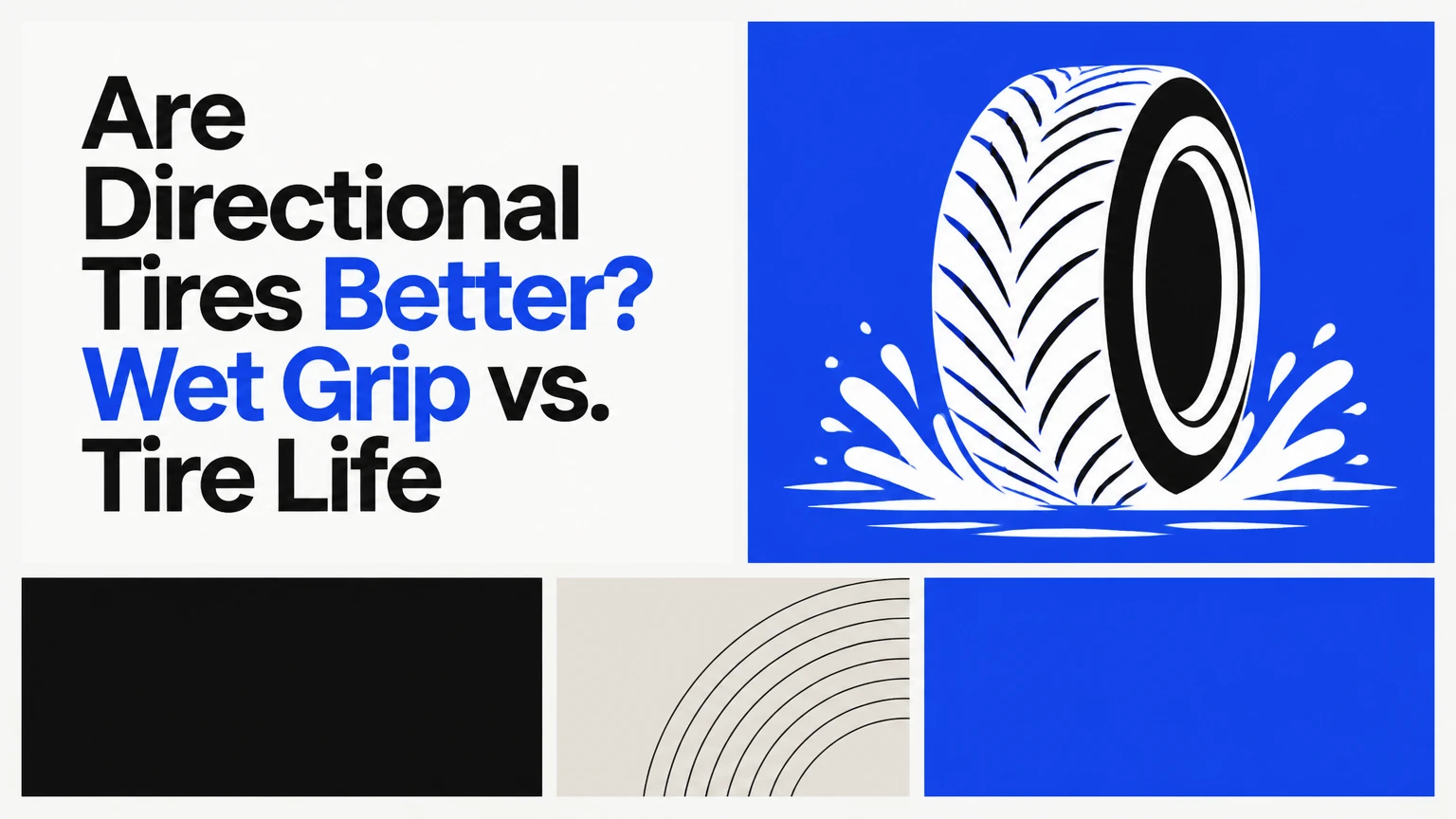
Directional tires are better for drivers who prioritize wet-road control, straight-line stability, or specialized snow and mud performance, but they are not universally better. Their V-shaped tread can evacuate water efficiently, while one-way mounting restricts rotation and may increase service costs. A premium asymmetrical or symmetrical touring tire can be the better choice for quiet commuting and long tread life.
Key Facts at a Glance
- Directional tires have a specific forward-rolling direction marked by a sidewall arrow.
- Directional tread usually improves straight-line water evacuation, but it cannot prevent hydroplaning caused by excessive speed, low pressure, worn tread, or deep water.
- Directional tires rotate front-to-rear on the same side unless a tire shop dismounts and remounts them.
- A directional tread does not automatically make a tire suitable for winter; look for winter compound, dense siping, and the 3PMSF symbol.
- Typical directional performance tires cost about $120-$300 or more per tire and often deliver shorter tread warranties than touring tires.
- Premium asymmetrical tires can combine strong wet performance, flexible rotation, lower noise, and better cornering than many budget directional tires.
What Are Directional Tires?
Directional tires, also called unidirectional tires, use a tread pattern designed to roll in one forward direction. An arrow or the word “Rotation” on the sidewall identifies the required direction, and the arrow must point toward the front of the vehicle when the tire is installed.
The most recognizable design is a V-shaped or chevron tread. The grooves usually begin near the center of the tread and open toward the shoulders, creating channels intended to move water, slush, or loose dirt outward as the tire rotates. Many models also use a continuous center rib or reinforced central tread blocks to improve on-center steering feel.
Tread direction is only one part of tire performance. Rubber compound, tread depth, casing construction, width, inflation pressure, alignment, temperature, and vehicle weight can produce larger safety differences than the arrow itself. A well-designed symmetrical touring tire with ample tread can outperform a worn or poorly inflated directional tire in rain.
What does the arrow on a directional tire mean?
The arrow specifies the tire’s forward rotation, not the side of the vehicle. A tire marked “Rotation” must point in the direction of forward travel on both the left and right sides. The V pattern may appear visually reversed from one side of the car, and that appearance is normal if both arrows point forward.
“Outside” and “Inside” markings indicate an asymmetrical tire’s installation orientation. A directional tire can also be asymmetrical, so a tire may require both the correct rotation direction and the correct outside-facing sidewall.
How Do Directional Tires Work in Rain and Snow?
Directional tires use angled grooves to guide water and slush away from the contact patch, which can improve wet-road tracking and resistance to standing-water disruption. The design cannot “radically minimize” hydroplaning under all conditions because speed, water depth, tire pressure, tread wear, vehicle weight, and road surface remain decisive.
A tire does not pump water through a fixed volume at a guaranteed rate. At higher speeds, the tread has less time to clear water, and deep standing water can overwhelm almost any passenger-car tire. The U.S. National Highway Traffic Safety Administration recommends checking tire pressure regularly and replacing tires when tread is worn, because both conditions reduce wet-weather margin.
A solid center rib can also reduce tread-block movement during acceleration, braking, and steering inputs. That construction may produce a sharper on-center response, although a rigid center section can transmit more impact harshness than a comfort-oriented touring design.
Are directional tires better in heavy rain?
Directional tires are often better in heavy rain when the tire is correctly mounted, properly inflated, and still has usable tread depth. The advantage is strongest in straight-line travel through shallow standing water, where the open channels can move water away from the central contact area.
The advantage is not absolute. A premium asymmetrical tire may offer equal or better wet braking, and a new symmetrical tire is safer than a worn directional tire. Drivers should reduce speed in standing water rather than rely on tread geometry, because hydroplaning begins when the water layer prevents sufficient rubber contact with the pavement.
Are directional tires better in snow?
Directional tires are better in snow only when the complete tire is engineered for winter conditions. A directional summer tire can perform poorly in freezing temperatures because its rubber compound hardens and its limited siping cannot generate enough snow grip. Tread direction alone does not establish winter capability.
A dedicated winter tire generally combines a flexible cold-weather compound, deep grooves, high sipe density, and a 3PMSF marking. The Three-Peak Mountain Snowflake symbol indicates that the tire passed a standardized severe-snow traction test, but it does not guarantee identical braking or handling across brands.
| Tire application | Typical tread features | Best temperature range | Winter qualification |
|---|---|---|---|
| UHP directional summer | Wide V grooves, low sipe count, soft compound | Above about 45°F | Usually no 3PMSF |
| Directional all-season | Moderate grooves, mixed siping, balanced compound | About 20-90°F | Some models carry 3PMSF |
| Directional winter | Deep grooves, dense wavy sipes, silica compound | Below about 45°F | Often 3PMSF |
| Mud or trail directional | Deep lugs, large voids, reinforced casing | Application-dependent | 3PMSF varies by model |
The 45°F threshold is a practical rule for comparing winter and summer compounds, not a precise point at which every tire changes behavior. Weather, road temperature, and tire design matter.
Are Directional Tires Better Than Other Tread Patterns?
Directional tires are usually better for water evacuation and high-speed straight-line response, while asymmetrical tires generally provide a stronger balance of wet grip, cornering, comfort, and rotation flexibility. Symmetrical tires remain effective for low-cost, quiet, predictable daily driving.
The tire category does not determine the winner independently of the specific model. A premium asymmetrical tire with a high wet-grip rating can be a better rain tire than an inexpensive directional model, especially when the vehicle spends most of its time on ordinary roads rather than at sustained highway or track speeds.
| Decision factor | Directional tire | Asymmetrical tire | Symmetrical tire |
|---|---|---|---|
| Typical tread layout | V-shaped forward pattern | Distinct inner and outer zones | Repeating pattern across tread |
| Wet evacuation | Strong straight-line channeling | Strong, model-dependent | Moderate to strong, model-dependent |
| Rotation pattern | Same-side front-to-rear | Usually cross-rotatable, keep “Outside” outward | Front-to-rear or cross pattern |
| Cornering response | Strong on-center stability | Often strongest dry cornering balance | Predictable, less aggressive |
| Road noise | Moderate to high on some models | Often low to moderate | Usually low on touring models |
| Typical tread life | About 30,000-55,000 miles | About 40,000-70,000 miles | About 55,000-80,000 miles |
| Maintenance complexity | Higher | Moderate | Lowest |
Do directional tires corner better?
Directional tires can improve steering response and high-speed stability, but asymmetrical tires often provide more dry-cornering support because their outer shoulder uses larger, stiffer tread blocks. A directional tire with a rigid center rib may feel more immediate in a straight line without producing the highest lateral grip in a corner.
Performance drivers should compare independent wet braking, dry handling, noise, and treadwear tests for the exact tire model. Tread shape is a design clue, not a substitute for testing.
Are directional tires louder?
Directional tires can be louder than touring tires, particularly when their large repeating blocks develop heel-and-toe wear or the vehicle’s alignment creates cupping. A correctly maintained directional tire may remain quiet, but its broad grooves and rigid blocks can create a noticeable hum on coarse pavement.
A rhythmic drone does not automatically indicate a bad wheel bearing. Run a hand lightly across the tread with the vehicle parked; a smooth direction and a sharp, sawtooth direction suggest heel-and-toe wear. A mechanic should confirm the diagnosis before replacing a bearing or suspension component.
What Do Directional Tires Cost?
Typical directional tires cost $120-$300 or more each for passenger cars, with specialized winter, performance SUV, and light-truck models often costing $190-$350 per tire. A four-tire set therefore commonly costs $480-$1,400 before mounting, balancing, taxes, and disposal fees.
Purchase price is only part of ownership cost. Restricted rotation can accelerate replacement on vehicles with uneven axle wear, and dismounting tires to reverse their wheel positions adds labor. Exact pricing depends on local shop rates, wheel size, tire construction, and whether the vehicle uses a staggered fitment.
| Ownership item | Directional performance tire | Asymmetrical touring tire | Symmetrical touring tire |
|---|---|---|---|
| Typical price per tire | $120-$300+ | $110-$280 | $90-$220 |
| Typical set price | $480-$1,200+ | $440-$1,120 | $360-$880 |
| Typical tread life | 30,000-55,000 miles | 40,000-70,000 miles | 55,000-80,000 miles |
| Rotation interval | About 5,000-7,500 miles | About 5,000-7,500 miles | About 5,000-7,500 miles |
| Special rotation labor | $25-$60 per tire, typical | Usually none | Usually none |
These are typical market ranges, not manufacturer guarantees. The UTQG treadwear number can help compare tires within the same brand and product family, but it is not a universal mileage promise. A UTQG 400 tire will not necessarily last twice as long as a UTQG 200 tire on every vehicle.
Do directional tires wear faster?
Directional tires do not inherently wear faster because they are directional. Many directional tires wear faster because they are performance products with softer compounds, wider contact patches, lower aspect ratios, and aggressive driving applications.
Uneven wear is more likely when same-side rotation cannot offset front-to-rear differences. Front-wheel-drive vehicles place steering, braking, and drive forces on the front axle, while performance cars may use staggered wheels that prevent normal rotation altogether.
How Should Directional Tires Be Rotated?
Directional tires should normally move from front to rear on the same side of the vehicle every 5,000-7,500 miles, provided the front and rear tire sizes match. Crossing a directional tire to the opposite side reverses its rolling direction and makes the tread function backward.
Use the vehicle owner’s manual as the primary rotation authority because some vehicles specify a different interval or prohibit rotation. A staggered setup with wider rear tires may require no routine rotation, while a shop can dismount, remount, and rebalance tires to change sides when the tread and tire manufacturer permit it.
What is the correct rotation procedure?
- Confirm matching sizes. Check the tire size on each axle and identify any staggered front-rear fitment.
- Inspect the sidewall arrows. Record the correct forward direction before moving any wheel.
- Move each front tire straight backward. Front left goes to rear left, and front right goes to rear right.
- Check tread and pressure. Measure cold inflation pressure against the vehicle placard, not the maximum pressure molded into the sidewall.
- Torque the lug nuts. Use the manufacturer’s torque specification and recheck after the vehicle has traveled the shop’s recommended distance.
- Relearn TPMS if required. Some vehicles need a sensor relearn after wheel positions change.
The success checkpoint is simple: every rotation arrow points toward the front of the vehicle, and each axle meets the vehicle’s specified pressure and size requirements.
What Problems Do Directional Tires Develop?
The most serious directional-tire error is backward mounting, followed by neglected uneven wear. A backward-mounted tire may produce more noise and weaker water evacuation, while heel-and-toe wear can create vibration, cupping, and a helicopter-like hum.
How can you tell if a directional tire is backward?
Find the arrow marked “Rotation” on the outer sidewall and verify that it points toward the front bumper. Do not judge installation solely by whether the V pattern appears to point upward, because viewing angle and tread design can make that visual check unreliable.
A backward tire should be corrected promptly by moving the wheel to the other side or having a tire shop dismount and remount the tire. Driving slowly to a shop is generally preferable to continuing normal high-speed travel in rain, but a visibly damaged or severely worn tire should not be driven.
How do you diagnose heel-and-toe wear?
Heel-and-toe wear appears as alternating high and low edges on tread blocks. The tread feels smooth when touched in one direction and rough when touched in the opposite direction, often with a repeating hum that increases with road speed.
Ask a technician to inspect alignment, toe settings, wheel balance, suspension joints, tire pressure history, and rotation records. Remounting the tire reverses its position on the wheel, but it cannot restore missing rubber or repair a structural defect. Severe wear requires replacement.
Can directional and non-directional tires be mixed?
Mixing directional and non-directional tires is technically possible in limited circumstances, but matching all four tires is safer and more predictable. If a replacement is unavoidable, install the matching pair on the same axle, preserve the correct rotation direction, and follow the vehicle and tire manufacturer’s guidance.
Do not mix summer and winter tires casually, and do not place a tire with substantially different wet grip or tread depth on one side of a driven axle. AWD vehicles can be especially sensitive to differences in rolling circumference, so consult the owner’s manual before replacing fewer than four tires.
Which Drivers Should Choose Directional Tires?
Directional tires suit performance drivers, motorists who regularly encounter standing water, and users selecting a specialized snow or mud design. Directional tires are usually a weaker choice for quiet high-mileage commuting when a quality asymmetrical or symmetrical touring tire offers longer life and simpler rotation.
Performance car owner
Choose a directional summer tire when precise on-center response, high-speed stability, and wet-road channeling matter more than maximum mileage. Expect softer compounds, higher cost, and more frequent inspections, especially on a rear-wheel-drive car with aggressive alignment settings.
Rain-heavy climate driver
Choose a directional or asymmetrical tire with independently verified wet braking and a suitable tread warranty. Do not select a directional design solely from its V pattern, because inflation pressure and remaining tread depth determine whether the water channels can work effectively.
Snow-belt driver
Choose a dedicated winter tire when temperatures regularly fall below about 45°F and snow or ice is routine. Select a 3PMSF-rated model, maintain four matching winter tires, and prioritize cold-weather compound and siping over directional appearance.
Daily commuter
Choose a premium touring tire when annual mileage, quietness, comfort, and low service complexity dominate. A symmetrical design usually provides the easiest rotation, while an asymmetrical design can add handling and wet-road capability without the same directional restriction.
Light-truck or off-road user
Choose a directional mud or trail tire when self-cleaning lugs and forward traction are central requirements. Large voids can reduce pavement comfort, increase noise, and lower wet braking performance on asphalt, so an aggressive tread is a poor default for a truck used mostly on highways.
What Should You Check Before Buying?
Verify the vehicle’s approved size, load index, speed rating, wheel-width range, seasonal rating, and replacement restrictions before comparing tread patterns. The tire placard inside the driver’s door and the owner’s manual provide the baseline specification, while the tire sidewall confirms the product’s actual markings.
Use this buying sequence:
- Match the original or approved tire size.
- Confirm the load index meets or exceeds the vehicle requirement.
- Confirm the speed rating is suitable for the vehicle.
- Decide between summer, all-season, all-weather, and winter compounds.
- Compare wet braking, noise, warranty, and tested tread life.
- Check whether the vehicle has staggered wheels.
- Confirm that the shop can mount directional or asymmetric tires correctly.
- Buy the full set when AWD circumference matching matters.
A high price does not guarantee the best result. The strongest match is the tire whose compound and casing suit the climate, vehicle, road surface, and annual mileage.
Frequently Asked Questions
Are directional tires safer at highway speed?
Directional tires can improve straight-line stability and wet-road tracking at highway speed, particularly when they have correct pressure and sufficient tread. They do not make excessive speed through standing water safe. Speed reduction remains the most effective response to hydroplaning risk.
Do directional tires improve fuel economy?
Directional tread does not guarantee better fuel economy. Soft performance compounds and wide tread can increase rolling resistance, while low pressure increases resistance regardless of tread pattern. Compare the exact tire’s rolling-resistance data, weight, and compound instead of assuming a V-shaped tread saves fuel.
Can I put only two directional tires on my car?
Install two replacement tires on the rear axle when only two tires are replaced, unless the vehicle or tire manufacturer specifies otherwise, and preserve the correct rotation direction. AWD vehicles may require four tires with closely matched circumference. Check the owner’s manual before fitting a partial set.
Are directional tires suitable for AWD vehicles?
Directional tires are suitable for AWD vehicles when all four tires meet the vehicle’s size, load, speed, and circumference requirements. AWD systems can react poorly to unequal tire wear, so measure tread depth and follow the manufacturer’s permitted difference before replacing one or two tires.
How much tread depth is safe in rain?
New passenger tires commonly begin with about 10/32-12/32 inch of tread, while many professionals recommend replacing tires near 4/32 inch for improved wet-weather margin. Legal minimums can be lower and vary by location. Replace sooner if cracks, bulges, puncture damage, or uneven wear appear.
Should directional tires be used year-round?
Directional tires can be used year-round only when their compound and certification suit the climate. A summer directional tire is unsuitable for regular freezing temperatures, while a winter directional tire may wear quickly in warm weather. Use seasonal tires when temperature and snowfall demand them.
The Bottom Line
Are directional tires better? They are better for a specific job, not for every driver. Choose them for wet-road channeling, performance response, specialized winter traction, or mud clearing, provided the tire’s compound and certification match the conditions.
Choose a premium asymmetrical tire when you want a broader balance of cornering, wet grip, quietness, and rotation flexibility. Choose a symmetrical touring tire when long life, comfort, and low maintenance matter most. The correct tire is the one that matches the vehicle and climate, not simply the one with the most dramatic tread pattern.


