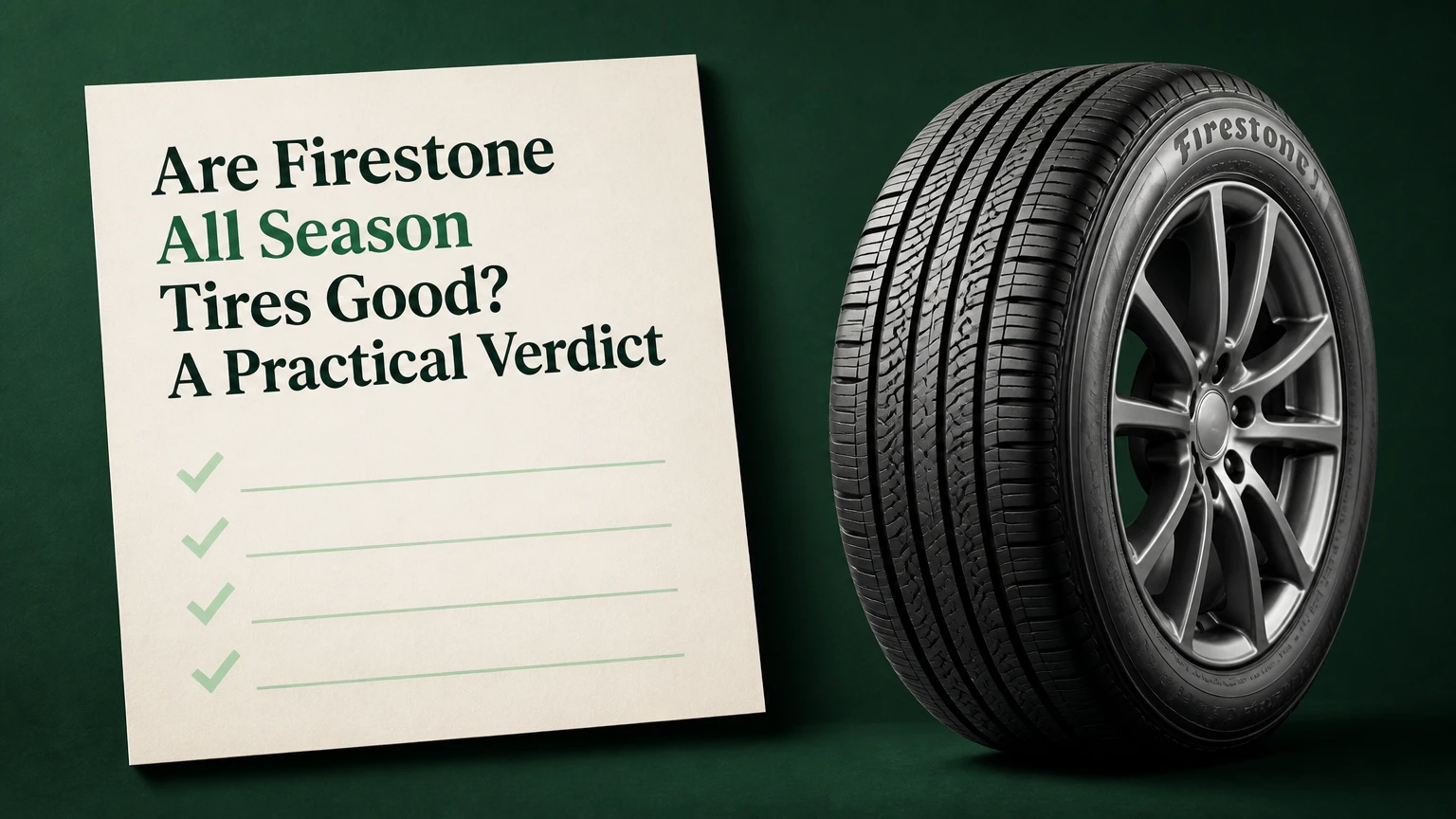
Firestone All Season tires are good value-oriented tires for daily commuting, ordinary rain, dry pavement, and occasional light snow. They are less suitable for aggressive cornering, severe winter conditions, frequent towing, or drivers who demand the shortest wet braking distances. Their value depends on the exact size, vehicle, climate, price, and maintenance history.
Key facts at a glance
Firestone All Season tires are standard touring tires for passenger cars, minivans, and some crossover applications.
Many passenger-car sizes carry a 65,000-mile limited treadwear warranty, but coverage varies by size and application.
Typical retail pricing is about $85-$145 per tire, with a four-tire installed purchase often reaching $400-$700.
All-season tires are not a substitute for severe-snow tires marked with the 3-Peak Mountain Snowflake symbol.
Correct inflation, rotation, alignment, and tire age influence safety and service life more than the brand name alone.
Firestone All Season tires favor ride comfort, predictable commuting, and tread longevity over sports-car steering response.
What Are Firestone All Season Tires?
Firestone All Season tires are non-directional touring tires designed to cover common year-round driving conditions without specializing in summer heat or severe winter traction. The product is positioned below Bridgestone’s premium lines and above the cheapest unknown-brand options, making purchase price and expected tread life its main appeal.
The name describes a tire category, not a single universal specification. Firestone sells related all-season products for different vehicles, including the standard All Season passenger tire, Destination LE3 for many SUVs and light trucks, and Firehawk AS V2 for performance-oriented applications. Size-specific construction, load index, speed rating, and warranty terms can differ.
A standard touring tire typically uses circumferential grooves to evacuate water and lateral sipes to create additional edges on wet or lightly contaminated pavement. Those features help in rain and occasional slush, but they cannot reproduce the flexible compound and open tread geometry of a dedicated winter tire at freezing temperatures.
The practical definition is simple: Firestone All Season tires are general-purpose commuter tires. They are designed to reduce the need for seasonal changes in moderate climates, not to provide maximum grip in every season.
Are Firestone All Season Tires Good?
Firestone All Season tires are good for drivers who prioritize affordable ownership, a comfortable ride, moderate road noise, and predictable dry-road behavior. They are a reasonable match for a sedan or minivan driven 12,000-15,000 miles annually in a climate with rain, heat, and occasional light snow.
The verdict changes when the operating conditions change. A driver in northern Minnesota, Vermont, or mountainous Colorado may need a 3PMSF-rated all-weather tire or dedicated winter tire. A driver with a sport sedan may prefer sharper steering from a performance all-season model. A driver who regularly carries heavy loads must prioritize the vehicle’s required load index over a low advertised price.
Firestone’s parent company, Bridgestone, provides substantial tire-engineering and distribution support, but brand ownership does not guarantee that every model will outperform every competitor. Independent test results, consumer reviews, tire age, vehicle alignment, and the actual tire size still matter.
Quick verdict by driver
| Driver or vehicle use | Verdict | Better fit or condition |
|---|---|---|
| Compact sedan commuter | Recommended | Standard Firestone All Season in the OE-approved size |
| Highway family vehicle | Recommended with checks | Compare wet braking and warranty terms |
| Sport sedan driver | Conditional | Firehawk AS V2 or another performance all-season tire |
| Snow Belt resident | Usually no | WeatherGrip, another 3PMSF tire, or winter tires |
| Frequent tower or heavily loaded SUV | Conditional | Destination LE3 or a tire with the required load range |
How Do Firestone All Season Tires Perform?
Firestone All Season tires provide their best balance on dry pavement and ordinary wet roads at normal highway speeds. Their tread channels move water away from the contact patch, while the tread compound and sipes preserve usable flexibility across a wider temperature range than a summer tire.
Dry-road handling
Dry braking is generally predictable, and the softer touring-tire construction absorbs broken pavement better than many sporty tires. That comfort comes with less immediate steering response. When a driver turns sharply, the sidewall can feel slower to load and communicate than a performance tire.
That behavior is not a safety defect by itself. It is a design trade-off. Drivers who value relaxed steering and a quiet cabin may prefer it, while drivers who judge a tire by cornering precision may find it vague.
Wet-road traction
Wet performance is adequate for commuting when the tread is healthy and the pressure is correct. Deep circumferential grooves help disperse standing water, but no touring tire eliminates hydroplaning risk at excessive speed or in deep water.
The most important wet-grip decline often occurs late in the tire’s life. Sipes and grooves become less effective as tread depth falls, even before the legal replacement indicator reaches 2/32 inch. Replace a tire when wear, cracking, vibration, impact damage, or age makes it unsafe, not only when the treadwear bars become flush.
Snow and ice
Firestone All Season tires can handle light snow and cold rain, but the standard product should not be treated as a severe-winter tire. The M+S marking used on many all-season tires does not equal the 3PMSF certification, which indicates that the tire passed a defined snow-traction test.
The distinction matters in regions with repeated snow, packed ice, freezing hills, or temperatures below about 45 degrees Fahrenheit. A tire can remain legal and usable while still offering substantially less winter grip than a 3PMSF all-weather or winter tire.
What Features and Ratings Matter?
The most important purchase specifications are the vehicle-approved size, load index, speed rating, UTQG information, warranty, and production date. Tread design terms such as “deep siping” sound useful, but they cannot replace checking the sidewall and the vehicle placard.
| Specification | Typical Firestone All Season information | Why it matters |
|---|---|---|
| Passenger-car warranty | Up to 65,000 miles in qualifying sizes | Sets a benchmark, not a guaranteed lifespan |
| Common wheel diameters | Approximately 14-20 inches | Availability and price depend on size |
| Speed ratings | S, T, or H in some applications | Must meet vehicle requirements |
| UTQG treadwear | Often about 480-560, size dependent | Relative rating, not a mileage promise |
| New tread depth | Often near 10/32 inch, size dependent | More usable rubber can extend service life |
| Replacement threshold | 2/32 inch legal minimum in many states | Safety replacement may be appropriate earlier |
UTQG numbers are comparative within the government-regulated labeling system, not a universal forecast. A 560-rated tire driven on a misaligned vehicle can wear faster than a lower-rated tire maintained correctly.
The sidewall also contains the load index and speed symbol. Never replace a tire with a lower load index because the dimensions look identical. The vehicle owner’s manual and driver-door placard control the required cold inflation pressure and minimum tire rating.
How Long Do Firestone All Season Tires Last?
Firestone All Season tires commonly last about 35,000-65,000 miles, with the actual result controlled by alignment, inflation, rotation frequency, climate, vehicle weight, and driving style. A carefully maintained commuter may approach the warranty mileage, while a heavy urban vehicle with poor alignment may need replacement near 35,000-45,000 miles.
The 65,000-mile figure is a limited warranty ceiling, not a service-life guarantee. Warranty coverage normally requires installation on the eligible vehicle, regular rotation, appropriate inflation, and proof of maintenance. The manufacturer may offer prorated credit rather than a free replacement when the tire wears prematurely.
At 12,000-15,000 miles per year, a set may provide roughly three to five years of use. Calendar age matters as well. The National Highway Traffic Safety Administration advises motorists to inspect tires for age and condition, and several vehicle and tire manufacturers recommend replacement around six years regardless of remaining tread, with ten years treated as an absolute upper limit by some manufacturers.
A tire’s DOT code identifies its production week and year. For example, a code ending in 2424 indicates production during the 24th week of 2024. Check that date before buying older inventory.
Maintenance rules that protect tread life
- Check cold pressure at least monthly and before long trips.
- Rotate according to the vehicle maker’s schedule, commonly every 5,000-8,000 miles.
- Align the wheels after pothole impacts, suspension work, or persistent steering pull.
- Measure tread across inner, center, and outer grooves.
- Replace tires with sidewall bulges, exposed cords, deep cuts, or severe cracking.
- Keep matching tires on the same axle and avoid mixing radically different tread designs.
A practitioner rule is useful here: if the inner shoulder is worn while the center tread remains deep, adding air will not fix the problem. The pattern usually points to alignment or suspension trouble.
How Much Do Firestone All Season Tires Cost?
A Firestone All Season tire typically costs about $85-$145 before installation, while a four-tire purchase commonly totals $400-$700 after mounting, balancing, disposal fees, taxes, and possible alignment. Larger wheels, higher load ratings, run-flat construction, and local labor rates can move the total outside that range.
| Purchase scenario | Tire price | Typical additional charges | Typical installed total |
|---|---|---|---|
| 15-inch sedan set | $85-$105 each | $80-$160 | $420-$580 |
| 16-17-inch passenger set | $95-$125 each | $100-$190 | $480-$690 |
| 18-20-inch crossover set | $120-$175 each | $120-$240 | $600-$940 |
| Alignment added to installation | Not applicable | $90-$180 | Add to set total |
Cost per mile makes the warranty easier to interpret. A $520 set lasting 52,000 miles costs about one cent per mile before maintenance and installation. A cheaper $360 set lasting 30,000 miles costs 1.2 cents per mile, so the lower checkout price may not be the lower ownership cost.
Pricing should be compared using the complete installed quote. Ask whether the quote includes valve stems, TPMS service, road-hazard coverage, disposal, balancing, taxes, and a four-wheel alignment.
Which Firestone Tire Fits Your Vehicle?
The correct Firestone model depends on vehicle category and driving conditions, not on the word “all-season” alone. Passenger cars generally need the standard All Season line, while SUVs, pickups, and performance sedans may require a different casing, load rating, or handling profile.
| Firestone model | Typical vehicle | Main use | Winter designation or limitation |
|---|---|---|---|
| All Season | Sedan, coupe, minivan | Value-oriented daily driving | Light snow only unless marked otherwise |
| Destination LE3 | CUV, SUV, light truck | Highway touring and utility use | Not automatically a severe-snow tire |
| Firehawk AS V2 | Performance sedan, sports car | Faster steering and dry handling | Performance all-season, not a winter tire |
| WeatherGrip | Passenger car, CUV, some SUVs | Year-round use with more winter ability | 3PMSF-rated in applicable sizes |
Vehicle fit requires more than matching diameter. Confirm the complete size, such as P215/60R16, load index, speed rating, construction type, and manufacturer approval. An XL extra-load tire may have different pressure and ride characteristics from a standard-load version in the same nominal size.
Electric vehicles deserve additional care because battery weight and instant torque can accelerate wear. An EV owner should choose a tire with the manufacturer-approved load capacity and monitor tread depth more often than the normal service interval.
Firestone All Season Versus All-Weather and Winter Tires
Firestone All Season tires are the better choice for moderate climates, while all-weather tires are the better compromise for drivers who face recurring snow but want one year-round set. Dedicated winter tires remain the strongest option for prolonged freezing conditions, packed snow, and ice.
| Tire category | Warm-weather behavior | Snow and ice ability | Seasonal change | Best application |
|---|---|---|---|---|
| Summer | Excellent dry grip | Poor below freezing | Required in winter climates | Performance driving |
| Standard all-season | Good | Light snow | Usually none | Moderate climates |
| All-weather, such as WeatherGrip | Good | Better, 3PMSF rated | Usually none | Variable four-season weather |
| Dedicated winter | Reduced warm-weather handling | Best | Required after winter | Frequent snow and ice |
The 3PMSF symbol is the quickest consumer check for severe-snow capability. It does not mean the tire is equal to a dedicated winter tire on ice, but it separates tested severe-snow products from ordinary M+S all-season tires.
One counterintuitive truth is that all-wheel drive does not create tire grip. AWD can help a vehicle accelerate, but braking and cornering still depend on the four contact patches. A two-wheel-drive car with proper winter tires can stop more effectively than an AWD vehicle on ordinary all-season tires.
Who Should Buy Firestone All Season Tires?
Firestone All Season tires suit drivers who spend most miles on paved roads, want a quiet ride, and experience temperatures from hot summer conditions to occasional light winter weather. They are especially sensible when the installed price is materially below premium touring alternatives and the vehicle does not require a specialized tire.
Best for commuters
A daily commuter covering 50 miles on highways and suburban roads can benefit from the touring construction, predictable response, and long-warranty positioning. Correct pressure and regular rotation are essential because long highway mileage exposes any alignment problem over many thousands of miles.
Acceptable for rain-heavy regions
Drivers in the Southeast or Pacific Northwest can use them if they reduce speed in standing water and replace worn tires promptly. A premium tire with stronger wet-braking results may justify its higher price for drivers who regularly encounter intense rainfall.
Poor fit for performance driving
Drivers who enjoy rapid transitions, mountain roads, or autocross-style steering should consider a performance all-season or summer tire. The standard Firestone All Season prioritizes compliance, so its steering feedback may feel delayed during aggressive cornering.
Conditional for towing and heavy loads
A crossover or light truck used for towing should use the load index and trailer requirements specified by the vehicle maker. The Destination LE3 may be a more appropriate Firestone option, but the exact tire must still match the placard and axle loads.
What Problems Occur With Firestone All Season Tires?
The most common problems are uneven wear, vibration, noise, slow leaks, and reduced wet grip near the end of tread life. These symptoms usually point to inflation, alignment, balancing, suspension, puncture, or aging issues rather than a single universal Firestone defect.
| Symptom | Likely cause | Immediate check | Corrective action |
|---|---|---|---|
| Feathered tread blocks | Toe misalignment | Run a hand across tread carefully | Alignment and rotation |
| Cupping or scalloped wear | Worn strut or imbalance | Inspect repeating dips | Suspension inspection and balance |
| Center wear | Overinflation | Compare cold PSI with placard | Set placard pressure |
| Both shoulder wear | Underinflation | Measure all four cold tires | Inflate, then inspect for leaks |
| Steering-wheel vibration | Imbalance or bent wheel | Note speed at vibration | Balance and wheel inspection |
| Slow pressure loss | Nail, valve, or bead leak | Check pressure over 48 hours | Professional leak repair |
Never diagnose a wheel-bearing failure from noise alone. Tire cupping can create a droning sound that changes with pavement texture and remains after a tire rotation, while a bearing often changes when vehicle load shifts during a turn.
If wet grip seems to disappear suddenly, check pressure first, then tread depth and tire age. Low pressure can increase heat, distort the contact patch, and accelerate shoulder wear.
How Should You Inspect and Replace Them?
Inspect Firestone All Season tires monthly, before long trips, and after striking a pothole or curb. Use a reliable pressure gauge on cold tires, examine the entire sidewall, and measure tread in multiple locations rather than judging condition from the center rib alone.
Replace a tire when it reaches the legal limit, develops structural damage, shows severe cracking, or becomes too old under the vehicle or tire manufacturer’s guidance. Replace all four when tread differences would materially affect handling, especially on AWD vehicles where the manufacturer may specify a narrow circumference tolerance.
A tire shop should investigate persistent pulling, vibration, or uneven wear before installing replacements. New tires cannot correct worn tie rods, bent wheels, weak struts, or incorrect alignment.
NHTSA’s tire-safety guidance summarizes the central risk in a sentence frequently used in its consumer materials: “Tires are the only thing between your vehicle and the road.” That principle explains why a bargain tire with the wrong load rating or poor maintenance is not a bargain.
Which Alternatives Should You Consider?
The best alternative depends on the weakness you want to correct. Choose WeatherGrip for more snow capability, Destination LE3 for an SUV-oriented application, Firehawk AS V2 for sharper handling, or a premium touring tire when wet braking and refinement matter more than initial price.
| Priority | Firestone choice | Alternative category | Trade-off |
|---|---|---|---|
| Lowest sensible ownership cost | All Season | Value touring tire | Less advanced wet performance possible |
| SUV highway comfort | Destination LE3 | Premium CUV touring tire | Higher purchase price |
| Steering response | Firehawk AS V2 | Summer performance tire | More noise or shorter tread life |
| Frequent snow | WeatherGrip | Dedicated winter tire | Winter tire changes or lower warm-weather precision |
| Maximum wet-road reserve | Premium touring model | Top-tier grand touring tire | Often $40-$100 more per tire |
Do not compare only brand reputation. Compare independent wet-braking tests when available, warranty mileage, treadwear reviews from the same size, replacement availability, and the complete installed price.
Frequently Asked Questions
Are Firestone All Season tires safe on the highway?
Firestone All Season tires are suitable for highway use when they have the correct speed rating, load index, inflation, tread depth, and age. Highway safety declines with excessive speed in standing water, underinflation, misalignment, or worn tread. Tire condition matters more than the advertised warranty mileage.
Do Firestone All Season tires have a treadwear warranty?
Many qualifying passenger-car sizes carry a limited warranty of up to 65,000 miles, but the exact coverage depends on the size, vehicle category, and product version. Warranty claims commonly require proof of purchase, regular rotation, correct inflation, and remaining usable tread. Confirm the current written terms before buying.
Can I use Firestone All Season tires in Michigan?
You can use them in Michigan for dry roads, rain, and occasional light snow, but they are not the strongest choice for repeated lake-effect snow or icy roads. A 3PMSF all-weather tire or dedicated winter tire provides a more appropriate winter margin.
Are Firestone All Season tires noisy?
Firestone All Season tires are generally tuned for moderate road noise and a compliant ride rather than aggressive handling. Noise can increase sharply with cupping, feathering, incorrect alignment, imbalance, or irregular pavement. A new tire that becomes noisy should receive a rotation and inspection before replacement.
Should I replace all four Firestone tires at once?
Replace all four when tread wear is similar or when the vehicle manufacturer requires matched circumference, especially on AWD systems. If only one tire is damaged, a shop should measure the remaining tread and confirm whether shaving, pairing, or replacing an axle is permitted by the vehicle maker.
What is the difference between M+S and 3PMSF?
M+S indicates a mud-and-snow tread classification, but it does not require the same severe-snow performance test as 3PMSF. The 3PMSF symbol identifies a tire certified for severe snow conditions. Neither marking makes a tire equal to a dedicated winter tire on ice.
The Bottom Line
Firestone All Season tires are good commuter tires when the priority is affordable, comfortable, long-wearing transportation in moderate weather. They are not the right answer for severe snow, frequent ice, demanding cornering, or vehicles requiring a higher load capacity. Before buying, confirm the OE-approved size, rating, DOT age, warranty terms, installed price, and local winter demands. For the right vehicle and climate, Firestone All Season tires offer a defensible balance of cost, comfort, and everyday safety.