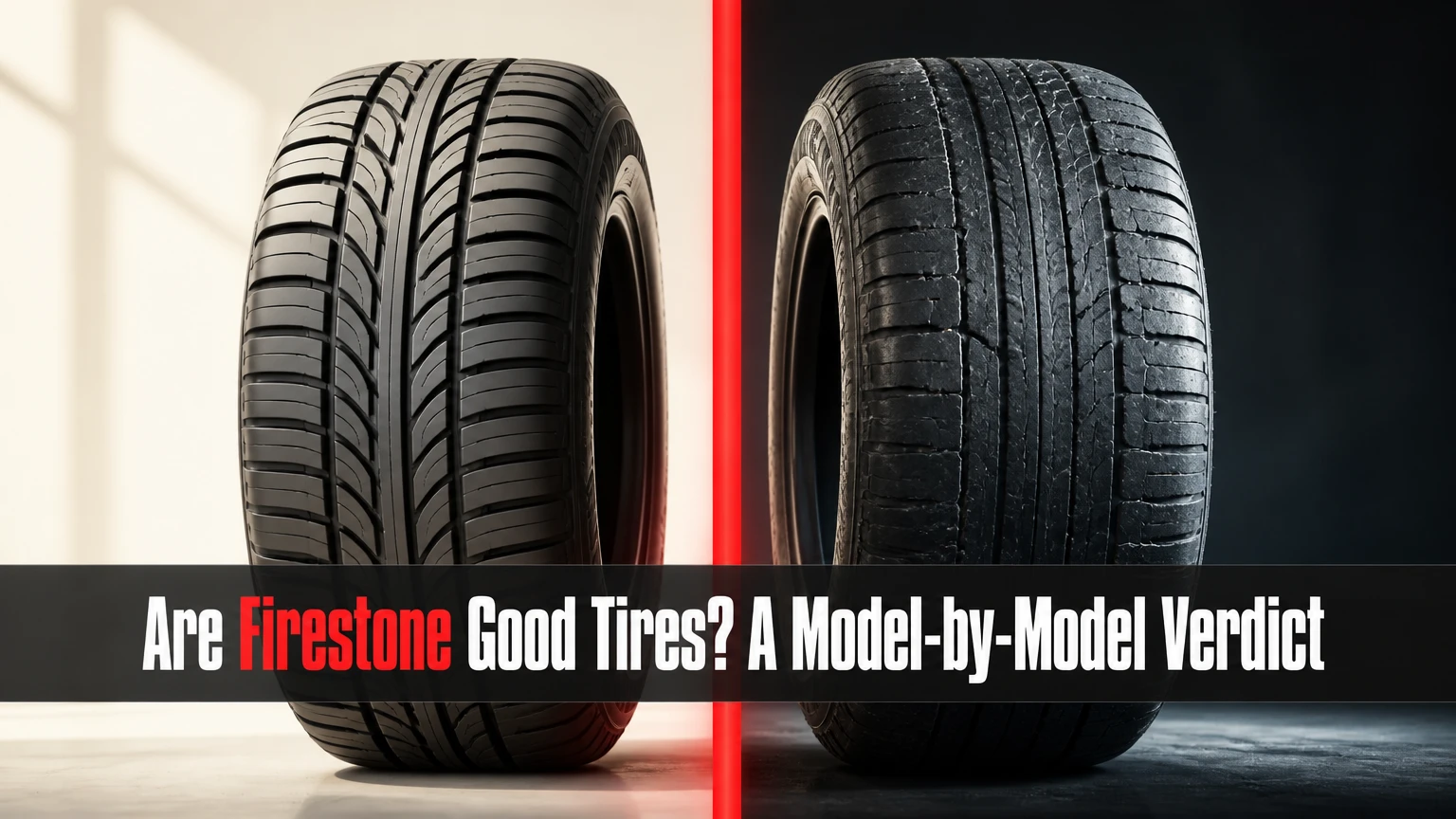
Firestone tires are generally good mid-priced tires for everyday driving, especially when the model matches the vehicle, climate, and workload. Bridgestone owns Firestone, but Firestone products do not all perform alike: Destination truck tires, WeatherGrip all-weather tires, Firehawk summer tires, and entry-level touring tires have different strengths, limits, and expected service lives.
Key Facts at a Glance
Firestone is owned by Bridgestone and occupies a value-oriented position below many flagship premium products.
Firestone passenger tires typically cost about $85-$150 each before installation, while truck and commercial models often cost $160-$310.
WeatherGrip carries the Three-Peak Mountain Snowflake, or 3PMSF, severe-snow symbol; a basic all-season tire generally does not.
Firestone’s Destination range covers highway, all-terrain, rugged-terrain, and mud-terrain use, so “Destination” is not one performance category.
A tire’s correct size, load index, speed rating, inflation pressure, alignment, and manufacturing age can matter more than the brand name.
Warranty mileage is a planning estimate, not a guaranteed service life; driving style, climate, rotation, and road conditions can shorten it.
Are Firestone Tires Good Overall?
Firestone tires are good value when buyers choose the correct product for normal commuting, family SUVs, light-truck use, or affordable performance driving. Firestone is usually weaker than the best Michelin, Continental, and Pirelli products in maximum wet grip, steering refinement, or long-term tread consistency, but the price difference can make Firestone sensible for many drivers.
Bridgestone acquired Firestone in 1988, giving the brand access to a large tire-development and manufacturing organization. That ownership does not mean a Firestone tire is identical to a Bridgestone tire. Compounds, tread patterns, casings, testing targets, warranties, and factory locations vary by model and size.
The useful verdict is therefore conditional. A Firestone Destination LE3 can be a reasonable highway tire for a pickup, while a Firestone Firehawk Indy 500 fits a completely different use. A low-cost Firestone All Season may meet the needs of a mild-climate commuter, but it is a poor substitute for a dedicated winter tire in frequent ice or deep snow.
What Firestone Tires Are Not Good For
Basic Firestone touring tires are not the right choice for repeated mountain snow, competitive track driving, severe off-road mud, or heavy commercial hauling unless the specific model is designed for that work. “All-season” describes a broad compromise, not a promise of strong winter traction.
Firestone also cannot compensate for a worn suspension, incorrect inflation, or poor alignment. A premium tire with improper pressure can wear badly and brake poorly, while a properly maintained mid-tier tire may deliver a safer and quieter result.
Who Makes Firestone Tires?
Bridgestone Corporation owns Firestone, and Firestone sells passenger, performance, SUV, light-truck, commercial, and winter tires through its own distribution network. Firestone tires can be produced at different factories, so the sidewall’s DOT code identifies the manufacturing plant and production date for a particular tire.
Firestone began in the United States in 1900 and became part of Bridgestone after the acquisition. The brand remains distinct in product positioning and naming. Bridgestone generally targets premium replacement buyers, while Firestone often targets drivers seeking a lower purchase price with established dealer support.
Manufacturing origin should not be treated as a simple quality score. Tire design, quality control, storage, transportation, correct fitment, and maintenance all affect performance. Check the complete DOT date code, which ends in four digits: “2325,” for example, means the 23rd week of 2025.
How Do Firestone Tires Perform in Rain?
Firestone wet performance ranges from adequate on entry-level touring models to strong on certain all-weather, touring, and truck products. Tread grooves evacuate water, while sipes create biting edges, but wet braking declines as tread depth falls and can change substantially with inflation pressure and road temperature.
The Firestone WeatherGrip uses a directional tread and 3PMSF certification for severe-snow service, making it a better choice for mixed rain and light-to-moderate winter conditions than a conventional all-season tire. Certification does not mean WeatherGrip stops as quickly as a dedicated winter tire on ice.
A practical replacement threshold matters. The U.S. Tire Manufacturers Association identifies 2/32 inch as the common minimum tread-depth benchmark in the United States, but wet-weather performance can deteriorate earlier. Many tire professionals recommend considering replacement around 4/32 inch when frequent rain is a major concern, particularly on vehicles without strong electronic stability assistance.
Firestone tire wet grip also depends on vehicle weight and axle loading. A front-wheel-drive sedan with worn rear tires can lose stability in standing water even when the front tires appear serviceable. Replace tires in axle pairs when possible, and place the tires with deeper tread on the rear axle unless the vehicle manufacturer specifies another arrangement.
Are Firestone Tires Good in Snow?
Firestone tires are good in snow only when the selected model matches the winter severity. WeatherGrip is an all-weather option with 3PMSF certification, Winterforce is a dedicated winter family, and ordinary Firestone all-season tires are intended for moderate conditions rather than persistent ice or deep snow.
The 3PMSF symbol means the tire met a standardized severe-snow traction test. The M+S marking, which appears on many all-season and all-terrain tires, does not provide the same severe-snow assurance. Rubber compounds also matter because winter tires remain more flexible at low temperatures than many all-season compounds.
| Firestone family | Main surface | Winter marking | Best fit | Main limitation |
|---|---|---|---|---|
| All Season | Dry and wet pavement | M+S or none, depending on size | Mild climates | Limited ice and deep-snow traction |
| WeatherGrip | Rain, slush, light snow | 3PMSF | Four-season commuters | Less ice grip than dedicated winter tires |
| Winterforce 2 | Snow, packed snow, cold pavement | 3PMSF | Seasonal winter driving | Faster warm-weather wear and softer handling |
| Destination A/T2 | Pavement, gravel, moderate snow | 3PMSF on applicable sizes | Pickups and SUVs | More noise and lower dry-road precision |
| Destination M/T2 | Mud, rocks, loose terrain | Size-dependent | Serious off-road use | Poorer highway comfort and wet-road refinement |
Drivers in areas with frequent freezing rain, mountain passes, or prolonged temperatures below freezing should consider Winterforce or another dedicated winter tire. Drivers who face occasional snow but use one set year-round may prefer WeatherGrip, accepting its compromise in summer wear and handling.
Which Firestone Tire Fits Your Vehicle?
The correct Firestone tire depends on vehicle type, road surface, annual mileage, weather, and load. Start with the driver-door placard and owner’s manual, then match the original tire size, load index, speed rating, construction type, and any run-flat or electric-vehicle requirements.
| Driving situation | Suitable Firestone family | Typical example | Selection priority | Avoid when |
|---|---|---|---|---|
| Sedan commuting | Touring or all-season | Firestone All Season | Price, comfort, wet braking | Snow and ice are frequent |
| Crossover travel | Touring or all-weather | WeatherGrip | Rain, slush, cabin comfort | Dedicated winter grip is required |
| Pickup highway use | Highway truck | Destination LE3 | Load support and mileage | Regular mud or rocky trails |
| Gravel and trail weekends | All-terrain | Destination A/T2 | 3PMSF option, sidewall strength | Maximum highway quietness matters |
| Rocky trail use | Rugged-terrain | Destination X/T | Puncture resistance and traction | The vehicle is driven mainly in town |
| Sports coupe | Summer performance | Firehawk Indy 500 | Dry cornering and steering | Temperatures regularly approach freezing |
| Work van or heavy-duty truck | Commercial | Transforce HT2 or CV2 | Load rating and casing durability | Quiet ride and soft comfort lead priorities |
Passenger, P-metric, XL, and LT tires are not interchangeable choices. An LT tire may carry more load but add weight, stiffness, noise, and rolling resistance. Never downgrade the vehicle’s original load index or speed rating without approval from the vehicle manufacturer or a qualified tire professional.
What Do Firestone UTQG Ratings Mean?
Firestone UTQG ratings describe treadwear, traction, and temperature performance, but the numbers are most useful for comparing tires within similar categories. A treadwear rating of 600 is not a promise of 60,000 miles, and winter or LT tires may not provide directly comparable UTQG data.
The U.S. National Highway Traffic Safety Administration explains that UTQG information helps consumers compare tires, but manufacturers conduct the treadwear test under specified conditions. Weather, pavement, alignment, inflation, rotation, vehicle weight, and driving habits can create large differences in actual mileage.
| UTQG element | Example marking | What it indicates | What it cannot guarantee |
|---|---|---|---|
| Treadwear | 600 | Relative wear index against a government test tire | Exact mileage |
| Traction | AA | Wet-braking traction grade | Snow or ice performance |
| Temperature | A | Resistance to heat generation | Tread life under every load |
| Speed rating | H, V, W | Maximum rated speed category | Safe driving speed in all conditions |
Treat UTQG as one input. A 500-rated tire with better wet braking and correct fitment may be preferable to a 700-rated tire with poor winter behavior for a rainy commuter.
How Long Do Firestone Tires Last?
Firestone passenger tires commonly carry limited warranties from approximately 55,000 to 70,000 miles, while actual service life often falls around 35,000-60,000 miles depending on model, vehicle, climate, and maintenance. Performance tires, aggressive truck tires, and winter tires normally last less because their compounds or tread designs prioritize grip.
A warranty covers specified defects and treadwear conditions, subject to exclusions, prorating, rotations, alignment, inflation, and proof of maintenance. It does not guarantee that a tire will reach its advertised mileage. Read the current Firestone warranty for the exact model and size because coverage can differ.
Age creates a separate replacement question. NHTSA recommends inspecting tires regularly and notes that some manufacturers recommend replacement at six years, while others use ten years as an absolute maximum. The date applies from manufacture, not purchase. Replace sooner for cracks, bulges, repeated air loss, exposed cords, impact damage, or vibration that a balance does not correct.
Practitioner insight: Tire age and tread depth answer different questions. A seven-year-old tire with 6/32 inch remaining may have more tread but less reliable rubber than a newer tire with 4/32 inch.
How Much Do Firestone Tires Cost?
Typical Firestone passenger tires cost about $85-$150 each, while Destination truck tires commonly cost $150-$240 and Transforce or larger commercial tires can reach $160-$310 each before installation. A complete installed set often adds roughly $100-$250 for mounting, balancing, valve service, disposal, taxes, and alignment.
Retail pricing changes with size, load rating, promotions, local labor, and inventory. A 17-inch or 20-inch tire can cost much more than the same model in a 15-inch size. Run-flat construction, high-load XL versions, and uncommon sizes also increase prices.
| Product category | Typical tire price | Typical installed set | Expected use |
|---|---|---|---|
| Basic passenger all-season | $85-$125 | $440-$750 | Low-cost commuting |
| Touring or all-weather | $110-$175 | $540-$950 | Rain and year-round travel |
| Destination highway | $145-$220 | $700-$1,150 | Pickup and SUV pavement |
| Destination all-terrain | $170-$260 | $800-$1,300 | Mixed road and trail use |
| Firehawk performance | $120-$210 | $580-$1,100 | Dry-road handling |
| Commercial Transforce | $160-$310 | $760-$1,500 | Vans and heavy-duty work |
Compare cost per expected mile rather than purchase price alone. A $600 set lasting 40,000 miles costs 1.5 cents per mile before installation; an $800 set lasting 60,000 miles costs about 1.33 cents per mile, provided both meet the vehicle’s traction and load requirements.
Firestone Versus Michelin, Continental, Goodyear, and BFGoodrich
Firestone usually wins on initial price and loses to premium competitors in the highest levels of wet braking, steering response, noise control, or long-distance tread consistency. The difference is model-specific, so compare equivalent tire categories rather than comparing a Firestone touring tire with a Michelin performance tire.
| Brand position | Typical strength | Typical price position | Better choice when | Firestone remains attractive when |
|---|---|---|---|---|
| Michelin | Long wear and refined touring performance | Highest | Mileage and comfort dominate | Budget limits the purchase |
| Continental | Wet grip and steering precision | High | Rain and responsive handling matter | A moderate commuter needs value |
| Goodyear | Broad range and strong truck coverage | Mid-high | Dealer availability and varied use matter | A comparable Firestone promotion lowers cost |
| BFGoodrich | Light-truck and off-road products | Mid-high | Trail durability is the priority | Destination pricing and service access win |
| Firestone | Value, broad fitment, dealer network | Mid | Balanced everyday ownership matters | The selected model matches the vehicle |
Independent tests can rank brands differently because tire size, test surface, temperature, vehicle, and scoring weights change the result. Tire Rack’s customer reviews, professional comparative tests, and the vehicle manufacturer’s original-equipment specification are more useful together than a universal brand ranking.
Is Firestone Better Than a Budget Tire?
Firestone is often a safer value than an unknown budget tire because product documentation, dealer support, warranty administration, and replacement availability are easier to verify. That advantage does not make every Firestone model superior to every lower-priced competitor, especially when independent wet-braking data shows a large model-level difference.
Choose the cheaper option only after verifying the tire’s load index, speed rating, date, warranty, severe-snow marking, and test or owner-review history. The lowest invoice can become expensive if the tire wears unevenly, generates vibration, or cannot be replaced as a matching pair.
Why Are Firestone Tires Wearing Unevenly?
Uneven Firestone tire wear usually indicates incorrect inflation, misalignment, worn suspension components, overloaded operation, or missed rotation intervals rather than a brand-specific defect. The tread pattern provides clues, but a technician should measure tread depth across the tire and inspect steering and suspension parts before replacing rubber.
| Wear pattern | Likely cause | Inspection | Corrective action |
|---|---|---|---|
| Center rib worn | Overinflation | Compare cold pressure with door placard | Set pressure cold; inspect for prior damage |
| Both shoulders worn | Underinflation or overload | Check pressure history and axle load | Inflate correctly; reduce load |
| One shoulder worn | Camber or suspension issue | Alignment and ball-joint inspection | Repair parts, then align |
| Feathered blocks | Toe misalignment | Hand-check tread direction | Correct toe setting |
| Cupped patches | Weak dampers or imbalance | Shock, wheel, and balance check | Repair suspension and rebalance |
| Rapid rear wear | Rotation or drivetrain load | Review rotation schedule | Rotate as permitted by vehicle maker |
Rotate according to the vehicle and tire manufacturer’s schedule, often around 5,000-8,000 miles, unless a directional or staggered setup prevents normal rotation. Check pressure monthly when tires are cold, and recalibrate or inspect TPMS after installation.
Practitioner insight: An alignment is not a substitute for worn suspension parts. Aligning a vehicle with loose tie rods or weak dampers may produce a temporary printout improvement while the tire continues to cup or feather.
Where Should You Buy Firestone Tires?
Buy Firestone tires from a retailer or installer that provides the exact model, size, load rating, manufacturing date, written warranty terms, road-hazard policy, and installation price. Firestone Complete Auto Care and independent tire dealers may simplify warranty service, while online retailers can offer broader inventory and lower advertised prices.
Before paying, verify these details:
- Match the sidewall size to the door placard, including load index and speed rating.
- Request tires manufactured within a reasonable recent period, especially for low-mileage vehicles.
- Confirm mounting, balancing, new valve stems, disposal, taxes, and alignment charges.
- Ask whether road-hazard coverage is included, optional, or excluded.
- Confirm the retailer will install four matching tires when the vehicle requires a matched set.
- Save the invoice and record the installation date, mileage, and cold-pressure recommendation.
Do not accept a different model because it is in stock without checking its winter marking, load capacity, speed rating, and intended surface. A Destination M/T2 may fit the wheel but still be a poor choice for a commuter who drives 20,000 highway miles annually.
Which Firestone Tire Should You Choose?
The best Firestone tire depends on the driver’s dominant risk: wet pavement, winter snow, heavy loads, highway mileage, or dry-road handling. The Firestone All Season fits a mild-climate budget commuter, WeatherGrip fits mixed rain and occasional snow, Destination LE3 fits highway trucks, Destination A/T2 fits mixed pavement and trails, and Firehawk fits warm-weather performance driving.
Budget Commuter
Choose Firestone All Season when the vehicle is a sedan or crossover used mainly on paved roads in a mild climate. Skip it if frequent snow, ice, high annual mileage, or unusually demanding wet-road conditions justify a more specialized tire.
Four-Season Regional Driver
Choose WeatherGrip when one set must handle rain, slush, and occasional snow. Choose Winterforce instead when winter roads remain cold and snow-covered for extended periods, because a dedicated winter compound generally provides stronger cold-weather traction.
Pickup and SUV Owner
Choose Destination LE3 for highway travel and Destination A/T2 for regular gravel, trails, or moderate snow. Destination X/T or M/T2 makes sense only when rough terrain is frequent enough to justify extra noise, weight, rolling resistance, and reduced pavement comfort.
Performance Driver
Choose Firehawk Indy 500 for warm, dry-road handling at a lower price than many premium summer tires. Do not use it as a winter tire, and expect shorter tread life than a touring tire because high-grip compounds and tread blocks prioritize cornering response.
FAQ
Are Firestone tires safe for highway driving?
Firestone tires are safe for highway driving when they have the correct size, load rating, speed rating, pressure, tread depth, and age. Highway safety also depends on rotation, alignment, wheel condition, and avoiding overloaded operation. Destination LE3 and comparable touring products suit pavement better than aggressive mud-terrain models.
Do Firestone tires come with a mileage warranty?
Many Firestone passenger and touring tires include limited mileage warranties, often in the 55,000-70,000-mile range, but coverage varies by model and size. Warranty service normally requires proof of purchase, proper rotation, correct inflation, and compliance with exclusions. Commercial, winter, and performance tires may have different or shorter coverage.
Are Firestone tires noisy?
Firestone tire noise depends on tread design, vehicle insulation, pavement, inflation, and wear. Touring tires are generally quieter than all-terrain or mud-terrain products, while cupping can create a humming or helicopter-like sound. If noise begins suddenly, inspect balance, suspension, tread wear, and wheel bearings before blaming the tire model.
Can I replace only two Firestone tires?
Replacing two Firestone tires is possible when the remaining pair has adequate tread, matching construction, and compatible performance. On most vehicles, the deeper-tread pair should go on the rear axle to reduce oversteer on wet roads, even when the vehicle is front-wheel drive. Follow the vehicle manufacturer’s instructions for AWD systems.
What tire pressure should Firestone tires use?
Use the cold tire pressure printed on the vehicle’s driver-door placard, not the maximum pressure molded into the Firestone sidewall. The placard accounts for the vehicle’s axle loads and handling calibration. Check pressure monthly and before long trips, because temperature changes alter pressure and underinflation increases heat and shoulder wear.
Should I buy Firestone tires?
You should buy Firestone tires when the selected model matches your climate, road surfaces, load demands, and budget. Firestone is a reasonable mid-tier choice for many commuters and truck owners, but buyers needing maximum wet braking, severe winter traction, or premium refinement should compare a model-specific alternative before deciding.
The Bottom Line
Firestone tires are generally good tires, but the brand name alone is not enough to make a purchase decision. Firestone All Season, WeatherGrip, Destination, Firehawk, Winterforce, and Transforce products serve different vehicles and conditions, with meaningful differences in snow capability, comfort, tread life, load support, and price.
For a mild-climate commuter, Firestone can deliver dependable value. For severe winter, demanding off-road work, or maximum wet-road performance, compare the exact Firestone model with Michelin, Continental, Goodyear, BFGoodrich, and dedicated winter alternatives. The right size, correct pressure, fresh manufacturing date, and consistent maintenance determine whether Firestone tires are good for your vehicle.