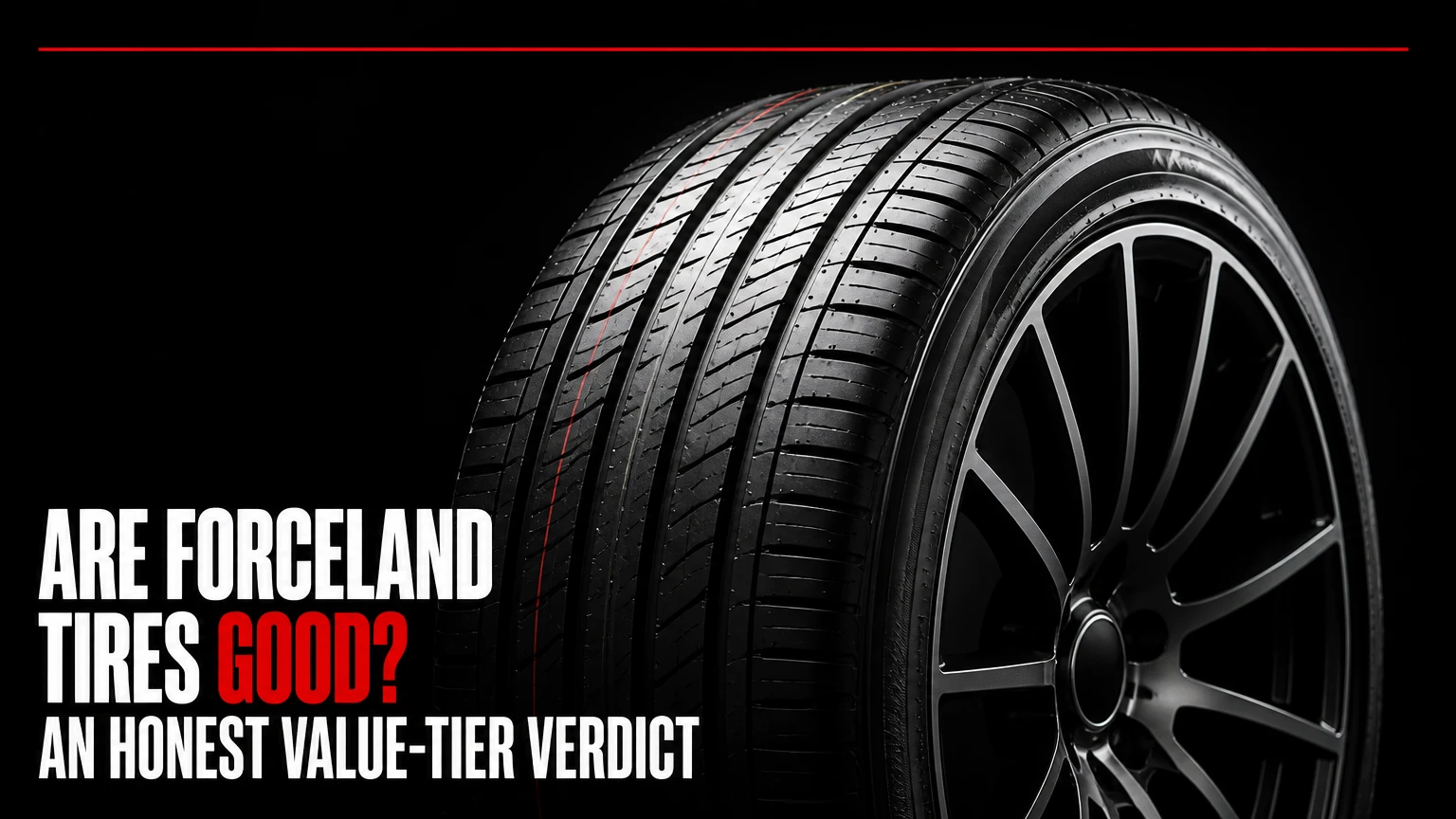
Forceland tires can be good enough for budget-focused daily driving when the exact model fits the vehicle, the tires are fresh, and the climate is mild. They generally offer acceptable dry-road traction and low purchase prices, but limited independent testing, inconsistent warranty coverage, and weaker severe-weather performance make premium or reputable mid-range tires better choices for demanding drivers.
Key Facts at a Glance
- Forceland is a value-tier tire brand associated with Mayrun Tyre and sold through online retailers in several markets.
- Typical advertised prices range from about $55-$80 for compact-car sizes and $120-$210 for large truck and SUV sizes.
- Common Forceland families include Kunimoto touring and highway models, Vitality performance models, and Rebel Hawk rugged or mud-terrain models.
- A UTQG traction grade of A describes controlled-test traction and does not prove that one tire stops shortest on every wet road.
- Most Forceland listings do not provide a conventional mileage warranty, so the retailer’s return and defect policy matters.
- Forceland all-season tires are not substitutes for winter tires or tires carrying the Three-Peak Mountain Snowflake, or 3PMSF, symbol.
What Kind of Brand Is Forceland?
Forceland is an entry-level, value-oriented tire brand rather than a premium manufacturer with the extensive testing record and warranty infrastructure associated with Michelin, Bridgestone, Continental, or Goodyear. Public brand information links Forceland with Mayrun Tyre, while retailer listings identify models manufactured in Asian facilities.
Manufacturing location alone does not establish whether a tire is safe or unsafe. A tire made in China or Thailand can meet applicable regulatory requirements, while a tire from any country can be a poor fit, incorrectly inflated, aged, or damaged. The more useful questions are whether the model has the correct certification markings, load capacity, speed rating, date code, retailer support, and credible customer history.
Independent comparative testing is the main limitation. Retailer reviews can reveal vibration, noise, or premature wear patterns, but they do not replace standardized braking tests performed across the same vehicle, temperature, pavement, and tire size. Forceland product pages commonly emphasize tread design, silica compounds, and noise control, yet those descriptions should be treated as manufacturer or seller claims rather than proof of class-leading performance.
Who Makes Forceland Tires?
Mayrun Tyre is the company most commonly associated with Forceland branding in public product information. Specific manufacturing plants can vary by model, size, production batch, and market, so a retailer or tire sidewall is a more reliable source for a particular tire’s origin than a generic brand page.
The U.S. National Highway Traffic Safety Administration, or NHTSA, states that “Tires are the only part of your vehicle that makes contact with the road.” That contact patch matters more than brand nationality. A buyer should verify the actual tire’s DOT registration, compliance markings, size, load index, and production date before installation.
Are Forceland Tires Good for Daily Driving?
Forceland tires are generally suitable for ordinary commuting when drivers prioritize low acquisition cost, drive mostly on dry or moderately wet roads, and maintain pressure and alignment. Forceland tires are less suitable when maximum wet braking, severe winter grip, long-distance durability, or strong manufacturer support outweighs the initial savings.
A Kunimoto touring or highway tire may make sense on an older sedan, compact crossover, or lightly used commuter vehicle whose annual mileage is modest. A Vitality model may provide sharper steering than a touring pattern, but an advertised V, W, or Y speed rating does not turn a budget tire into a track tire.
The economic case depends on more than the shelf price. A $70 tire that lasts 35,000 miles costs about $0.20 per tread mile before installation. A $115 tire lasting 55,000 miles costs about $0.21 per tread mile, so the cheaper purchase is not automatically the cheaper ownership choice. Those are typical planning examples, not a Forceland laboratory result.
Are Forceland Tires Safe?
Forceland tires can be safe when correctly sized, properly inflated, undamaged, and used within their load, speed, and weather limits. Safety becomes a poor bet when a driver relies on an old tire, mismatches load ratings, drives aggressively in heavy rain, or uses an all-season model in severe snow.
Legal compliance is a baseline, not a ranking. A tire can meet regulatory requirements while delivering less wet-weather margin than a more expensive competitor. Tread depth, inflation, alignment, suspension condition, and driver speed also affect stopping distance, which is why brand comparisons should not be reduced to a single UTQG letter.
Which Forceland Tire Line Fits Your Use?
The Kunimoto family is the logical starting point for passenger cars and highway-oriented crossovers, Vitality targets higher-speed road use, and Rebel Hawk patterns target loose surfaces. Product names and available sizes can change by market, so confirm the exact model’s sidewall markings and current retailer specification before ordering.
| Forceland family | Typical application | Example specifications | Main limitation |
|---|---|---|---|
| Kunimoto-F20 | Compact cars and sedans | UTQG 500 A A; T or H speed rating | Light-snow capability is not severe-winter traction |
| Vitality F22 | Performance sedans and coupes | UTQG 420 A A; V, W, or Y rating | Heat endurance and wet testing may trail premium UHP tires |
| Kunimoto-F36 H/T | Crossovers, pickups, highway use | UTQG 500 A A; T or V rating | Less effective in mud, rocks, and deep snow |
| Rebel Hawk R/T | Mixed pavement, gravel, trail use | Up to 10-ply or Load Range E listings | Louder ride and higher rolling resistance |
| Rebel Hawk M/T | Mud, dirt, and loose terrain | Q or R speed ratings on listed sizes | Poorer pavement comfort and wet-road refinement |
An LT tire or Load Range E model should not be selected merely because its sidewall appears stronger. The vehicle’s axle loads, wheel specification, intended payload, and required tire pressure must support that choice. Overly stiff construction can reduce ride comfort and may provide less useful grip on a lightly loaded pickup.
What Do UTQG Ratings Mean?
A Uniform Tire Quality Grading, or UTQG, label combines treadwear, traction, and temperature information. A listed 500 treadwear grade is a comparative index, while A traction and A temperature grades indicate performance categories under specified government testing conditions, not a universal ranking against every tire.
Forceland listings may show values such as 500 A A for Kunimoto models or 420 A A for Vitality F22. Treadwear numbers are not mileage guarantees because manufacturers assign them through comparison testing, and driving speed, alignment, inflation, climate, road texture, and rotation change actual wear.
Speed ratings describe sustained heat capability under defined test conditions. They do not recommend driving at the rating’s maximum speed, and they do not measure braking distance, cornering feel, hydroplaning resistance, or winter grip.
How Much Do Forceland Tires Cost?
Typical Forceland tire prices run approximately $55-$80 in 14-16-inch compact-car sizes, $85-$115 in 17-19-inch sedan and performance sizes, and $120-$210 in 20-22-inch truck and SUV sizes. Mounting, balancing, valve service, disposal, taxes, shipping, and alignment can add roughly $100-$250 for a four-tire installation.
| Vehicle and size group | Typical tire-only price | Typical installed set | Cost variable |
|---|---|---|---|
| Compact car, 14-16 inch | $55-$80 each | $320-$570 | Shipping and disposal fees |
| Sedan, 17-19 inch | $85-$115 each | $440-$710 | Low-profile mounting charges |
| Crossover, 17-19 inch | $95-$150 each | $480-$850 | XL load requirement |
| Truck or SUV, 20-22 inch | $120-$210 each | $650-$1,150 | Load Range E and alignment |
A low price can be rational for a vehicle nearing the end of its service life, a temporary budget constraint, or a low-mileage second car. The calculation changes for a rideshare vehicle, a family car carrying children on wet highways, or a truck that regularly tows near its rated capacity.
Check whether the listing includes a road-hazard plan, free replacement for defects, prorated coverage, or only a limited workmanship policy. “N/A mileage warranty” means the tire lacks a stated treadwear promise; it does not mean the tire has no defect protection at all.
How Do Forceland Tires Perform in Rain, Snow, and Heat?
Forceland tires offer their strongest value in dry, mild conditions and ordinary highway travel. Wet performance can be adequate with sufficient tread depth and moderate speed, but buyers should not infer exceptional emergency braking from an A traction grade or from deep-looking grooves alone.
Hydroplaning resistance depends on speed, water depth, inflation, tread wear, and groove geometry. A worn tire with 4/32 inch of remaining tread can behave very differently from a new tire, even if both carry the same model name. Correct pressure from the vehicle door placard is more useful than the maximum PSI molded into the sidewall.
Forceland all-season models should be treated as three-season tires in regions with frequent ice, packed snow, or temperatures well below freezing. The 3PMSF symbol identifies a tire that meets a standardized severe-snow traction test; the “M+S” marking alone does not provide the same assurance.
Track use is another boundary. Repeated high-speed cornering generates heat cycles and lateral loads that budget street tires are not designed to manage consistently. A dedicated performance tire from a tested UHP range is the safer choice for autocross, track days, or sustained mountain-road driving.
Are Forceland Tires Quiet?
Forceland touring and highway patterns can be reasonably quiet at normal road speeds, particularly when tread blocks use variable pitch spacing and the vehicle has good insulation. Noise depends heavily on tread pattern, pavement texture, inflation, alignment, and uneven wear, so no brand-wide quietness guarantee is justified.
A directional or aggressive Rebel Hawk pattern will normally generate more hum than a symmetric Kunimoto touring design. Cupping, feathering, and incorrect toe alignment can create a rhythmic roar that drivers mistakenly attribute to the rubber compound. If noise changes when the driver moves across lanes, inspect tread wear and wheel bearings before replacing all four tires.
How Long Do Forceland Tires Last?
A typical Forceland service-life estimate is approximately 35,000-50,000 miles under normal use, although aggressive driving, poor alignment, low pressure, heavy loads, and rough roads can reduce that range substantially. Many listings do not include a mileage warranty, so the estimate should not be treated as a guaranteed replacement threshold.
Rotate tires according to the vehicle manufacturer’s schedule, commonly every 5,000-7,500 miles when the manual does not specify another interval. Check cold pressure monthly and before long trips, because a tire can lose pressure without appearing visibly flat. Align the vehicle after pothole impacts or when the steering wheel is off-center.
Replace a tire when tread reaches 2/32 inch, when the wear bars are flush, or earlier if cracks, bulges, exposed cords, puncture damage, or persistent vibration appear. NHTSA also advises consumers to consider age and condition, not tread depth alone; many tire makers recommend inspection after six years and replacement around ten years, while local guidance and manufacturer instructions can be more conservative.
What Problems Do Forceland Buyers Report?
The most consequential reported problems are vibration, uneven wear, limited wet-weather confidence, and inconsistent after-sale support. Retailer reviews can identify patterns, but review volume varies by model and does not establish a controlled failure rate.
| Symptom | Likely cause | Corrective action | Replacement trigger |
|---|---|---|---|
| Steering vibration at 55-70 mph | Imbalance, radial force variation, bent wheel | Road-force balance and wheel inspection | Replace if structural defect remains |
| Outer shoulder wear | Toe or camber misalignment, underinflation | Four-wheel alignment and pressure check | Replace below legal tread or with cords |
| Center tread wear | Overinflation relative to placard pressure | Reset cold pressure to vehicle specification | Replace if wear bars are exposed |
| Cupping or scalloping | Worn shocks, imbalance, neglected rotation | Suspension inspection and rotation | Replace when irregular wear causes noise |
| Sidewall cracking | Age, UV exposure, harsh cleaners, storage | Remove petroleum-based dressing; inspect | Replace cracks reaching carcass layers |
| Wet grip decline | Low tread depth, cold compound, excessive speed | Slow down and measure tread | Replace at 4/32 inch for wet-weather reserve |
A road-force balance is preferable to repeated ordinary balancing when a new tire vibrates despite apparently correct weights. The machine measures assembly variation under load and can identify the best tire-to-wheel position, although it cannot repair a bent rim or defective casing.
How Should Forceland Tires Be Installed?
Match the original tire size, load index, speed rating, construction, and seasonal category before purchasing. A professional installer should mount, balance, torque, and inspect the tires, then reset the TPMS system where the vehicle requires relearning.
Use this buying and installation sequence:
- Read the driver-door placard and owner’s manual. Record the approved size, cold pressure, load index, and speed rating.
- Compare the full sidewall designation, such as P215/60R16 95H, rather than relying on wheel diameter alone.
- Inspect the four-digit DOT date code. Code 2426 means production during week 24 of 2026, not a 2026 expiration date.
- Ask the seller for the actual production date, return policy, defect coverage, and road-hazard terms.
- Confirm that directional arrows, outside markings, XL labels, and LT construction are installed correctly.
- Torque wheel fasteners to the vehicle manufacturer’s specification and recheck them after roughly 50-100 miles if the installer recommends it.
- Drive conservatively for the first 100-500 miles while tread surfaces wear in, avoiding hard braking and aggressive cornering.
The most common buying mistake is selecting the cheapest tire in the correct nominal size while ignoring load index and date code. A tire can physically fit the wheel yet fail to meet the vehicle’s axle-load requirement.
How Do Forceland Tires Compare With Alternatives?
Forceland is usually the lowest-cost option in this comparison, while a reputable mid-range tire often provides a stronger balance of warranty, wet-weather behavior, and wear consistency. Premium tires cost more initially but can justify the difference when annual mileage, rain exposure, winter severity, or vehicle value is high.
| Option | Typical cost per tire | Typical warranty position | Best-fit driving condition | Main trade-off |
|---|---|---|---|---|
| Forceland | $55-$210 | Often no mileage warranty | Mild-weather commuting | Less independent-test evidence |
| Linglong or similar value brand | $50-$190 | Varies by retailer | Lowest purchase price | Support and consistency vary |
| General or Kumho mid-range | $90-$240 | Model-specific limited warranty | Mixed daily driving | Higher upfront cost |
| Cooper or Falken mid-range | $100-$280 | Model-specific coverage | Highway, crossover, light truck | Some models cost near premium tires |
| Michelin, Bridgestone, or Continental | $140-$400 | Broad model-specific programs | High mileage and demanding weather | Highest purchase price |
The better alternative depends on the failure you are trying to avoid. Choose a mid-range tire when premature wear or wet-road braking would create more cost than the initial savings. Choose a premium tire when the vehicle is valuable, heavily used, or driven through frequent rain and freezing conditions.
Is Forceland Better Than Michelin?
Michelin is generally the stronger choice for wet-weather refinement, test documentation, treadwear support, and consistent long-distance performance, while Forceland wins on initial price. Forceland can be financially sensible on a low-mileage commuter, but Michelin is easier to justify for demanding mileage and weather.
Is Forceland Better Than a Mid-Range Tire?
Forceland is better only when the purchase budget dominates and the driving environment is forgiving. A mid-range tire commonly offers a more defensible ownership value when it includes a mileage warranty, stronger dealer support, and a larger body of comparative testing.
Who Should Buy Forceland Tires?
Forceland tires suit drivers who need a legal, correctly sized replacement at a low price and accept a smaller performance margin. They are a weaker choice for severe winter drivers, high-mileage commuters, sports-car owners, and people who cannot tolerate uncertain warranty support.
- Budget commuter: Reasonable choice for dry climates, moderate speeds, and annual driving below roughly 10,000-12,000 miles.
- Older vehicle owner: Sensible when the tire cost must remain proportional to the vehicle’s market value and the car is mechanically sound.
- Rideshare driver: Usually a cautious choice because high mileage magnifies treadwear and downtime costs; compare a warrantied mid-range tire first.
- Truck or towing owner: Select only a model whose load index and construction match the placard and axle loads; do not choose solely by ply count.
- Severe-winter driver: Not recommended as a sole solution unless the specific tire carries an appropriate severe-snow rating and local conditions support it.
- Track or aggressive-road driver: Not recommended; use a tested performance tire designed for repeated heat and lateral load.
An expert rule of thumb is to spend more when the tire is the limiting safety component in your use case. The value calculation changes sharply between a 3,000-mile annual commuter and a 30,000-mile delivery vehicle.
Frequently Asked Questions
Do Forceland Tires Have a Mileage Warranty?
Many Forceland listings show no conventional mileage warranty, although defect, return, and road-hazard terms differ by seller and model. Ask for written coverage before purchase, including prorating, installation requirements, rotation records, and the process for documenting premature wear.
Are Forceland Tires Good for Trucks?
Forceland truck tires can work for highway driving when the selected tire meets the pickup’s load index, speed rating, pressure requirements, and axle capacity. Rebel Hawk R/T or M/T patterns are more appropriate for loose terrain, but aggressive tread increases noise, rolling resistance, and wet-pavement compromises.
Can I Use Forceland All-Season Tires in Snow?
Forceland all-season tires may handle occasional light snow, but all-season labeling does not equal severe-winter capability. Drivers facing repeated snow, ice, or mountain travel should use a winter tire or an all-weather tire with the 3PMSF symbol and verify local chain regulations.
Where Can I Find the Forceland DOT Date?
The DOT code appears on the tire sidewall, usually near the complete DOT identification string. The final four digits identify the production week and year, so 2426 means week 24 of 2026; inspect both sides if the full code is printed only on the inner sidewall.
Should I Replace Only Two Forceland Tires?
Replace two tires only when the remaining pair has suitable tread, age, condition, and matching performance characteristics. On many all-wheel-drive vehicles, different rolling circumferences can stress the drivetrain, so follow the vehicle manufacturer’s replacement guidance and ask a tire professional to measure tread depth.
Are Forceland Tires Worth the Money?
Forceland tires are worth considering when low upfront cost is the main requirement, the vehicle is correctly matched, and driving occurs mainly in mild conditions. They are not the best value when long tread life, severe-weather grip, independent testing, or a strong mileage warranty matters more than purchase price.
The Bottom Line
Are Forceland tires good? Forceland tires are acceptable budget tires for carefully matched, normal commuter use, especially when the vehicle is older and the climate is mild. They are not a universal bargain: drivers who face heavy rain, severe snow, high annual mileage, towing, or aggressive performance use should compare a warrantied mid-range or premium tire before buying. Verify the exact model, load rating, DOT date, retailer policy, and installed cost, then maintain pressure, alignment, and rotation intervals.