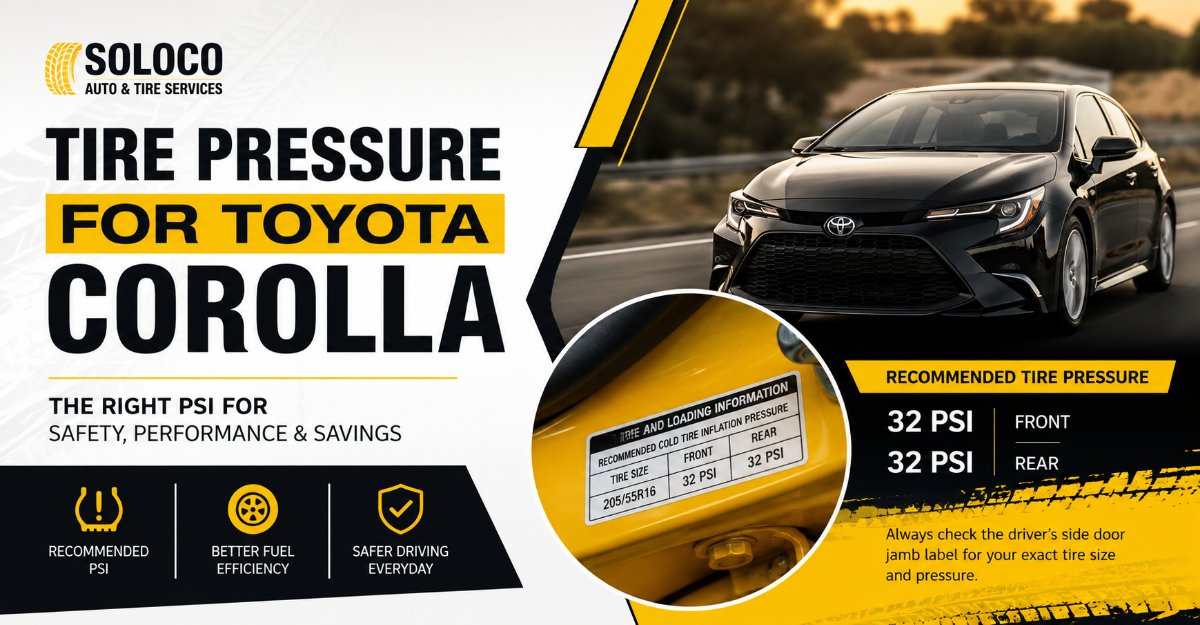
The correct tire pressure for Toyota Corolla models typically ranges from 32 PSI to 38 PSI for standard daily driving, while the space saver spare requires 60 PSI. Your exact recommended pressure depends heavily on your vehicle generation, trim level, and wheel size. You must always refer to the driver side door jamb placard for your specific vehicle configuration.
Key Facts / At a Glance
- Modern Corollas often use a staggered setup requiring 38 PSI in the front tires and 36 PSI in the rear tires.
- The physical air inside the tire supports 95 percent of the vehicle weight, while the rubber casing supports only 5 percent.
- Ambient temperature shifts cause tire pressure to fluctuate by roughly 1 PSI for every 10 degrees Fahrenheit of temperature change.
- The maximum pressure molded onto the rubber tire sidewall is a structural limit, never the recommended driving pressure.
- A blinking Tire Pressure Monitoring System (TPMS) light indicates a hardware malfunction, whereas a solid light indicates low air volume.
Tire Pressure For Toyota Corolla Models By Generation
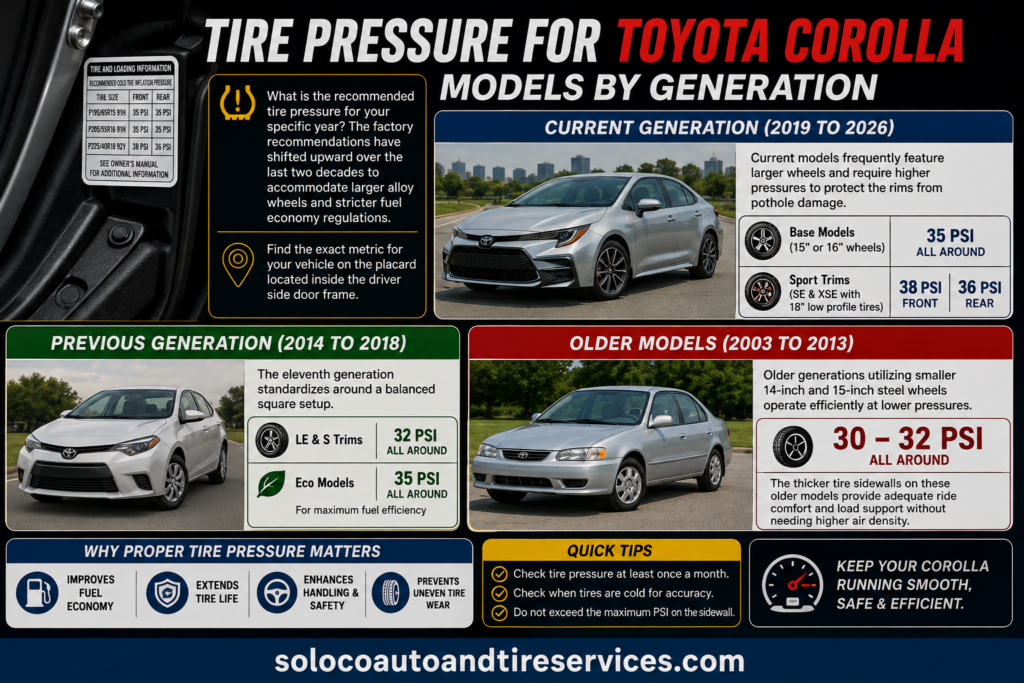
What is the recommended tire pressure for your specific year? The factory recommendations have shifted upward over the last two decades to accommodate larger alloy wheels and stricter fuel economy regulations. You can find the exact metric for your vehicle on the placard located inside the driver side door frame.
Current Generation (2019 to 2026)
Current models frequently feature larger wheels and require higher pressures to protect the rims from pothole damage. Base models with 15-inch or 16-inch wheels generally require 35 PSI on all four corners. Sport trims like the SE and XSE equipped with 18-inch low profile tires typically demand a split setup, taking 38 PSI in the front and 36 PSI in the rear.
Previous Generation (2014 to 2018)
The eleventh generation standardizes around a balanced square setup. Most LE and S trims from this era call for 32 PSI on all four tires. Eco models designed for maximum fuel efficiency often bump this requirement to 35 PSI to reduce rolling resistance on the highway.
Older Models (2003 to 2013)
Older generations utilizing smaller 14-inch and 15-inch steel wheels operate efficiently at lower pressures. Toyota typically recommended 30 PSI to 32 PSI for these vehicles. The thicker tire sidewalls on these older models provide adequate ride comfort and load support without needing higher air density.
Impact Of Trim Levels And Wheel Sizes
Different trim levels change the physical size of the tire sidewall, which dictates how much compressed air is necessary to support the chassis safely. Larger wheels require thinner rubber, meaning higher air pressure is mandatory to prevent the rim from striking the pavement on rough roads.
| Corolla Trim Level | Typical Wheel Size | Typical Front PSI | Typical Rear PSI |
| L / LE (Base) | 15-inch or 16-inch | 32 to 35 PSI | 32 to 35 PSI |
| SE (Sport) | 18-inch Alloy | 38 PSI | 36 PSI |
| XSE (Premium Sport) | 18-inch Alloy | 38 PSI | 36 PSI |
| Hybrid LE | 15-inch Alloy | 35 PSI | 35 PSI |
| Compact Spare Tire | 16-inch Steel | 60 PSI | 60 PSI |
Step By Step Tire Pressure Inspection Process
Checking your inflation levels takes less than five minutes and requires only a basic digital or analog gauge costing between $10 and $30. You should perform this inspection manually once every 30 days, as all tires naturally lose about 1 PSI of pressure per month due to permeation through the rubber.
Before You Start:
- Time Required: 5 minutes
- Cost: Free at most gas stations
- Tools Needed: Tire pressure gauge, portable 12V air compressor (optional)
- Prerequisite: Tires must be completely cold. The vehicle must sit parked for at least 3 hours, or driven for less than 1 mile.
Step 1: Locate The Factory Placard
Open the driver side door and locate the white and yellow sticker on the door jamb. Read the recommended cold tire inflation pressure specifically listed for the front and rear axles.
Step 2: Remove The Valve Stem Caps
Unscrew the plastic caps from the tire valve stems on all four wheels. Place them in your pocket immediately so they do not roll away or get lost.
Step 3: Seat The Pressure Gauge
Press the nozzle of your pressure gauge firmly and squarely onto the threaded valve stem. You will hear a brief hiss of air before the gauge seals.
Step 4: Read And Adjust The Metric
Check the digital screen or analog dial. If the reading is lower than the door placard specification, connect an air compressor and add air in short bursts. You will know it worked when the gauge reads the exact placard number.
Step 5: Deflate Overinflated Tires
If the gauge reads higher than the target number, press the small metal pin located in the center of the valve stem using the back of your gauge. Release air for two seconds, then retest.
Step 6: Secure The Valve Caps
Thread the plastic caps back onto the stems tightly. These caps block moisture and road debris from destroying the delicate valve core mechanism.
Common Mistake at this step: Checking the pressure immediately after a long highway drive. Kinetic friction heats the air inside the casing, expanding it and giving a false reading that is 3 to 5 PSI higher than the actual cold baseline.
Why Does The TPMS Warning Light Turn On?
What causes the yellow horseshoe shaped dashboard light to illuminate? The Tire Pressure Monitoring System activates when any tire drops 25 percent below the factory recommended placard value. The behavior of this light tells you exactly what type of failure has occurred.
If the light turns on and stays solid, you have a physical air leak or a temperature related pressure drop. A sudden cold front in autumn can easily drop your tire pressure by 3 to 4 PSI overnight, which is enough to trigger the sensor. You simply need to inflate the tires back to specification to resolve this.
If the light flashes for 60 to 90 seconds upon starting the car and then turns solid, you have a system hardware failure. This indicates that the vehicle computer has lost communication with one of the wheel sensors. This usually happens when the internal sensor battery dies, which typically occurs after 5 to 7 years of driving. Replacing a sensor costs between $50 and $150 per wheel at a professional tire shop.
How Do You Reset The Corolla TPMS System?
How can you clear the warning light after properly inflating your tires? Modern Toyota systems usually reset automatically after a few miles of driving, but older models require a manual calibration procedure to establish a new pressure baseline.
- Turn the ignition key to the ON position, but do not crank the engine.
- Locate the TPMS reset button. On models from 2007 to 2013, it is usually located under the steering wheel column. On 2014 to 2018 models, it is often hidden inside the glovebox.
- Press and hold the reset button until the yellow dashboard light blinks exactly three times.
- Release the button and leave the ignition in the ON position for several minutes to allow the computer to record the current air pressure in all four wheels.
- Turn the vehicle off, then start the engine normally and drive above 25 miles per hour for at least 15 minutes to finalize the synchronization.
Consequences Of Incorrect Tire Inflation
Driving with improper tire pressure fundamentally alters the contact patch, which is the exact area of rubber touching the road surface. Maintaining the optimal footprint grid flat on the pavement is critical for balanced braking, safe turning, and predictable wet weather handling.
Slight under-inflation provides a softer ride quality over potholes, but the drawbacks are severe. Low pressure causes the tire to bow outward, forcing the vehicle weight onto the outer edges of the tread. This destroys the tire shoulders rapidly and increases rolling resistance. Your fuel economy will drop by roughly 0.2 percent for every 1 PSI drop across your four tires.
Slight over-inflation delivers sharper steering feedback and a tiny bump in fuel economy, but it creates a harsh and uncomfortable ride texture. High pressure causes the center of the tire tread to bulge outward. The center tread will wear out prematurely, and your suspension components will absorb violent impact forces that the air volume was supposed to cushion.
Should You Use Nitrogen Or Compressed Air?
Is paying for a pure nitrogen fill worth the extra cost for a daily driven sedan? For the vast majority of drivers, standard atmospheric air is perfectly fine. Air is already 78 percent nitrogen, and the benefits of pure nitrogen only matter in extreme performance applications.
| Feature | Standard Compressed Air | Pure Nitrogen Fill |
| Cost | Free to $2 per fill | $5 to $10 per tire |
| Availability | Every gas station | Specialty tire shops |
| Pressure Retention | Loses about 1 PSI per month | Loses about 1 PSI every 3 months |
| Moisture Content | Contains trace water vapor | Completely dry gas |
| Best User Persona | Daily commuters and families | Track enthusiasts and fleet managers |
Nitrogen molecules are slightly larger than oxygen molecules, which means they migrate through the microscopic pores in tire rubber much slower. This keeps your pressures stable for longer periods. Furthermore, nitrogen is a dry gas, meaning it does not contain the moisture that causes standard air to expand unpredictably on hot race tracks. However, for a standard commuter vehicle, checking your tires monthly with a reliable gauge negates any practical advantage nitrogen offers.
Common Maintenance Mistakes To Avoid
Even experienced drivers routinely mismanage their tire maintenance due to widespread automotive myths. Avoiding these specific errors will extend the life of your tires and keep your suspension geometry intact.
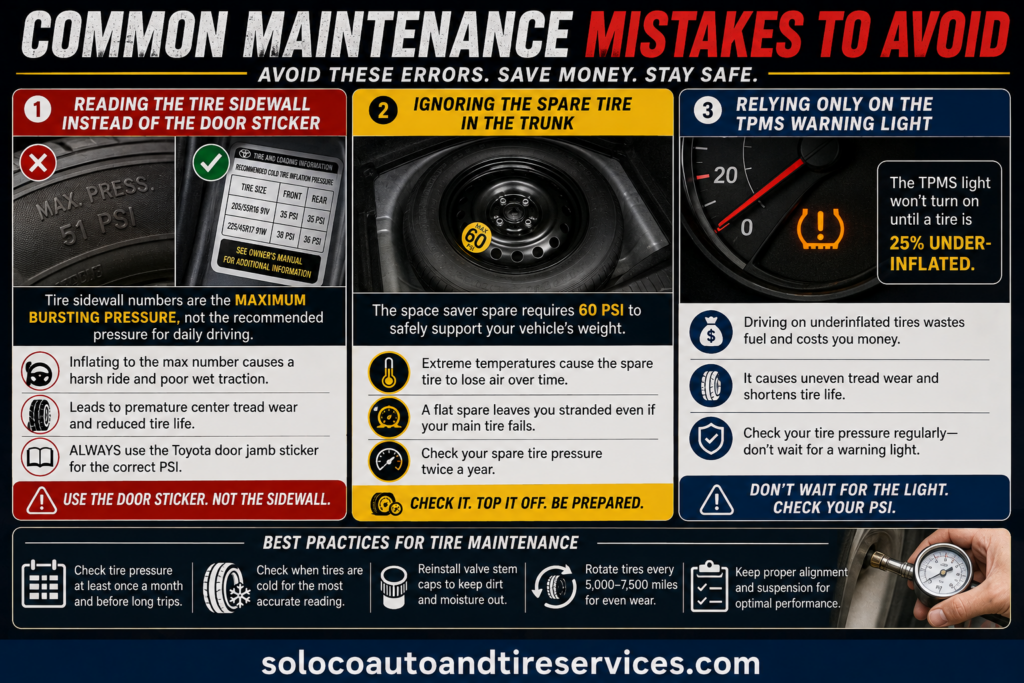
The most dangerous mistake is reading the numbers molded directly onto the tire sidewall. Tire manufacturers print a “Max Press” number on the rubber, which often reads 44 PSI or 51 PSI. This number represents the absolute structural bursting limit of the tire when carrying its maximum physical payload. Inflating to this number will result in a dangerously stiff ride, terrible wet traction, and immediate center tread destruction. Always use the Toyota door jamb sticker instead.
Another frequent failure mode is completely ignoring the spare tire in the trunk. The space saver spare requires a massive 60 PSI to support the weight of the vehicle safely on such a narrow footprint. Because it sits in the trunk through freezing winters and boiling summers, it constantly loses air. Drivers often experience a flat tire on the highway, only to pull out a spare tire that is also flat and entirely useless. You must check the spare tire pressure twice a year.
Finally, relying entirely on the TPMS warning light as your primary maintenance strategy is a terrible idea. The dashboard light does not illuminate until a tire is 25 percent underinflated. By the time the computer warns you, you have already been driving on dangerously soft tires, wasting fuel, and damaging your tread patterns for weeks.
Frequently Asked Questions
Does a Toyota Corolla tire pressure change in the winter?
Yes. Cold ambient temperatures cause the air molecules inside the tire to condense, dropping the overall pressure. You will typically lose 1 PSI for every 10 degrees Fahrenheit the temperature falls. You must proactively add air in late autumn to compensate for this physical reality.
Why does my tire pressure light stay on after filling my tires?
If the light stays solid after inflation, you likely need to drive the vehicle above 25 miles per hour for several minutes to wake up the wheel sensors and update the computer. If the light flashes upon startup, a sensor battery is dead and must be replaced by a mechanic.
Should I inflate my tires more if my trunk is heavily loaded?
Yes. If you are packing the vehicle with four heavy adults and a trunk full of dense luggage for a long highway trip, increasing the rear tire pressure by 2 to 3 PSI above the factory placard helps counteract suspension squat. Never exceed the maximum pressure listed on the sidewall.
How accurate are gas station air compressors?
The built in gauges attached to public gas station air compressors are notoriously inaccurate, often damaged by weather or dropped on the concrete by previous users. You should always use your own pocket digital or dial gauge to verify the final numbers after using a public machine.
Can I mix nitrogen and regular air in my tires?
Yes. Mixing standard compressed air into a tire filled with pure nitrogen is completely safe. It simply lowers the overall purity of the nitrogen gas, reducing its pressure retention benefits. It will not cause a chemical reaction or harm the structural integrity of the tire in any way.


