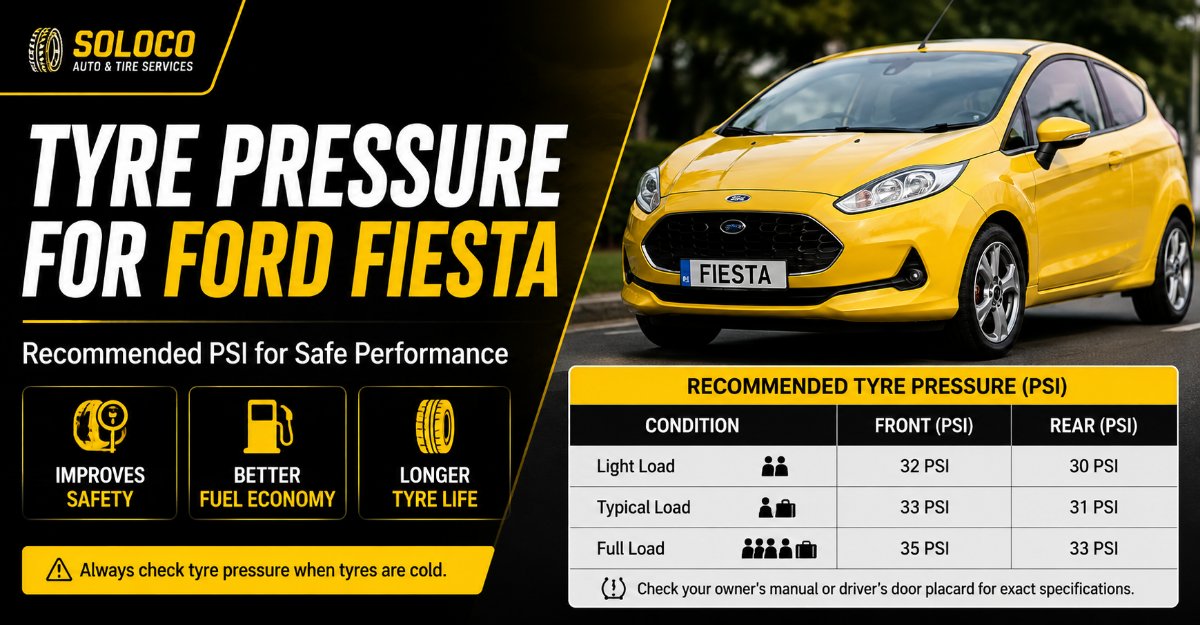
The recommended tyre pressure for Ford Fiesta vehicles typically ranges from 30 to 35 PSI (2.1 to 2.4 bar) under normal driving conditions. The exact specification depends entirely on your specific vehicle generation, alloy wheel size, and current passenger load. Always consult the placard located on the driver side door pillar for your exact chassis figures.
Key Facts At a Glance
- Normal commuting loads require roughly 32 PSI in the front and 30 PSI in the rear.
- Fully loaded vehicles require rear tyre pressure increases of up to 10 PSI to handle luggage weight.
- Driving heats the air inside the rubber, artificially raising pressure readings by 3 to 5 PSI.
- The emergency space-saver spare tyre must be inflated to 60 PSI (4.1 bar).
- Ford Fiestas use a front-heavy weight distribution, meaning front tyres usually require higher baseline pressure than the rear.
What Is the Correct Tyre Pressure for a Ford Fiesta?
The correct tyre pressure for a Ford Fiesta is determined by the specific generation of the vehicle, the engine block weight, and the amount of cargo in the cabin. Manufacturers calculate these exact volumetric limits to ensure the tread pattern makes perfect contact with the tarmac. Operating outside these parameters alters the handling dynamics and reduces braking efficiency.
Fiesta Mk8 Tyre Pressures (2017 to 2023)
The Mk8 generation relies heavily on lightweight 1.0 Litre EcoBoost engines. The baseline normal load assumes one or two passengers with minimal luggage. The full load specification assumes five adults and a trunk filled to capacity.
| Load Profile | Front Tyres (PSI / Bar) | Rear Tyres (PSI / Bar) | Typical Tyre Sizes |
| Normal Load (1 to 2 people) | 33 PSI (2.3 bar) | 30 PSI (2.1 bar) | 195/55 R16, 205/45 R17 |
| Full Load (5 people + luggage) | 35 PSI (2.4 bar) | 41 PSI (2.8 bar) | 195/55 R16, 205/45 R17 |
Fiesta Mk7 Tyre Pressures (2008 to 2017)
The Mk7 generation features slightly different chassis dynamics and accommodates heavier diesel engine blocks. These models require slightly lower baseline pressures at the rear axle when unladen.
| Load Profile | Front Tyres (PSI / Bar) | Rear Tyres (PSI / Bar) | Typical Tyre Sizes |
| Normal Load (1 to 2 people) | 32 PSI (2.2 bar) | 26 PSI (1.8 bar) | 195/50 R15, 195/45 R16 |
| Full Load (5 people + luggage) | 35 PSI (2.4 bar) | 41 PSI (2.8 bar) | 195/50 R15, 195/45 R16 |
Fiesta ST Performance Pressures
The Fiesta ST utilizes aggressive, low-profile rubber designed for maximum cornering grip. The stiff sidewalls require specific pressure ratios to prevent the front-wheel-drive platform from suffering severe understeer during aggressive driving.
| Load Profile | Front Tyres (PSI / Bar) | Rear Tyres (PSI / Bar) | Typical Tyre Sizes |
| Normal Load (1 to 2 people) | 35 PSI (2.4 bar) | 29 PSI (2.0 bar) | 205/40 R18 |
| Full Load (5 people + luggage) | 38 PSI (2.6 bar) | 41 PSI (2.8 bar) | 205/40 R18 |
How to Check and Adjust Your Ford Fiesta Tyre Pressure
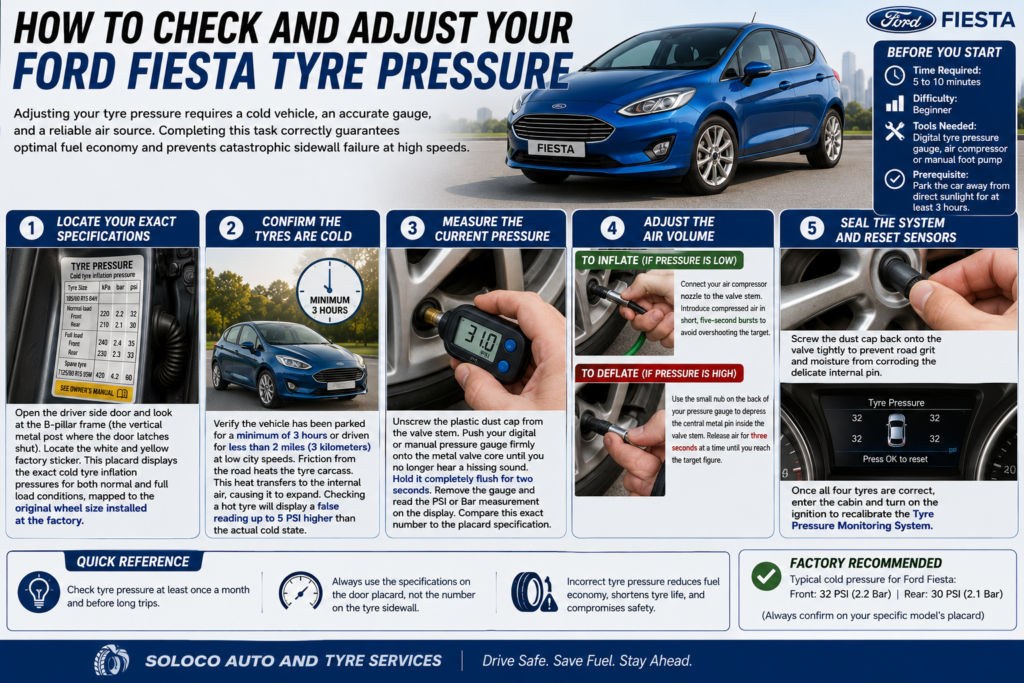
Adjusting your tyre pressure requires a cold vehicle, an accurate gauge, and a reliable air source. Completing this task correctly guarantees optimal fuel economy and prevents catastrophic sidewall failure at high speeds.
Before You Start
- Time Required: 5 to 10 minutes.
- Difficulty: Beginner.
- Tools Needed: Digital tyre pressure gauge, air compressor or manual foot pump.
- Prerequisite: Park the car away from direct sunlight for at least 3 hours.
Step 1: Locate Your Exact Specifications
Open the driver side door and look at the B-pillar frame (the vertical metal post where the door latches shut). Locate the white and yellow factory sticker. This placard displays the exact cold tyre inflation pressures for both normal and full load conditions, mapped to the original wheel size installed at the factory.
Step 2: Confirm the Tyres are Cold
Verify the vehicle has been parked for a minimum of 3 hours or driven for less than 2 miles (3 kilometers) at low city speeds. Friction from the road heats the tyre carcass. This heat transfers to the internal air, causing it to expand. Checking a hot tyre will display a false reading up to 5 PSI higher than the actual cold state.
Step 3: Measure the Current Pressure
Unscrew the plastic dust cap from the valve stem. Push your digital or manual pressure gauge firmly onto the metal valve core until you no longer hear a hissing sound. Hold it completely flush for two seconds. Remove the gauge and read the PSI or Bar measurement on the display. Compare this exact number to the placard specification.
Step 4: Adjust the Air Volume
Connect your air compressor nozzle to the valve stem to inflate a low tyre. Introduce compressed air in short, five-second bursts to avoid overshooting the target. If the tyre is over-inflated, use the small nub on the back of your pressure gauge to depress the central metal pin inside the valve stem. Release air for three seconds at a time until you reach the target figure.
Step 5: Seal the System and Reset Sensors
Screw the dust cap back onto the valve tightly to prevent road grit and moisture from corroding the delicate internal pin. Once all four tyres are correct, enter the cabin and turn on the ignition to recalibrate the Tyre Pressure Monitoring System.
What Equipment Should You Use to Inflate Your Tyres?
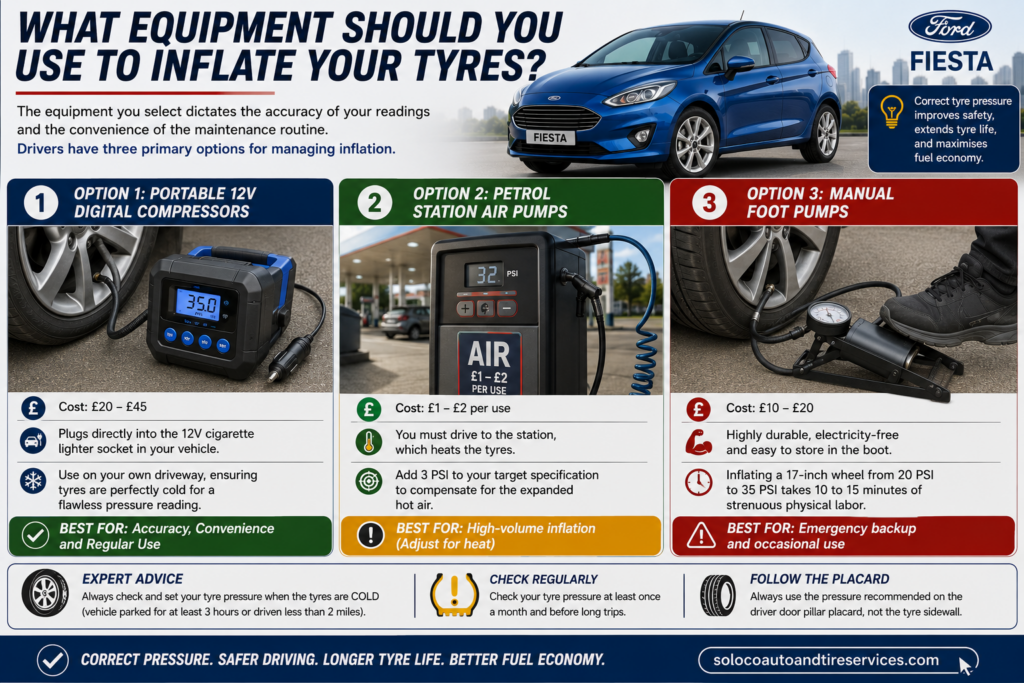
The equipment you select dictates the accuracy of your readings and the convenience of the maintenance routine. Drivers have three primary options for managing inflation.
Option 1: Portable 12V Digital Compressors
Portable 12V digital compressors are the most accurate and convenient method for inflating a Ford Fiesta. These units cost between £20 and £45. They plug directly into the 12-volt cigarette lighter socket inside your vehicle. Because you use them on your own driveway, you guarantee the tyres are perfectly cold, resulting in a flawless pressure reading.
Option 2: Petrol Station Air Pumps
Petrol station air pumps offer high-volume delivery but compromise reading accuracy. These machines cost roughly £1 to £2 per use. The primary drawback is that you must drive your vehicle to the station, which heats the tyres. If you must use a station pump, add 3 PSI to your target specification to compensate for the expanded hot air.
Option 3: Manual Foot Pumps
Manual foot pumps provide a reliable, electricity-free backup plan. These cost between £10 and £20. While they are highly durable and easy to store in the boot, inflating a modern 17-inch alloy wheel from 20 PSI to 35 PSI requires 10 to 15 minutes of strenuous physical labor. Choose this only as an emergency backup.
How Do Inflation Strategies Alter Driving Dynamics?
Modifying your tyre pressure outside of the factory recommendations will directly alter how your Ford Fiesta accelerates, corners, and consumes fuel. You must understand the mechanical trade-offs of under-inflation and over-inflation.
The Factory Spec Strategy (30 to 35 PSI)
Adhering to the exact placard specifications provides the best balance of safety and comfort. This setup maximizes the lifespan of the rubber by ensuring even tread wear across the entire width of the tyre. It also guarantees the vehicle meets the official factory braking distance metrics during emergency stops. The only drawback is the manual labor required to adjust the numbers whenever you load the vehicle with heavy cargo.
The Slight Over-Inflation Strategy (+3 PSI)
Adding 3 extra PSI above the placard recommendation creates a stiffer tyre carcass. This modification sharpens the steering response and slightly reduces rolling resistance, yielding marginal gains in fuel economy. However, this strategy creates a harsher ride quality over potholes. Long-term over-inflation causes the center of the tyre tread to wear out much faster than the outer edges.
The Under-Inflation Danger (-5 PSI or lower)
Running a tyre at 5 PSI below the placard recommendation is highly dangerous. While it may temporarily soften the ride quality over broken pavement, it causes catastrophic sidewall flexing at motorway speeds. This excessive flexing generates immense heat, drastically increasing the risk of a high-speed blowout. Furthermore, under-inflated tyres create massive drag, destroying your fuel economy and making the steering wheel feel heavy and sluggish.
Why You Must Never Use the Max PSI on the Tyre Sidewall
The maximum PSI printed directly on the rubber sidewall of your tyre is a structural failure limit, not an operational recommendation. This number (often reading between 44 and 51 PSI) indicates the absolute maximum pressure the tyre can hold before the internal steel belts risk structural separation.
Inflating your Ford Fiesta tyres to this sidewall maximum will drastically shrink the contact patch. The vehicle will essentially ride on a narrow strip of hard rubber, completely compromising wet-weather grip and extending your braking distances by several meters. Always ignore the sidewall numbers and follow the chassis placard in the door jamb.
How Do You Reset the Fiesta TPMS Warning Light?
Resetting the Tyre Pressure Monitoring System (TPMS) is a mandatory step after adjusting your air pressure or changing a flat tyre. The process differs based on the age of your Fiesta and the infotainment system installed.
For Mk8 Fiestas equipped with the SYNC 3 touchscreen system, press the vehicle settings icon on the main display. Navigate to “Vehicle”, select “Tyre Pressure”, and press and hold the “Reset” button until a confirmation message appears.
For Mk7 models or base-trim vehicles without touchscreens, use the directional pad on the left side of the steering wheel. Scroll through the driver display screen behind the steering wheel to “Settings”, then select “Driver Assist”, followed by “Tyre Monitor”. Press and hold the “OK” button on the steering wheel until the progress bar fills completely and the dashboard warning light extinguishes.
Expert User Recommendations by Driving Style
Different daily routines place different aerodynamic and physical demands on the Fiesta chassis. Adjust your maintenance habits based on how you use the vehicle.
- The Solo Commuter: If you drive to work alone with an empty boot, stick strictly to the “Normal Load” figures (typically 32 PSI front, 30 PSI rear). Check your pressures on the first Saturday of every month using a cold reading at home.
- The Family Hauler: If you regularly place teenagers in the back seats and load the boot with heavy groceries, you must inflate the rear tyres to the “Full Load” specification (often 41 PSI). Failing to do this will cause the rear of the vehicle to sag, throwing the headlight aim directly into the eyes of oncoming traffic.
- The ST Enthusiast: For fast road driving, maintaining a 4 to 6 PSI differential between the front and rear axles is critical. Keep the front tyres higher (e.g., 35 PSI) to manage the heavy engine block and preserve sharp turn-in, while leaving the rear slightly softer (e.g., 29 PSI) to allow the rear suspension to absorb mid-corner bumps without skipping.
Frequently Asked Questions
What pressure should the Ford Fiesta space-saver spare tyre be?
The emergency space-saver spare tyre must be inflated to 60 PSI (4.1 bar). Because the volume of the tyre is incredibly small, it requires massive internal pressure to safely support the weight of the vehicle corner. Always check the spare every six months, as it loses pressure naturally while sitting in the boot.
Why does my tyre pressure warning light flash when I start the engine?
If the TPMS warning light flashes for 60 to 90 seconds upon startup before turning solid, it indicates a systemic hardware failure, not a low tyre. This almost always means the internal battery inside one of the wheel valve sensors has died and the sensor must be completely replaced at a garage.
Does cold winter weather affect my tyre pressure?
Yes, ambient temperature directly impacts internal air pressure. For every 10 degrees Celsius the ambient temperature drops, your tyres will lose approximately 1 to 2 PSI. You must proactively add air during the transition from autumn to winter to prevent driving on under-inflated rubber.
Can I mix different tyre pressures on the same axle?
No, you must never mix pressure levels across the same axle. The left front and right front tyres must hold the exact same PSI. An imbalance of even 3 PSI will cause the vehicle to pull heavily to the side of the softer tyre during hard braking.
Is it normal to lose a small amount of PSI every month?
Yes, it is entirely normal for a healthy tyre to lose approximately 1 PSI every month through natural rubber permeation. However, if a single tyre routinely loses 3 to 5 PSI a week while the others remain stable, you likely have a slow puncture from a hidden nail or a failing valve core.
Where can I find the exact tyre size to match my pressure settings?
The exact size of your tyre is embossed in large rubber lettering on the outer sidewall. You will see a sequence of numbers such as 195/55 R16. Use this sequence to cross-reference the correct inflation column on your driver side door placard.


