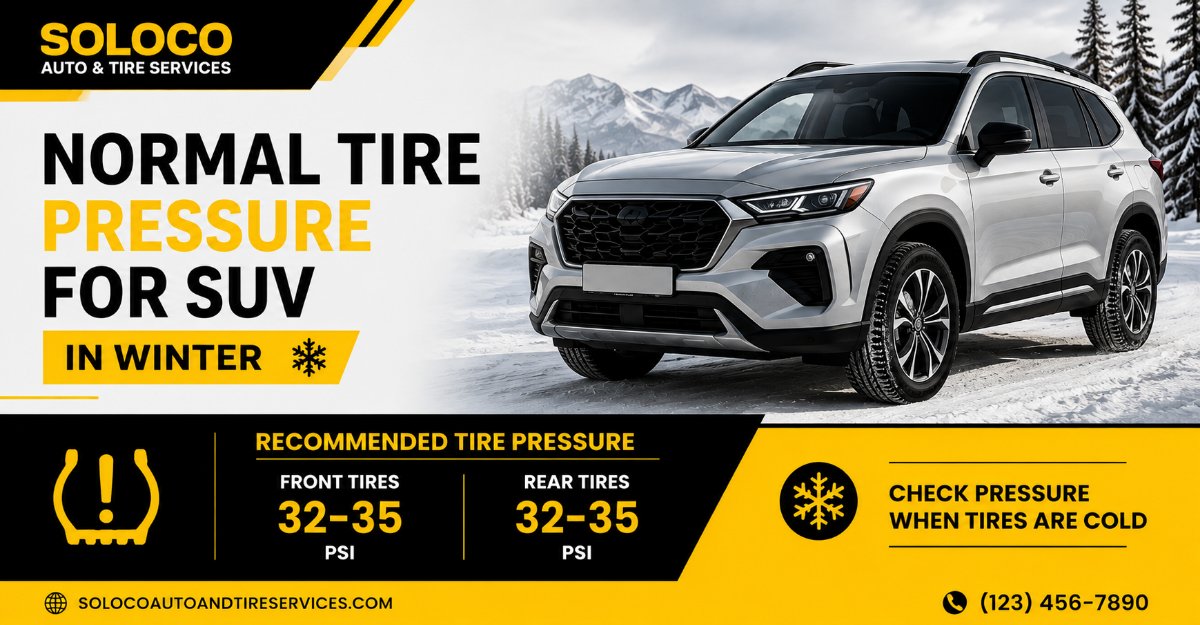
The normal tire pressure for an SUV in winter typically ranges from 32 to 36 PSI (pounds per square inch). However, drivers must inflate tires to the exact specification printed on the driver side door placard, never the maximum limit stamped on the tire sidewall. Because cold weather causes air molecules to contract, tire pressure automatically drops by 1 PSI for every 10 degree Fahrenheit decrease in ambient temperature, requiring frequent winter adjustments.
Key Facts at a Glance
- Standard SUV Range: 32 to 36 PSI based on the specific vehicle weight and chassis.
- Temperature Impact: Pressure drops by roughly 1 PSI for every 10°F (5.6°C) the temperature falls.
- Heated Garage Rule: Add 3 to 4 PSI above the placard recommendation if inflating tires inside a 60°F garage before driving into 20°F weather.
- TPMS Warning: The dashboard tire pressure light only triggers when a tire is 25 percent under-inflated, which is too late for safe winter driving.
- Max Sidewall PSI: Inflating to the 44 to 51 PSI limit printed on the rubber ruins snow traction by shrinking the tire footprint.
Standard SUV Winter Tire Pressure Guidelines
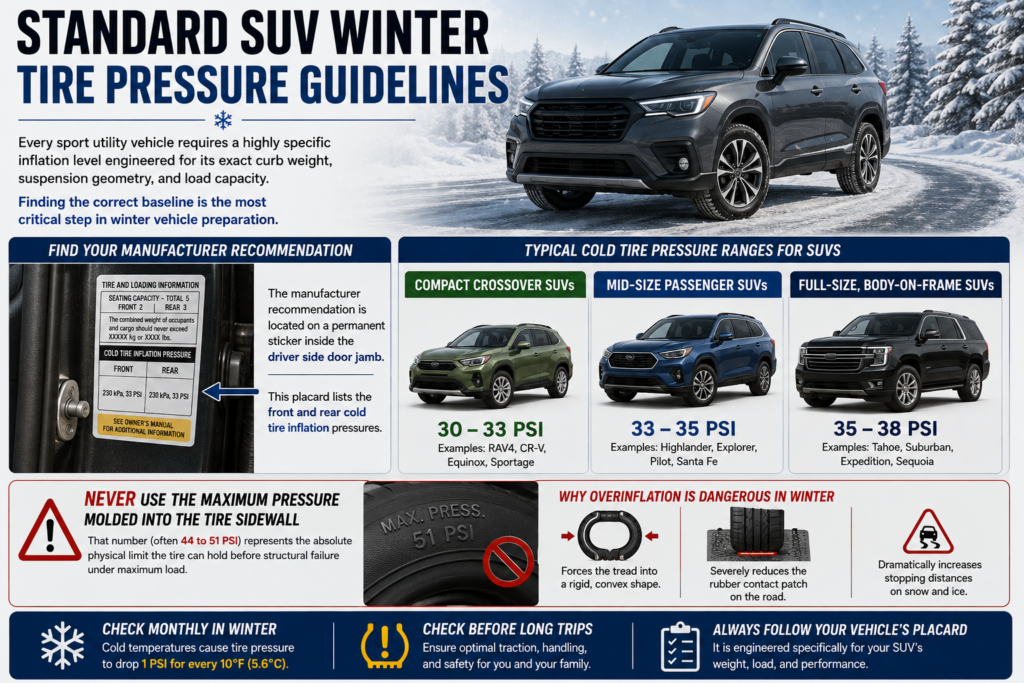
Every sport utility vehicle requires a highly specific inflation level engineered for its exact curb weight, suspension geometry, and load capacity. Finding the correct baseline is the most critical step in winter vehicle preparation.
The manufacturer recommendation is located on a permanent sticker inside the driver side door jamb. This placard lists the front and rear cold tire inflation pressures. Compact crossover SUVs generally require between 30 and 33 PSI. Mid-size passenger SUVs typically sit between 33 and 35 PSI. Full-size, body-on-frame SUVs often require 35 to 38 PSI to support their heavier towing chassis.
You must never use the maximum pressure molded into the tire sidewall. That number (often 44 to 51 PSI) represents the absolute physical limit the tire can hold before structural failure under maximum load. Inflating an SUV tire to the sidewall maximum in winter forces the tread into a rigid, convex shape. This severely reduces the rubber contact patch on the road, dramatically increasing stopping distances on snow and ice.
How does cold weather affect SUV tire pressure?
Ambient temperature dictates internal tire pressure through basic thermodynamics. Air is a gas that expands when heated and contracts when cooled.
This behavior follows the Ideal Gas Law formula, written as $PV = nRT$, where pressure ($P$) remains directly proportional to temperature ($T$) because the internal volume ($V$) of the tire remains constant. When the outside temperature plummets, the air molecules inside the tire lose kinetic energy and move closer together. This reduction in molecular collisions lowers the outward outward force against the rubber tire walls.
In practical application, SUV tires lose 1 PSI of pressure for every 10°F drop in ambient temperature. If a mechanic sets your tires to 35 PSI in a 70°F shop during October, the internal pressure will drop to 30 PSI when parked outside in a 20°F January snowstorm. This 5 PSI deficit is enough to compromise cornering stability, increase tread wear on the outer edges, and lower fuel economy.
The Heated Garage Adjustment Formula
Drivers who store and inflate their SUVs in heated garages must mathematically compensate for the freezing outside air. If your garage is 65°F and the outside temperature is 25°F, there is a 40 degree differential. Because pressure drops 1 PSI per 10 degrees, the tire will lose 4 PSI the moment the SUV is parked outside. To maintain a normal tire pressure for SUV in winter environments, you must over-inflate the tire by 4 PSI while inside the warm garage.
Step-by-Step Tire Inflation Process
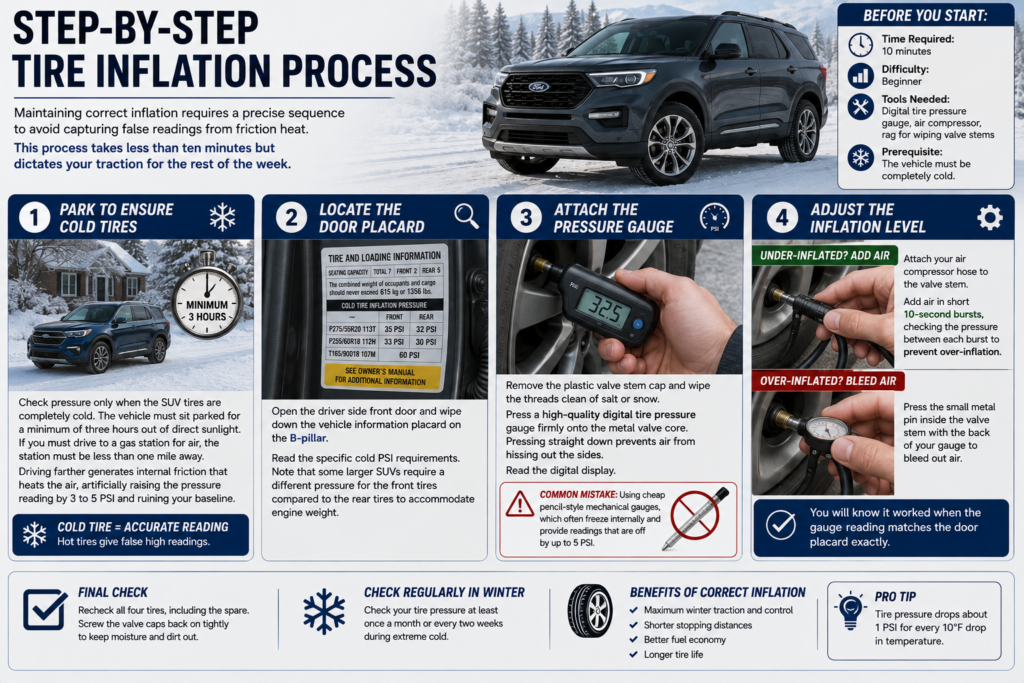
Maintaining correct inflation requires a precise sequence to avoid capturing false readings from friction heat. This process takes less than ten minutes but dictates your traction for the rest of the week.
Before You Start:
- Time Required: 10 minutes.
- Difficulty: Beginner.
- Tools Needed: Digital tire pressure gauge, air compressor, rag for wiping valve stems.
- Prerequisite: The vehicle must be completely cold.
Step 1: Park to ensure cold tires
Check pressure only when the SUV tires are completely cold. The vehicle must sit parked for a minimum of three hours out of direct sunlight. If you must drive to a gas station for air, the station must be less than one mile away. Driving farther generates internal friction that heats the air, artificially raising the pressure reading by 3 to 5 PSI and ruining your baseline.
Step 2: Locate the door placard
Open the driver side front door and wipe down the vehicle information placard on the B-pillar. Read the specific cold PSI requirements. Note that some larger SUVs require a different pressure for the front tires compared to the rear tires to accommodate engine weight.
Step 3: Attach the pressure gauge
Remove the plastic valve stem cap and wipe the threads clean of salt or snow. Press a high-quality digital tire pressure gauge firmly onto the metal valve core. Pressing straight down prevents air from hissing out the sides. Read the digital display. Common Mistake: Using cheap pencil-style mechanical gauges, which often freeze internally and provide readings that are off by up to 5 PSI.
Step 4: Adjust the inflation level
Attach your air compressor hose to the valve stem. If the tire is under-inflated, add air in short 10-second bursts, checking the pressure between each burst to prevent over-inflation. If the tire is over-inflated, press the small metal pin inside the valve stem with the back of your gauge to bleed out air. You will know it worked when the gauge reading matches the door placard exactly.
Which inflation equipment is best in winter?
Cold weather exposes the mechanical limits of cheap air compressors. Choosing the right inflation tool dictates whether you spend two minutes or twenty minutes freezing in a driveway.
| Equipment Type | Best Application | Max Flow / Fill Speed | Estimated Cost | Winter Reliability |
| 12V Portable Inflator | Roadside emergencies | Slow (4 to 8 mins per tire) | $30 to $80 | Medium (Plastics get brittle) |
| Gas Station Compressor | Urban commuters | Fast (1 to 2 mins per tire) | Free to $2.50 | Low (Lines freeze with moisture) |
| Home Pancake Compressor | Garage maintenance | Ultra-fast (Under 1 min) | $100 to $200 | High (Stores indoors) |
Portable 12V Cordless Inflators
These compact units plug directly into an SUV 12V accessory outlet or run on lithium-ion tool batteries. They feature digital auto-shutoff capabilities, allowing you to set the target PSI and wait inside the warm cabin. However, they possess very low flow rates. Filling four large SUV tires takes significant time, and the continuous operation can cause the tiny motors to overheat.
Gas Station Air Compressors
Heavy-duty commercial air stations provide massive flow rates capable of filling a tire in seconds. Unfortunately, gas station air lines are poorly maintained. During winter, condensation builds up inside the underground tanks. This moisture gets blasted into your tire and can freeze inside the valve stem. Furthermore, driving to the gas station warms your tires, making accurate cold-pressure adjustments impossible.
Home Garage Pancake Compressors
Small 1 to 6 gallon stationary air tanks running on standard 110V wall outlets are the ultimate tool for winter tire maintenance. They deliver high cubic feet per minute (CFM) output, filling tires instantly. Because they are stored in a dry garage, they inject far less freezing moisture into your tires compared to commercial outdoor pumps.
Should you use nitrogen or compressed air?
The debate between pure nitrogen and standard compressed air centers entirely around moisture content and pressure stability.
Standard compressed air is roughly 78 percent nitrogen and 21 percent oxygen, with the remainder being trace gases and water vapor. It is completely free and accessible everywhere. However, the water vapor inside standard air is highly susceptible to temperature changes. Moisture expands aggressively when warm and contracts sharply when cold, causing your tire pressure to fluctuate wildly during winter storms.
Pure nitrogen ($N_2$) is mechanically dried before injection. Because it lacks water vapor, a nitrogen-filled tire maintains a highly stable pressure regardless of overnight temperature drops. While it costs roughly $5 to $10 per tire, nitrogen prevents the internal freezing that degrades rubber and corrodes aluminum wheel rims.
Choose nitrogen if you live in severe mountain climates with extreme day-to-night temperature swings. Stick to compressed air if you live in mild winter regions and check your pressure monthly.
Common Winter Tire Pressure Mistakes
Even experienced drivers make critical errors when managing tire air pressure in sub-zero conditions. Avoid these specific failure modes.
Bleeding pressure on hot tires. If you check your tires after an hour on the highway, the gauge might read 40 PSI instead of your placard 35 PSI. Never let air out to “correct” this. The pressure is artificially high from driving heat. If you bleed it down to 35 PSI while warm, the tire will drop to a dangerous 30 PSI once it cools down overnight.
Trusting the TPMS blindly. The Tire Pressure Monitoring System (TPMS) dashboard light is a catastrophic failure warning, not a maintenance tool. Federal regulations only require the TPMS to illuminate when a tire loses 25 percent of its placard pressure. If your SUV requires 36 PSI, the light will not warn you until the tire hits 27 PSI. Driving on snow at 27 PSI guarantees poor handling and structural sidewall damage.
Ignoring the spare tire. The spare tire hanging under the rear chassis or sitting in the cold trunk loses pressure at the exact same rate as the four tires on the ground. A flat spare is useless during a midnight winter blowout. Check the spare tire pressure every November.
How do you fix winter tire pressure problems?
Winter driving introduces specific mechanical failures related to cold weather contraction. Here is how to diagnose and resolve the three most common issues.
The Morning TPMS Light. You start the SUV on a 10°F morning, and the low-pressure light illuminates. After 15 minutes of driving, the light turns off on its own.
- The Fix: The ambient cold dropped the pressure below the TPMS threshold. Driving generated friction heat, expanding the air and turning the light off. The tire is fundamentally under-inflated. Park the car overnight and add 3 PSI the next morning while it is cold.
Frozen Valve Cores. You attempt to check your tire pressure in sub-zero weather, but after removing the gauge, the metal valve stem continuously hisses air.
- The Fix: Moisture inside the air line froze the internal Schrader valve pin in the “open” position. Warm the metal stem with your bare hand for two minutes, or tap it gently with the back of a screwdriver to break the ice. Immediately replace the plastic dust cap, ensuring it has a rubber O-ring to keep future moisture out.
Slow Seasonal Bead Leaks. The tire loses 2 to 3 PSI every week without any visible nails or tread punctures.
- The Fix: Extreme cold causes aluminum wheel rims to contract faster than the rubber tire bead. This creates microscopic gaps where the tire meets the wheel, allowing air to seep out slowly. Take the SUV to a tire shop; they will dismount the tire, wire-brush the aluminum rim corrosion, and apply a specialized liquid bead sealer before re-inflating.
Frequently Asked Questions
Do dedicated winter snow tires require a different PSI than all-season tires? No. You should inflate dedicated winter tires to the exact same PSI listed on your SUV door placard. The vehicle weight and suspension geometry determine the air requirement, not the tread pattern or rubber compound of the tire.
Should I lower my tire pressure to get better traction in the snow? Never lower your tire pressure for on-road winter driving. While off-road enthusiasts “air down” to 20 PSI to crawl through deep, unplowed powder at very low speeds, doing this on a plowed highway causes the center of the tread to lift away from the asphalt. This eliminates your grip on ice and risks blowing the tire off the wheel rim.
How does mountain altitude affect my tire pressure in winter? Tire pressure increases by roughly 0.5 PSI for every 1,000 feet of elevation gain due to thinning atmospheric pressure outside the tire. However, temperatures also drop steadily as you climb. These two forces largely cancel each other out. Check your tires the morning after you arrive at the ski resort to ensure they have settled at the placard specification.
How often should I check my SUV tire pressure in the winter? You should manually check your cold tire pressure every two weeks during the winter, or immediately following any sudden cold front that drops the temperature by more than 15 degrees. Do not wait for the dashboard warning light to initiate your maintenance checks.
The Bottom Line
Maintaining normal tire pressure for SUV in winter environments requires proactive management, not passive observation. By adhering strictly to the driver door placard, adjusting for ambient temperature drops using the 1-PSI-per-10-degree rule, and utilizing a reliable digital gauge on cold tires, you guarantee maximum tread traction. Treat your tire pressure as a critical safety system, and your SUV will deliver the exact winter handling the engineers intended.


