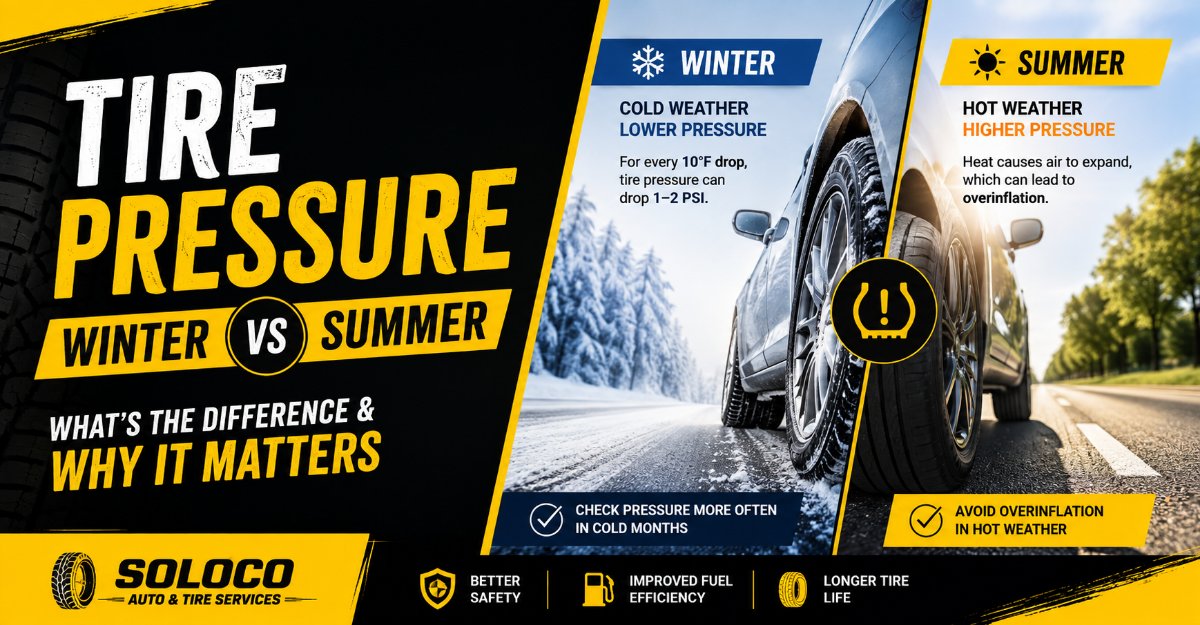
Managing tire pressure winter vs summer requires adjusting to ambient temperature shifts governed by the Ideal Gas Law. Tire pressure drops by 1 PSI for every 10 degrees Fahrenheit decrease in winter and rises by the exact same amount during summer heat. Drivers must always set their tires to the vehicle manufacturer placard pressure measured while the tires are cold, regardless of the current season.
Key Facts / At a Glance
- Tire pressure changes by exactly 1 PSI (0.07 Bar) for every 10 degrees Fahrenheit (5.6 degrees Celsius) of temperature shift.
- The recommended target pressure remains the cold placard PSI printed on the driver side doorjamb year round.
- Winter conditions primarily cause chronic underinflation, while summer driving risks temporary high heat overinflation.
- Modern radial tires can look completely perfectly inflated to the naked eye even when they are 5 to 10 PSI dangerously low.
- Pure nitrogen limits pressure fluctuations primarily because it lacks the volatile moisture content found in standard gas station compressed air.
How Does Temperature Affect Tire Pressure?
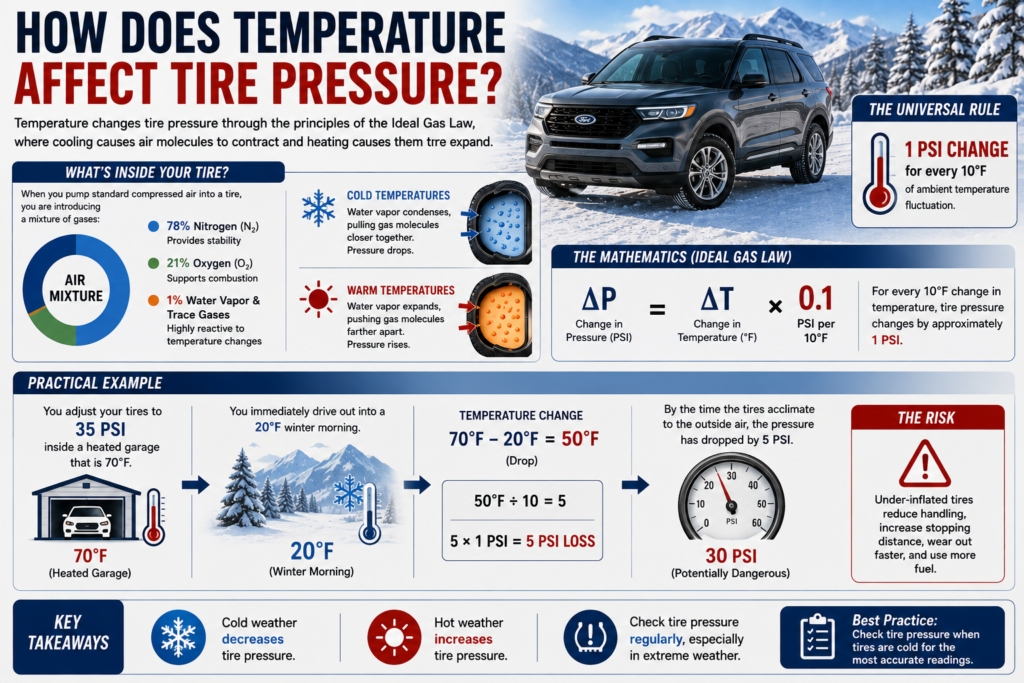
Temperature changes tire pressure through the principles of the Ideal Gas Law, where cooling causes air molecules to contract and heating causes them to expand. The universally accepted mathematical rate of this atmospheric shift is a 1 PSI change for every 10 degrees Fahrenheit of ambient temperature fluctuation.
When you pump standard compressed air into a tire, you are introducing a mixture that is roughly 78 percent nitrogen, 21 percent oxygen, and 1 percent water vapor and trace gases. The water vapor is highly reactive to temperature changes. When ambient temperatures plunge, this moisture condenses, pulling the gas molecules closer together and reducing the outward force against the inside of the tire casing. Conversely, when the ambient temperature spikes, the moisture expands rapidly, increasing the outward force.
Consider a practical mathematical scenario. If you adjust your tires to 35 PSI inside a heated garage that is 70 degrees Fahrenheit, and you immediately drive out into a 20 degree Fahrenheit winter morning, your tires undergo a 50 degree temperature drop. By the time the tires acclimate to the outside air, they will have lost 5 PSI, dropping to a potentially dangerous 30 PSI before you even reach the highway.
Executive Comparison: Tire Pressure Winter vs Summer
Understanding how to manage these fluctuations requires recognizing the distinct mechanical risks associated with each extreme season.
| Feature | Winter Conditions | Summer Conditions |
| Primary Safety Risk | Chronic underinflation | Overinflation from driving heat |
| Pressure Shift | Drops significantly overnight | Spikes during daytime operation |
| Tread Wear Pattern | Accelerated shoulder and edge wear | Accelerated center tread wear |
| Handling Impact | Sluggish steering, poor slush traction | Stiff ride, reduced contact patch |
| Typical Target | Factory door placard PSI (cold) | Factory door placard PSI (cold) |
Winter Tire Pressure Variables and Risks
Winter driving introduces a constant battle against air density contraction. The primary risk during the winter months is operating a vehicle with chronic underinflation caused by dropping overnight temperatures.
When tires are underinflated due to the cold, the center of the tire tread bows slightly upward, shifting the vehicle weight entirely onto the outer shoulders of the tire. This structural deformation dramatically reduces your traction in snow and increases your risk of hydroplaning in freezing rain or slush. Furthermore, underinflated winter tires generate excessive sidewall flexing, which generates internal heat that degrades the rubber compound prematurely.
Why is my low pressure light on in the winter?
Your low pressure light triggers in the winter because the sudden overnight temperature drop contracts the air inside the tire enough to cross the system threshold. Most modern Tire Pressure Monitoring Systems (TPMS) are federally mandated to trigger a dashboard warning when any single tire drops exactly 25 percent below the manufacturer recommended placard rating. If your recommended pressure is 32 PSI, a drop to 24 PSI on a freezing morning will illuminate the light.
Should tire pressure be higher or lower in winter?
Your target tire pressure should neither be higher nor lower in winter. You should always aim for the exact manufacturer placard rating. However, because the cold weather shrinks the air volume, you will actively need to add compressed air more frequently during winter months to maintain that standard baseline.
Summer Tire Pressure Variables and Risks
Summer driving combines high ambient heat with the intense thermal friction generated by hot asphalt. The primary risk during summer is operating a vehicle with severe overinflation caused by thermal expansion during highway driving.
As you drive on a 90 degree Fahrenheit summer afternoon, the friction between the tire tread and the road surface generates massive amounts of internal heat. It is entirely common for passenger vehicle tires to gain 4 to 6 PSI during a summer road trip.
This temporary overinflation forces the center of the tire tread to bulge outward, reducing the size of the contact patch touching the road. This results in a harsh ride quality, highly accelerated center tread wear, and a slightly higher risk of impact blowouts if you strike a pothole.
Is it safe to bleed air from hot tires in the summer?
You should never bleed air from hot tires during the summer. The pressure spike that occurs during highway driving is a normal operating condition carefully engineered into the tire design. If you bleed a hot tire down to the placard rating at a highway rest stop, that tire will become dangerously underinflated once it cools down overnight.
Standard Compressed Air vs Pure Nitrogen Inflation
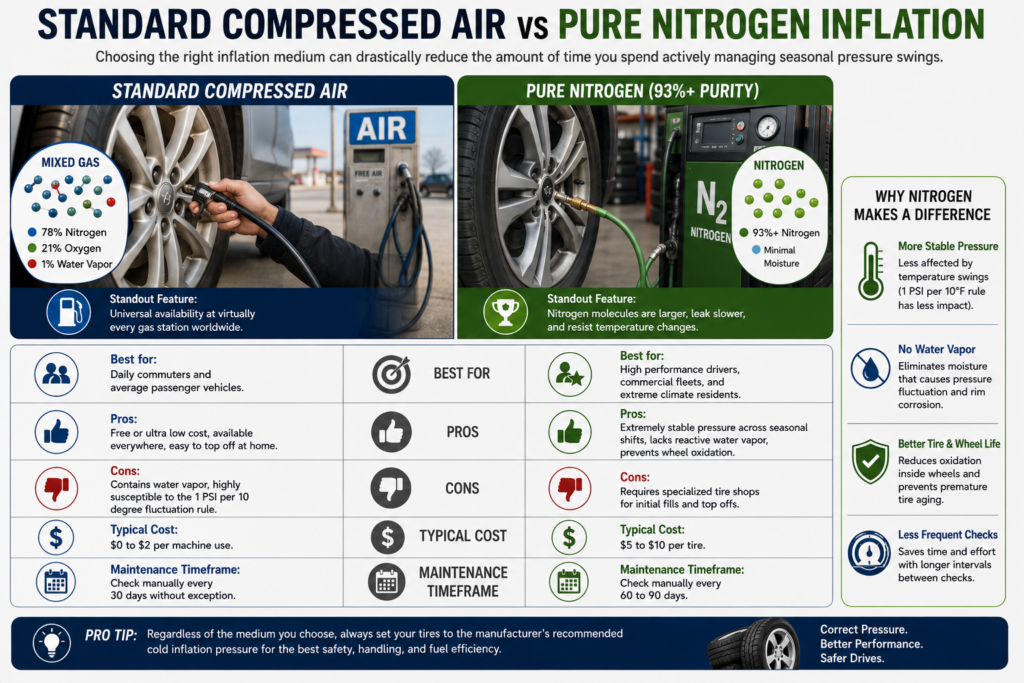
Choosing the right inflation medium can drastically reduce the amount of time you spend actively managing seasonal pressure swings.
Standard Compressed Air
Standard compressed air is the default choice for everyday drivers seeking absolute convenience. Its standout feature is its universal availability at virtually every gas station worldwide.
- Best for: Daily commuters and average passenger vehicles.
- Pros: Free or ultra low cost, available everywhere, easy to top off at home.
- Cons: Contains water vapor, highly susceptible to the 1 PSI per 10 degree fluctuation rule.
- Typical Cost: $0 to $2 per machine use.
- Maintenance Timeframe: Check manually every 30 days without exception.
Pure Nitrogen (93%+ Purity)
Pure nitrogen is highly favored by track racing professionals and low maintenance users. Its standout feature is that nitrogen molecules are slightly larger than oxygen molecules, meaning they leak through the microscopic pores of the tire rubber at a much slower rate.
- Best for: High performance drivers, commercial fleets, and extreme climate residents.
- Pros: Extremely stable pressure across seasonal shifts, lacks reactive water vapor, prevents wheel oxidation.
- Cons: Requires specialized tire shops for initial fills and top offs.
- Typical Cost: $5 to $10 per tire.
- Maintenance Timeframe: Check manually every 60 to 90 days.
How to Check and Adjust Your Tire Pressure
Follow this strictly ordered protocol every 30 days to ensure optimal safety and fuel efficiency.
- Park the vehicle: Ensure the car sits in a shaded area for at least 3 hours. Tires must be completely cold to get an accurate baseline reading.
- Consult the placard: Open the driver side door and locate the factory sticker on the doorjamb. Note the recommended cold PSI for both front and rear tires.
- Remove the cap: Unscrew the tire valve stem cap and keep it in a safe place.
- Press the gauge: Firmly press your digital or dial pressure gauge squarely onto the valve stem until the hissing sound completely stops.
- Read the metrics: Record the measured PSI value shown on the gauge screen or dial.
- Adjust air volume: If the reading is below the placard number, connect the air compressor and add air in short bursts. If the reading is too high, use the bleeder valve on the gauge to release excess pressure.
- Replace the cap: Secure the valve stem cap tightly to prevent moisture and road salt from corroding the valve core.
Expert Troubleshooting and Common Mistakes
Even experienced drivers frequently make errors when adjusting their seasonal tire pressure. Avoid these critical failure modes.
- Matching the sidewall number: The PSI number stamped directly onto the rubber sidewall of the tire is the absolute maximum structural limit of the casing. It is not your daily driving target. Inflating to this number guarantees a dangerous, rock hard ride and rapid suspension wear.
- Ignoring the spare tire: Spare tires sit in the trunk or under the truck bed experiencing the exact same seasonal temperature shifts as your active tires. A flat spare is useless in an emergency. Check it twice a year.
- Relying on visual inspections: The reinforced sidewalls of modern radial tires are designed to hold their shape even when deprived of air. A tire that is 10 PSI low will look structurally identical to a properly inflated tire. Always use a mechanical gauge.
Specialized Considerations for Heavy Vehicles and EVs
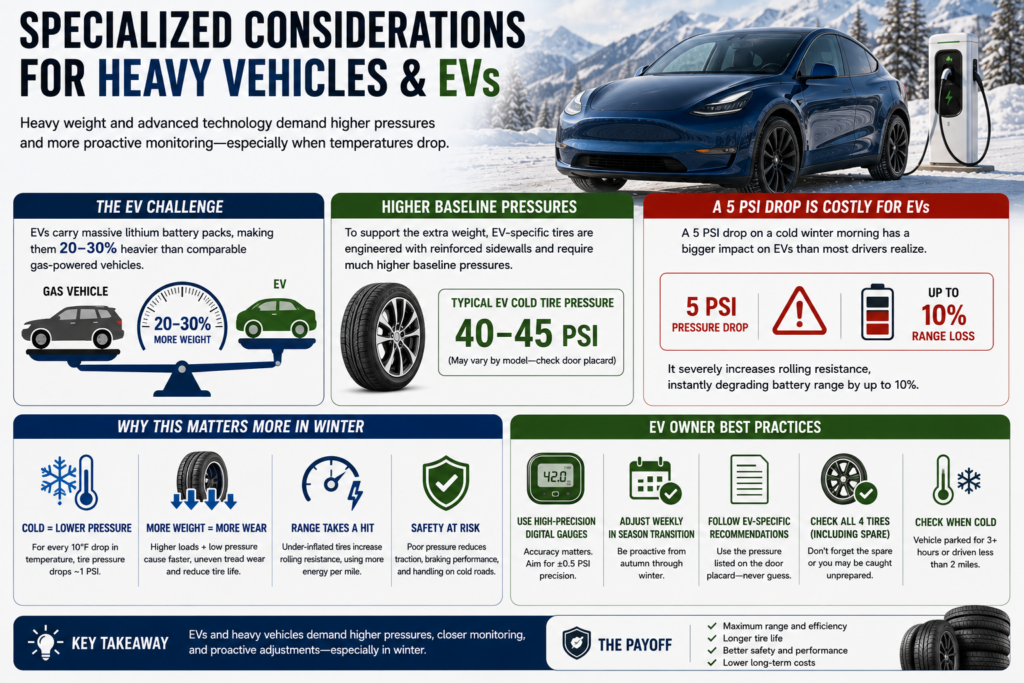
Electric vehicles (EVs) present a unique challenge for seasonal pressure management. Due to their massive lithium battery packs, EVs weigh 20 to 30 percent more than their internal combustion engine counterparts.
To support this immense weight, EV specific tires are engineered with reinforced sidewalls and run at much higher baseline pressures, frequently requiring 40 to 45 PSI. A 5 PSI drop on a cold winter morning is catastrophic for an EV. It severely increases rolling resistance, which instantly degrades battery range by up to 10 percent.
EV owners must be incredibly proactive, utilizing high precision digital gauges to adjust pressures weekly during the transition from autumn to winter.
Frequently Asked Questions
What type of tire gauge is most accurate?
Digital tire gauges and high quality analog dial gauges offer the highest accuracy, usually within 1 percent of the true pressure. Traditional pencil style stick gauges are prone to friction sticking and internal spring wear, making them highly unreliable for precise seasonal adjustments.
Does altitude affect tire pressure readings?
Yes, altitude affects your gauge readings. Atmospheric pressure drops as you climb higher above sea level. If you fill your tires at sea level and drive up a 5,000 foot mountain pass, your gauge will read approximately 2.5 PSI higher, even if the temperature remains completely constant.
Does bad tire pressure affect fuel economy?
Yes, underinflation drastically reduces fuel economy. For every 1 PSI drop below the recommended placard rating, your vehicle suffers a 0.2 percent decrease in overall gas mileage due to increased rolling resistance against the asphalt.
How long does it take tires to cool down?
Tires require a minimum of three hours of stationary parking out of direct sunlight to return to ambient baseline temperatures. Heavy duty truck tires and high performance EV tires may require up to four hours due to their thicker structural casing.
Can I mix nitrogen and regular air?
Yes, it is completely safe to mix nitrogen and standard compressed air. If you have nitrogen filled tires and experience a low pressure warning in the winter, you should immediately top off with standard air at a gas station rather than driving on an underinflated tire while searching for a specialized nitrogen shop.
The Bottom Line on Seasonal Tire Management
Navigating tire pressure winter vs summer ultimately comes down to understanding the physics of the air inside your wheels. Because the exact volume of air expands in the summer and contracts in the winter, your maintenance routine must adapt to the thermometer. By strictly adhering to the manufacturer cold placard rating, manually checking your tires once a month with a reliable gauge, and never adjusting pressure while the rubber is hot, you maximize your tread life, fuel economy, and absolute safety on the road.