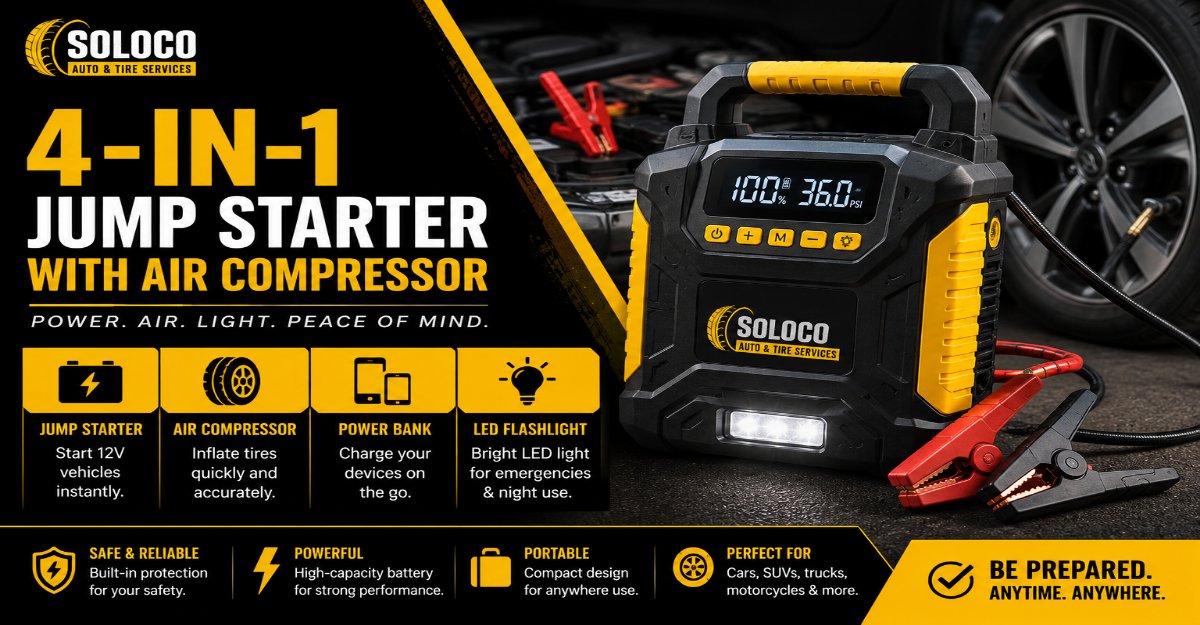
A 4-in-1 jump starter with an air compressor is a self-contained, multi-functional emergency power device engineered to rescue stranded motorists by combining an engine-starting battery, a motorized tire inflator, a portable power bank, and a multi-mode LED flashlight into a single compact chassis. These units eliminate the need for traditional jumper cables tied to a donor vehicle while providing auxiliary inflation and device-charging capabilities for roadside emergencies, remote camping, and routine automotive maintenance.
Key Facts At a Glance
- Primary Function: Delivers 500 to 4000+ peak amperes to crank dead vehicle engines independently.
- Secondary Function: Integrates a motorized piston air compressor capable of delivering 120 to 150 PSI for tire inflation.
- Power Bank Utility: Features USB-A and USB-C Power Delivery (PD) ports ranging from 37Wh to 88Wh for personal electronics.
- Chemistry Standard: Modern units utilize high-density Lithium-Ion (Li-Polymer or LiFePO4) cells, replacing heavy Lead-Acid AGM variants.
- Operational Lifespan: Quality units yield 300 to 500 charge cycles or roughly 3 to 5 years of functional service life.
What Is a 4-in-1 Jump Starter and What Are Its Core Functions?
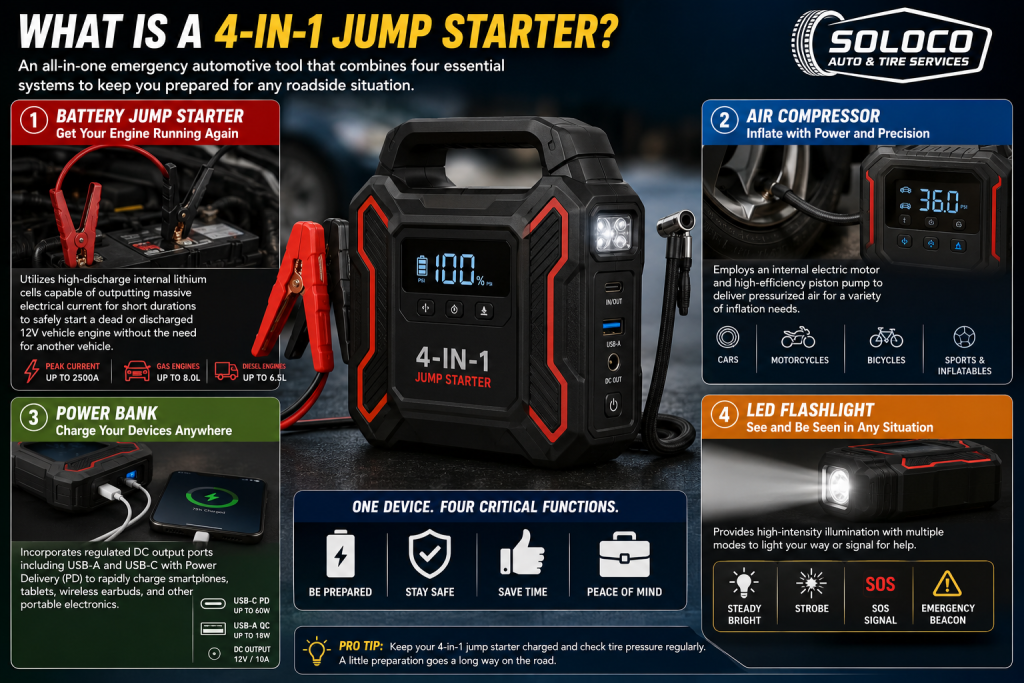
A 4-in-1 jump starter is an all-in-one emergency automotive tool that integrates four distinct utility systems into a portable housing. Understanding the individual mechanical and electrical components clarifies how these units perform under high-stress roadside conditions.
- Battery Jump Starter: Utilizes high-discharge internal cells capable of outputting massive electrical current for short durations to crank a discharged vehicle engine without a donor car.
- Air Compressor: Employs an internal electric motor and piston pump to generate pressurized air for inflating automotive tires, bicycle tires, sports equipment, and inflatables.
- Power Bank: Incorporates regulated DC output ports, including USB-A and USB-C ports with Power Delivery protocols, to charge smartphones, tablets, and portable electronics.
- LED Flashlight: Provides high-intensity illumination with steady, flashing strobe, and international SOS emergency signaling modes for night operations.
How Do the Internal Systems Work?
The internal mechanics of a 4-in-1 unit rely on distinct electrical and pneumatic engineering principles to execute heavy-duty tasks from a portable footprint.
The Jump Starter Mechanism
When a vehicle battery drops below the threshold required to engage the starter motor, the 4-in-1 device bridges the electrical deficit. When connected, the internal high-discharge lithium or lead-acid cells bypass the weak automotive battery, routing hundreds of amperes directly through the starter cables to spin the starter motor and engage the engine flywheel. Modern smart-clamp circuitry monitors voltage differentials to prevent dangerous electrical arcs.
The Air Compressor Mechanism
The pneumatic system relies on a permanent-magnet DC motor that drives a connecting rod and piston assembly within a sealed metal cylinder. As the piston reciprocates, it draws in ambient air through intake vents, compresses it to high pressure, and forces it through a braided high-pressure hose. Integrated digital microprocessors read real-time pressure sensors, allowing users to input a target PSI value that triggers an automatic shut-off mechanism when reached.
What Are the Step-by-Step Operating Protocols for Emergency Deployment?
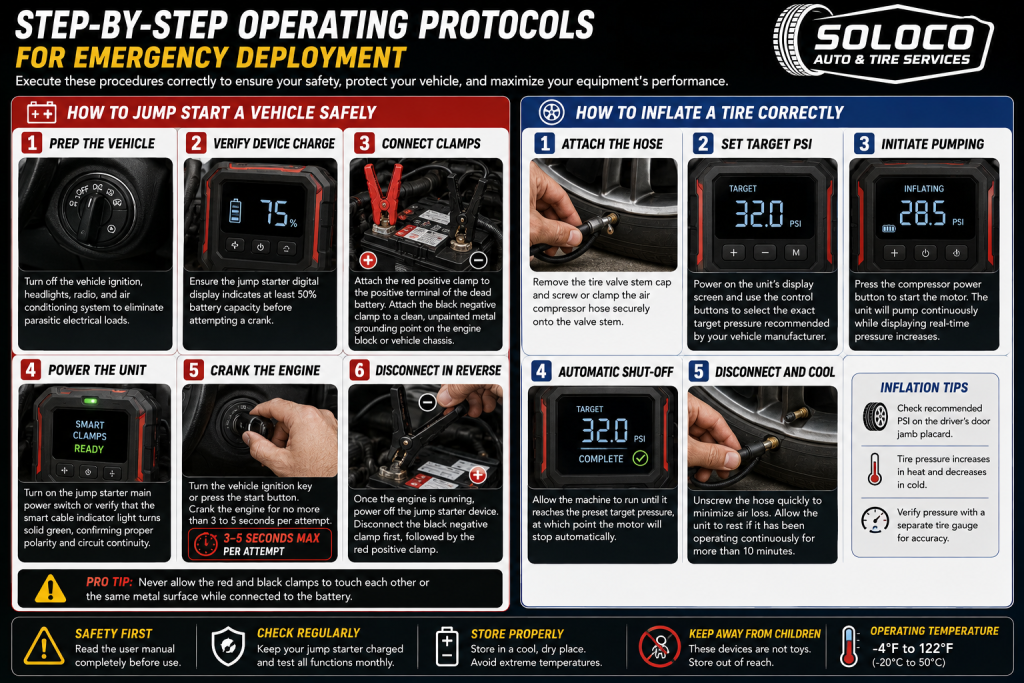
Executing emergency procedures correctly prevents equipment damage, personal injury, and electrical system failures in your vehicle.
How to Jump Start a Vehicle Safely
- Prep the Vehicle: Turn off the vehicle ignition, headlights, radio, and air conditioning system to eliminate parasitic electrical loads.
- Verify Device Charge: Ensure the jump starter digital display indicates at least 50% battery capacity before attempting a crank.
- Connect Clamps: Attach the red positive clamp to the positive terminal of the dead battery. Attach the black negative clamp to a clean, unpainted metal grounding point on the engine block or vehicle chassis.
- Power the Unit: Turn on the jump starter main power switch or verify that the smart cable indicator light turns solid green, confirming proper polarity and circuit continuity.
- Crank the Engine: Turn the vehicle ignition key or press the start button. Crank the engine for no more than 3 to 5 seconds per attempt.
- Disconnect in Reverse: Once the engine is running, power off the jump starter device. Disconnect the black negative clamp first, followed by the red positive clamp.
How to Inflate a Tire Correctly
- Attach the Hose: Remove the tire valve stem cap and screw or clamp the air compressor hose securely onto the valve stem.
- Set Target PSI: Power on the unit’s display screen and use the control buttons to select the exact target pressure recommended by your vehicle manufacturer.
- Initiate Pumping: Press the compressor power button to start the motor. The unit will pump continuously while displaying real-time pressure increases.
- Automatic Shut-Off: Allow the machine to run until it reaches the preset target pressure, at which point the motor will stop automatically.
- Disconnect and Cool: Unscrew the hose quickly to minimize air loss. Allow the unit to rest if it has been operating continuously for more than 10 minutes.
How Do Lithium-Ion and Lead-Acid AGM Battery Chemistries Compare?
Selecting the appropriate chemistry dictates the weight, storage requirements, temperature tolerance, and overall longevity of your emergency device.
Lithium-Ion Units (Li-Polymer and LiFePO4)
Lithium-ion units represent the modern industry standard. They offer high energy density, allowing them to deliver massive starting current from a lightweight housing weighing between 1.5 and 4 pounds. These units fit easily inside a glovebox or center console and retain up to 80% of their charge for 6 to 12 months of inactivity. However, extreme thermal exposure can degrade their internal cell structure.
Lead-Acid AGM Units
Lead-acid units utilize traditional Absorbent Glass Mat technology derived from workshop jump packs. These units are bulky, heavy, weighing between 15 and 30 pounds, and are typically stored in a garage or truck bed. While they offer superior cranking performance in extreme sub-zero temperatures compared to standard lithium cells, they suffer from high self-discharge rates and require manual recharging every 2 to 3 months to prevent sulfation.
What Key Technical Specifications Determine Engine Compatibility?
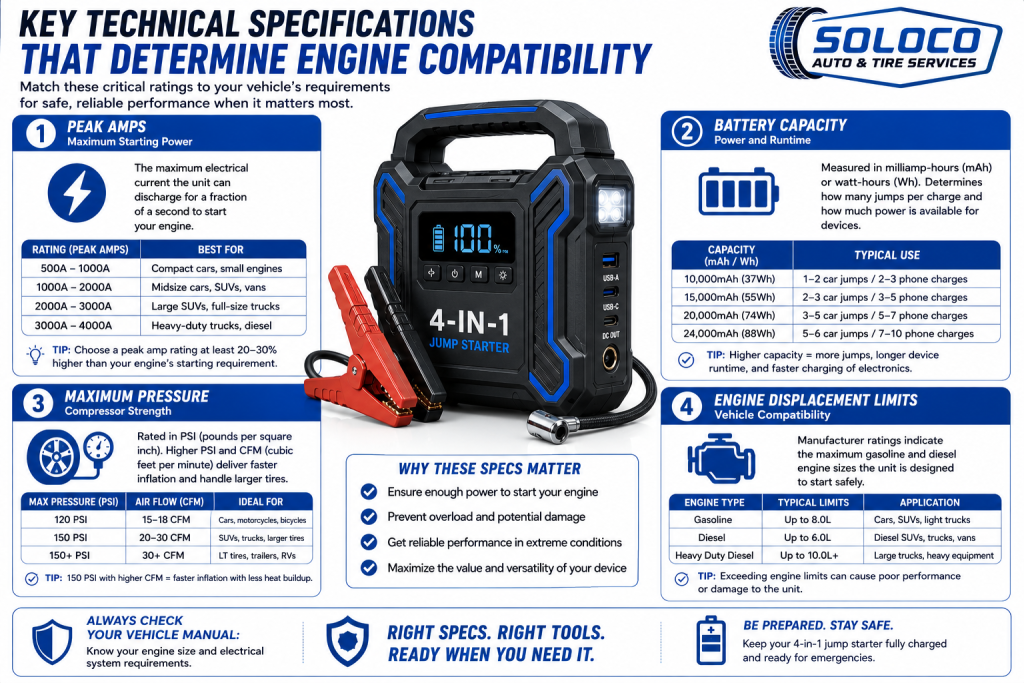
Evaluating the numerical ratings of a 4-in-1 device ensures it matches the electrical demands of your specific vehicle.
- Peak Amps: The maximum electrical current the unit can discharge for a fraction of a second. Ratings range from 500A for compact cars to 4000A for heavy-duty diesel trucks.
- Battery Capacity: Measured in milliamp-hours (mAh) or watt-hours (Wh). Portable units generally range from 10,000mAh to 24,000mAh (37Wh to 88Wh), determining how many times you can jump-start a car or charge a phone.
- Maximum Pressure: Compressor strength rated in PSI, typically ranging from 120 to 150 PSI. High-volume pumps feature higher cubic feet per minute (CFM) ratings to fill large tires faster.
- Engine Displacement Limits: Manufacturer ratings specify maximum gas and diesel engine sizes, such as up to 8.0L gas and 6.0L diesel, preventing user overload.
How Do Market Tiers, Pricing Structures, and Lifespans Vary?
Market positioning reflects build quality, internal cell capacity, pump speed, and integrated safety protections.
- Budget Units ($60 to $90): Best suited for small 4-cylinder sedans. These deliver 500A to 1000A, feature basic displays, and take 10 to 15 minutes to pump a completely flat tire.
- Mid-Range Units ($100 to $160): The industry sweet spot for general consumers. These deliver 1500A to 2500A, feature digital pressure presets, and inflate a standard passenger tire in 4 to 6 minutes.
- Premium Units ($180 to $300+): Designed for heavy-duty applications. These deliver 3000A+ output, fast-charging USB-C Power Delivery ports, rugged housings, and high-flow compressors that inflate tires in 2 to 3 minutes.
- Lifespan Expectations: A well-maintained lithium unit provides 3 to 5 years of service life, translating to approximately 300 to 500 complete charge and discharge cycles before internal resistance diminishes capacity.
Integrated 4-in-1 Units Versus Standalone Tools
| Feature | Integrated 4-in-1 Unit | Standalone Tools (Separate Starter & Compressor) |
|---|---|---|
| Space & Portability | Compact single-unit design fits easily in trunks, gloveboxes, or under seats. | Bulky setup requiring separate storage space for two distinct heavy devices. |
| Maintenance | Requires monitoring and charging a single master battery pack. | Requires maintaining multiple batteries, charging cables, and power sources. |
| Component Failure | If the internal master battery fails, all four functions become unavailable. | If one tool breaks, the other remains fully operational and usable. |
| Compressor Performance | Compact internal compressors run hotter and require strict duty cycle limits. | Standalone 12V compressors often offer higher airflow rates and longer run times. |
| Cost Efficiency | Lower combined cost compared to purchasing high-end standalone tools individually. | Higher total cost due to purchasing separate professional-grade housings and batteries. |
What Are the Most Common Operating Mistakes and How to Avoid Them?
Avoiding common user errors extends the operating life of your emergency device and prevents catastrophic equipment failure.
- Ignoring Compressor Duty Cycles: Running an integrated air compressor continuously for more than 10 minutes generates excessive heat that can melt internal plastic gears. Always allow the unit to rest for 10 minutes between inflation cycles.
- Storing in Extreme Heat: Leaving a lithium-ion jump starter inside a vehicle parked under direct summer sunlight where internal temperatures exceed 60 degrees Celsius (140 degrees Fahrenheit) accelerates cell degradation and poses a swelling hazard.
- Reversing Polarities: Connecting red clamps to negative terminals and black clamps to positive terminals can cause sparks or blow internal fuses if the unit lacks active reverse polarity protection. Always verify smart-clamp status lights.
- Crank Over-Extension: Forcing a stubborn engine to crank continuously for more than 10 seconds per attempt overheats the internal discharge cells. Limit cranks to 5 seconds and allow a 60-second recovery interval between attempts.
Troubleshooting Common Operational Issues
- Issue: The device screen is illuminated, but it fails to crank the vehicle engine.
- Fix: Inspect the clamp connection points. Scrape the metal teeth slightly against the battery terminals to break through corrosion layers. If the vehicle battery is completely drained (0 volts), press the manual “Boost” override button found on modern smart clamps to force power transmission.
- Issue: The air compressor shuts off automatically after running for only 2 seconds.
- Fix: Check your preset target pressure on the digital screen. If the preset target value is set lower than or equal to the actual current tire pressure, the unit triggers an immediate safety shut-off. Increase the target PSI setting above the current tire reading.
- Issue: The device loses battery charge rapidly while stored in the trunk during winter.
- Fix: Extreme cold temperatures reduce the chemical reaction rates of lithium and lead-acid batteries, causing temporary voltage drops and self-discharge. Bring the unit indoors during freezing winter months and verify its charge level once every 30 days.
Expert Recommendations for Different User Profiles
- For Daily Commuters and Compact Cars: Select a lightweight 1000A to 1500A lithium-ion unit. These models slide easily under seats or into gloveboxes, effortlessly handle 4-cylinder engines, and provide adequate air pressure for routine top-offs.
- For SUV, Truck, and RV Owners: Invest in a rugged 2500A to 4000A heavy-duty unit. Prioritize models featuring high-flow compressors, large digital interfaces, and solid copper alligator clamps designed to crank high-displacement V6 and V8 engines.
- For Off-Roaders and Campers: Prioritize units boasting an expanded battery capacity exceeding 20,000mAh, fast USB-C Power Delivery ports capable of charging laptops and field equipment, and an ultra-bright multi-mode LED work light for remote nighttime recoveries.