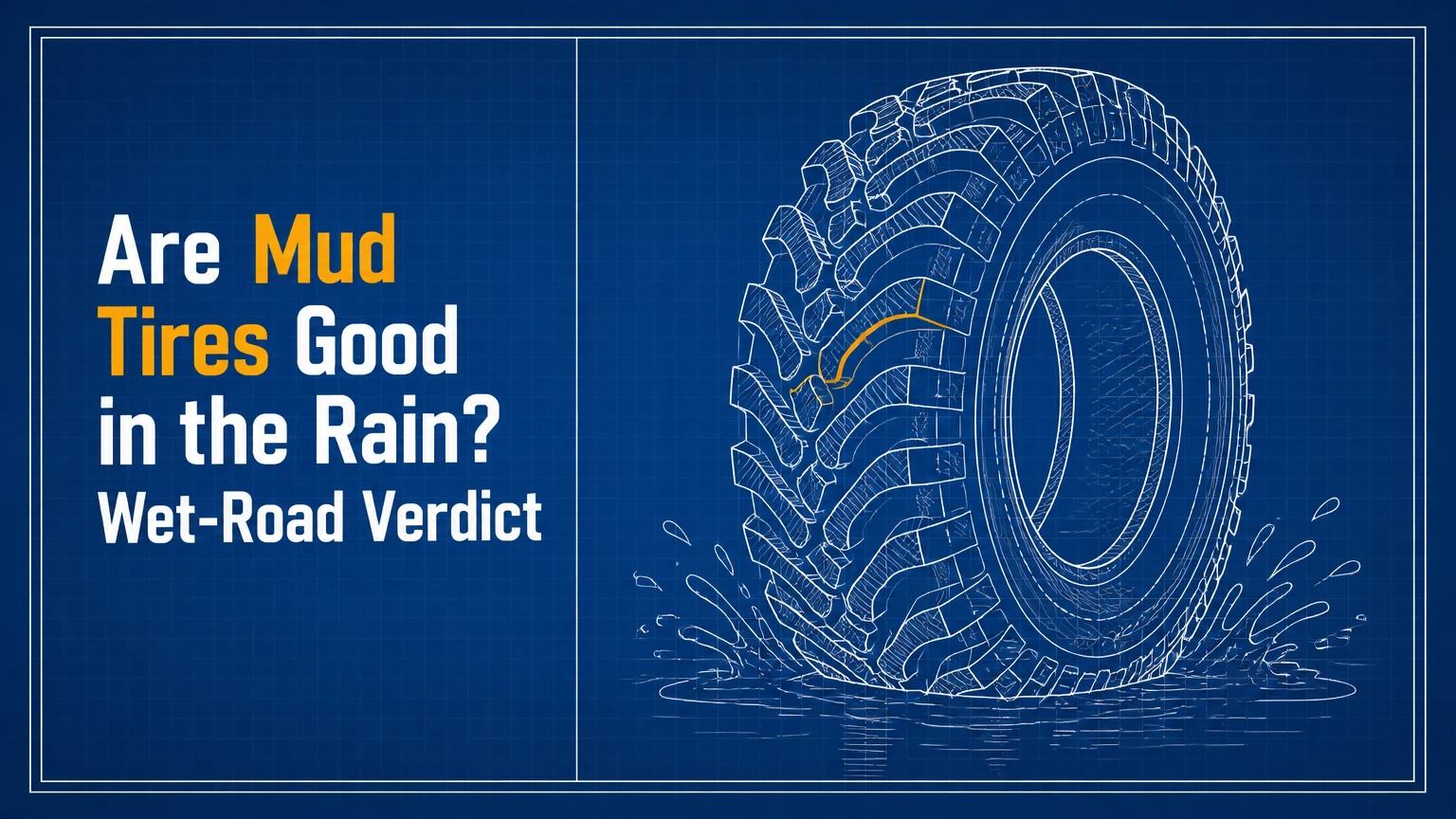
Mud-terrain tires are usually a poor choice for wet pavement, especially during highway braking and cornering. Their large tread blocks, high void ratio, limited siping, heavy construction, and off-road-oriented compounds can reduce wet-road grip, although they can perform well in deep mud and some standing water when properly inflated and driven conservatively.
Key Facts at a Glance
Mud-terrain tires prioritize traction in deep mud, rocks, ruts, and loose terrain rather than wet asphalt.
Large voids help clear thick mud, but void volume alone does not guarantee short braking distances on rain-slick pavement.
Siping, tread compound, inflation pressure, tread depth, speed, road texture, and vehicle load all affect wet grip.
Four-wheel drive improves acceleration on slippery surfaces but does not shorten braking distance or increase cornering grip.
All-terrain, rugged-terrain, and highway-terrain tires generally provide better everyday rain performance than traditional M/T tires.
No universal statistic proves that every mud tire has a fixed 20% higher hydroplaning risk or 75-100% longer wet stopping distance.
Are Mud Tires Safe on Wet Pavement?
Mud-terrain tires can be driven on wet pavement, but traditional M/T designs provide less grip and less predictable handling than road-oriented tires. The safety gap becomes most noticeable during emergency braking, fast lane changes, curved ramps, and turns over polished asphalt.
A mud tire is not automatically unsafe in light rain. A newer, well-siped radial with adequate tread, correct pressure, and a moderate speed may feel stable during ordinary commuting. The problem is reduced performance reserve. When a vehicle must stop suddenly or avoid an obstacle, the tire may lose traction earlier than an all-season, highway-terrain, or touring all-terrain tire.
The result depends on more than the tread label. A worn all-terrain tire can be worse in rain than a new M/T tire, while an aggressive mud tire operated at trail pressure can become dangerous almost immediately on pavement.
What changes the verdict?
| Condition | Effect on a mud tire | Practical response |
|---|---|---|
| New tread, correct pressure | Best available M/T wet performance | Drive at normal prudence, not aggressive speeds |
| Tread below 4/32 inch | Reduced water-channel depth and wet reserve | Plan replacement, especially before wet season |
| Trail pressure on pavement | Smaller, distorted contact area and heat buildup | Inflate to the vehicle placard specification |
| Heavy rain at highway speed | Greater hydroplaning and braking risk | Reduce speed and increase following distance |
| Deep mud or rutted trail | Strong M/T advantage over road tires | Air down only for the off-road section |
| Cold rain near freezing | Stiffer rubber and lower wet traction | Use a suitable winter-rated tire where required |
The National Highway Traffic Safety Administration advises drivers that “the best way to avoid hydroplaning is to slow down.” That guidance applies regardless of drivetrain, tire brand, or tread appearance.
Why Do Mud Tires Struggle in Rain?
Mud-terrain tires struggle on wet asphalt because their tread blocks are separated, lightly siped, and designed to flex through soft terrain rather than maintain a continuous, quiet contact surface. The same geometry that releases sticky mud can reduce braking and lateral grip on a hard road.
A road tire manages a thin water film with dense grooves, interlocking blocks, fine sipes, and a compound tuned for pavement temperatures. A mud tire instead uses large lugs and broad channels that bite into deformable ground. On asphalt, the tread block edges can move under load, and fewer rubber edges remain continuously engaged with the surface.
Wet grip is therefore a system property. Tread design matters, but so do compound temperature, inflation, alignment, suspension condition, tread wear, vehicle weight, and road texture.
How does the contact patch affect grip?
The contact patch is the portion of the tire touching the road at a given moment. A mud tire may have a similar overall footprint to another tire of the same size, but its high void ratio leaves more of that footprint occupied by grooves instead of rubber.
A simplified example shows the trade-off:
| Tire design | Typical tread void character | Pavement contact behavior | Main wet-road consequence |
|---|---|---|---|
| Highway terrain | 15-25% void appearance | Continuous ribs and small blocks | Stable braking and steering feel |
| All-terrain | 20-35% void appearance | Mixed ribs, grooves, and blocks | Good compromise across surfaces |
| Rugged terrain | 30-40% void appearance | Dense center with open shoulders | Moderate road grip with stronger trail ability |
| Mud terrain | 35-50% or more visual voids | Large lugs with separated contact zones | Less consistent pavement braking and cornering |
These are design-character ranges, not laboratory measurements for every model. Tread width, tire size, groove geometry, and manufacturer construction can alter the actual contact area.
Do large voids prevent hydroplaning?
Large voids can help a tire clear deeper water, but large voids do not automatically prevent hydroplaning. Hydroplaning begins when water cannot escape quickly enough from the contact patch and separates the tread from the road, with speed, water depth, inflation, tread depth, load, and road texture influencing the outcome.
Mud tires have a real advantage in thick mud because their open channels reduce packing. Deep standing water is more complicated. A tire with open grooves may evacuate water effectively at one speed and still lose grip on a smooth, wet highway because water flow, tread deformation, and steering load change continuously.
No reliable universal rule supports the claim that all M/T tires create exactly a 20% higher hydroplaning risk. Likewise, a claimed 75-100% longer wet stopping distance cannot be applied to every M/T tire without identifying the tire models, vehicle, speed, water depth, temperature, and test method.
That distinction matters. It replaces a memorable statistic with a usable safety conclusion: aggressive M/T tires generally offer less wet-pavement reserve than road-focused tires.
Are Siped Mud Tires Better in the Rain?
Siped mud-terrain tires are usually better in rain than unsiped versions, but siping does not make a mud tire equivalent to an all-terrain or highway tire. Fine grooves create additional biting edges and allow tread blocks to conform to small surface irregularities, especially in cool, wet conditions.
Siping also has limits. Too many cuts can allow a large lug to squirm under braking, produce irregular wear, or reduce the crisp block support that off-road drivers want. Some manufacturers mold siping only into selected center blocks while leaving shoulder lugs more solid for rock and mud durability.
Aftermarket siping can improve wet and cold-weather behavior, but it should be performed only by a qualified tire professional after checking the tire maker’s guidance. Cutting tread incorrectly can weaken blocks, affect warranties, and reduce resistance to chunking on rocks.
| M/T feature | Wet-road benefit | Off-road trade-off | Buying implication |
|---|---|---|---|
| Molded center sipes | More biting edges and water-film flexibility | More block movement | Prefer for frequent pavement use |
| Solid shoulder lugs | Stronger lateral edges in ruts | Less wet cornering flexibility | Useful for dedicated trail rigs |
| Silica-enhanced compound | Better cold and wet pliability | May trade some extreme-mud durability | Check manufacturer specifications |
| Stone ejectors | Reduce trapped rocks | Little direct wet benefit | Valuable for gravel and rocky trails |
| Flexible sidewall | More conformity at low pressure | More pavement wander and heat | Match load, pressure, and speed rating |
A practitioner rule is simple: choose a mud tire with molded siping when pavement is unavoidable, but do not purchase an M/T expecting road-tire wet braking.
Which Tire Type Performs Best in Rain?
Highway-terrain tires generally perform best on wet pavement, followed by road-oriented all-terrain tires, rugged-terrain hybrids, and traditional mud-terrain tires. The ranking changes when deep mud, rocks, or severe ruts become the primary surface.
| Tire category | Wet braking tendency | Hydroplaning behavior | Deep-mud traction | Typical tread life |
|---|---|---|---|---|
| Highway terrain, H/T | Strongest pavement bias | Usually strongest at road speeds | Limited | 55,000-80,000 miles |
| All-terrain, A/T | Good on pavement | Good when new and correctly inflated | Moderate to strong | 45,000-65,000 miles |
| Rugged terrain, R/T | Moderate to good | Moderate to good | Strong | 40,000-60,000 miles |
| Mud terrain, M/T | Weakest pavement bias | More sensitive to speed and pressure | Strongest | 20,000-45,000 miles |
Mileage ranges are typical market ranges, not guarantees. Tire size, rotation frequency, alignment, driving temperature, vehicle weight, and compound determine actual life.
Are rugged-terrain tires a good compromise?
Rugged-terrain tires are often the best compromise for drivers who want stronger off-road construction and aggressive styling without accepting the full wet-road penalty of a traditional M/T. Many R/T models use a more continuous, siped center tread with open shoulders.
The compromise is not universal. Some R/T tires are closer to M/T designs and can be noisy, stiff, or less effective on wet asphalt than a mild A/T. Review the manufacturer’s tread pattern, severe-snow rating, speed rating, and independent wet testing where available.
Examples commonly considered in this category include the Nitto Ridge Grappler and Toyo Open Country R/T. Their exact wet behavior depends on size, load range, vehicle, and road conditions, so a product name alone cannot establish a universal ranking.
What should a daily driver choose?
A driver who spends about 80-90% of the time on pavement should usually choose a highway tire or road-focused all-terrain tire rather than an M/T. The benefit includes shorter wet braking potential, lower noise, more even wear, and better fuel economy.
For occasional dirt roads, a mild A/T such as the Falken Wildpeak A/T4W or Toyo Open Country A/T III may provide enough gravel and trail capability. Those examples are not automatically best for every vehicle; verify the correct size, load index, speed rating, and manufacturer fitment.
A driver who regularly reaches deep mud may reasonably accept M/T limitations. The purchase makes sense when off-road traction prevents recovery problems, not when the main motivation is an aggressive sidewall appearance.
How Do Mud Tires Compare on Cost and Wear?
Mud-terrain tires commonly cost about $200-$500 per tire for light-truck sizes, with larger load-range E, 35-inch, and specialty applications often exceeding that range. Their ownership cost can also rise because aggressive tread wears faster, produces more noise, and may require more frequent balancing or rotation.
| Ownership factor | H/T example range | A/T example range | R/T example range | M/T example range |
|---|---|---|---|---|
| Typical tire price | $160-$350 | $180-$400 | $220-$450 | $250-$550 |
| Typical service life | 55,000-80,000 miles | 45,000-65,000 miles | 40,000-60,000 miles | 20,000-45,000 miles |
| Rotation interval | 5,000-8,000 miles | 5,000-7,500 miles | 5,000-6,000 miles | 3,000-6,000 miles |
| Highway noise tendency | Low | Low to moderate | Moderate to high | High |
| Fuel economy penalty | Lowest | Low to moderate | Moderate | Moderate to high |
These figures are typical retail and service ranges. Installation, disposal, alignment, tax, wheel size, regional supply, and rebates can change the final price.
Aggressive tread is not the only reason M/T tires wear quickly. Heavy casing construction adds mass, soft compounds can scrub on pavement, and large blocks can develop heel-and-toe or cupping when shocks, alignment, or rotation are neglected.
Does Four-Wheel Drive Make Mud Tires Safer in Rain?
Four-wheel drive and all-wheel drive can help a vehicle accelerate on a wet surface, but neither system creates additional tire-road friction for braking or cornering. A vehicle can launch confidently and still slide through a wet turn or require a long emergency stop.
Electronic stability control may help correct yaw after a loss of directional stability, and anti-lock braking can preserve steering control during hard braking. Neither system can restore grip after the tread rides on water.
This is a frequent and counterintuitive mistake. Drivers often judge wet traction by how easily a truck moves away from a stop, even though the more safety-critical events involve stopping and changing direction.
How should a 4WD driver adapt?
- Leave extra following distance, especially behind motorcycles and trucks that obscure spray.
- Reduce speed before standing water, ramps, bends, and painted lane markings.
- Avoid abrupt throttle, braking, and steering inputs.
- Keep electronic stability control enabled on public roads unless the vehicle manual says otherwise.
- Do not use cruise control during heavy rain or when hydroplaning is possible.
- If the vehicle begins to hydroplane, ease off the accelerator and steer smoothly toward the intended path.
Do not brake sharply or make a sudden steering correction while the tires are floating. If a vehicle repeatedly loses grip at ordinary speeds, inspect the tires and suspension rather than treating the behavior as normal for M/T equipment.
What Pressure and Tread Depth Should You Use in Rain?
Use the cold inflation pressure on the vehicle manufacturer’s door placard, not the maximum pressure molded into the tire sidewall. A typical trail pressure of 12-20 psi is for low-speed off-road use and must be restored before returning to pavement.
Underinflation can increase tread squirm, heat generation, shoulder wear, steering delay, and hydroplaning sensitivity. Overinflation can reduce the footprint’s useful shape and make the vehicle feel nervous on irregular wet pavement.
Check pressure when the tires are cold, ideally before driving or after the vehicle has been parked for several hours. A 10°F temperature change can alter pressure by roughly 1 psi, so seasonal checks matter.
| Inspection item | Practical threshold or interval | Why it matters in rain |
|---|---|---|
| Cold inflation pressure | Door placard value, checked monthly | Preserves intended footprint and load capacity |
| Tread depth | Replace planning at 4/32 inch in wet climates | Wet traction reserve declines before legal minimum |
| Legal wear bars | 2/32 inch in many U.S. jurisdictions | Indicates end of legal tread, not ideal wet safety |
| Rotation | Every 3,000-6,000 miles for aggressive M/T use | Limits cupping and uneven water-channel depth |
| Alignment | Check after hard trail impacts or pull | Prevents fast, uneven wet-grip loss |
| TPMS operation | Warning system functional before trips | Detects pressure loss before handling changes |
Tread depth alone cannot certify safety. Cracks, punctures, exposed cords, separated tread, bulges, severe cupping, and age-related hardening also require professional inspection.
What Are the Common Wet-Weather Failure Modes?
The most common wet-weather failures involve trail pressure, worn or cupped tread, excessive speed, poor alignment, and misplaced confidence in four-wheel drive. Each failure can make a usable mud tire behave unpredictably on pavement.
Returning to pavement at trail pressure
Restore road pressure before reaching normal traffic speed. If the vehicle has already traveled on pavement at low pressure, stop in a safe location, inspect for sidewall damage, and inflate according to the placard before continuing.
Ignoring cupping and heel-toe wear
Run a hand across the tread with the vehicle parked safely. Sawtooth edges, alternating high and low blocks, or a rhythmic hum indicate irregular wear that can reduce consistent contact and signal worn shocks or alignment problems.
Treating grooves as proof of wet safety
A deep tread may look water-ready while its compound remains hard, its blocks flex excessively, or its pressure is wrong. Visual void size cannot predict emergency wet braking by itself.
Adding siping without checking the tire
Professional siping can help a suitable tire, but it cannot correct a poor compound, excessive speed, worn casing, or incorrect size. Ask the installer how the modification affects the manufacturer warranty and off-road block durability.
Mixing incompatible tire conditions
Avoid mixing severely different tread depths, constructions, or models across an axle. Differences in grip can create uneven braking and handling, particularly on vehicles with electronically managed all-wheel drive.
How Should You Drive M/T Tires During Heavy Rain?
Drive M/T-equipped vehicles more slowly and smoothly during heavy rain, with greater space ahead and no cruise control. The correct response is preventive: reduce speed before water appears, avoid abrupt inputs, and treat standing water as a loss-of-control hazard.
A useful following-distance adjustment is to add at least two seconds to the normal gap during ordinary rain and more when spray, darkness, traffic, or standing water reduces visibility. This is not a guaranteed stopping-distance formula, because vehicle speed, load, brakes, and tire condition change the result.
Before a long trip, inspect the tread, check cold pressure, confirm the spare is inflated, and make sure the TPMS warning light is off. Replace a damaged or badly cupped tire before wet-weather travel, rather than relying on four-wheel drive to compensate.
What if hydroplaning starts?
Release the accelerator gradually, keep the steering pointed in the intended direction, and avoid sudden braking or lane changes. Once the tires regain contact, make any correction smoothly and slow down further.
If the truck pulls strongly, vibrates, or loses traction repeatedly on wet pavement, stop driving at highway speed and arrange an inspection. A tire defect, bent wheel, worn shock, alignment error, or pressure problem may be involved.
Which Driver Should Buy Mud Tires?
The right choice depends on the percentage of pavement, the severity of off-road terrain, and how much wet-road performance the driver is willing to trade. M/T tires fit dedicated trail users better than commuters who occasionally encounter a gravel road.
| Driver profile | Pavement share | Better starting category | Reason |
|---|---|---|---|
| Daily commuter | 90% or more | H/T or mild A/T | Wet braking, quietness, and tread life |
| Mixed-use pickup owner | 60-80% | A/T or R/T | Balanced road and trail performance |
| Frequent mud-trail driver | 30-60% | Siped M/T or aggressive A/T | More off-road bite with manageable pavement use |
| Dedicated trail rig | Under 30% | M/T | Maximum mud and loose-terrain traction |
| Cold, wet climate driver | 70% or more | 3PMSF-rated A/T or winter tire | Cold-weather compound and snow performance |
A commuter should avoid M/T tires unless the vehicle regularly needs their specific mud capability. A weekend off-roader should compare a heavily siped A/T with an R/T before accepting M/T noise and wet-road compromises.
A dedicated rig can use an unsparing M/T because pavement exposure is limited. Even then, the driver must maintain highway pressure, respect speed limits, and allow longer stopping space between trails.
How Do You Choose a Rain-Friendly Mud Tire?
Choose a rain-friendlier M/T by checking molded siping, wet-weather reviews from comparable vehicles, compound information, load rating, speed rating, and the tire’s actual use ratio. Do not rank models from tread appearance or a single anecdotal owner report.
Use this buying sequence:
- Confirm the tire size, load index, speed rating, and wheel compatibility.
- Identify whether the center tread contains molded sipes.
- Check whether the manufacturer publishes wet traction, severe-snow, or compound information.
- Compare the tire’s warranty mileage with the expected pavement percentage.
- Read reviews that identify vehicle weight, tire size, pressure, climate, and road type.
- Price installation, balancing, rotation, alignment, and a full-size spare.
- Compare a strong A/T or R/T before committing to M/T limitations.
Brand examples such as BFGoodrich Mud-Terrain T/A KM3, Firestone Destination M/T2, and Toyo Open Country M/T represent recognizable M/T options, but no model is automatically the safest in rain. Product generation, size, load range, inflation, and vehicle setup can materially change the result.
The best choice is often the least aggressive tire that still completes the driver’s actual trail work.
FAQ
Are mud tires better than all-terrain tires in standing water?
Mud tires can clear thick mud and may perform well through some deep standing water because their open tread channels resist packing. All-terrain tires usually provide better wet pavement braking and cornering, so the answer depends on whether the water is encountered on a trail or at highway speed.
Can rain make new mud tires slippery?
Rain can expose the pavement limitations of new M/T tires, but new tread is not inherently defective because it feels different from a road tire. Large blocks, limited siping, release agents, tire pressure, and a stiff casing can all affect initial feel. Drive conservatively until the tires are familiar.
Are mud tires suitable for winter rain?
Mud tires are not automatically suitable for cold-weather rain or snow. Some compounds stiffen significantly at low temperatures, and many M/T models lack the Three-Peak Mountain Snowflake rating. Drivers in cold regions should verify the tire’s temperature range and winter certification.
How often should mud tires be rotated?
A typical M/T rotation interval is 3,000-6,000 miles, with earlier inspection if the vehicle tows, carries heavy loads, or frequently drives on rocky surfaces. Follow the tire and vehicle manufacturer’s pattern, and correct alignment or shock problems that cause cupping.
Can lowering pressure improve wet traction?
Lowering pressure can improve low-speed conformity on rocks and loose terrain, but it usually makes highway wet handling worse when used outside the tire maker’s approved range. Inflate cold tires to the vehicle placard specification before driving on public roads.
Should I replace mud tires at 4/32 inch?
Four thirty-seconds of an inch is a sensible wet-weather replacement planning point, particularly for a vehicle used in heavy rain, although the legal wear limit is commonly 2/32 inch in the United States. Replace sooner if tread is damaged, uneven, cracked, or severely hardened.
The Bottom Line
Are mud tires good in the rain? Traditional mud-terrain tires are generally inferior to highway, all-terrain, and many rugged-terrain tires on wet pavement. Their deep voids excel in mud, but emergency braking and cornering depend on continuous rubber contact, siping, compound flexibility, pressure, tread depth, and speed.
Choose an M/T when deep mud and severe trail terrain justify the trade-off. Choose an A/T, R/T, or H/T when wet-road safety, commuting comfort, predictable braking, and long tread life matter more. Whatever the category, restore trail pressure, inspect tread condition, slow down in heavy rain, and never assume 4WD can replace tire grip.