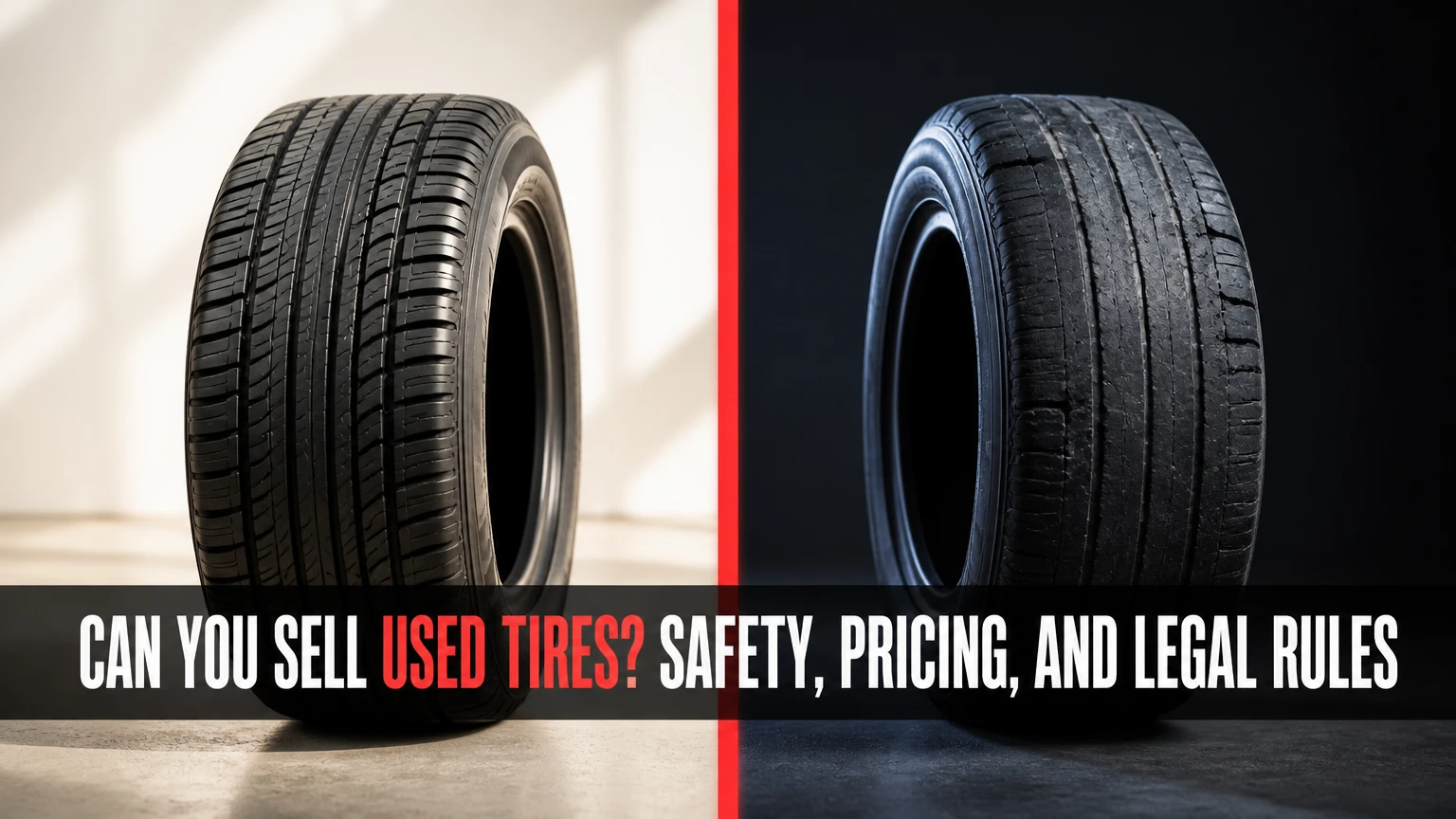
Yes, you can sell used tires if they are legal, structurally sound, accurately described, and suitable for continued service. The common 2/32-inch tread benchmark is a minimum in many United States jurisdictions, not a universal worldwide rule, and a tire can meet that threshold while still being unsafe because of age, damage, uneven wear, or an unsuitable repair.
Key Facts at a Glance
- A used tire should have measurable tread, intact sidewalls and beads, no bulges or exposed cords, and no unresolved safety defect.
- The last four digits of a tire’s DOT code identify its manufacture week and year.
- A 2/32-inch tread reading is commonly treated as a legal replacement threshold in the United States, but state and provincial rules differ.
- NHTSA does not establish a universal six-year sales cutoff; tire manufacturers provide different age recommendations.
- Matching pairs and complete sets usually sell faster and for more money than isolated tires.
- A tire that cannot be responsibly resold should go to an approved tire recycler, not an ordinary landfill or illegal dumping site.
Are Used Tires Legal to Sell?
Used tires are generally legal to sell when local law permits the transaction and the tires meet applicable safety, labeling, and disclosure requirements. The seller remains responsible for describing known defects, while commercial sellers may face additional licensing, inspection, waste-tire, tax, and recordkeeping rules.
The United States has no single nationwide used-tire resale rule that answers every case. State agencies regulate part-worn tire sales differently, and countries such as the United Kingdom use their own inspection and marking requirements. A private seller should check the state department of transportation, environmental agency, or consumer-protection office before selling repeatedly.
The 2/32-inch figure needs careful wording. Many states use 2/32 inch, or 1.6 millimeters, as a minimum tread-depth standard, and NHTSA identifies that depth as the point at which replacement is needed. A seller should not describe 2/32-inch tires as desirable merely because they may satisfy a legal threshold.
Commercial sellers may also need to comply with rules covering:
- Tire retailer or automotive-repair licensing
- Sales tax registration
- Used-tire inspection records
- Waste-tire transport and disposal fees
- Federal or state recall requirements
- Consumer warranties and return policies
- Storage limits for large tire inventories
A private one-time sale is different from operating a tire business. Repeatedly buying and reselling tires can create business obligations even when sales occur through Facebook Marketplace or Craigslist.
How Do You Inspect a Used Tire?
Inspect a used tire with a tread-depth gauge, flashlight, stiff brush, and the vehicle manufacturer’s fitment information. Measure several points across the tread, decode the DOT date, inspect the inner and outer sidewalls, and reject any casing with structural damage or an uncertain repair history.
Measure Tread Across the Tire
Measure the main grooves at the inside, center, and outside portions of the tread. Take readings at several points around the circumference because camber wear, inflation problems, and suspension faults can leave one section far thinner than the rest.
| Tread reading | Selling interpretation | Typical buyer response |
|---|---|---|
| 10/32-12/32 inch | Near-new condition | Premium price, especially for take-offs |
| 7/32-9/32 inch | Strong used condition | Good candidate for pairs or sets |
| 5/32-6/32 inch | Usable mid-life condition | Sells with accurate pricing |
| 3/32-4/32 inch | Limited remaining life | Discounted sale or recycling review |
| 2/32 inch | Common legal threshold | Low value and cautious demand |
| Below 2/32 inch | Usually unsuitable for road resale | Recycle rather than sell for driving |
A digital gauge is more reliable than judging tread from photographs. Record the lowest meaningful reading, not the most attractive measurement.
Read the DOT Date Code
The final four digits of the DOT Tire Identification Number show the production week and year. A code ending in 2319 means the tire was manufactured during the 23rd week of 2019; the code is not the installation date.
NHTSA advises consumers to follow tire-maker age guidance, and the U.S. Tire Manufacturers Association recommends professional inspection of tires that are five years old or older. Some manufacturers recommend replacement at 10 years from manufacture, while others use different limits. Therefore, “six years is always the maximum safe age” is too absolute.
Reject Structural and Repair Defects
Do not resell a tire for highway use when it has a sidewall bubble, exposed cord, deep cut, bead damage, visible separation, severe ozone cracking, or an unknown internal repair. A plug or patch in the tread is not automatically disqualifying, but a professional inspection should confirm that the repair is inside the repairable tread area and was completed correctly.
The Rubber Manufacturers Association’s widely repeated safety message says, “Tires are the only thing between your vehicle and the road.” That principle matters during resale: tread depth alone cannot establish casing safety.
Does Tire Age Make a Tire Unsellable?
Tire age does not create one universal legal cutoff, but increasing age reduces buyer confidence and raises inspection requirements. A 10-year-old tire with deep tread may be rejected by a responsible shop, while a three-year-old tire with a sidewall bulge is clearly unsuitable.
Age-related concerns include:
- Ozone cracking between tread blocks and in sidewall lettering
- Hardening rubber that reduces wet-road grip
- Internal belt separation
- Valve and bead deterioration
- Storage damage from sunlight, heat, moisture, or chemicals
- Unknown service history after long-term underinflation
Store saleable tires indoors, upright, away from electric motors, welding equipment, petroleum products, and direct sunlight. Do not apply thick silicone dressing to conceal cracks. A glossy sidewall can make inspection harder and may reduce buyer trust.
Run-flat, low-profile, winter, and high-performance tires need additional disclosure. Winter tires lose cold-weather performance as tread wears, and a tire with 5/32 inch remaining may have much less value as a snow tire than as a temporary warm-weather replacement.
Which Used Tires Have the Most Resale Value?
Take-off tires, matching premium-brand pairs, and complete truck or SUV sets usually have the strongest resale value. Value depends on size, tread, age, load and speed ratings, seasonal demand, local vehicle population, and whether all tires have compatible specifications.
| Tire category | Typical resale situation | Main value attributes |
|---|---|---|
| Passenger all-season | $20-$75 per tire | 15-18-inch size, 5/32-inch or more, common fitment |
| Premium matching pair | $60-$150 per pair | Same model, similar tread, recent DOT date |
| Take-off truck/SUV set | $300-$700 per set | 18-22-inch wheels, 8/32-inch or more, original equipment |
| UHP sports-tire pair | $80-$250 per pair | Premium brand, matching model, high speed rating |
| Winter tire set | $150-$500 per set | 7/32-inch or more, flexible rubber, matching size |
| Commercial truck casing | $10-$80 per casing | Repairable casing, suitable tread, documented condition |
| Scrap tire | $0-$5 per tire | Local recycling demand and transport cost |
These are typical private-sale ranges, not guaranteed appraisals. A common 205/55R16 tire may attract more inquiries than a rare 245/35R20 tire even when the rare tire originally cost more.
How Should You Price Used Tires?
Price used tires by comparing local listings with the same size, model, tread depth, and DOT age, then discounting for missing information or individual-tire sales. A practical starting point is often 30%-60% of comparable new-tire pricing for newer, undamaged tires, with lower percentages for older or unevenly worn stock.
Use the following factors in order:
- Safety and saleability: A tire with a defect has recycling value, not ordinary resale value.
- Remaining tread: A 9/32-inch tire can command several times the price of a 3/32-inch example.
- Age: Recent manufacture generally improves buyer confidence.
- Matching: A pair or set removes fitment uncertainty.
- Demand: Common commuter sizes and popular truck sizes move faster.
- Installation convenience: A mounted, balanced tire may justify more, but disclose wheel condition and service history.
| Example inventory | Typical asking price | Typical sale timeframe |
|---|---|---|
| One 205/55R16, 5/32 inch, 4 years old | $25-$45 | 3-14 days |
| Pair of matching 225/65R17, 7/32 inch | $80-$140 | 2-10 days |
| Four 235/65R18 SUV tires, 8/32 inch | $250-$450 | 3-21 days |
| Four 275/65R18 take-offs, 9/32 inch | $400-$700 | 3-30 days |
| Ten mixed passenger tires for a broker | $10-$30 total | Same day to 30 days |
| Unsafe or below-threshold tires | $0-$5 each | Dependent on recycler pickup |
Set the asking price about 10%-15% above the minimum amount you will accept when local buyers commonly negotiate. Do not inflate the price to recover the tire’s original purchase cost; resale buyers pay for remaining service, not historical expense.
Which Sales Channel Is Best?
Local peer-to-peer sales usually produce the highest price per tire, while tire shops and brokers offer faster clearance at wholesale rates. Online national sales work best for rare sizes or premium sets, but shipping, platform fees, freight damage, and returns can erase the apparent margin.
| Sales channel | Typical payout | Typical timeframe | Best inventory |
|---|---|---|---|
| Facebook Marketplace or Craigslist | 40%-70% of comparable new price | 3-14 days | Common local sizes and sets |
| Independent tire shop | 20%-45% of comparable new price | Same day to 7 days | Saleable pairs and common sizes |
| Used-tire dealer | 15%-40% of comparable new price | Same day | Larger mixed inventory |
| eBay Motors | 35%-65% after fees and freight | 7-30 days | Rare or premium fitments |
| Casing broker | $10-$80 per commercial casing | 7-30 days | Truck, bus, and fleet quantities |
| Tire recycler | $0-$5 per tire, sometimes a fee | Same day to 14 days | Unsafe or unsaleable tires |
Call shops before transporting the tires. Many dealers buy only inventory that matches their current demand, passes their inspection, and has enough tread to justify mounting labor.
What Information Should a Listing Include?
A useful used-tire listing identifies the exact tire, proves its condition, and states every limitation that could affect fitment or safety. Include the size, brand, model, DOT date, tread readings, load index, speed rating, repair history, quantity, and whether the tire is mounted on a wheel.
A tire size such as 205/55R16 91V contains more information than “16-inch tire.” The number 205 is section width in millimeters, 55 is aspect ratio, R identifies radial construction, 16 is wheel diameter, 91 is load index, and V is speed rating.
Photograph:
- Full tread face
- Tread-depth gauge at the lowest reading
- Both sidewalls
- DOT code
- Bead and rim area
- Any repair, patch, scuff, or uneven wear
- Tire mounted on a wheel, if applicable
State the compatible vehicle only as a fitment example, not as a guarantee. A tire that fits a Honda Accord in one year may not meet the load, speed, or wheel requirements of another vehicle.
Should You Clean Used Tires Before Selling?
Clean used tires with water, mild detergent, and a brush, then dry them before photographing. Remove stones from grooves, but do not use aggressive solvents, abrasive wheels, or oily tire dressings that can obscure cracking and contaminate the rubber.
Cleaning improves readability of the sidewall and DOT code. It does not improve tread life or repair structural damage. A buyer should see the tire’s real condition, including stains, shoulder wear, and repaired areas.
What Used Tires Should You Never Sell for Road Use?
Never sell a tire for normal road driving when the casing shows a bulge, separation, exposed cords, bead damage, severe cracking, or a repair outside the accepted tread-repair zone. Do not sell a recalled tire until the recall remedy and safety status are verified.
Common rejection cases include:
- A sidewall puncture, even when plugged
- A bubble caused by impact damage
- Tread separation or a raised belt
- Cords visible through worn tread
- Irregular wear that leaves a thin shoulder
- A tire with an unknown chemical or fire exposure
- A mismatched tire marketed as a complete AWD set
- A tire whose size, load index, or speed rating cannot be verified
A tire shop may identify internal damage with equipment unavailable to a private seller. If a buyer reports vibration after mounting, do not automatically blame balancing. Radial force variation, bent wheels, belt damage, and incorrect fitment can produce similar symptoms.
Can You Sell a Single Tire or Mismatched Pair?
You can sell a single tire or mismatched pair, but the listing must clearly state the quantity and compatibility limits. Matching tread depth, model, construction, and size generally matters more than matching brand alone, especially on AWD and four-wheel-drive vehicles.
Tread-depth differences above roughly 2/32 inch can create drivetrain concerns on some AWD systems, but the correct limit comes from the vehicle manufacturer. Subaru, Audi, BMW, and other manufacturers may specify tighter tolerances or require replacement of all four tires.
For a pair, record:
- Exact size and service description
- Same brand and model, if available
- Tread depth of each tire
- DOT date for each tire
- Repair status
- Rotation position, if known
Never describe two different tire models as a matched pair. A buyer may use them on one axle, but the vehicle manufacturer’s requirements still control.
How Do You Sell Used Tires Safely?
Sell used tires with complete disclosures, secure payment, and a written record that identifies the exact tires transferred. Meet buyers in a well-lit public location, preferably near a police-station exchange area or a tire shop, and avoid allowing strangers into your home.
A basic receipt should include:
- Seller and buyer names
- Date of sale
- Tire size, brand, model, and DOT code
- Quantity and tread measurements
- Known repairs or defects
- Price and payment method
- Statement that the buyer inspected the tires
- Any legally valid as-is language
An “as-is” statement does not excuse fraud or concealment. It cannot reliably protect a seller who knowingly hides a sidewall defect or misrepresents the tire’s age.
For online sales, calculate dimensional shipping costs before listing. Passenger tires can weigh 20-30 pounds each, while light-truck tires may weigh 35-70 pounds, and a four-tire shipment can become more expensive than the inventory.
Why Do Used-Tire Listings Fail?
Used-tire listings fail most often because they omit tread measurements, show poor photographs, use incorrect fitment terms, or price individual tires like complete sets. Buyers avoid listings that require several messages to establish basic safety and compatibility.
| Failure mode | Likely cause | Specific correction |
|---|---|---|
| No views after 7 days | Rare size or weak title | Add size, model, tread, and vehicle class |
| Views but no messages | Price exceeds local comparables | Reduce price 10%-15% |
| Many fitment questions | Missing load or speed rating | Publish the complete service description |
| Shop rejects inventory | Age, damage, or low tread | Regrade and separate recyclable tires |
| Buyer reports vibration | Damage, bent wheel, or balance issue | Stop resale claims and arrange professional inspection |
| Returns after shipment | Incomplete photos or wrong size | Photograph DOT code and sidewalls before sale |
Use a title such as Michelin Defender 205/55R16, 6/32 inch, DOT 2021, one tire. “Used tire cheap” does not give search systems or buyers enough information.
What Should You Do With Tires You Cannot Sell?
Tires that fail safety inspection should go to a licensed tire recycler, municipal collection event, tire retailer, or approved waste-tire facility. Disposal rules differ because whole tires can trap water, create fire hazards, and require specialized processing.
Do not burn tires or abandon them. Do not assume a scrap yard accepts passenger tires without a fee. Ask whether the facility accepts whole tires, charges per tire, limits quantities, or requires proof of residency.
Recycling may produce crumb rubber, molded products, civil-engineering fill, or fuel for approved industrial systems. Recycling usually returns less money than resale, but it is the correct endpoint for defective casings.
Which Strategy Fits Your Situation?
One Set From a Personal Vehicle
Clean the tires, measure each one, decode the DOT dates, and list the complete set locally. Price the set against comparable listings, not the original invoice, and expect a faster sale when all four tires share the same model and similar tread.
A Tire Shop or Salvage Yard
Sort tires immediately by size, application, tread depth, age, and defect status. Keep saleable inventory indoors, document the source, and establish a relationship with a licensed used-tire dealer or casing broker before storage becomes a compliance problem.
A Used-Tire Flipper
Focus on predictable fitments and matching pairs rather than random single tires. Take-off truck and SUV sets can produce better margins, but the purchase decision must account for transport, mounting, inspection, storage, advertising, and unsold recycling costs.
The business is less attractive when inventory requires shipping. A $100 gross sale can become unprofitable after $40 freight, platform fees, payment fees, and a return.
Frequently Asked Questions
Can I sell tires with plugs or patches?
A properly repaired tread puncture may remain saleable in some markets, but disclose the repair and obtain a professional inspection when possible. Sidewall repairs, shoulder repairs, overlapping repairs, and unknown internal patches are generally reasons to reject the tire for highway resale.
Can I sell tires that came off a wrecked car?
You can sell tires removed from a damaged vehicle if the tires themselves pass inspection and their history is disclosed. Check for impact-related sidewall damage, bent beads, hidden belt separation, flat-spotting, and uneven wear caused by suspension damage before listing them.
Do tire shops buy used tires from individuals?
Some independent tire shops buy selected used tires from individuals, but many purchase only from established suppliers or accept tires as trade-ins. Phone first, provide the size and DOT age, and expect a lower offer than a direct local sale because the shop assumes inspection and warranty risk.
Can I sell tires without wheels?
Yes, tires can be sold without wheels, and tire-only listings are easier to compare by size and model. State clearly that the wheel is not included, because a buyer who expects a mounted assembly may dispute the transaction or return the item.
Are old tires worth anything for scrap?
Old tires may have a small scrap value, typically $0-$5 each, but transport and disposal charges can reduce the payment to zero. Tires below the safe resale standard should be directed to a permitted recycler rather than marketed as inexpensive road tires.
Does tire pressure affect the selling price?
Tire pressure does not determine lasting value, but a tire stored flat or driven severely underinflated may have hidden sidewall damage. Inflate it only to the vehicle or tire manufacturer’s specified pressure for inspection, and never use inflation to conceal a casing problem.
The Bottom Line
You can sell used tires when the tires are safe, legal in your jurisdiction, accurately identified, and honestly disclosed. Inspect tread and casing, record the DOT date, price according to remaining service and local demand, and sell matching pairs or sets whenever possible. If a tire has structural damage, uncertain history, or insufficient tread, recycling is the responsible alternative. Include the exact phrase can you sell used tires in your decision process only as a starting question, then let inspection and local rules determine the answer.
Title tag: can you sell used tires: Safety, Pricing, and Legal Rules
Meta description: Check DOT age, tread, repairs, and local rules before listing used tires. Price pairs and sets accurately, avoid unsafe sales, and choose cash or recycling.