A 3-Peak Mountain Snowflake tire is snow-rated, but it is not automatically a dedicated snow or winter tire. The 3PMSF symbol confirms tested severe-snow traction, while the tire’s category determines its cold-weather compound, ice grip, dry-road handling, and intended use. Dedicated winter tires generally outperform other 3PMSF tires on ice and persistent freezing roads.
Key Facts at a Glance
The 3PMSF symbol means a tire passed a regulated severe-snow traction test.
A 3PMSF tire may be a dedicated winter, all-weather, or all-terrain tire.
M+S marking does not require the same snow-performance test as 3PMSF.
The 3PMSF test primarily measures acceleration traction on packed snow, not ice braking.
Dedicated winter tires usually provide the strongest ice and cold-weather performance.
All-weather 3PMSF tires suit moderate winters when year-round convenience matters.
What Does the 3PMSF Symbol Mean?
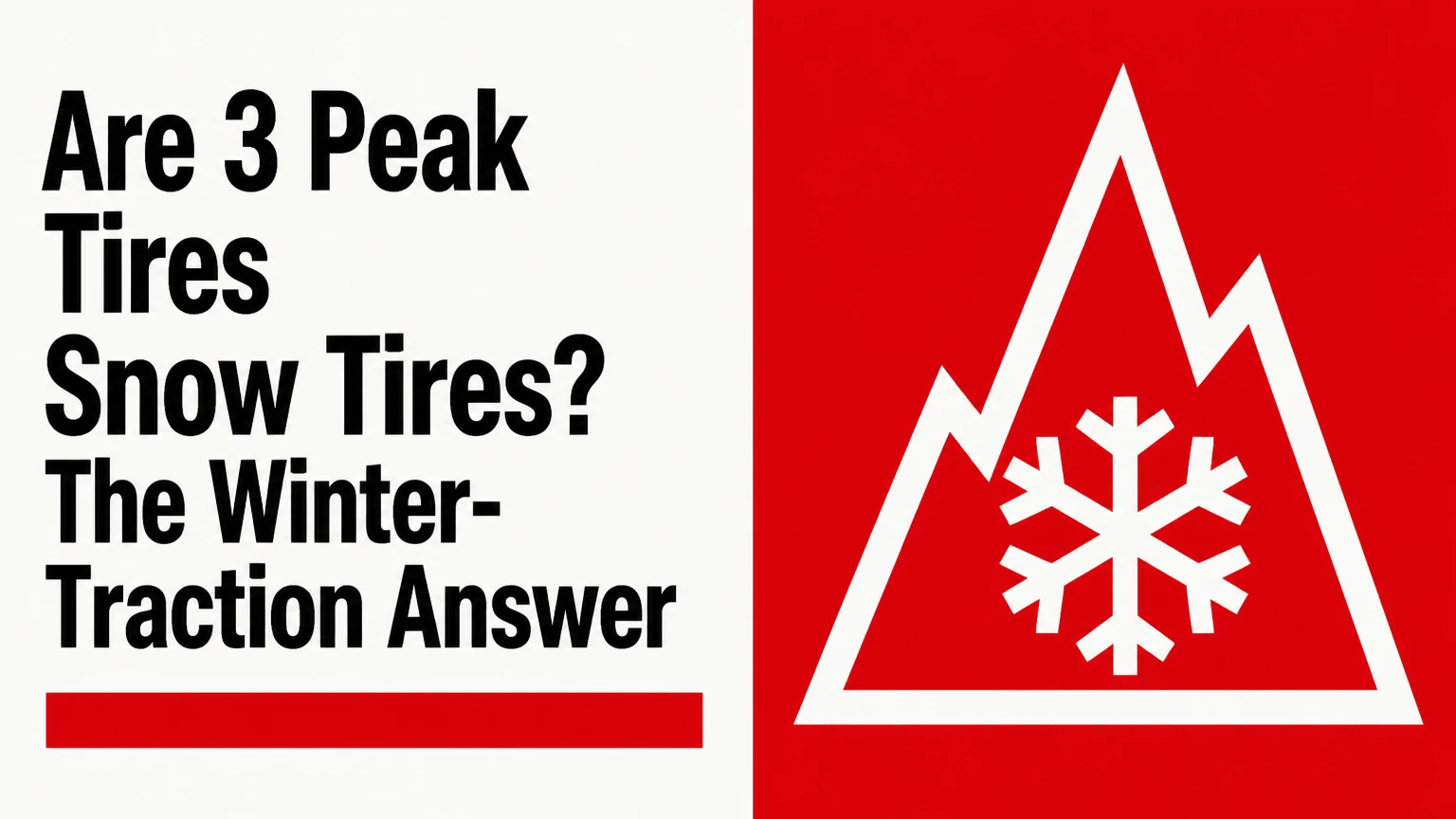
The 3-Peak Mountain Snowflake symbol is a mountain outline containing a snowflake, molded into a tire sidewall. It identifies a tire that meets a defined severe-snow-service performance requirement, rather than merely having grooves that appear suitable for winter driving.
The symbol is often abbreviated as 3PMSF, 3-Peak Mountain Snowflake, mountain snowflake, or severe-snow rating. Tire manufacturers place it beside other markings such as M+S, the tire size, load index, speed rating, and DOT identification number.
The designation is a threshold, not a complete description of winter capability. Two tires can both carry 3PMSF while differing substantially in ice braking, packed-snow cornering, highway noise, tread life, and performance in warm weather.
Tire Rack describes the designation as a symbol showing that a tire has passed “a specific snow traction performance test.” That wording matters because the test result does not classify the product as a dedicated winter tire.
Is 3PMSF the Same as a Snow Tire?
3PMSF is a snow-performance certification, while snow tire or winter tire describes a product designed primarily for cold-season use. A dedicated winter tire carries 3PMSF, but an all-weather or all-terrain tire can also carry the same symbol without offering equivalent ice performance.
In ordinary shopping language, many drivers call any 3PMSF tire a snow tire. In technical buying decisions, that shortcut can cause a poor match. A mountain driver who needs ice traction should look for a dedicated winter tire, not only the snowflake symbol.
A 3PMSF all-weather tire can be a sensible substitute for seasonal tires in a city with intermittent snow. A 3PMSF all-terrain tire can suit a pickup that travels on unplowed roads and gravel. Neither fact makes those products interchangeable with a studless winter tire.
How Is a 3PMSF Tire Tested?
The 3PMSF designation comes from a standardized snow-traction procedure associated with ASTM F1805 and regional regulations. The tire is evaluated against a standardized reference tire on medium-packed snow, with the test measuring traction during acceleration.
The general procedure uses a test vehicle, a candidate tire, a standard reference tire, and a controlled snow surface. The candidate must reach a specified traction index relative to the reference tire. Depending on the applicable regulatory version and market, published explanations commonly cite a threshold around 110, meaning approximately 10% greater acceleration traction than the reference tire.
The test is valuable, but narrow. ASTM F1805-style testing does not establish a tire’s exact stopping distance on ice, emergency cornering ability, wet-road braking, or performance after thousands of miles of wear.
What the Snow Test Does Not Measure
The 3PMSF test does not guarantee that a tire will stop quickly on black ice. It also does not rank every snow tire from best to worst, establish safe speed in a storm, or prove that an all-terrain tire will handle an icy urban intersection.
A tire can earn 3PMSF through tread geometry, compound design, and snow-biting features, yet remain less effective than a dedicated winter tire on polished ice. Drivers should treat the symbol as an entry requirement for severe snow, not as a universal winter-performance score.
This distinction explains many confusing real-world results. A 3PMSF all-terrain tire may climb through deep, loose snow effectively because its voids clear accumulation, while a studless winter tire may brake and turn better on a frozen paved road.
What Types of Tires Carry the 3PMSF Mark?
Dedicated winter, all-weather, and all-terrain tires can all carry the 3PMSF mark. Their common certification does not erase differences in compound softness, sipe density, tread pattern, casing strength, and seasonal purpose.
| Tire category | Typical compound and tread | Strongest condition | Main limitation |
|---|---|---|---|
| Dedicated winter | Flexible cold-weather compound, dense sipes, directional grooves | Ice, packed snow, temperatures below 7°C | Faster warm-weather wear and seasonal changeovers |
| All-weather | Moderate-cold compound, numerous sipes, directional or asymmetric tread | Rain, occasional snow, mixed temperatures | Less ice grip than a dedicated winter tire |
| All-terrain | Durable compound, large blocks, open voids, reinforced casing | Deep snow, gravel, trails, unplowed roads | Harder blocks can reduce icy-road grip |
| Standard all-season | General-purpose compound, moderate grooves, limited winter siping | Dry and wet roads above freezing | Often lacks 3PMSF severe-snow certification |
| Studded winter | Cold compound, winter tread, metal studs permitted by local law | Glare ice and hard-packed snow | Road noise, pavement wear, seasonal restrictions |
Dedicated Winter Tires
Dedicated winter tires are built for sustained cold, snow, and ice. Their compounds remain more flexible at low temperatures, and their dense sipes create many biting edges that help the tread conform to irregular frozen surfaces.
Examples include the Bridgestone Blizzak, Michelin X-Ice, Nokian Hakkapeliitta, and Continental VikingContact families. Exact performance varies by model and size, so the product category is more meaningful than a brand name alone.
Winter tires usually sacrifice some warm-weather steering response and tread life. Their softer compounds can wear quickly during a prolonged warm spell, especially when tire pressure is low or the vehicle is driven aggressively.
All-Weather Tires
All-weather tires are year-round tires engineered with more winter capability than conventional all-season products. Many carry 3PMSF, use substantial siping, and maintain better cold-weather flexibility than ordinary touring all-seasons.
Examples include the Michelin CrossClimate2, Nokian WR G4, and comparable 3PMSF products from other manufacturers. These tires are useful when a driver encounters several snow events each winter but does not want a second wheel set.
The trade-off is measurable in priorities rather than one universal score. An all-weather tire usually provides better warm-weather usability than a winter tire, while a dedicated winter tire normally gives more margin on ice and persistent snow.
All-Terrain Tires
3PMSF all-terrain tires combine severe-snow certification with stronger casings, wider voids, and tread blocks designed for loose surfaces. Falken Wildpeak A/T3W and BFGoodrich All-Terrain T/A KO2 are familiar examples in the light-truck market.
All-terrain tires can be appropriate for rural roads, construction access, hunting trails, and frequent gravel travel. They are not automatically the best option for a city truck that spends nearly every winter mile on wet or icy pavement.
Large tread blocks can squirm on dry pavement, generate noise, and provide fewer fine edges for ice. A winter-rated all-terrain tire is still a compromise between off-road durability and frozen-road grip.
3PMSF Versus M+S: Which Marking Matters More?
3PMSF is the stronger winter-performance indicator because it requires a snow-traction test, while M+S generally describes tread geometry without requiring the same standardized performance demonstration. M+S remains useful information, but it cannot establish severe-snow capability by itself.
| Marking | Performance test required | Typical meaning | Buying implication |
|---|---|---|---|
| M+S | No severe-snow test | Tread has mud and snow geometry | Not enough evidence for severe winter use |
| 3PMSF | Yes, regulated snow traction test | Meets severe-snow threshold | Better baseline for frequent snow |
| Stud symbol or local approval | Varies by jurisdiction | Hardware or legal winter designation | Check local restrictions and road rules |
| No winter marking | No winter indication | Summer, touring, or performance design | Avoid for regular snow and freezing roads |
The distinction is especially important because many drivers assume “all-season” means “all-weather.” In North American retail language, ordinary all-season tires often carry M+S but not 3PMSF. The sidewall is more reliable than the marketing label.
A tire with both markings has passed the higher snow threshold while retaining the manufacturer’s tread classification. Buyers should still check the exact model, because two tires with 3PMSF can have very different cold-weather behavior.
How Do 3PMSF Tires Perform on Snow, Ice, and Dry Roads?
3PMSF tires provide verified snow acceleration capability, but surface-specific performance depends on compound, tread design, temperature, and wear. Dedicated winter tires normally have the advantage on ice, all-weather tires offer the broadest seasonal compromise, and all-terrain tires excel in loose snow more than polished pavement.
| Driving surface | Dedicated winter | All-weather 3PMSF | All-terrain 3PMSF | Standard M+S all-season |
|---|---|---|---|---|
| Packed snow at -10°C | Very strong traction | Strong traction | Strong traction | Variable, often limited |
| Glare ice at -5°C | Strongest non-studded option | Moderate | Limited to moderate | Weak |
| Deep loose snow | Strong with narrow tread | Moderate to strong | Strongest clearance | Variable |
| Wet pavement at 4°C | Strong braking | Strong braking | Moderate braking | Moderate braking |
| Dry pavement at 15°C | Soft steering response | Predictable | Noisy and less precise | Usually strongest |
| Warm pavement at 25°C | Rapid wear risk | Normal wear | Normal to moderate wear | Best seasonal suitability |
Are 3PMSF Tires Good on Ice?
3PMSF tires can perform on ice, but the symbol alone does not guarantee strong ice braking. Dedicated studless winter tires generally use softer compounds and dense siping that create more grip on frozen pavement than many all-weather or all-terrain 3PMSF tires.
Studded winter tires can offer additional traction on glare ice where studs are legal and appropriate. Studs do not eliminate stopping-distance limits, and they can perform less advantageously on clear wet pavement than a quality studless tire.
Drivers should reduce speed before intersections, leave substantially more following distance, and avoid assuming that four-wheel drive improves braking. All four tires contact the road during braking, so tire grip remains the limiting factor.
Does AWD Replace 3PMSF or Winter Tires?
AWD and four-wheel drive improve acceleration and hill-start capability, but they do not replace winter-rated tires. A vehicle with AWD can still overrun its tires while braking or cornering on snow and ice.
This is a common counterintuitive result. Drivetrain power determines how effectively torque reaches the road, while tire compound and tread determine how effectively the vehicle stops and turns. AWD is most useful when paired with tires suited to the surface.
When Should You Install and Remove Winter-Rated Tires?
Drivers should install dedicated winter tires when temperatures regularly fall below about 7°C, or 45°F, rather than waiting for the first snowfall. Removal is appropriate when temperatures remain consistently above that threshold and the local winter season has ended.
The 7°C guideline is a practical compound rule, not a legal requirement. Standard all-season and summer compounds become less flexible as temperatures fall, while winter compounds preserve more grip. Exact crossover behavior differs by model, road temperature, and tire condition.
Calendar dates are less reliable than local conditions. A driver in Minneapolis may change tires in October, while a driver in Vancouver may need winter capability intermittently from November through March. Mountain passes and early-morning frost can justify earlier installation than city weather forecasts suggest.
Using dedicated winter tires through a hot summer can accelerate wear and reduce steering precision. All-weather tires are designed for year-round operation, although unusually hot climates can still shorten their life.
How Much Do 3PMSF Tires Cost?
Typical retail pricing ranges from $120-$200 per dedicated winter tire, $140-$230 per all-weather tire, and $200-$400 or more per truck-sized all-terrain tire. The vehicle’s tire size, speed rating, load index, brand, wheel package, and local labor rates can change the final bill substantially.
| Purchase item | Typical sedan cost | Typical SUV or truck cost | Common timing |
|---|---|---|---|
| Four dedicated winter tires | $480-$800 | $700-$1,400 | Every 4-6 seasons, condition dependent |
| Four all-weather 3PMSF tires | $560-$920 | $700-$1,300 | Year-round replacement cycle |
| Four 3PMSF all-terrain tires | Not typical | $800-$1,600+ | Replacement varies by use |
| Seasonal mount and balance | $80-$160 | $100-$220 | Twice yearly |
| Second wheel set | $300-$900 | $500-$1,500 | One-time purchase |
| TPMS service or sensor work | $0-$200 | $0-$250 | Vehicle and sensor dependent |
| Seasonal storage | $50-$150 | $60-$180 | Per season |
A second wheel set can reduce repeated tire mounting and protect tire beads from frequent service. Its payback depends on local labor prices, ownership duration, and whether the vehicle requires expensive TPMS sensors.
Dedicated winter tires can also extend the life of summer or all-season tires because each set covers fewer months and miles. A direct per-tire comparison therefore understates the ownership calculation.
Which 3PMSF Tire Should You Choose?
The right category depends on winter severity, road treatment, driving frequency, and whether the vehicle needs off-road capability. Frequent ice and unplowed snow favor dedicated winter tires, mixed city weather favors all-weather tires, and loose snow plus trail use can justify all-terrain tires.
| Driver situation | Recommended tire | Why it fits | Avoid this compromise |
|---|---|---|---|
| Mountain resident, frequent snow | Dedicated winter | Best cold and ice margin | Ordinary M+S all-season tires |
| City commuter, 3-10 snow events yearly | All-weather 3PMSF | No seasonal swap, stronger snow ability | Aggressive A/T tires for pavement |
| Rural driver on unplowed roads | Winter or 3PMSF A/T | Depends on highway versus trail miles | Low-sipe performance tires |
| Pickup used off-road | 3PMSF all-terrain | Durable casing and loose-snow traction | Expecting A/T tires to match ice tires |
| Warm region with rare snow | Quality all-season | Better heat and rain balance | Buying winter tires for one forecast |
| Frequent icy highway travel | Dedicated winter, possibly studded | Highest frozen-road traction | Relying on AWD alone |
Mountain and Rural Drivers
Choose dedicated winter tires when roads remain below freezing, snow accumulates repeatedly, or emergency travel cannot wait for plowing. A narrow, properly sized winter tire can be more useful than a large, heavy tire with a fashionable aggressive tread.
Check local stud regulations before selecting studded tires. Some jurisdictions restrict installation dates, removal dates, road locations, or vehicle types.
City and Suburban Drivers
Choose all-weather 3PMSF tires when snow is intermittent, roads are treated quickly, and year-round convenience matters more than maximum ice performance. This choice is particularly practical for drivers who lack storage space or cannot schedule two seasonal service appointments.
An all-weather tire remains a compromise. Drivers who regularly encounter untreated hills, freezing rain, or long subzero periods should move toward dedicated winter tires.
Truck and SUV Owners
Choose 3PMSF all-terrain tires when off-road durability, deep loose snow, and gravel traction matter alongside paved-road use. Choose dedicated winter tires instead when the truck’s winter work consists mainly of commuting on icy asphalt.
Verify the tire’s load index, maximum load, speed rating, rim width range, and vehicle placard requirements. A tire that fits physically may still be an inappropriate replacement if its load or speed specification is lower than required.
What Tread Depth and Age Are Safe for Winter?
Winter traction usually becomes noticeably less dependable as tread wears, and many practitioners replace winter tires around 4/32 inch, or approximately 3.2 millimeters, rather than waiting for the legal minimum. Deep snow needs usable grooves, while ice grip also depends on compound condition and sipe sharpness.
The common penny test is a rough screening method, not a winter-performance measurement. Use a tread-depth gauge at several points across each tire, inspect for uneven wear, and compare the result with the manufacturer’s winter-wear guidance.
A tire can have legal tread and still perform poorly after years of heat, ultraviolet exposure, and storage. Check the DOT date code on the sidewall. Tires older than six years deserve careful professional inspection, especially when the rubber feels hard, shows cracks, or has spent several hot summers mounted on the vehicle.
Expert rule of thumb: replace a matched axle pair together when possible, and never mix a single winter tire with three substantially different tires. Different traction levels can produce unstable handling, particularly on a vehicle with ABS, traction control, or AWD.
Why Are 3PMSF Tires Still Slipping?
A 3PMSF tire can slip because certification does not overcome low pressure, worn tread, polished ice, excessive speed, incorrect sizing, or unsuitable vehicle loading. The symbol confirms a test threshold under controlled conditions, not guaranteed grip on every winter surface.
Use this troubleshooting sequence:
- Check cold pressure. Inspect all four tires before driving, using the vehicle placard rather than the maximum pressure molded into the sidewall. Cold weather lowers pressure, and underinflation distorts the contact patch.
- Measure tread depth. Check inner, center, and outer grooves. Uneven wear can leave one part of the tire unable to clear water or snow.
- Inspect tire age and damage. Look for cracking, bulges, puncture repairs, and hardened rubber.
- Confirm all four tires match. Compare size, construction, load index, speed rating, and model family, especially on AWD vehicles.
- Reduce speed and increase distance. Snow traction cannot compensate for excessive kinetic energy.
- Check the road surface. Freezing rain, compacted ice, wet snow, and dry powder demand different tread behavior.
Adding ballast to a rear-wheel-drive pickup can improve rear-axle stability in some conditions, but weight does not create tire grip and can increase stopping distance. Follow the vehicle manufacturer’s loading guidance rather than adding arbitrary sandbags.
Are 3PMSF Tires Suitable for Year-Round Driving?
All-weather 3PMSF tires are intended for year-round use, while dedicated winter tires are not. Winter tires can be driven briefly in warm weather, but sustained temperatures above about 7°C increase wear, soften handling, and reduce their economic advantage.
All-terrain 3PMSF tires are also commonly used year-round when their load, noise, fuel-economy, and wet-road compromises are acceptable. Drivers should compare the tire’s wet braking, highway stability, and temperature suitability rather than assuming the snow symbol determines every season.
A summer tire remains the better choice for maximum warm-weather performance. A standard all-season tire may be the better value in a region where snow is rare and temperatures stay mild.
Frequently Asked Questions
Are all-season tires good in snow if they have M+S?
M+S all-season tires can provide usable traction in light, temporary snow, but M+S alone does not prove severe-snow performance. Drivers who regularly encounter snow should look for the 3PMSF symbol, while drivers facing ice and prolonged freezing conditions should consider dedicated winter tires.
Can I use only two 3PMSF tires?
Do not install only two winter-rated tires unless the vehicle and tire manufacturer explicitly permit that configuration. Four tires with comparable traction provide more predictable braking and cornering. Mixing winter and non-winter tires can create uneven grip and unstable handling on snow.
Are narrow winter tires better than wide tires?
Narrow winter tires can cut through loose snow more effectively, while wider tires may provide advantages on cleared pavement in some applications. The correct size is the vehicle manufacturer’s approved winter size, because load capacity, wheel clearance, ABS calibration, and speed rating also matter.
Do tire chains make 3PMSF tires unnecessary?
Tire chains can add traction in severe snow, but they do not replace an appropriate tire for ordinary winter driving. Chains may be legally required on certain mountain routes, have speed limits, and require adequate wheel-well clearance. Use the vehicle and chain manufacturer’s installation instructions.
How long do 3PMSF tires last?
Typical service life ranges widely: dedicated winter tires may last three to six seasons, all-weather tires commonly last 40,000-60,000 miles, and all-terrain tires vary sharply with pavement and off-road use. Tread depth, age, alignment, inflation, heat, and driving style determine replacement timing more than the symbol itself.
Does the snowflake symbol guarantee legal winter compliance?
The 3PMSF symbol may satisfy a winter-tire requirement in some jurisdictions, but legal definitions differ by country, state, province, road, and vehicle class. Check the local transportation authority before traveling, particularly where chains, studs, or designated winter tires are regulated.
The Bottom Line
The answer to “are 3 peak tires snow tires” is yes for snow capability, but no if the phrase means dedicated winter tires. The 3PMSF symbol proves severe-snow traction against a test reference; it does not guarantee superior ice braking or identify the tire’s category.
Choose dedicated winter tires for frequent snow, ice, and sustained subfreezing temperatures. Choose all-weather 3PMSF tires for moderate winters and year-round convenience. Choose 3PMSF all-terrain tires when deep snow and off-road durability matter. In every case, match all four tires, maintain cold pressure, replace worn rubber early, and treat the mountain snowflake as a performance baseline rather than a promise of ice-proof driving.