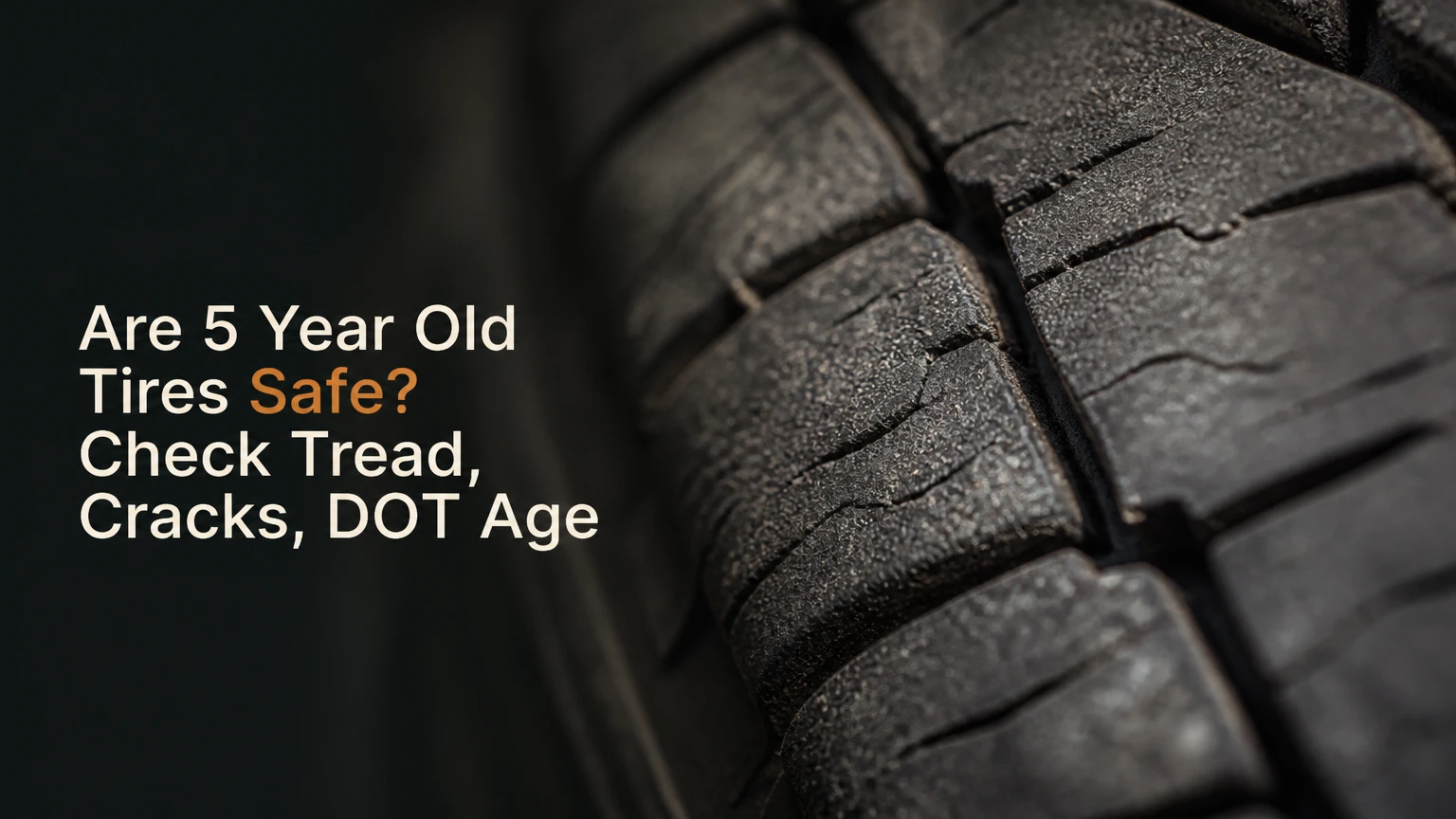
Five-year-old tires can be safe to drive on when they have sufficient tread, correct inflation, no structural damage or age cracking, and a sound inspection history. Tire age alone does not automatically make a tire unsafe, but five years is the point at which annual professional inspections become especially important and replacement planning should begin.
Key Facts at a Glance
- Tire age begins at the week of manufacture shown by the four-digit DOT date code, not the purchase date.
- The U.S. Department of Transportation does not impose one universal rule requiring every tire to be discarded at 10 years.
- Tread depth of 2/32 inch, or 1.6 millimeters, is the common legal replacement limit in the United States, subject to local law.
- Tread at 4/32 inch, or about 3.2 millimeters, provides less wet-weather margin even when the tire remains legally usable.
- Sidewall cracks, bulges, exposed cords, belt separation, repeated pressure loss, or sudden vibration require immediate professional assessment.
- Michelin recommends removing tires from service at 10 years from manufacture, while other vehicle and tire manufacturers may recommend replacement sooner.
Can You Drive on Five-Year-Old Tires?
Yes, many five-year-old passenger-car tires remain serviceable, but a five-year-old tire deserves a condition-based decision rather than an automatic approval. A tire professional should inspect the tread, inner and outer sidewalls, bead area, valve stem, inflation pressure, wear pattern, and signs of belt or casing damage.
Age changes the risk profile because rubber compounds slowly oxidize even when a tire has low mileage. Heat, ultraviolet exposure, ozone, underinflation, vehicle loading, and long periods under a static load accelerate that process. A carefully stored tire in a temperate climate may be healthier than a heavily loaded tire exposed to desert heat, even if both have the same DOT age.
The correct answer is therefore: a five-year-old tire is potentially safe after inspection, not automatically safe because it still has tread. Do not drive on it until examined if it has visible cracking, a bulge, a wave-like tread, a persistent thump, steering vibration, or unexplained pressure loss.
A practical five-year decision rule
| Tire condition at five years | Recommended decision | Reason | Typical next action |
|---|---|---|---|
| 6/32 inch tread, no cracks, stable pressure | Usually continue | Good wear and condition margin | Inspect every 6-12 months |
| 4/32-5/32 inch tread, no damage | Plan replacement | Reduced wet-weather reserve | Replace before heavy rain or winter |
| 3/32 inch tread with visible weather cracks | Replace now | Age and low tread compound risk | Fit matching, correctly rated tires |
| Any bulge, exposed cord, or belt shift | Do not drive | Possible casing failure | Use roadside assistance or spare |
| 8/32 inch tread but deep sidewall cracks | Replace now | Tread depth cannot show casing condition | Have a shop document the failure |
| Unknown age or unreadable DOT date | Treat as high uncertainty | Service history is incomplete | Inspect date on opposite sidewall |
How Does a Tire Age Even When It Is Not Driven?
Tire aging is a chemical and mechanical process that continues during storage. Oxygen gradually reacts with rubber and bonding materials, while heat increases reaction speed; repeated flexing, ultraviolet light, ozone, moisture, and static loading can then worsen surface and internal deterioration.
Aging may reduce elasticity in the sidewall and tread compound. The result can include fine cracks in the sidewall, cracking at the base of tread grooves, stiff ride quality, weakened bonding between rubber layers, and eventual separation between steel belts and surrounding rubber. Internal damage is not always visible from outside.
A parked car can also create a different stress pattern from a daily driver. A tire that supports the same vehicle weight for months may develop flat-spotting or localized deformation, while a tire used regularly experiences flexing that keeps its compound mobile. Regular driving does not stop aging, however, and it does not repair damage caused by heat, underinflation, impact, or ozone.
What conditions accelerate tire aging?
| Exposure or use condition | Typical effect | Inspection implication | Higher-risk example |
|---|---|---|---|
| High sustained heat above 90°F | Speeds oxidation and pressure-related stress | Check pressure monthly | Sun-exposed vehicle in Arizona |
| Direct sunlight and UV | Dries and cracks exposed sidewalls | Inspect shaded sidewall areas too | Convertible parked outdoors |
| Ozone near electrical equipment | Promotes surface cracking | Look for circumferential cracks | Garage beside motors or welders |
| Underinflation | Raises flexing and heat generation | Measure cold pressure with a gauge | Tire 8 psi below placard pressure |
| Static loading for months | Encourages flat-spotting and casing stress | Check for thumps and waves | Stored RV or trailer |
| Salt, chemicals, and petroleum products | Can attack rubber surfaces | Wash contamination promptly | Tire exposed to solvents |
| Climate-controlled indoor storage | Reduces UV and heat exposure | Still track manufacture date | Mounted spare in a dry garage |
How Do You Read the DOT Tire Date Code?
The last four digits of the DOT date code identify the tire’s manufacture week and year. A code ending in 2121 means the tire was manufactured in the 21st week of 2021, generally around late May 2021, and its age should be calculated from that production period.
The complete DOT identification string may appear on only one sidewall. If the visible sidewall ends before the four-digit date, inspect the inner sidewall or ask a tire shop to read it safely. Do not confuse a tire’s DOT identification number with its purchase date, installation date, model number, or load index.
Use this calculation:
Approximate tire age = current date minus the manufacture week and year.
For example, a tire marked DOT XXXX 1820 was made in the 18th week of 2020. A tire bought in 2022 could already have been approximately two years old at sale. Tire Rack and several manufacturers advise consumers to check production age when buying tires, especially used or discounted inventory.
What should you record from the sidewall?
Record the four-digit date, tire size, load index, speed rating, brand, model, and any visible damage. The size might read 225/65R17 102H: 225 is section width in millimeters, 65 is aspect ratio, R identifies radial construction, 17 is wheel diameter, 102 is load index, and H is speed rating.
The date code does not tell you the tire’s remaining safety by itself. It establishes the age that must be combined with inspection findings, service conditions, and manufacturer guidance.
Is Tread Depth More Important Than Tire Age?
Tread depth and tire age are separate safety variables, so neither one can replace the other. A nearly new tire with a sidewall bulge is unsafe, while a five-year-old tire with 6/32 inch tread may be serviceable if its casing and rubber remain sound.
Measure tread depth with a tread-depth gauge at several points across each tire. Check the inner, center, and outer ribs because alignment, worn suspension parts, underinflation, and overinflation can produce uneven wear that a single measurement misses.
The 2/32-inch benchmark is widely used for legal minimum tread in the United States, but legal requirements vary by jurisdiction and vehicle category. The National Highway Traffic Safety Administration, or NHTSA, identifies worn tread, underinflation, overloading, and tire damage as important tire-safety concerns. Legal compliance is not the same as a comfortable safety margin.
Tire industry guidance often treats 4/32 inch as a practical wet-weather planning threshold because deeper grooves evacuate more water. That threshold is not a universal legal limit, and wet braking depends on speed, water depth, temperature, compound, vehicle ABS calibration, and road surface.
How should you test tread?
- Set a quality tread-depth gauge to zero.
- Measure at least three locations across each major groove.
- Repeat at four or more positions around the tire.
- Record the lowest reading, not the average.
- Replace or professionally assess tires at or below the applicable legal limit.
- Plan replacement when tread approaches 4/32 inch before a wet season or long trip.
The penny or quarter test is a rough screening method, not a substitute for a gauge. Coin tests can miss uneven wear and do not measure sidewall age cracking, internal separation, or correct pressure.
What Visual Damage Means a Five-Year-Old Tire Is Unsafe?
A five-year-old tire should be removed from service when it has a bulge, exposed cord, deep weather cracking, tread separation, a cut that reaches structural material, repeated pressure loss, or a deformation that changes while rotating. These defects indicate possible casing or bonding failure, and no amount of remaining tread makes them safe.
Inspect with the tires clean and properly illuminated. Examine the full outer sidewall, tread grooves, shoulder, bead area, and valve stem. Have a shop inspect the inner sidewall because damage can face the suspension and remain invisible from outside.
Warning signs and likely causes
| Symptom | Possible cause | Driving status | Required response |
|---|---|---|---|
| Sidewall bulge | Impact damage or broken cord | Do not drive | Replace the tire |
| Fine surface cracks | Weather checking or ozone aging | Limit driving until assessed | Professional inspection |
| Deep cracks at tread grooves | Rubber aging or flex fatigue | Avoid highway speeds | Replacement commonly required |
| Raised or sinking tread section | Belt separation | Do not drive | Replace immediately |
| Rhythmic thumping | Separation, flat-spot, or imbalance | Stop if persistent | Inspect tire and wheel |
| Steering vibration at 50-70 mph | Imbalance, bent wheel, or belt issue | Reduce speed and investigate | Balance and structural check |
| Tire loses pressure weekly | Puncture, valve, bead, or casing leak | Do not ignore | Leak test and repair decision |
| Exposed steel or fabric | Excessive wear or damage | Do not drive | Immediate replacement |
Surface discoloration alone is not a reliable failure diagnosis. A brown or gray appearance can result from antiozonant migration, cleaning chemicals, or weathering, while cracks and deformation provide more meaningful evidence.
Does a Five-Year-Old Spare Tire Need Replacement?
Yes, a spare tire needs its own age and condition assessment because low mileage does not protect it from aging. A full-size spare mounted beneath an SUV or attached to a rear door may experience rain, road salt, ozone, heat, and ultraviolet exposure for years without being inspected.
A temporary compact spare has additional limits. Its small diameter, high inflation pressure, narrow tread, speed restriction, and limited distance rating make it an emergency-use device, not a permanent replacement. Check the vehicle manual and the molded sidewall instructions before driving on one.
Inspect the spare at every oil service or at least twice yearly. Check its DOT date, pressure, valve condition, cracks, mounting hardware, and accessibility. A spare that cannot be removed from a seized carrier is not an effective emergency solution.
Are Five-Year-Old RV and Trailer Tires Safe?
Five-year-old RV and trailer tires require more conservative treatment than many passenger-car tires because they can carry heavy static loads while spending long periods parked. Sun exposure, underinflation, sidewall flexing, and load concentration can cause deterioration before tread wears out.
Replacement timing is manufacturer-specific. Many RV specialists advise replacing tires around five to seven years, while some manufacturers use a six-year or ten-year service recommendation. Michelin’s published guidance recommends that tires be removed from service at 10 years from the date of manufacture, regardless of tread, and says tires should be inspected annually after five years of service.
That recommendation is not a universal U.S. legal expiration rule. NHTSA does not establish a single federal age at which every tire becomes illegal. The tire maker’s instructions, RV or trailer manufacturer’s load requirements, inspection findings, and local regulations control the practical decision.
Passenger car, RV, trailer, and spare comparison
| Application | Main aging stress | Typical replacement planning | Inspection frequency |
|---|---|---|---|
| Daily passenger car | Heat cycles, mileage, road impacts | When worn, damaged, or manufacturer age limit arrives | Every service and before trips |
| Low-mileage commuter | Long storage and low flexing | At five years, begin annual age review | At least annually |
| Motorhome | Static load, sun, underinflation | Often five to seven years by owner practice | Before every major trip |
| Travel trailer | Static load and sidewall stress | Often five to seven years | Before each season and trip |
| Full-size spare | Neglect and environmental exposure | Replace by condition and age | Twice yearly |
| Temporary spare | Age, high pressure, emergency use | Follow molded limit and vehicle manual | Twice yearly |
Are Five-Year-Old Used Tires Worth Buying?
Five-year-old used tires can be a poor value even when their visible tread looks attractive. The buyer receives less remaining age, unknown heat and load history, uncertain repair history, and no guarantee that all four tires have compatible wear or construction.
A used tire should have a readable DOT code, matching size and appropriate load and speed ratings, no repairs in prohibited areas, no inner-liner damage, no bead damage, and no cracking. Ask the seller to show the tire off the vehicle and to disclose its storage and service history.
The price difference should justify the reduced service life. Typical U.S. retail figures for four replacement passenger tires range from roughly $500-$1,200 installed, depending on size, brand, taxes, mounting, balancing, disposal, and alignment. A five-year-old used set may cost approximately $200-$600, but those figures are typical market ranges, not fixed prices. Installation and disposal can narrow the apparent savings.
| Purchase option | Typical installed cost for four | Remaining-age uncertainty | Best use case |
|---|---|---|---|
| New economy tires | $450-$700 | Low, if recently manufactured | Budget daily driving |
| New touring tires | $650-$1,100 | Low | Highway and family vehicles |
| New premium tires | $900-$1,600 | Low | Wet traction and severe climates |
| Five-year-old used set | $200-$600 | High | Short-term, low-mileage need |
| Two new tires only | $250-$800 | Moderate if axle matched | Replacing one damaged axle pair |
| RV or light-truck tires | $700-$1,800 | Low when new | Heavy loads and motorhomes |
Never mix tires with incompatible load ratings on a heavily loaded vehicle. On vehicles requiring only two replacement tires, the shop should follow the vehicle and tire manufacturer’s placement guidance, which commonly places the tires with greater wet traction on the rear axle.
What Should You Check Before a Long Trip?
Before a long trip, verify the DOT age, cold inflation pressure, tread depth, visible condition, spare, and load. A complete inspection usually takes 10-20 minutes at home, while a shop inspection, pressure adjustment, and rotation typically take 30-60 minutes.
Use the tire-pressure value on the driver-door placard or owner’s manual, not the maximum pressure molded into the sidewall. The placard value is matched to the vehicle’s design load and handling characteristics. Check pressure when the tires are cold, ideally before driving or after at least three hours parked.
Pre-trip checklist
- Read all four DOT dates. Replace any tire with unknown age before a remote trip.
- Measure tread depth. Record the lowest reading on each tire.
- Inspect both sidewalls. Look for cracks, cuts, bulges, and exposed cords.
- Check tread shoulders. Uneven wear can indicate alignment or suspension problems.
- Measure cold pressure. Adjust all tires, including the full-size spare.
- Check TPMS operation. A warning light requires diagnosis, not merely a reset.
- Inspect valve stems and caps. Leaks often originate at the valve or bead.
- Confirm load and speed ratings. Compare the sidewall markings with vehicle requirements.
- Test for vibration. A new thump or pull deserves inspection before highway driving.
- Recheck after loading. Heavy luggage can change required pressure and axle load.
Do not rely on a visual inspection after driving several miles because heat raises pressure and can temporarily mask a slow leak. Cold measurements are the useful baseline.
When Should You Replace Five-Year-Old Tires?
Replace five-year-old tires when inspection finds structural damage, serious weather cracking, tread at the legal limit, repeated pressure loss, severe uneven wear, or manufacturer-specific age guidance. If the tires pass inspection but have 4/32 inch or less tread, replacing them before a wet season is a prudent safety decision.
Replacement is also sensible when the vehicle has an unknown service history. A tire that spent five years on a sun-exposed trailer is not equivalent to a tire stored indoors as a climate-controlled spare. The DOT date establishes age, but exposure history determines how much that age matters.
Manufacturer guidance versus legal status
| Guidance source | Common position | What it means for drivers |
|---|---|---|
| NHTSA | No universal federal tire expiration age | Inspect condition and follow manufacturer guidance |
| Michelin | Remove from service at 10 years from manufacture | Treat 10 years as a firm manufacturer limit |
| Vehicle manufacturer | May specify six, eight, or ten years | Check owner’s manual and service information |
| Tire manufacturer | May require inspection after five years | Obtain model-specific recommendations |
| State or local law | May set rules for certain vehicles | Verify commercial, bus, or trailer requirements |
| Tire retailer | Provides inspection and replacement advice | Useful, but manufacturer guidance takes priority |
A professional inspection cannot guarantee a future failure-free period. It can identify visible and measurable warning signs, but some internal degradation may remain undetectable without specialized testing. That limitation is why conservative age policies exist.
What Are the Most Common Mistakes?
The most common mistake is treating tread depth as a complete safety certificate. Tread measures remaining groove depth, not rubber elasticity, belt adhesion, bead integrity, or damage on the inner sidewall.
Another mistake is using the purchase date. A tire purchased in 2025 may have been manufactured in 2023, so its age starts from the DOT week, not the receipt. Consumers should also avoid tire dressings containing petroleum distillates, which can damage rubber, and should never inflate a hot tire down to the placard pressure.
Three practitioner rules prevent many avoidable failures:
- Inspect the inner sidewall. The side facing the suspension often receives less cleaning and less visual attention.
- Treat new vibration as a fault. A balance problem is common, but belt separation must be excluded before continued highway use.
- Track all six tires. A neglected spare can be older and more hazardous than the four tires being driven.
Frequently Asked Questions
Are five-year-old tires with full tread safe?
Five-year-old tires with full tread may be safe, but full tread does not prove that the rubber and internal belts remain sound. Check the DOT age, sidewalls, tread grooves, pressure stability, wear pattern, and vibration history. A tire professional should inspect any tire stored outdoors, mounted on an RV, or showing cracking.
How long do tires usually last with low mileage?
Passenger tires commonly last about six to ten years by age, but mileage and condition vary substantially. Low mileage reduces tread wear but does not stop oxidation, ozone exposure, ultraviolet damage, or static-load stress. Follow the tire manufacturer’s age recommendation and arrange annual inspections once tires reach five years.
Can dry rot on a tire be repaired?
Dry rot, weather cracking, and age-related rubber deterioration cannot be repaired safely with a patch or sealant. A patch repairs certain punctures in the tread’s repairable area; it does not restore cracked sidewalls, degraded bonding, or weakened casing cords. Replace tires with deep or widespread age cracking.
Is 4/32-inch tread still legal?
Tread at 4/32 inch may remain legal in many jurisdictions because 2/32 inch is the commonly used U.S. minimum, but legality varies. Four thirty-seconds is a practical wet-weather replacement-planning point, not a universal legal threshold. Replace sooner if wear is uneven, the tire is aged, or driving conditions are rainy or snowy.
Should all four tires be replaced together?
Replacing all four tires together preserves similar tread depth and handling balance, especially on all-wheel-drive vehicles. If only two tires need replacement, follow the vehicle manufacturer’s instructions and have a tire professional determine axle placement, size compatibility, load rating, and whether tread-depth differences are acceptable.
Are old tires safe after being stored in a garage?
Garage storage reduces sunlight and rain exposure but does not stop tire aging. A five-year-old stored tire still needs a DOT-date check, pressure check, and inspection for cracks, deformation, bead damage, and contamination. Indoor storage improves the odds of serviceability, but it does not override the tire manufacturer’s age limit.
The Bottom Line
Are 5 year old tires safe? They can be, if a qualified inspection confirms adequate tread, stable inflation, intact sidewalls, no belt or casing damage, and suitable service history. Replace them immediately for bulges, exposed cords, deep cracks, tread separation, repeated air loss, or unexplained vibration. Use the DOT manufacture date, not the purchase date, and begin annual professional inspections at five years.


