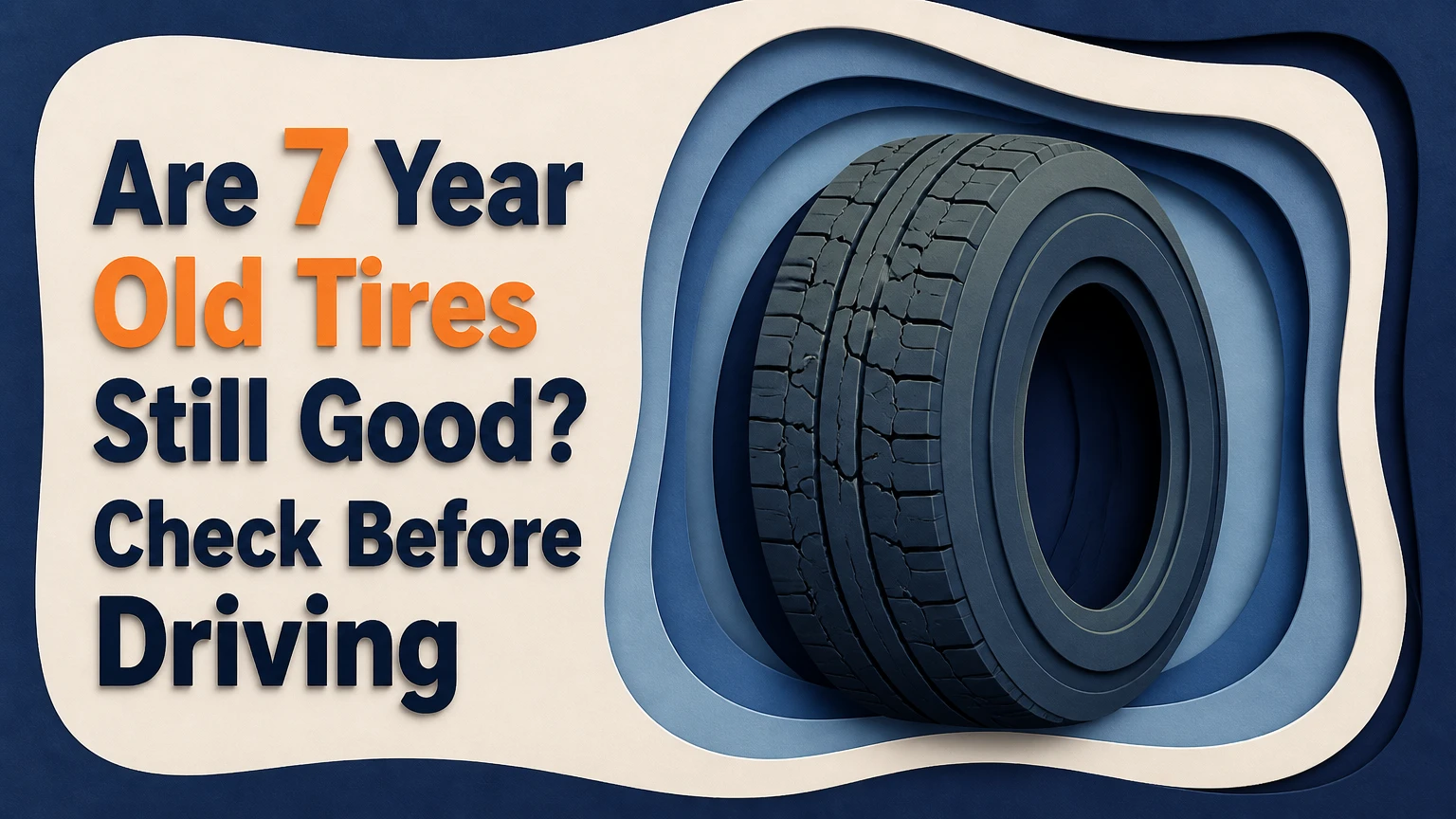
Seven-year-old tires are generally not a safe choice for normal driving, even when the tread looks deep. Rubber compounds lose elasticity through oxidation, heat, ozone, and repeated flexing, so the safest decision is to replace tires at seven years unless a qualified tire professional has just inspected them and the vehicle is used only for a short, low-speed trip to service.
Key Facts at a Glance
- A tire’s age begins at its date of manufacture, not the date of installation.
- The final four digits of the DOT code show the production week and year.
- Seven-year-old tires can have hidden belt, casing, or bonding damage beneath acceptable tread.
- Michelin recommends replacing tires 10 years after manufacture, while some vehicle manufacturers recommend replacement at six years.
- A bulge, exposed cord, deep sidewall crack, tread separation, or sudden vibration requires immediate removal from service.
- Tread depth of 2/32 inch is a replacement threshold, but adequate tread does not make aged rubber structurally safe.
Are 7-Year-Old Tires Still Good?
Seven-year-old tires are usually too old to keep in ordinary service, particularly on vehicles that travel at highway speeds, carry heavy loads, or operate in hot climates. Age alone does not prove that every tire will fail immediately, but seven years places the tire beyond the cautious replacement interval used by many manufacturers and safety professionals.
The decision should start with the tire’s manufacture date, then consider climate, storage, inflation history, mileage, damage, and tire type. A lightly used tire stored indoors may look better than a heavily used tire exposed to desert heat, but neither condition eliminates chemical aging.
A tire shop can inspect tread, sidewalls, beads, valve areas, pressure, and visible separation. No routine external inspection can guarantee that the internal belts and casing remain sound. For that reason, a professional may advise replacement even when the tire has no obvious defect.
A seven-year-old tire should not be treated as equivalent to a new tire with the same tread depth. The conservative answer is replacement. If replacement cannot happen immediately, avoid high-speed, long-distance, wet-weather, heavy-load, and towing use.
Why Do Tires Age Even When They Have Tread?
Tires age through thermo-oxidative degradation, a chemical process in which oxygen and ozone alter rubber polymers and protective additives. Heat, sunlight, flexing, low inflation, and long storage periods accelerate the loss of elasticity, which can reduce grip and weaken the bond between rubber and steel reinforcement.
The aging process affects several tire components:
- Tread compound: Hardening reduces wet traction and cold-weather flexibility.
- Sidewall rubber: Surface checking can develop where the sidewall repeatedly flexes.
- Belt skim and bonding layers: Separation can begin inside the tire without a visible surface warning.
- Inner liner and casing: Air retention and structural resilience may decline.
- Bead area: Mounting damage, corrosion, or age-related cracking can compromise the wheel seal.
Tire aging is not the same as tread wear. Tread wear removes rubber from the road-contact surface, while oxidation changes the rubber’s chemistry throughout the casing. A tire can therefore fail an age assessment while passing a tread-depth check.
Michelin states that it recommends replacement “10 years after the date of manufacture,” including for tires that appear usable. That is an upper recommendation, not a guarantee that every tire remains safe until its tenth birthday.
How heat and storage change the timeline
Heat speeds chemical reactions, and tire interiors become hotter when pressure is low, loads are high, speeds are sustained, or ambient temperatures are elevated. A tire used in Arizona, southern Texas, Florida, or other hot regions may age faster than a similar tire used in a mild climate, although there is no reliable public formula that converts temperature into a precise number of safe years.
Indoor parking slows UV exposure but does not stop oxygen-driven aging. A spare in a trunk, under a vehicle, or beside an exterior-mounted rear door can face heat and ozone even when it has never touched pavement.
How Do You Read a Tire’s Age?
Read the final four digits of the DOT Tire Identification Number on the sidewall. The first two digits identify the production week, and the last two digits identify the production year.
Use these steps:
- Find the sidewall marking that begins with DOT.
- Locate the final four-digit group, often molded inside a rounded rectangle.
- Read the first two digits as the week, from 01 through 52.
- Read the final two digits as the year.
- Compare the production date with the current date, not the vehicle registration date.
For example, a code ending in 2420 means the tire was produced during week 24 of 2020. In 2026, that tire is approximately six years old, becoming seven years old during week 24 of 2027.
The complete DOT marking may appear only on the inner sidewall. If the outer sidewall lacks the four-digit date, inspect the tire’s opposite side or ask a technician to identify it. Do not infer age from the vehicle’s model year, purchase receipt, or installation date.
| DOT date ending | Approximate manufacture date | Age in 2026 | Practical response |
|---|---|---|---|
| 1816 | Week 18 of 2016 | About 10 years | Replace regardless of tread |
| 2420 | Week 24 of 2020 | About 6 years | Arrange inspection or replacement |
| 3521 | Week 35 of 2021 | About 4-5 years | Inspect condition and monitor age |
| 0923 | Week 9 of 2023 | About 3 years | Assess wear, damage, and pressure |
| 4879 | Week 48 of 1979 | More than 46 years | Remove from road use immediately |
A three-digit date code indicates manufacture before 2000. Such a tire is far beyond any modern service recommendation and should not be driven. A missing or unreadable date code is also a reason to seek professional identification before relying on the tire.
What Does Tread Depth Tell You?
Tread depth tells you how much usable tread remains, but it does not certify the tire’s structural condition. In the United States, 2/32 inch, or approximately 1.6 millimeters, is commonly used as the legal minimum in many jurisdictions, while wet-weather performance can deteriorate well before that point.
Measure tread in several locations across each tire rather than relying on one groove. Compare the result with the tire’s molded wear bars, which typically appear when the remaining tread reaches the replacement threshold.
Replace a tire sooner when you find:
- Tread at or below 2/32 inch.
- Uneven wear across the inner, center, or outer ribs.
- Cupping, scalloping, or repeated high and low spots.
- Cracks at the groove base or between tread blocks.
- Tread separation, chunking, or missing rubber.
- A puncture in the shoulder or sidewall.
- Different tire sizes or incompatible speed and load ratings.
The penny test can provide a rough screening signal in the United States, but it cannot evaluate aging, pressure, alignment, casing damage, or belt separation. Treat it as a limited tread check, not a safety certificate.
Do Different Tire Types Age Differently?
All tire types age chemically, but their compounds, operating temperatures, and intended conditions change the practical risk. Winter tires often lose their most important traction characteristic, pliability, before they reach the visible wear limit.
| Tire type | Primary design feature | Seven-year concern | Recommended decision |
|---|---|---|---|
| All-season | Balanced compound for mixed conditions | Hardening reduces wet and cold grip | Replace for regular road use |
| Summer performance | Softer compound and high-speed handling | Heat cycling and oxidation reduce grip | Replace before performance driving |
| Winter or snow | Flexible compound for low temperatures | Hardened rubber loses ice and snow traction | Replace before another winter season |
| Run-flat | Reinforced sidewall for limited-pressure travel | Heat and casing stress compound aging | Professional inspection, replacement preferred |
| Trailer tire | Load-focused casing, often long parked periods | Sun, ozone, overloading, and underinflation | Replace conservatively at age |
| Full-size spare | Same construction as road tire | Trunk or underbody heat causes aging | Include in the replacement plan |
A tire category does not create a universal expiration date. Vehicle manufacturers, tire manufacturers, load conditions, and local regulations can differ. Winter tires deserve special caution because a tire can retain visible tread while no longer delivering the low-temperature flexibility for which it was designed.
Should You Replace Seven-Year-Old Tires or Get an Inspection?
Replace seven-year-old tires when the vehicle is used for highway travel, frequent rain, towing, heavy loads, mountainous roads, or high ambient temperatures. An inspection can help identify whether a tire is already damaged, but inspection does not reverse aging or establish a guaranteed remaining service life.
Published guidance varies:
- After five years: Michelin advises regular yearly inspection after five years from the manufacturing date.
- At six years: Several vehicle manufacturers recommend replacement at six years, but this is not a universal law.
- At ten years: Michelin and Continental publish ten-year replacement guidance, regardless of remaining tread.
- At seven years: The tire is already beyond the age at which many owners should plan replacement rather than continue ordinary use.
The six-year and ten-year figures are often confused. Six years may reflect a vehicle-maker recommendation for a particular model or market; ten years is commonly an outer manufacturer recommendation. Neither figure means a tire is safe in every condition until that exact date.
The National Highway Traffic Safety Administration has noted that tire aging is complex and that drivers should follow vehicle and tire manufacturer recommendations. NHTSA does not establish one universal replacement age for every tire.
What a professional inspection can and cannot find
A technician can assess inflation, tread, damage, wear pattern, wheel condition, valve components, visible cracking, and signs of separation. The tire may also be removed for an internal inspection if damage or low-pressure operation is suspected.
A shop cannot normally x-ray the tire or certify that every internal bond will remain intact for a specified period. A clean visual inspection means “no visible defect found,” not “guaranteed safe for another year.”
Can You Drive Seven-Year-Old Tires to a Tire Shop?
Drive only the shortest practical distance to a tire shop if the tires have no bulge, exposed cord, deep crack, active air loss, tread separation, or severe vibration. Use low speeds, avoid freeways, reduce cargo, check cold pressure, and arrange roadside assistance instead when a visible defect exists.
Do not drive on an aged tire that has:
- A sidewall bubble or bulge.
- A cut reaching the casing or cord.
- Steel or fabric cords showing.
- A tread section lifting from the casing.
- Rapid pressure loss.
- Strong pulling, thumping, or vibration after a recent impact.
- A flat tire that has been driven while deflated.
A temporary trip is not a justification for continued commuting. Heat builds inside a tire during speed and load, so a short city trip and a 100-mile freeway trip do not impose the same stress.
Which drivers should replace immediately?
| Driving situation | Added stress or exposure | Seven-year action | Safer alternative |
|---|---|---|---|
| Daily freeway commute | Sustained speed and heat generation | Replace before regular driving | New tires with correct ratings |
| Hot desert climate | Higher casing and pavement temperatures | Replace promptly | Fresh tires and monthly pressure checks |
| Frequent towing | High load and tire flexing | Replace before towing | Correct load-range tires |
| Occasional city use | Lower speed, but persistent aging | Replace soon, do not rely on low mileage | Professional inspection while arranging tires |
| Show car used on public roads | Long storage plus road loads | Replace before events | Modern tires with matching load rating |
| Vehicle stored off-road | Low road exposure, continuing aging | Do not assume stored tires are road-safe | Replace before returning to service |
What Signs Mean an Old Tire Has Failed?
Cracks, bulges, air loss, exposed cords, tread separation, or unexplained vibration indicate that an aged tire should be removed from service. These defects can result from oxidation, impact damage, underinflation, overload, or separation between internal layers.
Inspect all four tires and the spare in good light. Look at both sidewalls, the tread grooves, the shoulder, and the area near the rim. A tire that repeatedly loses pressure needs diagnosis, even if the puncture is not obvious.
| Warning sign | Likely issue | Driving advice | Required action |
|---|---|---|---|
| Fine sidewall cracks | Weather checking or oxidation | Avoid high-speed travel | Replace after professional assessment |
| Deep cracks in grooves | Compound or casing deterioration | Do not continue normal use | Replace the tire |
| Bulge or blister | Broken internal plies | Do not drive | Install spare or use towing |
| Tread lifting or flaking | Separation or chunking | Stop driving | Replace and inspect the axle |
| Repeated vibration | Balance, wheel, belt, or casing issue | Slow down and stop if persistent | Tire and wheel diagnosis |
| Exposed steel or fabric | Severe wear or structural damage | Do not drive | Immediate replacement |
| Uneven shoulder wear | Misalignment or underinflation | Limit driving | Correct pressure, alignment, and tire |
A vibration is not automatically proof of age-related separation. Bent wheels, failed suspension parts, poor balance, and uneven wear can produce similar symptoms. The correct response is prompt diagnosis rather than continued operation based on guesswork.
How Much Does Replacement Usually Cost?
A typical passenger-car tire replacement costs about $80-$250 per tire, while larger SUVs, performance vehicles, run-flats, and specialty tires can exceed $300 per tire. Mounting, balancing, valve service, disposal, taxes, alignment, and roadside assistance can add to the invoice.
| Expense | Typical passenger-car range | Typical SUV or specialty range | Timing |
|---|---|---|---|
| Tire purchase, each | $80-$250 | $150-$350+ | Same day to several days |
| Mount and balance, each | $20-$50 | $25-$70 | 30-60 minutes |
| Tire disposal, each | $3-$10 | $5-$15 | At installation |
| Four-wheel alignment | $90-$200 | $110-$250 | 45-90 minutes |
| Roadside towing | $75-$200 locally | $100-$300+ longer distance | Immediate service |
| Full-size spare replacement | $100-$300 | $150-$400+ | Often overlooked |
Prices vary by region, tire size, brand, speed rating, and shop. Replacing only two tires may cost less immediately, but the newer tires normally belong on the rear axle of a front-wheel-drive vehicle when the vehicle manufacturer permits a two-tire replacement. Confirm the correct fitment with the installer and owner’s manual.
Do not select a cheaper tire with a lower load index or speed rating than the vehicle requires. A tire’s age decision and its fitment decision are separate safety checks.
Is Keeping Seven-Year-Old Rubber Ever Reasonable?
Keeping seven-year-old tires is reasonable only for a stationary display vehicle or for a controlled, very short move where replacement is already scheduled. Seven-year-old tires are not a sensible cost-saving choice for normal commuting, long trips, wet roads, towing, or emergency driving.
The common argument for keeping them is remaining tread. That argument fails when the tire’s casing has aged, the compound has hardened, or the cost of a failure includes vehicle damage, towing, missed work, or injury. Low annual mileage reduces wear but does not stop oxidation.
Insurance also requires precision. Tire age does not automatically void every insurance claim. Coverage depends on the policy, jurisdiction, crash facts, maintenance condition, and whether negligence contributed to the loss. A severely deteriorated tire can still complicate a claim or create liability, so replacement is a risk-control decision rather than an insurance loophole.
Practitioner rules that prevent avoidable failures
- Date the spare when dating the road tires. A full-size spare may be older than the tires currently installed.
- Check pressure monthly and before long trips. Underinflation increases flexing heat, which accelerates casing stress.
- Replace tires as an axle-matched set when possible. Matching size, model, construction, and wear improves predictable handling.
- Treat a vibration after an impact as a defect until proven otherwise. Rebalancing may not repair internal damage.
- Read the owner’s manual before replacing two tires. Some all-wheel-drive systems require closely matched rolling circumference.
What Should You Do Today?
Confirm the DOT date, inspect every tire and the spare, measure tread in multiple locations, and compare the tire size, load index, and speed rating with the vehicle placard. If the tires are seven years old, schedule replacement rather than planning another season of ordinary use.
Use this decision sequence:
- Check for immediate defects. Do not drive with a bulge, exposed cord, major crack, separation, or rapid air loss.
- Decode the date. Record the week and year from the final four DOT digits.
- Check pressure cold. Inflate to the vehicle placard specification, not the maximum molded on the sidewall.
- Measure and inspect wear. Look for 2/32-inch tread, irregular wear, cracking, and damage.
- Review the use case. Highway speed, heat, towing, heavy cargo, and rain favor immediate replacement.
- Arrange the correct tires. Match size, construction, load index, speed rating, and seasonal needs.
- Replace the spare or document its limit. Do not leave an aged emergency tire as the backup plan.
FAQ
Do tires expire if they are never used?
Unused tires still age because oxygen, ozone, heat, and time alter rubber compounds without road mileage. Indoor, dark, temperature-controlled storage slows some damage, but it does not stop chemical aging. Check the DOT date on unused tires, including spare tires, and follow the tire manufacturer’s replacement guidance.
Are tires from 2019 safe in 2026?
Tires manufactured in 2019 are approximately six to seven years old in 2026, depending on their production week. Age alone does not prove immediate failure, but regular highway use, hot climate exposure, cracking, low pressure, or heavy loads strongly support replacement rather than continued service.
Can old tires pass inspection?
Old tires can pass a visual or legal inspection if tread depth, pressure, and visible condition meet the local standard. A pass does not prove that hidden internal bonding remains strong. Ask the inspector to record the DOT age and visible condition, then apply the tire and vehicle manufacturer’s age guidance.
Are seven-year-old winter tires safe for snow?
Seven-year-old winter tires are a poor choice for snow because winter compounds depend on flexibility at low temperatures. Rubber hardening reduces ice and packed-snow traction even when the tread pattern remains deep. Replace old winter tires before the season, especially when cracks, uneven wear, or reduced cold-weather grip appears.
Can a spare tire be older than the other tires?
A spare tire can be older than the four road tires because it often remains in a trunk, underbody carrier, or exterior mount for years. Heat, ozone, sunlight, and lack of pressure checks can degrade it without mileage. Read its DOT date and replace it when its age or condition exceeds manufacturer guidance.
Does a garage prevent tire dry rot?
A garage reduces direct UV exposure and usually lowers temperature swings, but garage storage does not prevent oxidation or ozone damage. Keep stored tires clean, away from electric motors and ozone-producing equipment, properly inflated when mounted, and protected from petroleum products. Age remains a separate replacement factor.
The Bottom Line
Are 7 year old tires still good? Usually not for normal road use. Seven-year-old tires may retain tread while losing rubber elasticity and internal structural strength, so the prudent choice is to replace them, especially before highway travel, winter driving, towing, or use in a hot climate. Verify the DOT date, inspect for defects, and use a qualified tire professional when a short trip to the shop is unavoidable.