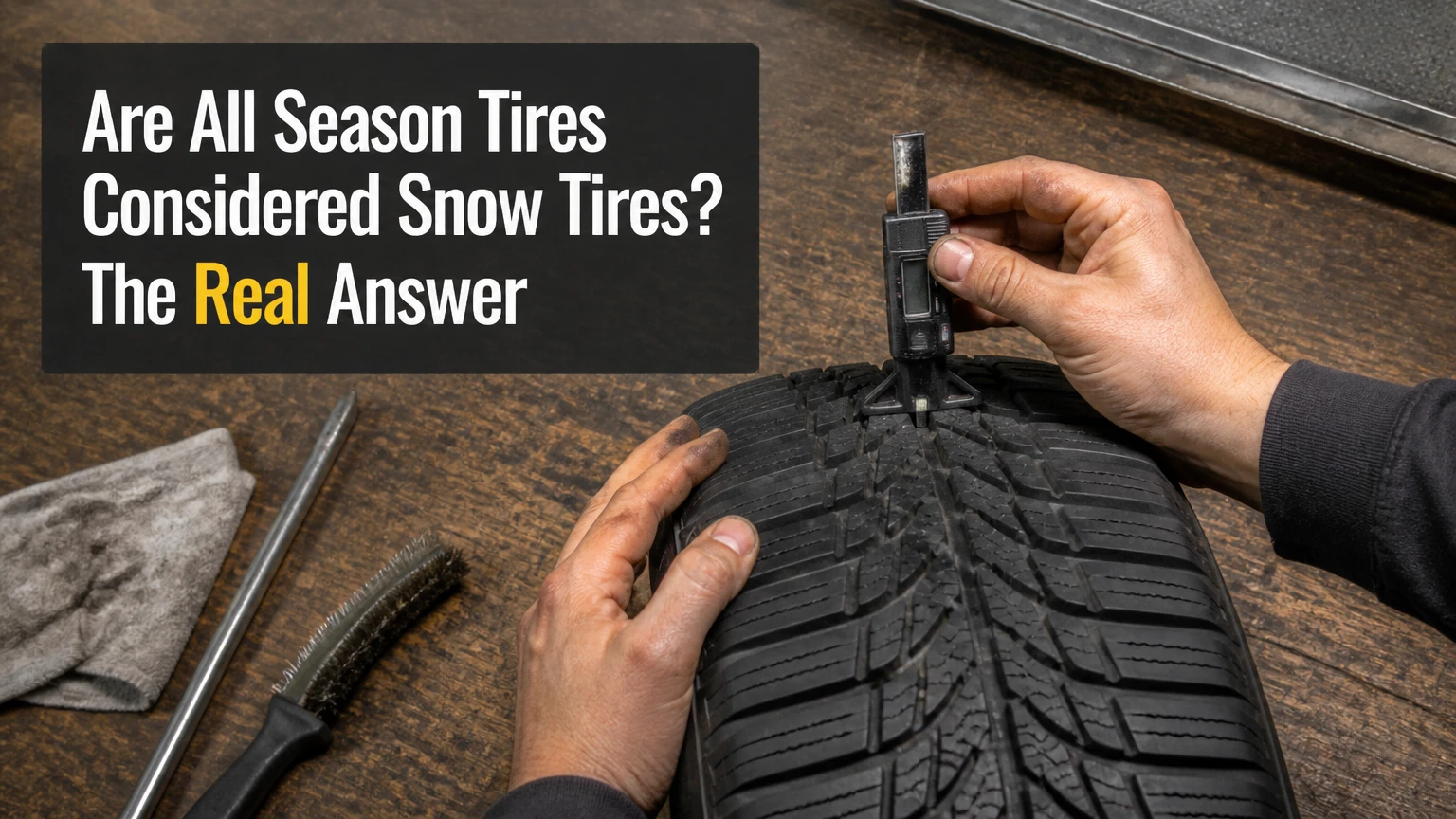
No, all-season tires are not automatically considered snow tires. Standard all-season tires are designed for dry roads, rain, and occasional light snow, while winter tires use cold-flexible compounds and heavily siped tread for snow and ice. An all-weather tire with the Three-Peak Mountain Snowflake symbol is a separate exception.
Key Facts at a Glance
- Standard all-season tires are not dedicated snow or winter tires.
- Winter tires remain more flexible than all-season tires in sustained cold, commonly below 45°F (7°C).
- The Three-Peak Mountain Snowflake, or 3PMSF, identifies a tire that meets a defined severe-snow traction test.
- The M+S marking alone does not prove winter performance on ice or packed snow.
- All-wheel drive improves acceleration, but tire traction still controls braking and cornering.
- Drivers who regularly encounter snow, ice, or temperatures below freezing usually gain more safety from four matching winter tires.
Are All Season Tires Considered Snow Tires?
All-season tires are not legally or technically identical to snow tires in most tire classifications. “Snow tire” is the common North American term for a winter tire, whereas “all-season” describes a compromise tire intended to operate across several seasons without a scheduled tire change.
The important exception is the all-weather category. Some all-weather tires carry both an all-season marketing label and the 3PMSF symbol, giving them verified severe-snow capability that ordinary all-season tires lack. The sidewall symbol matters more than the phrase “all season” on the product name.
A standard all-season tire can provide useful traction in a shallow snowfall when pavement remains warm and roads are promptly cleared. That capability does not make the tire equivalent to a winter model during freezing temperatures, packed snow, black ice, or repeated storms.
What makes a tire a snow tire?
A snow tire, more accurately called a winter tire, is engineered for cold-weather traction. Its compound remains pliable at low temperatures, while its tread uses deeper grooves, flexible blocks, and dense siping to create more edges against snow and ice.
Winter tires are not defined by tread depth alone. A new all-season tire may have deeper tread than a worn winter tire, yet the winter tire can still grip better because its compound and tread block behavior remain suitable in cold conditions.
How Do All-Season and Winter Tires Differ?
All-season tires prioritize year-round convenience, tread life, low noise, and balanced wet and dry handling. Winter tires prioritize cold-weather braking and traction, accepting faster warm-weather wear, more noise, and the cost of seasonal installation.
| Feature | Standard all-season | All-weather 3PMSF | Studless winter |
|---|---|---|---|
| Typical operating focus | 45-95°F | 20-95°F | Below 45°F |
| Severe-snow symbol | Usually absent | Present | Present |
| Siping level | Moderate | High | Very high |
| Warm-weather use | Year-round | Year-round | Seasonal only |
| Typical tread warranty | 50,000-80,000 miles | 40,000-60,000 miles | Often none or limited |
| Ice traction priority | Low to moderate | Moderate | High |
Why does the rubber compound matter?
Tire rubber becomes less flexible as temperatures fall, but there is no universal instant at which every all-season tire suddenly stops working. The 45°F guideline is a practical industry rule for comparing seasonal tire behavior, not a mechanical on-off threshold.
Winter tires use compound formulations designed to retain flexibility in cold conditions. All-season compounds are harder and more heat-resistant, which helps tread life and steering stability in summer but can reduce grip as winter temperatures fall.
The effect is most noticeable during braking and cornering. A driver may still accelerate on an all-season tire in cold weather, especially with AWD, yet have substantially less reserve when stopping for a traffic light or avoiding a vehicle.
Why does tread design matter?
All-season tread patterns balance water evacuation with continuous road contact. Their grooves remove rain, but their tread blocks generally have fewer and less flexible biting edges than winter designs.
Winter tires use narrow sipes that open and close as the tread contacts the road. The sipes create edges for packed snow and help the tread conform to irregular icy surfaces. Deep circumferential grooves also help move slush away from the contact patch.
Snow traction is not created by empty grooves alone. Tread flexibility, block arrangement, contact pressure, temperature, and the surface beneath the snow all affect the result.
How Much Snow Can All-Season Tires Handle?
All-season tires can handle light, occasional snow when speeds are moderate, tread is healthy, and roads are cleared quickly. Standard all-season tires become a poor choice when snow is deep, temperatures remain below freezing, roads are packed or icy, or the vehicle must travel before plows and salt trucks arrive.
A practical boundary is more useful than a universal snow-depth number. A few inches of fresh, loose snow over warm pavement may be manageable, while a thin layer of polished ice can defeat even a relatively new tire. The driver’s route and stopping requirements matter more than the forecast alone.
Avoid treating an all-season tire’s remaining tread as a winter rating. At 4/32 inch of tread, many tire professionals recommend replacement for wet-weather performance, and winter traction may become unacceptable well before the legal minimum tread depth.
Does M+S mean a tire is suitable for snow?
M+S means Mud and Snow, but the marking does not represent the same severe-snow test as 3PMSF. The U.S. Tire Manufacturers Association explains that M+S is based primarily on tread geometry, while 3PMSF indicates performance against a standardized snow-traction reference.
Many all-season, all-terrain, and crossover tires carry M+S. Some perform competently in moderate snow; others are optimized mainly for dry pavement or off-road durability. The marking cannot tell you how a tire will brake on ice.
What Does the Three-Peak Mountain Snowflake Mean?
The Three-Peak Mountain Snowflake symbol identifies a tire that has met a regulated severe-snow traction threshold. In the United States, the designation is associated with the ASTM F1805 snow-traction test, and the tire must achieve at least 110% of the traction of a standardized reference tire.
3PMSF does not mean “best in every winter condition.” The test measures longitudinal snow traction, not every aspect of ice braking, lateral grip, slush resistance, or vehicle stability. A 3PMSF all-weather tire remains a compromise compared with a dedicated winter tire.
| Sidewall marking | Meaning | What it does not prove | Typical tire categories |
|---|---|---|---|
| No winter marking | Manufacturer’s standard classification | Snow or ice capability | Touring all-season |
| M+S | Mud-and-snow tread designation | Severe-snow traction | All-season, A/T, SUV |
| 3PMSF | Meets severe-snow traction threshold | Superior ice braking | All-weather, winter |
| Stud symbol or studs | Metal inserts for ice traction | Legal use in every region | Studded winter |
Are all-weather tires winter tires?
All-weather tires are not identical to dedicated winter tires, although 3PMSF all-weather tires are more winter-capable than ordinary all-season tires. They combine a cold-tolerant compound and winter-oriented tread with a construction that remains acceptable for spring, summer, and fall driving.
All-weather tires suit drivers who face occasional snow but do not want two tire sets. They generally produce more road noise, wear faster in hot weather, and provide less ice traction than a dedicated winter tire.
In regions with frequent snow and prolonged freezing conditions, all-weather tires are a convenience compromise rather than a full substitute for winter tires. In a moderate climate, they can be the most practical single-set option.
Which Tire Stops Better on Snow and Ice?
Dedicated winter tires normally stop and corner better than standard all-season tires on snow and ice, particularly when the pavement is cold. The exact stopping-distance advantage varies with temperature, vehicle, speed, tire condition, snow type, and test surface, so a universal 30-40% improvement should not be treated as guaranteed.
The difference is often largest during emergency braking. Winter tires keep more contact with the road as the tread compound flexes, while all-season tread can become stiff and slide earlier.
Ice is an especially demanding surface. Neither tire category can create dependable grip on glare ice, but a studless winter tire or approved studded tire gives the driver more traction margin than an ordinary all-season tire.
Can AWD make all-season tires safe in winter?
AWD cannot replace winter tires because the drivetrain controls power delivery, not the tire’s friction against the road. AWD can help a vehicle accelerate through snow, but it cannot provide the same improvement during braking or cornering.
This distinction creates a common crash pattern. An AWD vehicle on all-season tires may pull away from a snowy intersection confidently, then fail to stop when the driver reaches an icy crosswalk. The tires remain the limiting interface.
AWD, winter tires, speed control, and adequate following distance work together. None removes the need for the others.
What Do All-Season and Winter Tires Cost?
Typical retail prices range from about $100-$220 per all-season tire and $120-$280 per winter tire for common passenger cars, excluding wheels, taxes, installation, and storage. A complete seasonal setup often adds $120-$240 per year for two tire changes and balancing, plus $80-$200 for storage where a shop provides it.
| Expense | All-season setup | Winter setup with existing wheels | Winter setup with second wheels |
|---|---|---|---|
| Four replacement tires | $400-$880 | $480-$1,120 | $480-$1,120 |
| Seasonal mounting and balancing | $0-$120 annually | $120-$240 annually | $80-$160 annually |
| Steel wheel set | $0 | $0 | $300-$700 |
| Seasonal storage | Usually $0 | $80-$200 | $80-$200 |
| Typical first-year total | $400-$1,000 | $680-$1,560 | $940-$2,180 |
All-season tires often carry warranties of 50,000-80,000 miles, while winter tires commonly have shorter or no mileage warranties because seasonal use, compound softness, and storage affect wear. A winter tire can last four to five seasons if removed during warm weather and stored correctly, but annual mileage determines the actual lifespan.
Cost comparisons should include more than the tire invoice. A second wheel set reduces mounting frequency, protects tire beads, and shortens seasonal appointments, but it increases the initial purchase price.
When Should Drivers Switch Tires?
Drivers should install winter tires before sustained temperatures regularly fall near 45°F (7°C), rather than waiting for the first snowstorm. Removal is usually appropriate when spring temperatures remain consistently above that range and severe winter conditions have ended.
Local weather patterns matter more than calendar dates. A driver in Minneapolis may switch in October or November and remove winter tires in March or April, while a driver in Vancouver, Seattle, or the Mid-Atlantic may choose all-weather tires to avoid two annual changes.
Check local laws before choosing studded tires. Some jurisdictions restrict stud use by date, road type, or vehicle class, while others prohibit studs entirely.
Should winter tires be installed on only one axle?
Winter tires should be installed as a matching set of four, not only on the driven axle. Putting winter tires on the front of a front-wheel-drive vehicle can make the rear lose grip first during a turn, creating oversteer and possible spinout.
Installing winter tires only on the rear can preserve rear stability but leave the front with poor steering and braking traction. Tire manufacturers and vehicle safety organizations generally recommend four matching winter tires with the same size, construction, and compatible load and speed ratings.
For an all-wheel-drive vehicle, follow the manufacturer’s allowable circumference difference. Some AWD systems can be damaged when tires have significantly different rolling diameters.
What Happens If Winter Tires Stay on in Summer?
Winter tires wear substantially faster on warm, dry pavement because their softer compounds generate more friction and heat. Steering response can also become less precise, braking distances can increase on hot asphalt, and uneven wear may reduce the tires’ next-season performance.
Winter tires are not unsafe in every mild summer trip, but year-round use defeats their design purpose. A short emergency drive is different from leaving them installed for months.
Summer heat can also accelerate shoulder wear and tread squirm on heavier vehicles. Remove winter tires once sustained warm weather arrives, even if plenty of tread remains.
Which Drivers Should Choose Each Tire Type?
The correct choice depends on winter severity, driving schedule, road treatment, and tolerance for seasonal tire changes. A warm-climate commuter does not need the same equipment as a rural driver who leaves home before plows reach the road.
| Driver situation | Recommended tire | Why | Main limitation |
|---|---|---|---|
| Phoenix commuter | Standard all-season | Snow is rare and temperatures stay warm | Weak traction in an unusual freeze |
| Chicago urban driver | 3PMSF all-weather or winter | Cold, slush, and periodic snow | All-weather wears faster in heat |
| Rural Ontario commuter | Four winter tires | Packed snow and freezing roads are frequent | Seasonal cost and storage |
| Colorado mountain traveler | Winter tires plus chains where required | Cold grades and changing elevations | Chains may still be mandatory |
| Florida SUV owner | Standard all-season | Winter traction demand is minimal | No severe-snow capability |
Who should choose standard all-season tires?
Standard all-season tires fit drivers in warm climates, heavily maintained urban areas, and regions where snow is rare. They also suit vehicles that remain parked during winter storms rather than traveling through them.
They are not a sound choice for a driver who must commute at dawn after repeated freezes. The purchase saves seasonal labor, but that convenience has a traction cost when conditions move beyond light snow and wet pavement.
Who should choose all-weather tires?
All-weather tires suit transitional climates with rain, occasional snow, and temperatures that sometimes remain below freezing. The 3PMSF symbol should be present when severe-snow capability matters.
Choose a model with the vehicle manufacturer’s approved size and load rating. Do not assume that every tire marketed as “four season,” “all climate,” or “all weather” carries the same certification.
Who should choose dedicated winter tires?
Dedicated winter tires are the strongest choice for frequent snow, ice, prolonged freezing temperatures, steep roads, untreated rural routes, and drivers who cannot postpone trips. Four matching tires on a second wheel set make seasonal changes simpler and preserve the winter compound.
Dedicated winter tires are not a substitute for cautious driving. They improve available traction, but they cannot make excessive speed, poor visibility, or black ice safe.
What Winter Tire Problems Should Drivers Troubleshoot?
Winter performance problems usually come from pressure loss, mismatched tires, worn tread, packed snow, or incorrect seasonal timing. Drivers should inspect the tires before blaming the vehicle’s AWD system or electronic stability controls.
| Symptom | Likely cause | Immediate check | Corrective action |
|---|---|---|---|
| TPMS warning | Cold-weather pressure drop | Measure cold pressure | Inflate to door-jamb specification |
| Highway vibration | Snow or ice inside wheel | Inspect wheel barrels | Remove packed material |
| Rear stepping out | Winter tires on front only | Compare axle tire types | Install four matching tires |
| Poor acceleration | Worn tread or packed snow | Measure tread depth | Replace or clear tread |
| Steering feels vague | Winter tires used in heat | Check ambient temperature | Change to all-season tires |
| AWD warning light | Rolling-diameter mismatch | Compare tire sizes and wear | Follow vehicle service guidance |
Tire pressure commonly falls about 1 psi for each 10°F temperature decrease, although the exact change depends on initial temperature and air conditions. Check pressure at least monthly and before long trips, using the placard inside the driver’s door rather than the maximum pressure molded into the sidewall.
What should drivers inspect before a snowstorm?
- Measure cold inflation pressure on all four tires.
- Confirm tread depth and inspect for cracks, bulges, and exposed cords.
- Verify that all four tires have compatible size, load index, and speed rating.
- Clear snow and ice from wheel wells and wheel barrels.
- Check that the spare tire, jack, scraper, and emergency kit are usable.
- Review local chain, stud, and winter-tire requirements before mountain travel.
A tire with adequate tread can still be unsuitable if it is aged, damaged, incorrectly inflated, or installed against the vehicle manufacturer’s specifications.
Are All Season Tires Considered Snow Tires? Final Verdict
No, standard all-season tires are not considered snow tires because their compound and tread are designed for broad year-round use rather than severe cold, packed snow, and ice. Choose ordinary all-season tires for warm climates, 3PMSF all-weather tires for moderate mixed weather, and four dedicated winter tires for frequent or severe winter driving.
Frequently Asked Questions
Are all-season tires safe in light snow?
All-season tires can be adequate in light, fresh snow when temperatures are moderate, tread is healthy, roads are treated, and the driver reduces speed. All-season tires become less dependable on packed snow, freezing rain, polished ice, deep accumulation, and untreated roads where braking distance and cornering grip matter most.
Can I use snow tires on an SUV with four-wheel drive?
Yes, snow tires can be used on an SUV with four-wheel drive, provided the tire size, load index, speed rating, and rolling circumference meet the vehicle manufacturer’s requirements. Four-wheel drive and winter tires address different problems, so combining them improves acceleration and available braking traction without eliminating slippery-road risk.
Do new all-season tires work better in snow than worn winter tires?
A new all-season tire may outperform a severely worn winter tire because tread depth and condition matter, but that comparison does not make all-season tires winter tires. Against a properly maintained winter tire with usable tread, a standard all-season tire usually has less cold-weather flexibility and fewer snow-biting edges.
How long do winter tires last?
Winter tires commonly last four to five seasons when used only during cold months, stored indoors or in a cool dry place, and kept correctly inflated. Mileage, road temperature, vehicle weight, alignment, driving style, and tread depth determine replacement timing more accurately than a fixed calendar age.
Are tire chains better than winter tires?
Tire chains can provide stronger traction than ordinary tires in deep snow and are sometimes legally required on mountain roads, but they are not a universal replacement for winter tires. Chains require compatible clearance, reduced speeds, correct installation, and removal on bare pavement to avoid vehicle and road damage.