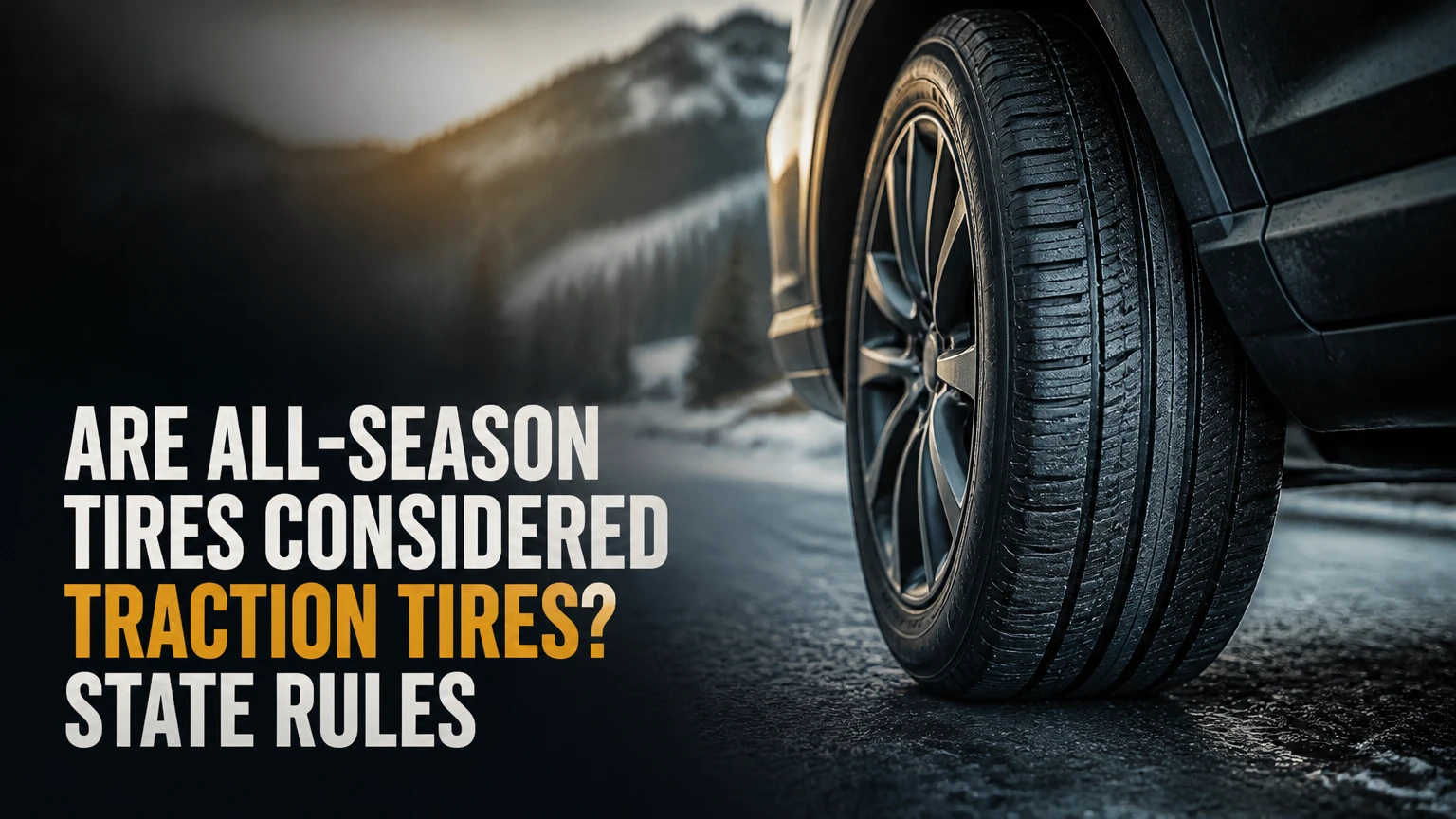
Standard all-season tires are not automatically considered traction tires. The answer depends on the tire’s sidewall marking, tread condition, the severity of the road-control event, and the jurisdiction’s legal definition. An all-season tire with M+S may satisfy rules in some states, while Oregon and similar jurisdictions generally require 3PMSF-rated or studded tires in specified chain-control situations.
Key facts at a glance
M+S indicates a mud-and-snow tread pattern; it does not certify severe-snow performance.
3PMSF means the tire passed a standardized severe-snow traction test administered under the tire industry’s qualifying procedure.
Washington and Montana may accept qualifying M+S tires for some traction-tire requirements, often with at least 1/8 inch of tread.
Oregon’s chain-control guidance generally gives 3PMSF or studded tires a stronger legal position than ordinary M+S all-season tires.
All-wheel drive improves acceleration but cannot create additional tire grip during braking or cornering.
A tire can be legally compliant and still provide less snow and ice control than a dedicated winter tire.
Are All-Season Tires Considered Traction Tires by Law?
All-season tires are legally considered traction tires only when they meet the definition used by the relevant state or road authority. The phrase “traction tire” does not have one universal meaning across the United States, so a tire accepted in Washington may not receive the same treatment in Oregon.
A legal definition can include a tread marking, a minimum tread depth, studs, or a severe-snow certification. Some rules apply only when signs activate a traction requirement, while others apply during a defined winter season. A driver crossing state lines must follow the rule for the road being traveled, not the rule from the vehicle’s home state.
The Oregon Department of Transportation’s TripCheck guidance distinguishes ordinary mud-and-snow tires from tires meeting the severe-snow standard used for traction-tire compliance. Washington State Department of Transportation guidance, by contrast, commonly recognizes qualifying tires marked M+S or bearing the mountain-snowflake symbol, while also imposing tread and chain-control requirements.
Why does the same tire qualify in one state but not another?
States write their own highway-control rules because snow, ice, mountain grades, commercial traffic, and enforcement practices differ. A legal label is therefore a location-specific compliance question, not a permanent property shared by every tire sold as all-season.
For example, an M+S all-season tire may meet a Washington traction-tire requirement if it has sufficient tread, yet fail an Oregon requirement that calls for a 3PMSF symbol or studs. Posted signs remain controlling even when the vehicle has all-wheel drive.
What Is the Difference Between M+S and 3PMSF?
M+S and 3PMSF are different sidewall designations with different evidentiary value. M+S describes tread geometry, whereas 3PMSF identifies a tire that passed a standardized snow-traction performance test.
| Marking | What it indicates | What it does not prove | Typical legal significance |
|---|---|---|---|
| M+S | Mud-and-snow tread pattern based on void geometry | Severe-snow braking, ice grip, or cold-compound flexibility | Accepted for some Washington and Montana requirements |
| 3PMSF | Severe-snow traction certification symbol | That the tire equals a dedicated winter tire on ice | Common qualification for strict traction rules |
| Stud symbol or visible studs | Mechanical ice-grip equipment | Legal use on every date or road | Often accepted, subject to seasonal restrictions |
| No winter marking | General highway tire design | Snow or ice suitability | Usually weak evidence for traction compliance |
The M+S designation does not require the same severe-snow test associated with 3PMSF. A conventional all-season tire can therefore carry M+S while offering modest performance on packed snow. The symbol is useful information, but it should not be treated as a winter-performance guarantee.
What does the 3PMSF symbol look like?
The 3PMSF symbol is a three-peaked mountain surrounding a snowflake. Tire manufacturers place it on the sidewall, often near the tire size, load index, and service description.
The designation is associated with a standardized snow-traction test for passenger and light-truck tires. It indicates that the tire achieved the required performance relative to a reference tire under defined conditions. It does not mean the tire is studded, optimized for glare ice, or appropriate for every mountain pass.
How Do All-Season Tires Behave in Winter?
All-season tires usually provide predictable wet and dry performance in moderate climates, but their snow and ice capability varies widely by model. Their tread compounds and block designs prioritize year-round durability, quietness, and warm-weather stability rather than maximum grip on frozen surfaces.
Does an all-season tire suddenly harden below 45°F?
No. The 45°F rule is an oversimplification, not a universal chemical switch. Tire compounds gradually lose flexibility as temperature falls, and the rate depends on the formulation, pavement, wear, inflation, and tire design.
All-season tires are not automatically unsafe at 44°F, and winter tires do not become useless at 46°F. The meaningful change occurs across a range of conditions, especially when cold pavement combines with snow, ice, or freezing rain. Winter compounds generally retain more flexibility at low temperatures, while all-season compounds normally offer better warm-weather wear and handling.
Which tread features matter on snow and ice?
Sipes, open grooves, block edges, compound flexibility, and contact pressure all affect winter traction. Sipes create additional biting edges and help manage snow, but siping alone cannot compensate for a hard compound or inadequate tread depth.
A worn all-season tire has less groove volume for slush evacuation and fewer usable block edges. Hydroplaning resistance also declines as tread wears, which matters because winter roads often contain water under melting snow.
How Much Tread Does a Traction Tire Need?
A common legal minimum in Washington and Montana is 1/8 inch, equal to 4/32 inch or approximately 3.2 millimeters, for tires used under certain traction requirements. That threshold is not universal, and it does not transform an otherwise nonqualifying tire into a legal traction tire.
| Tread measurement | Condition | Practical interpretation |
|---|---|---|
| 10/32-12/32 inch | New winter or all-terrain tire range | Strong groove depth, assuming sound compound |
| 6/32-8/32 inch | Usable winter-service range | Often adequate when evenly worn |
| 4/32 inch, 1/8 inch | Common legal traction threshold | May satisfy some state rules, but offers limited reserve |
| 2/32 inch | Common replacement limit | Unsafe for dependable snow and often legally insufficient |
| Below 2/32 inch | Worn beyond legal limit in many states | Replace immediately |
Measure tread in several grooves across each tire, not at one convenient point. Uneven wear, shoulder wear, cupping, exposed belts, sidewall damage, and age can make a tire unsuitable even when the deepest groove measures above 4/32 inch.
A tread-depth gauge costs typically $5-$15 and is more reliable than judging tread by appearance. The built-in wear bars indicate approximately 2/32 inch, not a recommended snow-driving threshold.
Which Tire Types Usually Qualify as Traction Tires?
3PMSF-rated all-weather tires, dedicated winter tires, and many studded tires usually have the strongest claim to traction-tire status. Standard all-season tires qualify only where the governing rule accepts their M+S marking and tread condition.
| Tire category | Common sidewall marking | Typical new tread | Typical set price | Best operating situation |
|---|---|---|---|---|
| Standard all-season | M+S, sometimes no 3PMSF | 10/32-11/32 in | $400-$900 | Rain, dry roads, light occasional snow |
| All-weather | M+S and 3PMSF | 10/32-12/32 in | $600-$1,100 | Mixed seasons with recurring snow |
| Studless winter | 3PMSF | 11/32-14/32 in | $500-$1,000 | Frequent snow, ice, and subfreezing roads |
| Studded winter | 3PMSF, installed studs | 11/32-14/32 in | $600-$1,200 | Severe ice and remote, untreated roads |
Prices are typical United States retail ranges for four tires before mounting, balancing, taxes, and disposal fees. Tire size, vehicle load rating, brand, rebates, and run-flat construction can move the total substantially.
Are all-weather tires the same as all-season tires?
All-weather tires are a winter-capable category between conventional all-season and dedicated winter tires. Most all-weather models carry 3PMSF and use more open, heavily siped tread patterns with compounds designed for lower temperatures.
The category name is not a legal standard by itself. Confirm the 3PMSF symbol and read the state rule. A tire marketed as “all weather” without 3PMSF should not be assumed to meet a severe-snow requirement.
Do winter tires always qualify?
Dedicated winter tires normally carry 3PMSF, so they generally meet traction-tire definitions that recognize the symbol. Studded tires may also qualify, but states can restrict stud use by date, vehicle type, road, or weather condition.
Oregon, for example, restricts studded-tire use seasonally and can still require chains or approved traction devices when conditions become severe. A winter tire is not a universal exemption from every chain-control order.
How Do State Traction-Tire Rules Differ?
State rules differ in their accepted markings, minimum tread, dates, and treatment of all-wheel-drive vehicles. The following examples illustrate the problem, but drivers should verify the current rule with the state transportation department before traveling.
| Location | Commonly recognized tire evidence | Tread or equipment issue | Important limitation |
|---|---|---|---|
| Washington | M+S or 3PMSF in applicable guidance | At least 1/8 inch is commonly specified | Chains can still be required at higher control levels |
| Oregon | 3PMSF, studs, or approved traction equipment under posted controls | Ordinary M+S may not satisfy stricter definitions | Follow TripCheck signs and current ODOT wording |
| Montana | M+S or 3PMSF may qualify in applicable rules | Tread-depth and posted-control requirements apply | Mountain routes can impose additional equipment rules |
| Colorado | 3PMSF, chains, or qualifying traction equipment depending on route | Passenger-vehicle requirements vary by corridor | I-70 traction laws can be stricter than general assumptions |
| California | Requirements vary by chain-control level | 3PMSF does not always eliminate carrying chains | Follow Caltrans signs, especially in the Sierra Nevada |
Can all-season tires meet Washington requirements?
Some M+S-marked all-season tires can meet Washington’s traction-tire definition when they have at least 1/8 inch of tread. Washington State Department of Transportation still permits chain requirements under severe conditions, and drivers must obey the displayed control level.
The legal answer does not equal the performance answer. A compliant M+S tire may accelerate adequately on shallow snow yet require substantially more distance to stop on polished ice than a 3PMSF winter tire.
Are all-season tires accepted in Oregon?
Ordinary M+S all-season tires should not be assumed to satisfy Oregon’s stricter traction-tire requirements. Oregon’s TripCheck guidance gives priority to tires with the 3PMSF symbol, studded tires, or approved chains and traction devices under the applicable control level.
Because Oregon’s rules can change with the posted condition, check TripCheck before traveling through the Cascades, including routes near Government Camp, Santiam Pass, and Siskiyou Summit.
Does AWD Make Traction Tires Unnecessary?
All-wheel drive does not make traction tires unnecessary. AWD can distribute engine torque among four wheels and improve acceleration, but braking and cornering still depend primarily on tire-road friction.
That distinction matters on ice. Four all-season tires on an AWD crossover may move away from a stop more effectively than two driven wheels, yet the vehicle can still slide when the driver brakes for stopped traffic. Electronic stability control can reduce wheel slip, but it cannot create grip that the tire compound and road surface do not provide.
A practical rule is simple: AWD helps the vehicle go; winter-capable tires help it turn and stop.
How Should You Check Whether Your Tires Qualify?
Use a five-step inspection before a winter trip:
- Read both sidewalls. Find M+S, M/S, MS, or the 3PMSF mountain-snowflake symbol.
- Measure all four tires. Record the shallowest tread measurement in 32nds of an inch.
- Check the tire model. Search the manufacturer’s specification page for the exact size and service description.
- Read the route rule. Check the transportation department for every state on the route.
- Pack required equipment. Carry chains or approved cables when signs or regulations require them, even with AWD and 3PMSF tires.
Also verify the load index, speed rating, tire age, inflation pressure, and compatibility with the vehicle. The driver-door placard gives the correct cold inflation pressure; the number molded into the tire sidewall is the maximum pressure, not the vehicle’s recommended setting.
What should you do with used or mixed tires?
Install winter or all-weather tires as a complete set of four unless the vehicle manufacturer specifies a different approved arrangement. Mixing high-grip 3PMSF tires on one axle with worn all-season tires on the other can create a handling imbalance during braking and lane changes.
Used winter tires deserve additional scrutiny. A tire with 6/32 inch of tread may pass a basic legal inspection, but an eight-year-old tire with hardened rubber, repaired damage, or long storage may perform poorly. Check the DOT date code and inspect for cracks before purchase.
All-Season, All-Weather, or Winter Tires: Which Is Better?
The best choice depends on winter frequency, road treatment, temperature, travel routes, and tolerance for seasonal tire changes. No single category maximizes dry-road life, severe-snow grip, low noise, price, and legal flexibility at the same time.
| Driver situation | Recommended tire | Why | Main compromise |
|---|---|---|---|
| Southern or coastal climate | Standard all-season | Lower cost and longer warm-weather life | Weak control in repeated snow and ice |
| City driver with occasional snow | 3PMSF all-weather | No seasonal swap and stronger snow performance | Higher cost and somewhat faster summer wear |
| Rural or mountain commuter | Dedicated winter | Flexible compound and dense siping | Second wheel set, storage, and seasonal labor |
| Frequent glare ice | Studded winter where legal | Mechanical ice bite | Road noise, pavement wear, and date restrictions |
| Interstate traveler crossing states | 3PMSF all-weather or winter | More broadly recognized than M+S alone | Still may require chains |
How much do seasonal changes cost?
A typical tire swap costs $80-$160 per visit for mounted wheel assemblies, or approximately $160-$320 per year for two changes. Mounting and balancing loose tires can cost $120-$240 per change, while a second wheel set often costs $400-$1,000 depending on size and construction.
Dedicated winter tires can still make financial sense for a mountain driver because one set avoids wearing the other set during its off-season. The calculation changes for a driver who sees snow once every few years and primarily uses treated urban roads.
What Common Mistakes Cause Winter-Tire Problems?
Several recurring mistakes create more risk than the tire category itself:
- Treating M+S as a winter test. M+S does not establish 3PMSF-level snow performance.
- Using legal tread as a performance target. Four thirty-seconds may satisfy a rule but provide less snow reserve than a new tire.
- Installing winter tires only on the drive axle. The mismatch can cause oversteer or unstable braking.
- Ignoring temperature and pavement. Cold wet asphalt, slush, and glare ice require different grip than loose snow.
- Relying on AWD to avoid chains. Road-control signs can require chains or traction devices regardless of drivetrain.
- Dropping tire pressure for snow. Use the vehicle placard pressure; underinflation can damage the tire and reduce control.
- Ignoring tire age. Rubber compounds age even when tread remains visible.
One practitioner rule deserves emphasis: if a tire model has 3PMSF but only 3/32 inch of remaining tread, the symbol remains on the sidewall, but the tire is no longer a sensible severe-winter choice. Certification describes the tire when qualifying, not its current condition after wear.
Frequently Asked Questions
Are all-season tires good enough for occasional snow?
All-season tires can be adequate for occasional light snow when tread is healthy, speed is reduced, and roads are treated. Drivers who regularly encounter freezing temperatures, packed snow, hills, or unplowed roads should choose a 3PMSF all-weather or winter tire instead, especially when stopping distance matters more than purchase price.
Can I drive with M+S tires on a mountain pass?
M+S tires may be legal on some mountain passes, but legality depends on the state, posted control level, tread depth, and vehicle type. Before departure, check the transportation agency’s current road report and carry the chains or cables required by the route. M+S alone does not guarantee safe ice traction.
Are 3PMSF tires safer than ordinary all-season tires?
3PMSF tires generally provide stronger performance on packed snow and cold surfaces than ordinary all-season tires because they meet a severe-snow traction requirement and often use more winter-oriented tread features. The symbol does not guarantee superior glare-ice braking, and a worn 3PMSF tire can perform poorly.
Do tire chains count as traction tires?
Chains and approved cables are traction devices rather than tire categories, but road authorities commonly accept them when a chain-control order requires additional traction. Requirements differ by vehicle and control level. Carrying chains does not permit a driver to ignore installation instructions or posted restrictions.
Should I replace all four tires if only two are worn?
Replace all four when tread-depth differences exceed the vehicle manufacturer’s limit, particularly on AWD and four-wheel-drive vehicles. Large differences in rolling circumference can stress driveline components, while mixing winter and all-season grip can destabilize braking. Consult the vehicle manual before replacing only one axle.
How can I tell whether my all-season tires have 3PMSF?
Inspect the sidewall for a mountain outline containing a snowflake. The marking may appear near M+S text, the tire size, or the manufacturer’s branding. If the symbol is absent, use the exact model name and size on the manufacturer’s specification page rather than relying on a retailer’s “winter capable” description.
The Bottom Line
Are all-season tires considered traction tires? Sometimes legally, but not universally. An M+S all-season tire with at least 1/8 inch of tread may satisfy certain Washington or Montana requirements, while Oregon and other strict jurisdictions may require a 3PMSF tire, studs, chains, or another approved device. Check the sidewall and the route-specific rule before traveling.
For mild climates, a sound all-season tire may be the practical choice. For recurring snow, select a 3PMSF all-weather tire; for sustained mountain winter driving, use dedicated winter tires and carry the equipment required by posted controls. Legal compliance is the minimum. Tire grip determines whether the vehicle stops and turns.