All-season tires are good for most drivers who encounter dry roads, rain, moderate temperatures, and occasional light snow. They provide a practical year-round balance, but all-season tires are not the best choice for severe snow, frequent ice, maximum summer grip, track driving, or consistently extreme climates.
Key facts at a glance
Standard all-season tires prioritize year-round versatility rather than maximum dry, wet, or winter traction.
The 3PMSF symbol identifies a tire that passed a severe-snow performance test; M+S alone does not provide the same assurance.
Dedicated winter tires generally provide the largest braking and traction advantage below freezing on snow and ice.
A typical premium all-season tire costs about $130-$250 per tire before installation, while UHP models may wear sooner.
Tire pressure changes approximately 1 psi for every 10°F change in air temperature, so pressure should be checked against the vehicle placard.
Tire age, tread depth, uneven wear, alignment, and climate matter more than the label “all-season” alone.
What Are All-Season Tires?
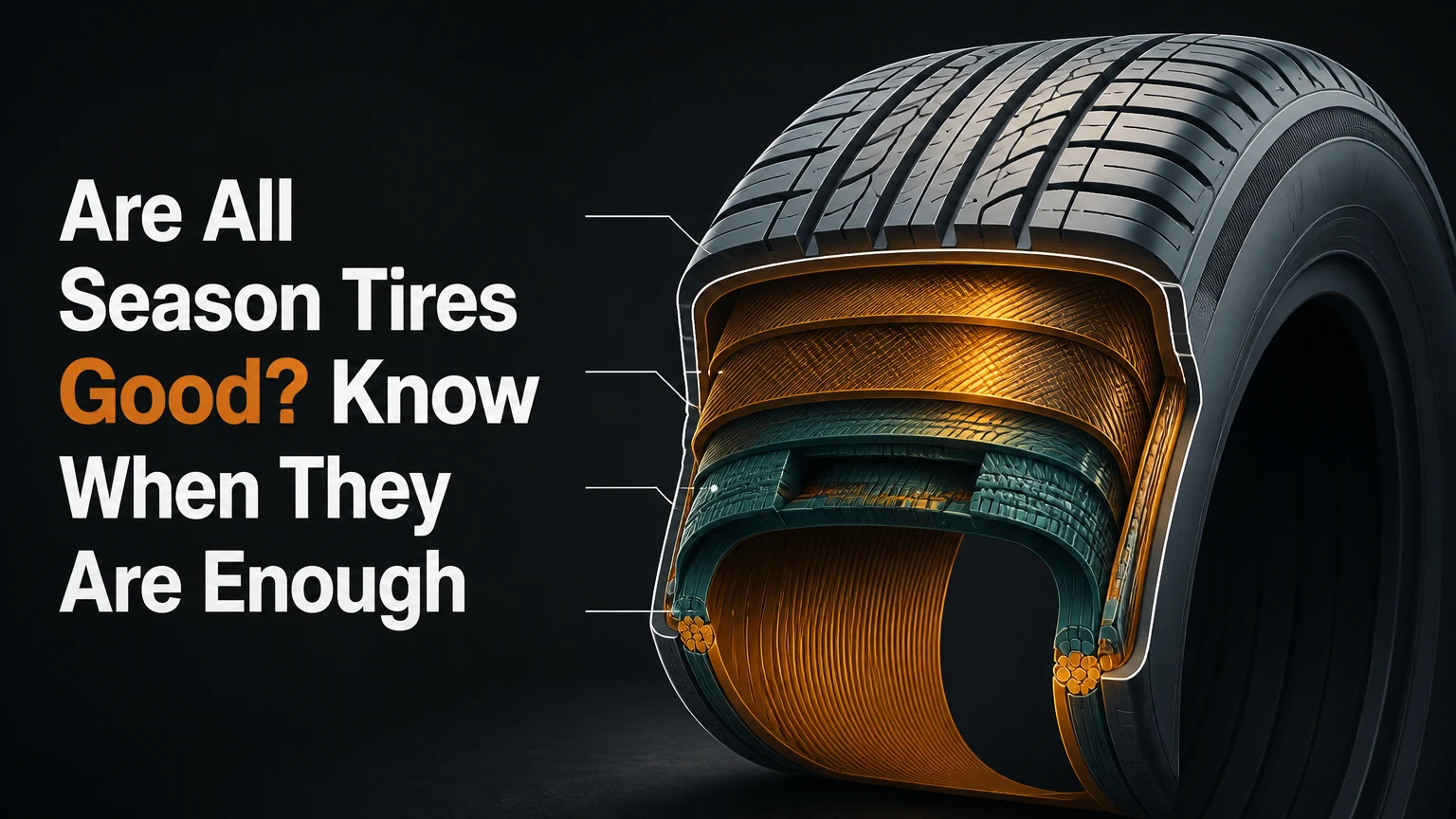
All-season tires are road tires engineered to cover a broad operating range with one rubber compound, moderate tread depth, circumferential grooves, and small traction cuts called sipes. The design gives a commuter car dependable dry-road handling, wet-road braking, and limited snow capability without requiring two complete tire sets.
The name describes a compromise, not universal seasonal performance. A summer tire uses a compound and tread pattern optimized for warm pavement, while a winter tire stays more flexible in low temperatures and uses denser siping for snow and ice. An all-season tire occupies the middle ground.
The familiar 45°F, or 7°C, threshold is useful as a rough industry rule for considering winter tires, but it is not a physical on-off switch. Tire performance changes progressively with temperature, pavement, moisture, speed, load, and tread condition. A modern all-season tire can remain usable below 45°F, while a worn winter tire can still perform poorly.
All-season tires suit drivers who want one set for commuting, errands, highway travel, and moderate seasonal changes. They are less suitable when a driver regularly faces unplowed roads, mountain passes, prolonged subfreezing temperatures, or performance driving.
How Do All-Season Tires Work?
All-season tires combine a moderately flexible compound, intermediate tread voids, circumferential water channels, and lateral sipes to distribute grip across several road conditions. The tread must retain enough rubber on dry asphalt for steering stability while leaving enough open space to move rainwater and light slush away from the contact patch.
Why does the rubber compound matter?
The rubber compound controls how much flexibility and friction an all-season tire retains as temperatures change. Summer compounds can lose flexibility in cold weather, while winter compounds can wear quickly and feel imprecise when driven on hot pavement. All-season compounds use a middle formulation, often with silica and other additives, to reduce both weaknesses.
Compound performance is not identical between brands. A touring tire may emphasize low rolling resistance and long tread life, while an ultra-high-performance all-season tire uses a firmer construction and more responsive tread blocks. The second tire may steer better in warm weather but deliver less mileage and comfort.
How do grooves and sipes create traction?
Main grooves channel water away from the contact patch, reducing the amount of water that must pass between rubber and pavement. Tread blocks provide the edges that interact with the surface, and sipes open slightly under load to create additional biting edges in light snow.
Sipes cannot transform an all-season tire into a winter tire. Snow traction also depends on compound flexibility, block movement, tread depth, temperature, and the tire’s severe-snow certification. Once tread becomes shallow, the grooves and sipes lose their ability to clear water and slush effectively.
What Types of All-Season Tires Exist?
All-season tires differ substantially in handling, comfort, tread life, and snow performance. Standard touring tires favor mileage and quietness, grand touring tires add steering precision, UHP all-seasons emphasize warm-weather grip, and all-weather tires add a 3PMSF severe-snow certification.
| Tire category | Typical tread-life range | Main design priority | Best-fit vehicle |
|---|---|---|---|
| Standard touring | 65,000-90,000 miles | Comfort, low noise, long wear | Sedan, minivan, compact crossover |
| Grand touring | 55,000-75,000 miles | Highway stability and balanced grip | Midsize sedan, luxury car, crossover |
| UHP all-season | 25,000-50,000 miles | Steering response and cornering | Sports sedan, coupe, performance SUV |
| All-weather | 40,000-60,000 miles | Snow traction with year-round use | Crossover, SUV, sedan in snowy regions |
Mileage is a typical range, not a guarantee. Alignment, inflation, driving style, vehicle weight, climate, and rotation intervals can change actual life by tens of thousands of miles.
An all-weather tire is not simply a more aggressive all-season tire. In North America, the 3PMSF marking indicates that the tire met a defined severe-snow traction test. All-weather tires remain road-legal in summer, but their open tread and flexible construction can produce more noise, rolling resistance, and warm-weather tread movement than a touring all-season tire.
Are All Season Tires Good for Winter?
All-season tires are adequate for occasional light snow and treated roads, but they are a poor substitute for winter tires in frequent snow, ice, deep slush, or sustained freezing conditions. Drivers in a snow belt should choose either 3PMSF all-weather tires for moderate winter demands or dedicated winter tires for maximum cold-weather traction.
| Winter condition | Standard all-season | 3PMSF all-weather | Dedicated winter |
|---|---|---|---|
| Cold, dry pavement at 20°F | Usable with reduced grip | Better low-temperature flexibility | Best cold-weather response |
| Wet pavement near freezing | Good if tread is healthy | Good, with more open tread | Good, but warm-season removal needed |
| Light, occasional snow | Acceptable on cleared roads | Stronger traction margin | Strongest traction |
| Packed snow and steep roads | Limited | Capable in many conditions | Preferred |
| Glazed ice | Poor | Limited | Better, though no tire makes ice safe |
| Deep unplowed snow | Poor choice | Better clearance and biting edges | Best available non-studded option |
The 3PMSF symbol appears as a mountain outline containing a snowflake. M+S, M/S, or Mud and Snow markings indicate a tread geometry classification, but M+S alone does not confirm performance in a standardized severe-snow test.
All-wheel drive improves acceleration by distributing engine torque. It does not shorten braking distances or create additional tire grip. A vehicle with AWD and worn all-season tires can stop less effectively than a front-wheel-drive vehicle with high-quality winter tires.
How Do All-Season Tires Compare With Summer and Winter Tires?
All-season tires win on convenience and annual ownership simplicity, while summer tires win in warm-weather handling and winter tires win in freezing conditions. The correct choice depends on which road condition creates the greatest safety risk during the year.
| Decision factor | All-season | Summer | Winter |
|---|---|---|---|
| Warm dry grip | Good | Best | Fair |
| Heavy rain at warm temperatures | Good to very good | Very good | Fair |
| Light snow | Fair | Poor | Very good |
| Ice traction | Poor | Very poor | Best of the three |
| Typical tread life | 40,000-90,000 miles | 20,000-40,000 miles | 25,000-50,000 miles |
| Seasonal storage | None | Required with winter set | Required with summer set |
| Typical purchase price | $90-$250 each | $120-$300 each | $110-$280 each |
Summer tires are the better tool for a warm climate, high-speed road driving, or a vehicle whose steering and braking performance matter more than winter convenience. Winter tires are the better tool when snow and ice are recurring conditions rather than occasional surprises.
For drivers who need both summer and winter capability, two complete wheel-and-tire sets can reduce repeated mounting stress and make seasonal changes faster. The extra cost includes wheels, storage, balancing, and replacement, but the setup provides a larger performance improvement than buying a more expensive compromise tire.
What Are the Benefits and Drawbacks?
The primary benefits of all-season tires are convenience, predictable year-round behavior, broad availability, and lower ownership complexity. The primary drawback is that the same tread and compound cannot match a dedicated tire at either temperature extreme.
Advantages
- One set eliminates two seasonal mounting appointments.
- Storage costs and garage space requirements disappear.
- Touring models often offer 65,000-90,000-mile warranties.
- Moderate tread designs usually produce less noise than aggressive winter patterns.
- Drivers avoid using winter tires on hot pavement, where they can wear rapidly.
- Modern all-seasons provide strong wet-road performance when properly inflated.
Limitations
- Snow and ice braking can remain substantially longer than with winter tires.
- UHP all-seasons may sacrifice 30,000-50,000 miles of tread life for sharper handling.
- A worn all-season tire loses rain and snow performance before it appears visibly bald.
- Severe heat can reduce steering precision compared with a summer tire.
- One damaged tire on an AWD vehicle may require replacing more than one tire to preserve compatible rolling circumference.
A practical rule is to optimize for the worst routine condition, not the average day. If nearly every winter drive occurs on plowed suburban roads, an all-weather tire may be enough. If weekly travel includes icy hills before road crews arrive, dedicated winter tires provide a more appropriate safety margin.
What Do All-Season Tires Cost to Own?
A typical set of four all-season tires costs approximately $360-$1,000 before tax and installation, depending on size, brand, vehicle load rating, and performance category. Installation, balancing, valve service, and disposal commonly add $80-$180 per set, while seasonal storage and swapping can add $80-$150 per event.
| Purchase tier | Typical price per tire | Four-tire purchase | Common product type |
|---|---|---|---|
| Budget | $70-$110 | $280-$440 | Basic touring tire |
| Mid-range | $110-$180 | $440-$720 | Grand touring or all-weather |
| Premium | $180-$300 | $720-$1,200 | Premium touring, UHP, or EV tire |
| Winter set comparison | $120-$280 | $480-$1,120 | Dedicated winter tire |
The cheapest tire is not always the lowest-cost option. A tire with a 70,000-mile warranty may cost less per mile than a budget tire that lasts 35,000 miles, especially when wet braking and roadside service are considered.
UTQG treadwear numbers help compare tires within the same manufacturer’s test system, but they do not predict exact mileage across brands. A 700 rating is not a promise of 70,000 miles. Treat warranty mileage, independent test results, wet braking, and owner maintenance as separate evidence.
How Long Should All-Season Tires Last?
All-season tires commonly last four to six years in normal service, although mileage may range from about 25,000 miles for a performance model to more than 80,000 miles for a touring model. Age, cracking, tread depth, impact damage, and uneven wear determine replacement timing more reliably than mileage alone.
The U.S. National Highway Traffic Safety Administration recommends inspecting tires regularly and replacing tires that show aging or damage; tire manufacturers also publish age-related inspection guidance that can be stricter than tread-based replacement. The DOT code on the sidewall identifies the week and year of manufacture, so a code ending in 2319 indicates production during the 23rd week of 2019.
A five-year-old tire is not automatically unsafe, and a two-year-old tire with severe misalignment is not automatically safe. Have older tires professionally inspected for sidewall cracking, tread separations, bulges, and hardening. Replace a tire immediately after a serious structural failure, even when tread remains.
New tires often feel different for the first several hundred miles because mold-release residue wears away and the driver adapts to the new tread. A cautious 300-500-mile break-in period is reasonable for avoiding aggressive cornering, abrupt braking, and sustained high speed, but no universal rule requires exactly 500 miles.
Which All-Season Tire Fits Your Driving?
The best all-season tire depends on climate, annual mileage, vehicle type, and the road surface you actually encounter. A quiet touring tire fits a commuter covering 12,000 miles on maintained roads, while a 3PMSF all-weather tire fits a driver who regularly faces snow but lacks storage for two sets.
City commuter
Choose a standard touring tire with a 65,000-90,000-mile warranty, strong wet braking, and a low noise rating. Michelin Defender 2, Continental TrueContact Tour 54, and comparable touring products illustrate this category, but the exact tire size and load rating must match the vehicle placard.
Highway driver
Choose a grand touring tire with stable tracking, reinforced construction, and strong hydroplaning resistance. Continental TrueContact Tour 54 and Pirelli P7 AS Plus 3 are examples of products aimed at long highway use, where noise, straight-line stability, and wet-road confidence matter more than maximum cornering.
Snow-region driver
Choose a 3PMSF all-weather tire if snowfall is moderate and roads are cleared promptly. Michelin CrossClimate 2 and Pirelli Cinturato WeatherActive represent this category. Drivers facing steep, icy, or consistently unplowed roads should use dedicated winter tires instead.
Performance driver
Choose a UHP all-season tire only when winter exposure is limited to cold pavement or occasional light snow. Michelin Pilot Sport All Season 4 and BFGoodrich g-Force COMP-2 A/S Plus prioritize steering response, but their tread life and ride comfort usually trail touring designs.
Electric vehicle owner
Check the tire’s load index, rolling resistance, and EV suitability before choosing by tread pattern alone. EV weight and instant torque can increase wear, while low rolling resistance can improve range but may alter wet grip and ride quality. Never replace an EV tire with a lower load rating.
What Should You Check Before Buying?
Check the vehicle’s tire placard, the tire’s size, load index, speed rating, 3PMSF marking, warranty, test results, and production date before paying. Tire size alone is insufficient because two tires with the same dimensions can have different load capacity, speed capability, noise, and winter performance.
Use this buying sequence:
- Read the driver-door placard and owner’s manual.
- Match the original size, load index, and speed rating unless a qualified tire professional approves a change.
- Decide whether M+S capability is enough or whether 3PMSF certification is required.
- Compare wet braking and snow test results, not only treadwear warranty.
- Check the tire’s manufacture date and inspect every installed tire.
- Confirm TPMS compatibility, rotation direction, and any front-to-rear size difference.
- Price installation, alignment, disposal, and road-hazard coverage together.
Do not select a tire solely because it has a high UTQG number. Long wear cannot compensate for inadequate snow performance, poor wet braking, incorrect load capacity, or an unsuitable speed rating.
How Should All-Season Tires Be Maintained?
Check tire pressure at least monthly and before long trips, using the cold pressure printed on the vehicle placard rather than the maximum pressure molded into the sidewall. A 20°F temperature drop can reduce pressure by roughly 2 psi, which increases rolling resistance and shoulder wear.
Rotate tires according to the vehicle and tire manufacturer, commonly every 5,000-7,500 miles. Directional tires may require a front-to-back rotation only, while staggered fitments may not be rotatable across axles.
Inspect tread and sidewalls monthly. Replace tires when tread reaches the legal limit in your jurisdiction or when wet and snow performance has deteriorated, and investigate any bulge, puncture, exposed cord, deep cut, or crack.
What do uneven wear patterns mean?
| Visible symptom | Likely cause | Corrective action |
|---|---|---|
| Center tread wear | Overinflation | Set cold pressure to placard value |
| Both shoulder edges worn | Underinflation | Check leaks, then correct pressure |
| One shoulder worn | Alignment problem | Obtain alignment inspection |
| Feathered tread blocks | Toe misalignment | Correct toe and rotate tires |
| Cupped or scalloped tread | Balance or suspension fault | Inspect shocks, bushings, and balance |
| Vibration at 55-75 mph | Wheel imbalance or bent wheel | Balance and inspect wheel assembly |
A rotation cannot cure an alignment problem. Moving a damaged tire to another axle may temporarily change the noise while allowing the mechanical fault to destroy the replacement set.
When Are All-Season Tires the Wrong Choice?
All-season tires are the wrong choice when a driver routinely encounters severe snow, black ice, unplowed roads, track use, desert heat combined with performance driving, or legal requirements for certified winter equipment. A tire should be replaced by a more specialized design when the road condition exceeds its compound and tread capability.
Check regional rules before traveling through mountain areas or across national borders. Some jurisdictions recognize M+S markings for winter regulations, while others require 3PMSF tires or tire chains during designated periods. Local transportation agencies and the tire manufacturer provide more reliable requirements than a generic online buying guide.
All-season tires also become the wrong choice when they are mismatched on an AWD vehicle. Differences in tread depth and rolling circumference can increase driveline stress on some systems, so consult the owner’s manual before replacing fewer than four tires.
Are All Season Tires Good for Rain and Hot Weather?
All-season tires are generally good for rain and ordinary summer temperatures, especially when they have full tread depth and correct inflation. Summer tires usually provide shorter warm-weather braking and stronger cornering at the limit, while all-season tires offer better year-round flexibility.
Hydroplaning resistance depends on speed, water depth, inflation, tread depth, and groove design. No tread pattern guarantees safety in standing water. Slow down before entering deep water, avoid abrupt steering, and replace tires before the grooves become too shallow to evacuate water effectively.
FAQ
Can all-season tires be used year-round?
Yes, all-season tires can remain installed throughout the year when their temperature, snow, load, and speed demands match the local climate. Year-round use does not remove the need for monthly pressure checks, rotations, tread inspections, and replacement when age or damage reduces performance.
Are all-weather tires better than all-season tires?
All-weather tires are better than standard all-season tires for recurring snow and freezing temperatures because 3PMSF certification requires a severe-snow performance test. Standard all-season tires are usually quieter, more efficient, and longer-wearing on dry roads, so they remain preferable in mild climates.
Do all-season tires work with all-wheel drive?
All-season tires work with all-wheel-drive vehicles when the size, load index, speed rating, and rolling circumference meet the manufacturer’s requirements. AWD improves acceleration on slippery surfaces but does not replace winter traction or shorten braking distances.
Should I replace all four tires at once?
Replacing all four tires is usually safest, particularly on AWD vehicles or when the existing tires have substantial tread-depth differences. If one tire is damaged, the vehicle manufacturer or tire shop may approve a single replacement after matching tread depth and rolling circumference.
What tread depth is unsafe in snow?
Snow traction begins to decline well before the legal minimum, and many professionals recommend replacing tires near 4/32 inch because shallow grooves clear less water and snow. The legal limit is commonly 2/32 inch in the United States, but local rules and tire condition also matter.
Do all-season tires save money?
All-season tires can reduce ownership costs by eliminating seasonal mounting, storage, and a second wheel set. Savings disappear when a driver needs winter traction, replaces UHP tires frequently, or accepts longer stopping distances in conditions that require a dedicated winter tire.
The Bottom Line
Are all season tires good? Yes, for the majority of drivers who encounter moderate weather, maintained roads, rain, and occasional light snow. Choose a standard or grand touring tire for mild climates, a 3PMSF all-weather tire for regular but manageable snow, and dedicated winter tires when freezing roads, ice, steep grades, or unplowed conditions are routine. The safest decision matches the tire to the worst conditions you regularly drive through, not to the label alone.


