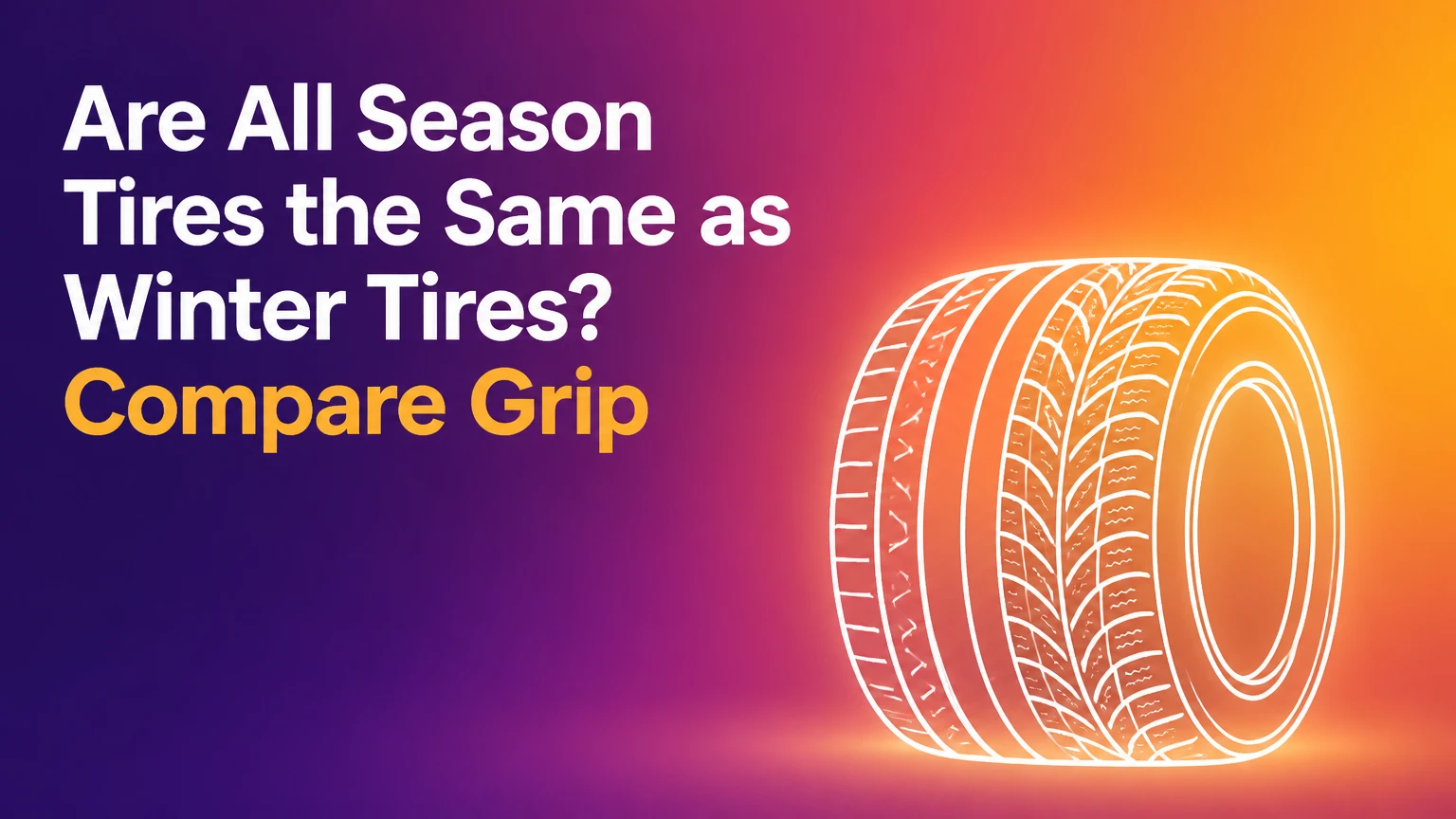
No, all-season tires are not the same as winter tires. All-season tires balance dry handling, wet traction, road noise, and moderate cold, while winter tires use a cold-flexible compound, deeper tread features, and dense siping for snow and ice. Winter tires are the safer choice when freezing temperatures and recurring snow or ice are normal.
Key facts at a glance
All-season tires are designed for moderate climates, not consistently severe winter conditions.
Winter tires remain more flexible in cold weather and usually provide stronger snow and ice traction.
The 3PMSF symbol identifies a tire tested for severe snow conditions; M+S alone does not.
The 7°C, or 45°F, guideline helps determine when winter tires should be installed.
AWD improves acceleration on slippery roads, but it does not provide winter-tire braking grip.
Winter tires should be installed as a matching set of four, not only on the powered axle.
Are All Season Tires the Same as Winter Tires?
All-season tires and winter tires differ in rubber compound, tread geometry, temperature range, and intended road conditions. All-season tires are compromise products for year-round use in mild or moderate weather; winter tires are specialized for sustained cold, packed snow, slush, and ice.
The word “all-season” does not mean “equally effective in every season.” It means the tire can operate across a wider annual temperature range than a summer tire while retaining acceptable dry and wet-road manners. That compromise limits its performance at both extremes.
Winter tires sacrifice some warm-weather handling and tread life to preserve cold-weather flexibility. Their tread blocks contain more biting edges, their grooves evacuate slush, and their compounds are formulated to stay pliable when ordinary rubber becomes noticeably harder.
The difference is functional, not cosmetic. Two tires can have similar sizes and both carry an M+S marking while behaving very differently during an emergency stop on ice.
How Does Temperature Change Tire Grip?
Temperature changes tire grip because rubber flexibility affects how much tread can conform to the road surface. Around 7°C, or 45°F, many all-season tires begin losing cold-weather flexibility, while winter tires retain more usable compliance below freezing.
The 7°C guideline is not a switch that makes an all-season tire suddenly unsafe. Tire design, pavement temperature, vehicle weight, speed, sunlight, and moisture all affect traction. It is a practical seasonal planning threshold because road surfaces can remain colder than the air, especially before sunrise.
A winter tire’s advantage becomes more meaningful when several factors occur together:
- Morning temperatures remain below 7°C.
- Snow, slush, freezing rain, or black ice appears repeatedly.
- The vehicle travels on untreated, hilly, rural, or shaded roads.
- The driver must travel regardless of weather.
- Stopping and steering performance matter more than low purchase cost.
On dry pavement above approximately 7°C, a quality all-season tire often provides better balance, quieter operation, and slower wear. Winter tires are not automatically superior on every surface.
Why Do Winter Tires Grip Snow and Ice Better?
Winter tires grip snow and ice better through a combination of flexible rubber, high sipe density, open grooves, and tread edges that remain active in cold conditions. No single feature creates the entire advantage.
Compound flexibility
Winter compounds commonly use higher silica content and specialized polymers that retain flexibility at low temperatures. Flexible tread can conform to small surface irregularities, which increases mechanical grip on cold pavement.
An all-season compound is harder by design. That hardness improves heat resistance, rolling durability, and summer wear, but it reduces conformity as temperatures fall.
Sipes and biting edges
Sipes are narrow cuts in tread blocks. When a winter tire rolls over snow, sipes open and close, creating additional edges that help the tread interact with packed snow and wet ice.
Dense siping does not eliminate ice’s low friction. It improves the tire’s opportunity to generate traction, particularly when the tire is cold and the surface contains snow crystals or a thin layer of moisture.
Tread voids and snow packing
Winter tread generally uses deeper, more open grooves to clear slush and loose snow. Tread blocks can also retain a controlled amount of snow. Snow can adhere to snow more effectively than smooth rubber adheres to loose snow, although this principle does not mean a tire should be allowed to clog completely.
Studs, where permitted
Studded winter tires add metal pins that can penetrate hard ice. They may help on persistent glazed ice and untreated mountain roads, but they create more noise, can damage some pavement, and are restricted by law in several regions.
What Is the Difference Between All-Season, All-Weather, and Winter Tires?
All-season tires target mild year-round conditions, all-weather tires add a severe-snow rating for broader winter capability, and winter tires prioritize cold-weather performance above warm-weather versatility. The categories overlap in marketing language, so the sidewall symbol and product specifications matter more than the name alone.
| Tire category | Typical temperature use | Snow symbol | Main design priority |
|---|---|---|---|
| Standard all-season | Above and below 7°C in moderate conditions | Often M+S; 3PMSF varies by model | Dry, wet, and light-snow balance |
| All-weather | Year-round, including recurring moderate snow | Usually 3PMSF | One-set convenience with stronger winter ability |
| Studless winter | Frequently below 7°C and below freezing | 3PMSF | Cold, snow, slush, and ice traction |
| Studded winter | Persistent ice and severe untreated roads | 3PMSF plus studs | Ice penetration and severe winter control |
Where do all-weather tires fit?
All-weather tires are the middle option for drivers who want one set but experience real winter weather. A 3PMSF-rated all-weather tire generally performs better in snow than a conventional M+S all-season tire, although it usually remains less capable on ice and deep snow than a dedicated winter tire.
The label “all-weather” is not globally standardized in exactly the same way across every market. Verify the Three-Peak Mountain Snowflake symbol, the manufacturer’s winter-use description, and independent test results for the specific model.
What Do M+S and 3PMSF Mean?
M+S means Mud and Snow, but the marking alone does not prove severe-winter performance. The 3PMSF symbol, a mountain with a snowflake, indicates that the tire met a defined severe-snow traction test under the applicable regulatory standard.
M+S is a manufacturer-applied designation in many markets. It generally indicates a tread pattern intended to provide more traction in mud or light snow than a basic highway tire, but it does not require the same severe-snow test used for 3PMSF certification.
The Three-Peak Mountain Snowflake is more useful when comparing winter capability. It still does not guarantee equal performance across brands, because braking, ice grip, wet handling, noise, and wear vary by tire model.
Check the sidewall before buying. A tire’s marketing name can be vague; its size, load index, speed rating, M+S marking, and 3PMSF symbol provide more actionable information.
Which Tire Performs Better on Each Road Surface?
Winter tires usually win on snow, packed snow, and cold ice, while all-season tires often win on warm dry pavement and can provide a quieter, more durable ride. Wet performance depends heavily on the individual model, water depth, temperature, and tread condition.
| Road condition | Usually stronger choice | Why | Important limitation |
|---|---|---|---|
| Warm, dry pavement | All-season | Harder compound and stable tread blocks | Performance varies by touring or performance design |
| Cold, dry pavement | Winter | More flexible rubber below 7°C | May feel less precise at highway temperature |
| Light rain above 7°C | All-season | Efficient water evacuation and warm-weather compound | Worn tread raises hydroplaning risk |
| Slush | Winter | Open grooves and flexible tread | Speed still determines slush-planing risk |
| Packed snow | Winter | Sipes and snow-gripping tread edges | Deep snow can overwhelm any passenger tire |
| Glazed ice | Winter, especially specialized ice models | Cold compound and dense siping | No tire makes high-speed ice safe |
| Gravel or mud | Model-dependent | Void size and casing design matter | M+S is not an off-road capability rating |
Published test results should be treated as model-specific. A premium all-season tire may outperform a budget winter tire in one wet test, while the winter tire delivers a substantial advantage on packed snow. Comparing categories alone cannot replace comparing the exact products.
Which Tire Should You Choose for Your Climate?
Choose standard all-season tires for warm regions with rare snow, all-weather tires for moderate winter conditions where one set is preferred, and dedicated winter tires for recurring freezing weather, snow, ice, hills, or untreated roads.
| Driving situation | Typical winter exposure | Recommended setup | Reason |
|---|---|---|---|
| Southern U.S. or Mediterranean climate | 0-3 snow events per year; few freezing mornings | Standard all-season | Winter performance is rarely needed |
| Mid-Atlantic or lower-elevation city | 5-15 snow events; plowed roads | All-weather or winter set | Choice depends on ice, hills, and travel necessity |
| Northern city with regular freezing weather | 2-5 winter months below 7°C | Four studless winter tires | Cold flexibility matters for daily travel |
| Mountain or rural route | Frequent unplowed snow and shaded ice | Studless or approved studded winter tires | Road exposure exceeds normal urban conditions |
| Low-mileage second vehicle | Occasional winter trips | All-weather plus a no-drive plan during storms | Avoids storing a dedicated set if exposure is limited |
Climate averages do not tell the whole story. A driver in a mild city who commutes over a mountain pass can need winter tires, while a driver in a colder city who rarely drives during storms may reasonably choose all-weather tires.
When Should You Change Tires?
Install winter tires before temperatures consistently fall below 7°C and remove them when spring temperatures reliably remain above that level. Schedule the change before the first storm because appointment delays and sudden overnight freezes often occur before snowfall.
A practical changeover method is:
- Track morning temperatures for one to two weeks.
- Book winter installation when readings regularly approach 7°C.
- Install all four tires with matching size and suitable ratings.
- Set cold inflation pressure to the vehicle placard specification.
- Recheck pressure after the first major temperature change.
- Remove winter tires when warm daytime and morning temperatures persist.
Many northern drivers use winter tires for approximately four to six months, but the correct window depends on latitude, elevation, road treatment, and driving schedule. Keeping winter tires on through warm summer weather accelerates wear and can reduce handling precision.
How Much Do Winter Tires Cost to Own?
A typical dedicated winter setup costs about $480-$1,000 for four studless tires, plus approximately $60-$120 for seasonal mounting and balancing when separate wheels are not available. Total ownership cost depends on tire size, brand, wheels, storage, mileage, and replacement timing.
| Expense | Typical range | Frequency | Cost-control option |
|---|---|---|---|
| Standard all-season tire | $80-$150 each | Every 4-6 years, mileage-dependent | Compare tread warranty and size |
| All-weather tire | $140-$220 each | Often 3-5 years | Use one set and avoid seasonal mounting |
| Studless winter tire | $120-$250 each | Commonly 3-5 winter seasons | Buy a second wheel set |
| Seasonal installation | $60-$120 | Twice yearly | Use dedicated wheels |
| Tire storage | $40-$150 | Per season | Store indoors, cool, dry, and covered |
| Steel wheel set | $300-$800 | Usually a one-time purchase | Confirm brake and TPMS compatibility |
Two sets do not necessarily mean twice the tire expense over time. Each set is used for only part of the year, so annual mileage is divided between them. However, tires still age in storage, and low-mileage drivers may replace them because of age or cracking before tread is exhausted.
Prices are typical North American retail ranges, not guaranteed quotes. Larger SUV, truck, run-flat, performance, and electric-vehicle tire sizes can cost substantially more.
How Long Do Winter Tires Last?
Winter tires commonly last three to five winter seasons or approximately 15,000-30,000 winter miles, but age, storage, alignment, driving style, temperature, and tread depth determine actual service life. A tire can look legal yet lose meaningful winter performance before it reaches the legal wear bar.
Replace winter tires when:
- Tread depth approaches 4/32 inch, or 3.2 millimeters, for winter use.
- The rubber develops cracks, bulges, or impact damage.
- The tire has become hard, brittle, or irregularly worn.
- The tire reaches the manufacturer’s age limit.
- Tread wear differs substantially across the axle.
The 4/32-inch guideline is a practical winter-performance threshold, not a universal legal limit. Legal minimums are often lower and may not represent adequate snow traction. Measure each tire in several grooves rather than checking only the most visible area.
Why Are Two Winter Tires Unsafe?
Two winter tires are unsafe because they create different traction levels between the front and rear axles. During braking or cornering, the end with less grip can lose stability first, causing understeer or oversteer that electronic stability control cannot fully overcome.
Installing winter tires only on the drive axle is especially risky:
- Front-wheel drive with winter tires only in front can leave the rear axle unstable during braking.
- Rear-wheel drive with winter tires only at the rear can leave the front unable to steer effectively.
- AWD vehicles can still develop an unstable axle response with mismatched tires.
- Different tread depths or compounds can alter braking balance.
Install four matching winter tires whenever possible. If replacing only two tires, many tire manufacturers and safety organizations recommend placing the tires with greater remaining traction on the rear axle, subject to vehicle and tire-maker instructions.
Does AWD Make Winter Tires Unnecessary?
AWD does not make winter tires unnecessary because AWD helps transmit engine power during acceleration but cannot create extra tire-road friction during braking. Steering and stopping still depend on the grip available at each tire.
An AWD vehicle on all-season tires may pull away from a snowy intersection more easily than a front-wheel-drive vehicle. That advantage can create false confidence, especially when the vehicle later approaches a stop sign on polished ice.
Winter tires benefit AWD vehicles in three ways:
- They increase cold-surface compliance.
- They improve braking and cornering traction.
- They help all four driven wheels maintain usable grip during acceleration.
AWD is valuable equipment, but it is a drivetrain feature, not a tire compound. The two systems solve different traction problems.
What Should You Check Before Buying?
Check the vehicle placard, owner’s manual, tire sidewall, and local winter-tire rules before selecting a replacement set. The correct tire must match the vehicle’s required size, load index, speed rating, construction, and clearance.
Use this buying checklist:
- Confirm the original tire size, such as 225/60R17.
- Match or exceed the required load index.
- Follow the manufacturer’s speed-rating guidance.
- Check whether the vehicle requires run-flat, XL, EV, or acoustic tires.
- Buy four tires with the same model and similar tread depth.
- Verify 3PMSF certification for serious snow use.
- Confirm wheel, brake, and TPMS compatibility.
- Check the tire’s production date and inspect for storage damage.
- Compare independent tests for snow, ice, wet braking, noise, and wear.
- Review studded-tire restrictions in your province, state, or country.
Electric vehicles deserve additional attention because their weight and instant torque can increase wear and place higher demands on load capacity. Follow the EV manufacturer’s specifications rather than choosing a tire by size alone.
How Should Winter Tires Be Maintained?
Maintain winter tires by checking pressure monthly, rotating them according to the tire maker’s schedule, inspecting tread depth, and storing them clean, dry, and away from heat. Cold weather lowers air pressure, but drivers should add air to specification rather than intentionally reducing pressure.
A common approximation is a pressure change of about 1 psi for each 10°F, or 5.5°C, change in temperature. The exact change varies with tire volume and temperature measurement, so the door-jamb placard remains the correct target.
Store unmounted tires upright or as recommended by the manufacturer, away from sunlight, ozone sources, solvents, and electric motors. Mark their previous positions before removal, but rotate only when the directional arrow, asymmetric pattern, and vehicle requirements permit it.
Do not mix a winter tire with an all-season tire on the same axle. Differences in tread depth, compound, and handling response can affect stability even when all four tires are the correct nominal size.
Why Winter Tires Are Not Year-Round Tires
Winter tires are poor year-round tires because warm pavement makes their softer compound wear faster and can reduce steering precision. Continued summer use also removes tread that the driver needs when the next winter arrives.
Typical consequences of summer use include:
- Faster shoulder and center tread wear.
- Longer or less consistent braking on hot dry pavement.
- Softer steering response during high-speed maneuvers.
- More rolling resistance and possible fuel-consumption changes.
- Premature loss of the tire’s winter-specific edges.
A driver who uses winter tires for one short summer trip is unlikely to destroy them immediately, but months of warm-weather driving is an inefficient and potentially unsafe practice. All-weather tires are the better one-set compromise for drivers who cannot manage seasonal changes.
The Bottom Line
Are all season tires the same as winter tires? No. Standard all-season tires suit mild climates and occasional light snow, while winter tires provide stronger cold-weather, snow, and ice performance through specialized compounds and tread designs.
Choose all-season tires when freezing weather is rare. Choose all-weather tires when you need one set for moderate year-round conditions and the tire carries the 3PMSF symbol. Choose four dedicated winter tires when your driving includes recurring sub-7°C temperatures, packed snow, ice, steep roads, or travel during storms.
The correct decision depends less on the calendar season than on the surfaces, temperatures, and consequences you face during an ordinary commute.
Frequently Asked Questions
Can all-season tires be used in light snow?
All-season tires can be used in light snow when temperatures are moderate, tread depth is healthy, roads are treated, and the driver can reduce speed. M+S all-season tires are not equivalent to severe-snow-rated winter tires. Drivers who regularly encounter freezing roads should consider 3PMSF all-weather or dedicated winter tires.
Are all-weather tires better than all-season tires in winter?
All-weather tires are generally better than standard all-season tires in winter because most carry the 3PMSF severe-snow symbol and use more winter-oriented tread features. They still do not match dedicated winter tires on sustained ice, deep snow, or prolonged sub-freezing roads, where a separate winter set remains the stronger option.
Do winter tires improve braking on black ice?
Winter tires can improve braking on black ice compared with many all-season tires because their compounds remain flexible and their tread creates more usable edges. Black ice remains extremely slippery, and braking distance depends on speed, surface temperature, vehicle systems, and tire condition. No tire makes icy roads safe at normal dry-road speeds.
Can I put winter tires on only the front of my car?
You should not install winter tires only on the front of a front-wheel-drive car. The rear tires may lose grip first during braking or cornering, producing oversteer and a spin. Install four winter tires with matching specifications, unless the vehicle manufacturer gives a specific alternative for that model.
How can I tell whether my tires are winter-rated?
Look for the Three-Peak Mountain Snowflake symbol on the sidewall, then confirm the tire model’s specifications. M+S alone indicates a mud-and-snow tread designation and does not establish severe-winter performance. Also check tread depth, production age, load rating, speed rating, and the vehicle manufacturer’s requirements.
Should low-mileage drivers buy winter tires?
Low-mileage drivers should buy winter tires when they must travel during frequent freezing weather, untreated-road conditions, or emergency situations. Drivers who can avoid driving during storms may choose 3PMSF all-weather tires instead. The decision should account for exposure and required mobility, not annual mileage alone.