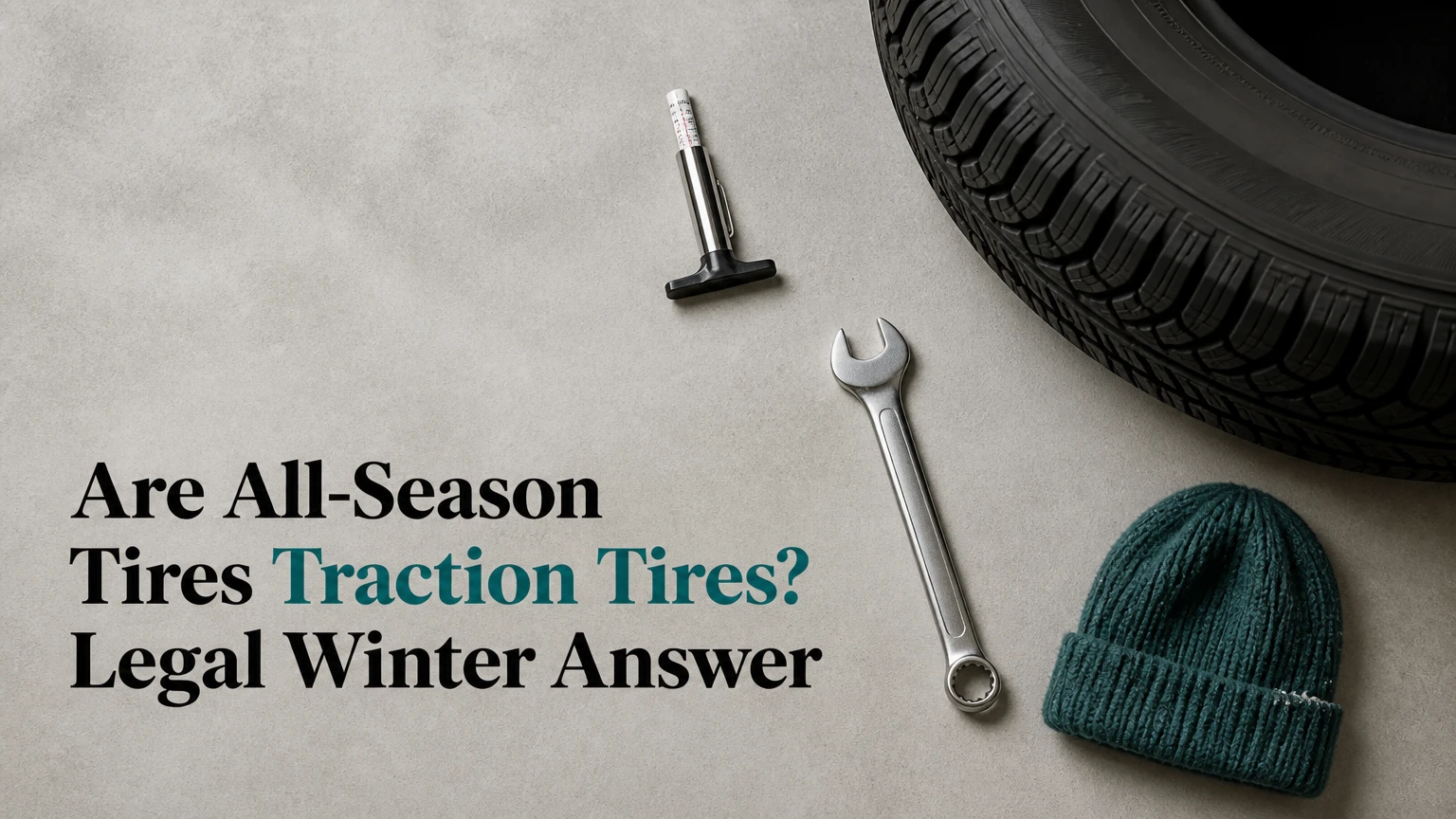
No, all-season tires are not automatically traction tires for severe winter driving. Some all-season tires carry an M+S marking, but that marking does not prove tested severe-snow performance or legal compliance everywhere. A tire with the 3PMSF symbol may qualify for winter traction requirements, while local law ultimately controls.
Key Facts at a Glance
- Standard all-season tires are designed for moderate temperatures, rain, dry pavement, and light snow.
- M+S means Mud and Snow, but it is not the same as the 3PMSF severe-snow rating.
- The 3PMSF symbol identifies a tire that passed a standardized severe-snow traction test.
- “Traction tire” is a legal term whose meaning varies by state, province, road authority, or country.
- Winter tires usually outperform all-season tires on ice, packed snow, and cold pavement below approximately 7°C, or 45°F.
- AWD improves acceleration but does not provide the braking and cornering grip that winter tires provide.
What Does “Traction Tire” Mean?
A traction tire can mean a winter-capable tire under a transportation authority’s chain-law rules, or it can simply mean any tire that creates road grip in ordinary conversation. The legal meaning is narrower, so drivers must check the specific jurisdiction rather than rely on the tire category printed on a retailer’s website.
Washington provides a useful example. During certain mountain-pass restrictions, “traction tires” generally refers to approved tires with an appropriate winter designation and sufficient tread, while studded tires and tire chains may be treated separately. Oregon, Colorado, California, British Columbia, and other jurisdictions use different wording, dates, exemptions, and equipment requirements.
Are All-Season Tires Legally Traction Tires?
Standard all-season tires may satisfy a local traction law only when their markings, tread depth, tire size, and use meet that authority’s requirements. An M+S marking may be accepted under some rules, but a 3PMSF tire provides stronger evidence of severe-snow capability and is often preferred by road agencies.
Legal compliance also depends on conditions. A road sign may require chains even when a vehicle has winter-rated tires. Commercial vehicles, trailers, passenger cars, and vehicles with different gross weights can face separate rules. Check the current transportation department notice before mountain travel.
A tire retailer’s description is not a substitute for the law. The relevant authority is usually the state department of transportation, provincial ministry, highway agency, or police agency named in the traction notice.
Does M+S Mean a Tire Is a Traction Tire?
M+S does not mean that an all-season tire has passed a severe-winter performance test. The designation generally describes tread geometry that provides more open space than a conventional highway tread, but it does not establish a required level of ice grip, cold flexibility, or snow-braking performance.
Many touring all-season tires carry M+S. Their rubber compound can still become less flexible in cold weather, and their relatively closed tread can pack with deep snow. M+S remains useful information, but it is a lower threshold than the 3PMSF marking.
What Does the 3PMSF Symbol Certify?
The 3PMSF symbol, a mountain with three peaks surrounding a snowflake, identifies a tire that met a standardized severe-snow traction test under the applicable tire-regulatory system. The marking is based on measured performance, not only on a manufacturer’s tread description.
3PMSF does not make every tire a dedicated winter tire. All-weather tires, some all-terrain tires, and dedicated snow tires can carry the symbol. The mark also does not guarantee equal performance on glare ice, wet pavement, or every type of snow.
| Marking | What it indicates | What it does not prove | Typical tire examples |
|---|---|---|---|
| M+S | Mud-and-snow tread designation | Severe-snow braking or ice grip | Touring all-season, highway all-season |
| 3PMSF | Certified severe-snow traction test result | Equal performance to a studded tire | All-weather, winter, some all-terrain |
| Stud symbol or studs | Physical metal traction hardware where legal | Safe use on bare pavement or universal legality | Studded winter tire |
| No winter marking | No stated winter designation | Adequate snow or cold-weather performance | Summer performance tire |
The markings answer different questions. M+S describes a tread classification, while 3PMSF communicates tested severe-snow capability. Neither marking overrides a chain requirement or a worn-tire safety problem.
How Do All-Season Tires Behave in Snow and Ice?
All-season tires provide usable traction in light snow, cold rain, and occasional freezing conditions, but their performance falls behind winter tires as temperatures drop and snow or ice becomes continuous. The difference comes from both rubber flexibility and tread design, not from a single temperature switch.
A conventional all-season compound is engineered to resist wear during warm-weather driving. A winter compound uses polymers and silica formulations that remain more flexible in cold conditions. The exact formula varies by tire model, so 7°C, or 45°F, is a practical guideline rather than a universal failure point.
Tread design matters as well. Winter tires use deeper grooves, more biting edges, and dense siping to remove slush and create grip on compacted snow. All-season tires usually use larger, more stable tread blocks that improve steering response, noise levels, rolling resistance, and dry-road life.
Why Does Snow Grip Snow Better Than Rubber?
Compacted snow can form a mechanical bond with snow lodged in a winter tire’s tread grooves, which helps the tire generate forward and lateral grip. Winter tread blocks and sipes create more edges for that process, while a smoother all-season tread can lose its ability to clear and retain snow.
Ice is different. Snow-packed tread does not solve the low-friction problem on polished ice. Winter tires use flexible compounds and numerous microscopic edges, but even they cannot create normal pavement grip on glare ice. Reduced speed, greater following distance, and smooth steering remain necessary.
Is 7°C a Legal Tire-Change Temperature?
The 7°C threshold is not a legal definition and should not be treated as a precise cutoff. Tire manufacturers and winter-driving organizations commonly use approximately 7°C as a practical point where winter compounds begin offering an advantage, but road temperature, precipitation, tire condition, and driving speed also matter.
A driver in a dry climate with occasional overnight frost may not need winter tires at exactly 7°C. A driver who regularly encounters snow, shaded ice, or mountain roads may benefit from winter tires at higher daytime temperatures because the pavement remains cold.
What Are the Main Tire Choices?
The main choices are standard all-season tires, all-weather tires, studless winter tires, studded winter tires, and chains used when required. These categories overlap in some markings, but their compounds, tread patterns, legal use, and seasonal compromises differ.
| Tire type | Winter marking | Best operating situation | Typical service pattern | Main limitation |
|---|---|---|---|---|
| Standard all-season | Often M+S | Rain, dry pavement, light snow | 50,000-80,000 miles | Weak ice and deep-snow grip |
| All-weather | Usually 3PMSF and M+S | Variable weather with occasional snow | 40,000-60,000 miles | More noise and wear than touring all-season |
| Studless winter | Usually 3PMSF | Repeated snow, ice, and subfreezing roads | 3-4 winter seasons | Reduced warm-weather life |
| Studded winter | 3PMSF plus metal studs | Frequent hard-packed snow or ice where legal | 3-4 winter seasons | Road restrictions and bare-road noise |
| Tire chains | No tire rating by themselves | Severe conditions or posted chain control | Installed as needed | Low speed, storage, installation effort |
The mileage ranges are typical consumer-market ranges, not guarantees. Alignment, inflation, vehicle weight, driving style, climate, and rotation intervals can change actual life substantially.
Are All-Weather Tires Winter Tires?
All-weather tires are not identical to dedicated winter tires, but they are a legitimate compromise for drivers who need one set throughout the year. Most all-weather models carry the 3PMSF symbol, use more winter-oriented tread features than standard all-season tires, and remain suitable for summer driving.
An all-weather tire usually sacrifices some warm-weather quietness, fuel economy, tread life, or dry-road steering precision. It also normally cannot match a dedicated winter tire on severe ice or repeated deep snow. Michelin CrossClimate 2 is a well-known example of a 3PMSF all-weather design, but the symbol and model specifications matter more than the brand name.
How Do the Options Compare?
Dedicated winter tires are the strongest choice for repeated snow and ice, while standard all-season tires are the most efficient choice for mild climates. All-weather tires occupy the middle position, giving one-set convenience with more severe-snow capability than conventional all-season tires.
| Decision factor | Standard all-season | All-weather | Studless winter | Studded winter |
|---|---|---|---|---|
| Light-snow use | Suitable at moderate speed | Suitable | Excellent | Excellent |
| Packed-snow use | Limited | Good | Excellent | Excellent |
| Glare-ice use | Weak | Moderate | Strong | Strongest where permitted |
| Warm-weather noise | Lowest | Moderate | Higher | Highest |
| Typical tread life | 50,000-80,000 miles | 40,000-60,000 miles | 3-4 seasons | 3-4 seasons |
| Seasonal storage | None | None | Usually required | Usually required |
| Typical purchase price | $90-$220 each | $120-$280 each | $110-$300 each | $140-$350 each |
| Legal winter evidence | M+S or none | Usually 3PMSF | 3PMSF | 3PMSF plus studs |
Prices are typical United States retail ranges for common passenger-car and crossover sizes. Large SUV, performance, run-flat, and commercial-light-truck sizes can cost considerably more.
What Does Each Option Cost?
A complete set of four tires typically costs $360-$880 for standard all-season tires, $480-$1,120 for all-weather tires, and $440-$1,400 for winter tires before tax. Mounting, balancing, valve service, and disposal commonly add $80-$180 per installation.
Drivers who keep two mounted wheel sets may spend $500-$1,200 on an additional set of wheels. Seasonal storage often costs $50-$150 per season. A two-set arrangement therefore costs more initially, but it preserves the summer tires during winter and the winter tires during summer.
Chains cost less than a second tire set, usually about $80-$250 for passenger vehicles, but they require practice, compatible clearance, and installation during poor weather. Some vehicles have very limited wheel-well space and cannot use conventional chains without manufacturer approval.
How Much Tread Depth Do Winter Tires Need?
A tire with less than 4/32 inch of tread, approximately 3.2 millimeters, has reduced reserve for snow and slush, and some traction laws use 4/32 inch as a qualifying threshold. The 2/32-inch limit commonly associated with legal replacement is not a reliable winter-performance threshold.
Measure tread depth in several grooves across the tire, because shoulder wear and uneven wear can hide the lowest value. A simple tread-depth gauge is more reliable than the penny test. Replace a winter tire when its tread reaches the manufacturer’s wear indicators or when winter performance has materially declined.
| Tread depth | Winter-use interpretation | Recommended action |
|---|---|---|
| 8/32 inch or more | Strong usable reserve | Inspect normally |
| 6/32-7/32 inch | Generally serviceable | Monitor before winter |
| 4/32-5/32 inch | Reduced snow reserve | Plan replacement |
| Below 4/32 inch | Poor winter margin | Replace for regular snow use |
| At wear bars, usually 2/32 inch | Legally worn in many areas | Replace immediately |
Tread depth is only one condition variable. A tire can have 7/32 inch remaining and still perform poorly if it is cracked, damaged, incorrectly inflated, or more than several years old.
Can You Mix All-Season and Winter Tires?
Do not mix all-season and winter tires on a vehicle unless the vehicle manufacturer and a qualified tire professional specifically approve the arrangement. Different tire compounds and tread responses can create an axle-level grip imbalance that causes oversteer, understeer, or unstable braking.
The safest standard practice is four matching winter tires when winter tires are installed. If replacing only two tires, many manufacturers recommend placing the tires with greater remaining tread on the rear axle, including on front-wheel-drive vehicles, because rear traction loss can produce a rapid spin.
Mixing tire categories is especially risky on AWD and four-wheel-drive vehicles. Small differences in rolling circumference can stress driveline components, while different traction levels can confuse stability-control behavior. Consult the owner’s manual for permitted circumference and tread-depth differences.
Does AWD Make All-Season Tires Safe in Winter?
AWD does not make standard all-season tires equivalent to winter tires. All-wheel drive can help a vehicle accelerate on snow by distributing engine torque, but it cannot create additional tire-road friction during braking or cornering.
The vehicle still depends on four contact patches, each roughly the size of a hand, to stop and turn. An AWD crossover with worn all-season tires can accelerate confidently and then lose control while braking on ice. The apparent confidence can encourage excessive speed, which increases the severity of a traction loss.
Use AWD as a drivetrain aid, not as a winter-tire substitute. The most balanced winter setup is AWD combined with four winter-rated tires when snow and ice are frequent.
When Are Chains Still Required?
Chains can still be required when road authorities impose maximum traction controls, even if a vehicle has 3PMSF tires. Chains provide mechanical bite in deep snow and severe conditions, but they are not permitted at every speed or on every road surface.
Before carrying chains, verify the vehicle’s owner manual for chain clearance. Some passenger cars require low-profile cables, chains only on a specified axle, or no chains because suspension and brake components leave insufficient space. Practice fitting them in dry conditions and carry gloves, a kneeling mat, and a flashlight.
| Situation | Preferred equipment | Important constraint |
|---|---|---|
| Occasional light snow | Standard all-season | Reduce speed and increase distance |
| Frequent snow below freezing | Four winter tires | Remove or change for sustained warm weather |
| Mixed seasons, one tire set | 3PMSF all-weather tires | Accept shorter tread life and more noise |
| Posted chain control | Approved chains or cables | Follow the road sign, not retailer advice |
| Glare ice and hard-packed snow | Studless or studded winter tires | Studs may be restricted by date or location |
Which Tire Should Each Driver Choose?
A driver should choose standard all-season tires for mild winters, all-weather tires for variable conditions, and dedicated winter tires for repeated snow, ice, or mountain travel. Legal requirements, annual mileage, storage space, and the cost of two tire sets determine the final choice.
Mild-Climate Commuter
Choose standard all-season tires when winter temperatures usually remain above freezing, snow is rare, and travel can be postponed during storms. Select a model with strong wet braking, maintain the vehicle’s recommended cold inflation pressure, and replace tires before severe wear.
Do not choose this setup for regular mountain-pass travel simply because snow is infrequent at home. The route matters more than the driveway.
Variable-Weather Driver
Choose 3PMSF all-weather tires when the vehicle must operate year-round and the driver encounters occasional snow, slush, and freezing mornings. This option avoids seasonal mounting and storage, but it does not provide the same ice performance as dedicated winter tires.
All-weather tires are often the best one-set solution for suburban drivers who cannot avoid winter travel but do not face deep snow every week.
Severe-Winter Driver
Choose four dedicated winter tires when snow, ice, freezing rain, or subfreezing pavement is a recurring part of the driving season. The extra purchase and seasonal change costs are justified by greater cold-weather braking, cornering control, and snow evacuation.
Studded tires may help on repeated hard-packed ice where local law permits them. They are a poor choice for drivers who spend most winter miles on clear, dry pavement.
Common Mistakes That Reduce Winter Traction
The most damaging winter-tire mistakes involve confusing markings, ignoring condition, and assuming drivetrain capability replaces tire grip. Correcting these errors often improves safety more than buying a larger wheel, changing vehicle drive modes, or increasing tire width.
- Treating M+S as severe-winter certification: Check for 3PMSF when tested snow performance matters.
- Using two winter tires only: Install a complete set of four to preserve balanced handling.
- Running winter tires through hot summers: Warm pavement accelerates wear and reduces compound life.
- Inflating by the sidewall number: Use the vehicle placard or owner’s manual, not the tire’s maximum pressure.
- Ignoring tire age: Inspect for cracks and consult the manufacturer’s service-life guidance even when tread remains.
- Waiting until the storm to fit chains: Practice installation before travel and confirm clearance first.
An expert rule of thumb is to inspect tread, pressure, sidewalls, and age before the first winter storm, not after traction has already failed. A second is to compare stopping capability, not acceleration, when evaluating AWD and tire choices.
The Bottom Line
Are all season tires traction tires? Usually not in the severe-winter sense, and never automatically in the legal sense. An M+S marking may satisfy one jurisdiction’s minimum definition, while a 3PMSF all-weather or winter tire provides stronger evidence of tested snow performance.
Use standard all-season tires for mild climates and occasional light snow. Use all-weather tires for year-round convenience with moderate winter exposure. Use four dedicated winter tires for recurring snow, ice, freezing roads, or mountain-pass travel, and follow local chain laws regardless of tire type.
FAQ
Are all-season tires safe in light snow?
All-season tires can be safe in light snow when they have adequate tread, correct inflation, and a cautious driver. Their performance decreases as snow becomes deeper, packed, or icy. Drivers should reduce speed, increase following distance, avoid abrupt steering, and postpone travel when road conditions exceed the tire’s capability.
Are all-terrain tires traction tires?
Some all-terrain tires qualify as traction tires because they carry the 3PMSF symbol or meet a local authority’s M+S and tread requirements. Other all-terrain tires have only M+S or no winter marking. Inspect the sidewall and verify the applicable road rule before assuming an all-terrain tire qualifies.
Do winter tires improve braking on dry roads?
Winter tires can perform well on cold, dry pavement, but standard all-season or summer tires may brake and steer more precisely on warm, dry roads. Winter compounds can feel softer and wear faster as temperatures rise. Drivers should change back when sustained warm conditions return, following the manufacturer’s guidance.
How long do winter tires last?
Winter tires commonly last three to four seasons, although mileage, storage, alignment, inflation, and road temperature can shorten or extend that period. Replace them when tread falls near 4/32 inch for winter use, the wear indicators are reached, or the rubber shows cracking or other age-related damage.
Are tire chains better than winter tires?
Chains can provide exceptional bite in deep snow and may be mandatory during severe chain control. Winter tires provide more consistent everyday handling, braking, and steering on cold pavement, snow, and ice. Chains are equipment for specific conditions, not a convenient replacement for properly selected tires.
Should tire pressure change in winter?
Tire pressure should be set to the vehicle manufacturer’s cold-pressure specification, usually printed on the driver-door placard. Pressure falls approximately 1 psi for every 10°F temperature decrease, so check pressure when tires are cold and recheck after major weather changes. Never use the sidewall maximum as the vehicle setting.