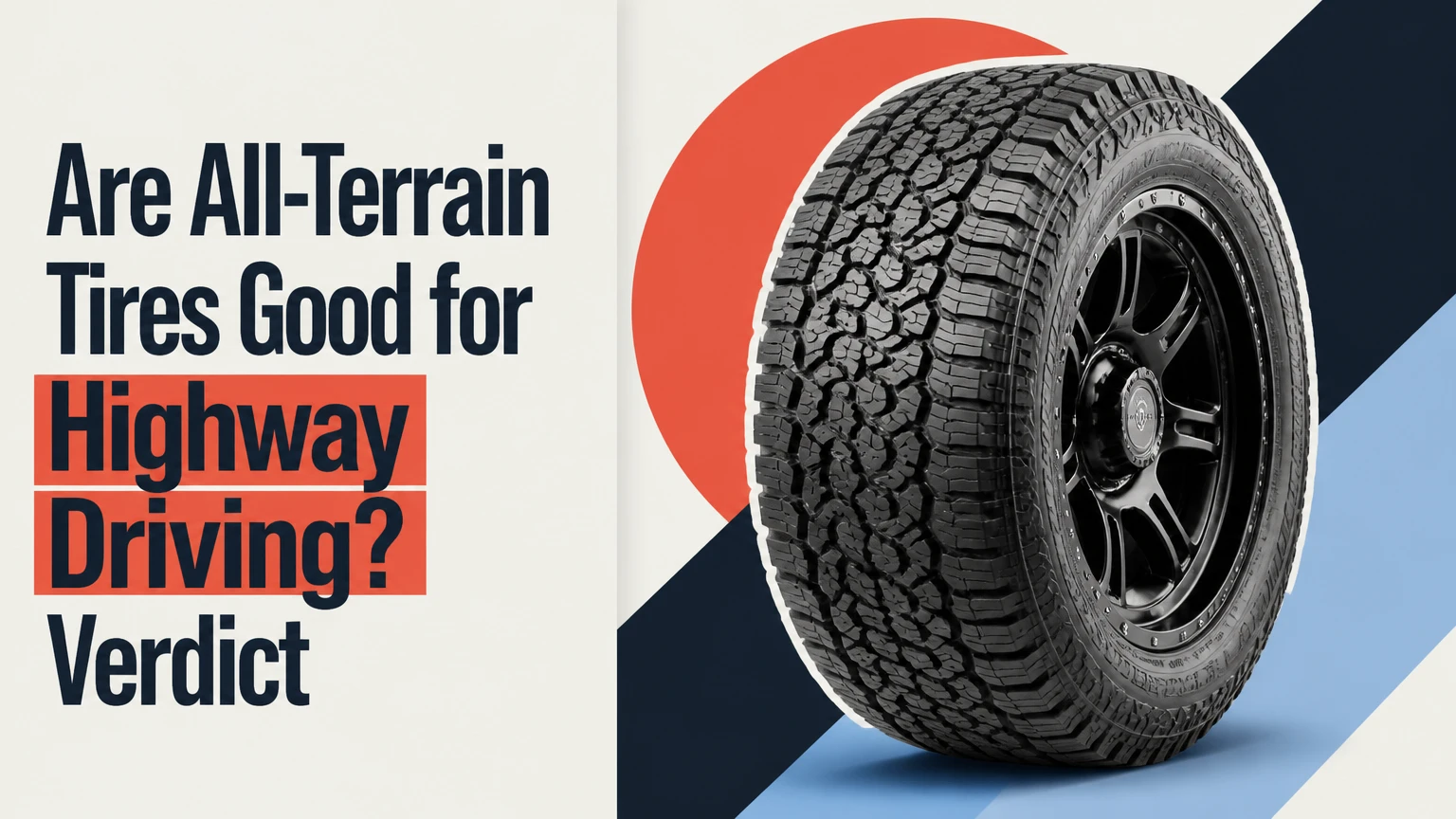
Yes, all-terrain tires are good for highway driving when a vehicle regularly needs gravel, dirt, snow, or tougher sidewalls. They are not the best highway-only choice: compared with highway-terrain tires, A/T tires usually produce more noise, slightly slower steering response, higher rolling resistance, and sometimes longer wet or dry stopping distances. The right answer depends on weather, load, road surface, and annual mileage.
Key Facts at a Glance
- An all-terrain tire is a compromise between a quiet highway-terrain tire and an aggressive mud-terrain tire.
- A road-biased A/T tire suits a commuter who occasionally drives gravel, snow, or forest roads.
- A 3PMSF marking certifies a tire for a severe-snow performance test, but it does not make the tire equal to a dedicated winter tire on ice.
- A/T tires can reduce fuel economy, but a universal 2-3 MPG penalty is not technically reliable because vehicle, size, pressure, tread design, and driving conditions all matter.
- The vehicle placard remains the starting point for inflation pressure; a replacement tire must also meet the vehicle’s required load and speed ratings.
- LT Load Range E tires are often unnecessary for lightly loaded SUVs and half-ton pickups, where their stiff construction can reduce ride comfort.
What Is an All-Terrain Tire?
An all-terrain tire is a road-legal tire designed to maintain predictable pavement performance while adding traction and casing protection for gravel, dirt, sand, ruts, and light-to-moderate mud. The tread normally has larger blocks, wider grooves, stronger shoulders, and more sidewall protection than a highway-terrain tire.
A/T tires occupy the middle of the common terrain spectrum. Highway-terrain tires prioritize low noise, wet-road efficiency, and smooth handling. Mud-terrain tires prioritize self-cleaning traction in deep mud and loose terrain, accepting substantial highway noise and reduced pavement refinement. All-terrain tires attempt to preserve enough of both characteristics for mixed driving.
The label does not define one uniform design. A compact SUV A/T tire can behave almost like an H/T tire, while a heavy LT tire with large shoulder lugs can feel closer to an X/T or M/T product. Read the tread pattern, service description, load range, speed rating, severe-snow marking, and warranty rather than relying on the A/T letters alone.
How Do All-Terrain Tires Work on Asphalt?
All-terrain tires work on asphalt through stabilized tread blocks, drainage grooves, sipes, and reinforced construction. Those features create a usable contact patch on pavement while leaving enough open tread to move stones, slush, and loose soil away from the tire.
Interlocking blocks reduce tread squirm during braking and cornering. Narrow sipes create additional biting edges on wet pavement and packed snow, although too many flexible edges can reduce block stability and accelerate irregular wear. Grooves evacuate water, but hydroplaning resistance depends on speed, water depth, inflation, tread depth, and vehicle alignment, not groove width alone.
Modern silica-containing compounds can remain more flexible in cool weather than older all-terrain formulations. That helps shoulder-season grip, but a 3PMSF tire remains a compromise on polished ice. The tread cannot replace the low-temperature compound and dense siping of a dedicated winter tire.
Which A/T Design Is Most Highway-Friendly?
A road-biased A/T tire is usually the quietest highway choice, while a rugged hybrid design gives up more comfort for loose-surface traction. The table below describes typical design behavior, not a regulated industry classification.
| A/T design | Typical road/off-road split | Highway behavior | Appropriate use |
|---|---|---|---|
| Road-biased A/T | 80/20 | Lowest noise, fastest steering response, strongest wet-road focus | 90% highway driving with gravel or snow access |
| Balanced A/T | 60/40 | Moderate hum, stable handling, stronger shoulder protection | Mixed commuting, towing, camping, regular gravel |
| Rugged or hybrid A/T | 40/60 | Noticeable hum, heavier steering, high puncture resistance | Work sites, rocky tracks, deep gravel, occasional mud |
| Mud-terrain tire | 20/80 | Loud, less precise, higher rolling resistance | Frequent mud and technical off-road travel |
Are All-Terrain Tires Quiet and Stable at Highway Speed?
Road-biased A/T tires can remain comfortable at 65-75 mph, but most produce more tread noise than comparable H/T tires. Noise rises when tread blocks become uneven, the tire is heavily siped, the casing is an LT design, or the vehicle has little cabin insulation.
Highway stability depends more on casing construction, tread-block stiffness, tire pressure, alignment, and load than on the A/T label. A properly inflated P-metric A/T tire can track cleanly, while an overloaded or underinflated tire can wander, heat up, and wear its shoulders.
A/T steering often feels less immediate because taller tread blocks flex before the carcass fully responds. That delay is small in a mild tire and obvious in a heavy, aggressive design. Drivers moving from a touring H/T tire should expect a firmer turn-in and possibly more steering effort.
What Happens to Fuel Economy?
A/T tires often reduce fuel economy because heavier casings, deeper tread, larger voids, and greater rolling resistance require more energy. A typical change may range from negligible to roughly 1-3 MPG, but the result varies too widely to promise a fixed penalty.
Tire size can matter more than tread category. Moving from a 265/65R17 P-metric H/T tire to a heavier 285/70R17 LT A/T tire changes diameter, width, mass, gearing, and aerodynamic drag at the same time. Comparing only “H/T versus A/T” hides those variables.
The U.S. Department of Energy identifies rolling resistance as a factor in vehicle fuel use, while tire manufacturers publish rolling-resistance data inconsistently across replacement categories. Check actual trip-computer results over several tanks, with cold pressure verified, rather than treating a claimed MPG number as universal.
Does A/T Mean Better Winter Highway Traction?
A/T tires improve traction in loose snow and slush when they carry the 3PMSF symbol, but 3PMSF certification does not guarantee superior ice braking or equal performance to a dedicated winter tire. The Three-Peak Mountain Snowflake marking indicates that the tire passed a standardized severe-snow traction test.
Many A/T tires carry only the M+S marking. M+S means the tread meets a geometric mud-and-snow definition; it is not the same as severe-snow certification. In regions with frequent packed snow, freezing rain, or temperatures consistently below about 45°F, a dedicated winter tire remains the safer specialized option because its compound stays more flexible.
The Tire and Rubber Association of Canada and major tire manufacturers distinguish severe-snow certification from winter-tire design. Certification is useful screening information, not a complete winter ranking.
How Do A/T, H/T, and M/T Tires Compare?
Highway-terrain tires win for quiet pavement commuting, all-terrain tires win for mixed surfaces, and mud-terrain tires win for frequent deep mud. No tread category simultaneously maximizes wet braking, fuel economy, cabin silence, rock protection, snow traction, and mud cleaning.
| Decision factor | H/T tire | A/T tire | M/T tire |
|---|---|---|---|
| Highway noise at 70 mph | Lowest, typically 64-70 dB in comparable tests | Moderate, typically 68-75 dB | Highest, often 72-80 dB |
| Pavement steering | Most precise | Moderate response | Slowest response |
| Gravel protection | Basic sidewall and tread | Reinforced tread and shoulders | Strongest casing options |
| Deep mud clearing | Poor | Moderate | Best |
| Fuel economy | Highest | Moderate | Lowest |
| Severe-snow availability | Some 3PMSF choices | Many 3PMSF choices | Fewer winter-focused designs |
| Typical set price, 17-inch size | $550-$1,000 | $650-$1,400 | $800-$1,600+ |
| Best road mix | 95-100% pavement | 60-90% pavement | Below 50% pavement |
Noise figures are typical comparative ranges, not universal laboratory results. Vehicle insulation, pavement texture, tire size, speed, and tread wear can alter sound pressure by several decibels.
Is an A/T Tire Better Than an H/T Tire for Daily Driving?
An A/T tire is better than an H/T tire for daily driving when the route includes regular gravel, unplowed snow, construction debris, or rough access roads. An H/T tire is better when nearly every mile occurs on paved roads and the priorities are quietness, wet braking, ride comfort, and efficiency.
The U.S. Tire Manufacturers Association recommends selecting a tire that meets the vehicle manufacturer’s size, load, and speed requirements. That principle matters more than a rugged appearance. A tire that cannot carry the vehicle’s loaded axle weight is unsuitable regardless of its terrain rating.
| Driver situation | Best starting category | Why | Main sacrifice |
|---|---|---|---|
| Urban SUV, paved commute | H/T | Lowest noise and rolling resistance | Limited loose-surface grip |
| Rural home with 5 miles of gravel | Road-biased A/T | Better stone and snow control | Moderate noise and cost |
| Half-ton towing on mixed roads | Balanced A/T, correct load rating | Stronger stability and casing | Firmer ride |
| Snow-belt daily driver | 3PMSF A/T or winter tire | Better snow traction | Ice performance may remain limited |
| Frequent mud and trails | M/T or rugged A/T | Open tread clears mud | Poorer highway refinement |
What Should You Check Before Buying A/T Tires?
Check the vehicle placard, tire size, load index, speed rating, service description, 3PMSF marking, treadwear warranty, and actual road percentage before buying A/T tires. The placard is normally located on the driver-door jamb and lists the manufacturer’s cold inflation pressure and approved sizes.
Should You Choose P-Metric or LT Tires?
Choose P-metric A/T tires for ordinary SUV and half-ton pickup use unless the vehicle’s loads, towing demands, or tire fitment require LT construction. LT tires use stronger construction and often higher load ranges, but they can weigh more, ride harder, consume more fuel, and transmit more impact harshness.
Load Range E does not mean a tire must be inflated to its maximum sidewall pressure during normal driving. Inflation must support the actual axle load and follow the vehicle or tire manufacturer’s application guidance. Never lower an LT tire below a safe pressure merely to imitate a passenger tire’s ride.
Does a Larger A/T Tire Improve Highway Driving?
A larger A/T tire can increase ground clearance and reduce sidewall exposure, but it can also reduce acceleration, alter speedometer readings, increase rubbing risk, and raise fuel consumption. A taller tire changes effective gearing, while a wider tire can add mass and aerodynamic drag.
After changing tire diameter, verify speedometer accuracy, TPMS behavior, suspension clearance, spare-tire compatibility, and the tire’s load capacity. A recalibration may be necessary, especially on vehicles with electronic stability-control systems that use wheel-speed differences.
How Much Do A/T Tires Cost to Own?
A/T tires typically cost about $650-$1,400 per set in common SUV and half-ton pickup sizes, while premium LT or rugged designs can exceed $1,600. Installation, balancing, disposal fees, alignment, and replacement TPMS components can add approximately $100-$250 per set.
| Cost item | Typical amount | Timing | Main cost driver |
|---|---|---|---|
| Four road-biased A/T tires | $650-$1,100 | Every 40,000-60,000 miles | Size and brand |
| Four premium balanced A/T tires | $900-$1,400 | Every 50,000-65,000 miles | Compound and casing |
| Mounting and balancing | $80-$180 | At installation | Wheel diameter and local labor |
| Four-wheel alignment | $100-$200 | When wear or steering suggests it | Vehicle suspension |
| Rotation service | $0-$80 | Every 5,000-8,000 miles | Shop policy |
| Replacement TPMS sensors | $120-$300 | When sensors fail | Sensor type and labor |
Mileage warranties are conditional. They normally require documented rotations, correct inflation, alignment maintenance, and replacement before the legal or manufacturer wear limit. Severe off-road use can consume tread faster than the warranty’s highway assumptions.
What Problems Do A/T Tires Cause on Highways?
A/T tires can cause excess noise, uneven wear, vibration, wandering, reduced fuel economy, and harsher ride quality when the design or setup does not match the vehicle. These problems usually arise from tread geometry, load range, inflation, alignment, balance, or neglected rotation rather than from the A/T category alone.
Why Do A/T Tires Get Loud?
A/T tires become loud when alternating tread blocks develop cupping or feathering, because each worn block strikes the pavement at a different angle. Run a hand across the tread with the vehicle parked; a sawtooth pattern indicates irregular wear that needs inspection.
Rotate tires according to the tire maker’s pattern, commonly every 5,000-8,000 miles, and correct alignment or worn suspension components. Rotation cannot repair advanced cupping, but it can prevent a new set from developing the same pattern.
Why Does the Steering Wheel Vibrate?
A highway-speed vibration usually indicates imbalance, radial-force variation, a bent wheel, a tire defect, or uneven wear. If vibration appears consistently between 55 and 75 mph, request a wheel inspection and road-force balance rather than repeatedly adding ordinary wheel weights.
A vibration that changes with braking can indicate a brake or hub issue. A vibration that follows one tire after tire rotation points toward the tire or wheel, which gives the technician a useful diagnostic clue.
Why Did Fuel Economy Drop More Than Expected?
A fuel-economy loss greater than roughly 3 MPG warrants a pressure, size, alignment, and mechanical check rather than an assumption that A/T tread caused everything. Verify cold pressure with an accurate gauge, compare the current tire’s mass and diameter with the original, and check for dragging brakes.
The door-jamb pressure remains the correct starting reference for the original approved tire size. A replacement size or load range may require a different pressure calculation, so obtain the correct value from the tire manufacturer or a qualified tire professional.
Which Drivers Should Choose A/T Tires?
Drivers should choose A/T tires when their highway use includes a meaningful risk of gravel damage, snow, muddy access roads, or construction debris. A road-biased A/T is the most rational choice for a commuter who spends 80-90% of the time on pavement but still needs occasional surface versatility.
Highway Commuter and Weekend Camper
Choose a mild A/T tire with a 3PMSF marking, moderate tread blocks, and a P-metric construction where approved. This combination limits noise and fuel loss while improving confidence on gravel roads, snowy driveways, and maintained campsites.
Skip an aggressive LT hybrid tire if the vehicle rarely leaves pavement. Its added mass and stiffness may provide no practical benefit during the other 15,000-20,000 miles of annual highway travel.
Towing and Fleet Driver
Choose a balanced A/T tire that meets the truck’s required load index and supports the actual axle load. Tire load capacity does not increase the truck’s legal payload or towing rating, and no tire can correct an overloaded trailer, weak suspension, or incorrect hitch setup.
Check cold pressures before every long tow, inspect sidewalls after work-site travel, and rotate on a shorter 5,000-mile interval if the truck carries uneven loads. Stability comes from the entire tire, wheel, suspension, hitch, and load system.
Severe-Winter Driver
Choose dedicated winter tires when ice, packed snow, or repeated subfreezing travel dominates the season. Choose a 3PMSF A/T tire only when one set must cover moderate winter roads and the vehicle also spends substantial time on gravel or unpaved surfaces.
A/T tires are not a substitute for chains where local law requires them, and four-wheel drive does not shorten braking distance on ice. Drivetrain traction helps acceleration; tire grip controls steering and stopping.
What Is the Best Alternative to an A/T Tire?
The best alternative is an H/T tire for pavement-first driving, a dedicated winter tire for severe cold and ice, or an M/T tire for frequent deep mud. Selecting the alternative by terrain frequency avoids paying for tread capability that remains unused.
Use an H/T tire when quietness, wet stopping, and fuel economy outweigh sidewall protection. Use winter tires when temperatures remain low and snow or ice is a recurring hazard. Use M/T tires only when mud-clearing ability is worth their highway noise, handling compromises, and faster wear.
FAQ
Can I Use All-Terrain Tires on a Two-Wheel-Drive Truck?
Yes, two-wheel-drive trucks can use all-terrain tires if the tires match the approved size, load index, speed rating, and wheel specifications. A/T tread can improve traction on loose surfaces, but it cannot provide the driven-axle advantage of four-wheel drive. Carrying proper ballast, reducing speed, and maintaining pressure remain important on snow.
Are A/T Tires Safe in Heavy Rain?
A/T tires can be safe in heavy rain when they have adequate tread depth, correct pressure, and a suitable wet-weather design. Large voids do not guarantee hydroplaning resistance, and worn or underinflated tires lose water-clearing ability. Reduce speed for standing water because no tread pattern prevents hydroplaning at every speed.
Do All-Terrain Tires Need More Frequent Rotation?
Most A/T tires benefit from rotation every 5,000-8,000 miles, although the vehicle and manufacturer schedule controls. Tall blocks and high torque can expose uneven wear quickly, especially on trucks with solid rear axles or misalignment. Record each rotation and inspect for feathering, cupping, shoulder wear, and embedded stones.
Can I Mix A/T and H/T Tires?
Do not mix A/T and H/T tires on the same axle unless the vehicle and tire manufacturers explicitly permit the combination. Four-wheel-drive and all-wheel-drive vehicles often require closely matched tire circumference, so mismatched tread depth or diameter can stress the driveline. Replace tires in axle pairs or as a complete set according to the vehicle guidance.
Do A/T Tires Last Longer Than Highway Tires?
A/T tires do not automatically last longer than highway tires. A premium A/T may carry a 50,000-65,000-mile warranty, but heavy casing, aggressive blocks, low pressure, towing, and gravel use can accelerate wear. An H/T tire may deliver more usable highway miles when the vehicle remains on pavement and receives regular maintenance.
The Bottom Line
All-terrain tires are good for highway driving when the vehicle needs one tire for pavement, gravel, snow, and light off-road travel. A road-biased A/T is usually the best compromise for mixed-use drivers, while an H/T tire remains superior for nearly all-pavement commuting and a winter tire remains superior for severe ice and snow. Compare load rating, 3PMSF status, pressure requirements, noise, cost, and real road use before choosing. For the right vehicle and route, are all terrain tires good for highway driving has a clear answer: yes, but only when their off-road benefits justify their highway compromises.