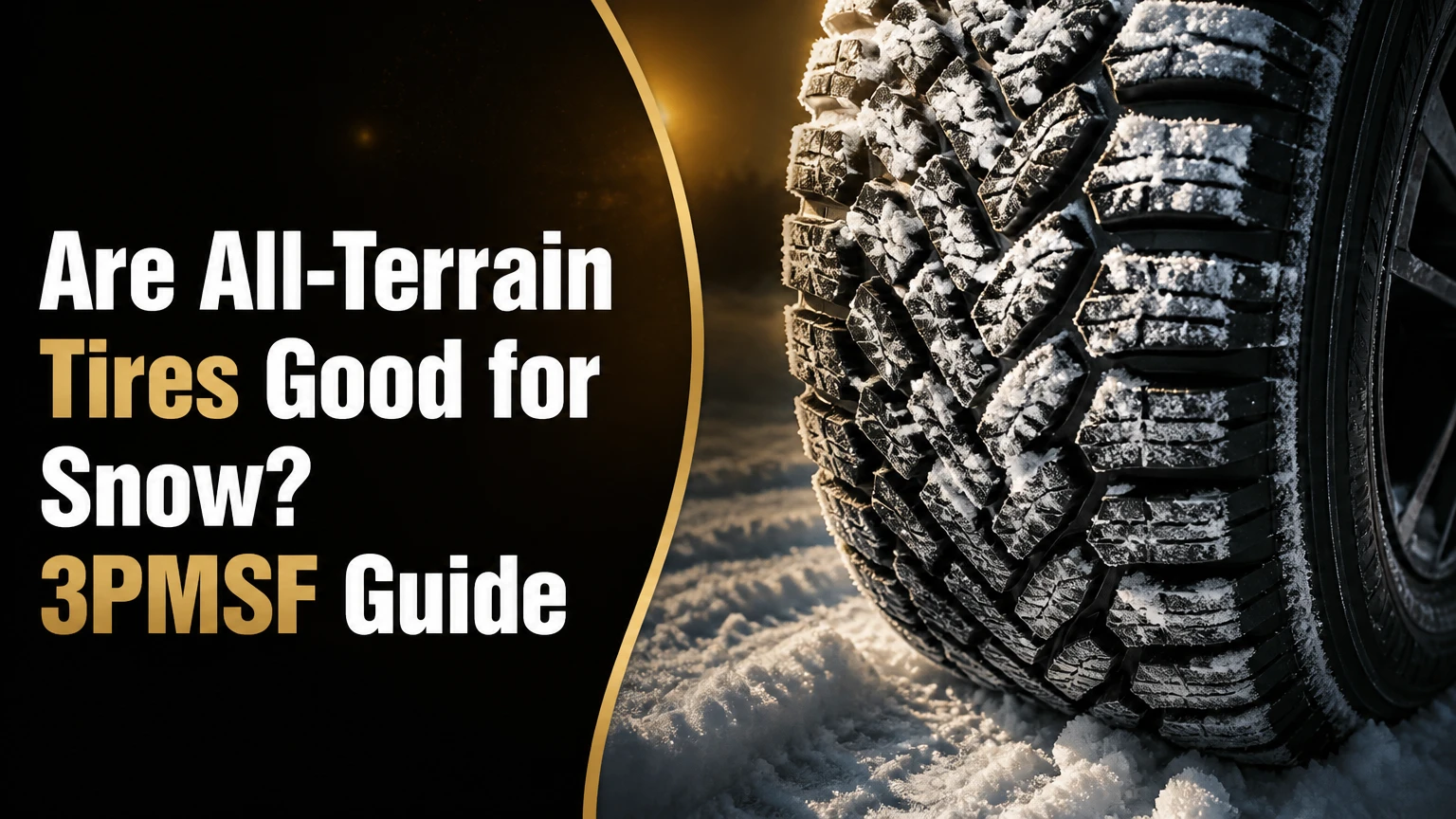
All-terrain tires are good for light to moderate snow when they have adequate tread and the Three-Peak Mountain Snowflake, or 3PMSF, rating. They are less capable than dedicated winter tires on ice, packed snow, and repeated freezing conditions, so tire choice should follow the surface, temperature, snowfall, and road grades you regularly drive.
Key Facts at a Glance
- A 3PMSF all-terrain tire is certified for severe-snow service, while an M+S marking alone does not certify winter traction.
- Dedicated winter tires generally provide the shortest braking and strongest cornering grip on ice and packed snow.
- Deep all-terrain tread helps in loose snow, but tread depth cannot compensate for a hard cold-weather rubber compound.
- Four-wheel drive and all-wheel drive improve acceleration in snow, but they do not shorten braking distance.
- Typical 3PMSF all-terrain tires cost about $160-$350 per tire before installation, depending on size and load rating.
- Replace winter-capable tires when tread, damage, age, or cold-weather performance no longer provides a safe margin.
What Is an All-Terrain Tire?
An all-terrain tire is a light-truck or SUV tire designed to divide its work between paved roads and unpaved surfaces. Compared with a highway-terrain tire, an A/T tire usually has deeper tread, larger grooves, stronger sidewalls, and more open shoulders for gravel, mud, sand, and loose snow.
The compromise is important. A/T tires normally produce more noise, rolling resistance, and steering effort than highway tires, while offering less ice grip and winter flexibility than dedicated snow tires. An all-terrain tire is therefore a versatile year-round design, not automatically a winter tire.
The tire’s intended vehicle also matters. A half-ton pickup carrying tools may need a higher load index than a crossover, and an LT-rated tire can ride more firmly than a passenger-rated tire in the same nominal size. Always match the vehicle placard, wheel size, load index, and speed rating before comparing tread patterns.
How Do All-Terrain Tires Grip Snow?
All-terrain tires gain traction in loose snow from tread depth, void volume, block edges, and compound design. Each feature helps a different part of the traction problem, so an aggressive-looking tread cannot predict performance on every winter surface.
Tread Depth and Open Voids
Deep tread gives an A/T tire more usable material for clearing loose snow. Large grooves also reduce the chance that snow will fill the tread and turn the tire into a nearly smooth contact patch.
Typical new A/T tires measure roughly 12/32-18/32 inch, although size, model, and load range change the specification. The number alone is not decisive. A shallow 3PMSF tire with a flexible compound can outperform a deeper non-winter-rated tire on cold packed snow.
Sipes and Block Edges
Sipes are narrow cuts in tread blocks that create additional biting edges. They also allow blocks to flex, which helps the tread conform to small irregularities in compacted snow and ice.
Dedicated winter tires generally use more numerous and more specialized sipes than A/T tires. That design difference explains why an A/T tire may climb through fresh snow effectively yet slide during a stop at an icy intersection.
Snow Packing
Snow can provide useful traction against snow when the tread pattern holds some of it without clogging. The effect works best in loose or moderately compacted snow and becomes far less useful on wet ice, polished hardpack, or warm slush.
The common phrase “snow grips snow” describes a real traction mechanism, but it is not a guarantee. Rubber compound temperature, vehicle speed, surface pressure, and tread edges still determine whether the tire accelerates, turns, and stops safely.
Cold-Weather Compound
Rubber becomes less compliant as temperature falls. Dedicated winter tires use compounds and tread structures engineered for low-temperature flexibility, while many conventional A/T tires prioritize heat resistance, wear, and off-road durability.
The often-repeated 45°F threshold is a useful seasonal rule for many summer-oriented tires, not a universal legal or chemical cutoff for every A/T model. Check the manufacturer’s application guidance rather than assuming every tire hardens identically at one temperature.
What Does the 3PMSF Symbol Mean?
The 3PMSF symbol means a tire passed a regulated severe-snow traction test relative to a reference tire. The symbol is a mountain outline containing a snowflake, and tire manufacturers use it on products intended to meet a higher snow-performance standard than an M+S tire alone.
3PMSF certification is valuable, but limited. It indicates standardized acceleration traction in a defined test, not equal performance among all certified tires, superior ice braking, or suitability for every severe winter road. A 3PMSF A/T tire remains a compromise between off-road strength and winter specialization.
Is M+S Enough for Winter Driving?
M+S is not enough evidence of winter capability. The mud-and-snow marking generally describes tread geometry and does not carry the same severe-snow performance requirement as 3PMSF certification.
A tire can display M+S and still use a compound and tread design optimized for warm-weather highway use. Drivers in regions with frequent freezing rain, mountain passes, or packed snow should look for 3PMSF and compare independent winter testing when available.
Which All-Terrain Tire Types Perform Best in Snow?
The best A/T category for snow is a severe-snow-rated model with 3PMSF certification, dense siping, and a compound intended for low temperatures. Mild A/T tires suit occasional snow, while rugged-terrain tires trade some hard-surface traction for off-road bite and sidewall strength.
| Tire category | Typical tread and rating | Best winter surface | Main limitation |
|---|---|---|---|
| Mild A/T | 12/32-15/32 inch, often M+S | 1-4 inches of fresh snow | Weak ice and cold-compound performance |
| 3PMSF A/T | 13/32-18/32 inch, severe-snow certified | Fresh snow, slush, mixed roads | Longer ice braking than winter tires |
| Trail-terrain | 11/32-14/32 inch, some 3PMSF models | Plowed suburban roads | Less flotation and sidewall protection |
| Rugged-terrain, R/T | 15/32-19/32 inch, model-dependent 3PMSF | Deep loose snow and rough access roads | Large blocks can slide on hardpack |
| Mud-terrain, M/T | 16/32-20/32 inch, rating varies | Deep mud and unbroken loose snow | Poorer packed-snow and ice control |
Examples often considered in the severe-snow A/T group include the BFGoodrich All-Terrain T/A KO3, Falken Wildpeak A/T4W, and some Goodyear Wrangler Duratrac variants. Product markings and sizes can change, so verify the exact sidewall and manufacturer specification rather than relying on a model family name.
Are All-Terrain Tires Good for Different Snow Conditions?
All-terrain tires are strongest in loose, unplowed snow and mixed roads, but their advantage narrows as the surface becomes harder and more polished. Snow depth, temperature, slope, speed, and braking demand matter more than the label printed on the tread.
| Driving surface | 3PMSF A/T result | Dedicated winter result | Practical decision |
|---|---|---|---|
| 2-6 inches of fresh snow | Strong forward traction | Strong traction with easier steering | A/T works for occasional travel |
| 8-12 inches of unplowed snow | High clearance and void benefit | Strong, but ground clearance may limit vehicle | A/T suits trucks and SUVs |
| Packed residential snow | Moderate stopping and cornering | Stronger edge grip | Winter tire preferred |
| Glare ice | Limited grip | Best available conventional tire grip | Choose winter tire or avoid travel |
| Wet slush at 35°F | Moderate, speed-sensitive | Stronger braking consistency | Reduce speed with either tire |
| Dry pavement below 20°F | Acceptable with 3PMSF | More flexible but may feel softer | Both can work within limits |
A/T tires can also struggle when wide tread blocks ride over a narrow strip of slush. Lowering speed is the correction, not lowering tire pressure below the placard value. Underinflation increases heat, changes handling, and can damage the tire.
Are All-Terrain Tires Better Than Winter Tires?
Dedicated winter tires are better for ice, packed snow, low temperatures, and emergency braking. A/T tires are better when the same vehicle must handle gravel, work sites, rocks, deep loose snow, and year-round highway mileage without seasonal replacement.
| Criterion | 3PMSF A/T | Dedicated winter tire | Highway all-season |
|---|---|---|---|
| Fresh snow traction | Strong | Strong | Moderate |
| Ice braking | Moderate | Strongest conventional option | Weak |
| Deep loose snow | Strong on trucks and SUVs | Strong, vehicle clearance dependent | Weak to moderate |
| Dry-road noise | 68-74 dB typical cabin range | 67-72 dB typical range | 65-70 dB typical range |
| Warm-weather wear | Usable year-round | Rapid above about 45°F | Usable year-round |
| Typical tread warranty | 50,000-65,000 miles | Often 40,000-60,000 miles | 60,000-80,000 miles |
| Seasonal swap requirement | None | Usually two sets | None |
| Typical tire price | $160-$350 | $130-$300 | $120-$280 |
The comparison changes when roads are consistently icy. Winter tires use softer cold-weather compounds, dense siping, and flexible tread blocks that maintain contact at temperatures where many A/T designs become less compliant.
Tire Rack testing and manufacturer winter testing commonly demonstrate the same pattern: acceleration performance can look acceptable while braking and cornering reveal the larger winter-tire advantage. A tire that gets a truck moving is not necessarily a tire that can stop it before an obstacle.
Does AWD or 4WD Make A/T Tires Safe in Snow?
AWD and 4WD improve propulsion by distributing engine torque across multiple wheels, but both systems have limited effect on braking. The anti-lock braking system, tire-road friction, vehicle speed, and driver input determine stopping performance.
This is why a 4WD pickup on M+S tires can accelerate up a snowy hill and still slide through a stop sign. Electronic stability control can reduce a skid, but it cannot create friction that the tire compound and road surface do not provide.
A useful practitioner rule is to select tires for the worst braking surface you regularly encounter, not the easiest hill you can climb. If winter roads include steep descents, blind corners, or frequent glare ice, dedicated winter tires provide a larger safety margin than drivetrain upgrades.
How Much Do Snow-Capable A/T Tires Cost?
A snow-capable A/T tire typically costs $160-$350 per tire before mounting, balancing, taxes, and disposal fees. Large LT sizes, high load ranges, three-quarter-ton trucks, and specialty fitments can push the price above $400 each.
| Vehicle example | Typical tire price | Typical four-tire purchase | Common added cost |
|---|---|---|---|
| Subaru Crosstrek or RAV4 | $150-$220 | $600-$880 | $80-$160 installation |
| Ford Explorer or half-ton pickup | $220-$350 | $880-$1,400 | $100-$200 installation |
| Ram 2500 or similar HD truck | $300-$450+ | $1,200-$1,800+ | $120-$240 installation |
| Dedicated winter setup | $130-$300 | $520-$1,200 | $700-$1,600 second wheels and tires |
A single 3PMSF set can reduce seasonal storage and mounting charges. That apparent saving should be compared with fuel use, road noise, warm-weather wear, and the safety benefit of a second winter set.
How Long Do 3PMSF A/T Tires Last?
Premium A/T tires commonly carry 50,000-65,000-mile treadwear warranties, but severe-snow capability declines before the legal wear bars become the only concern. Many technicians use about 6/32 inch as a practical winter replacement point, while 4/32 inch is a common wet-road replacement guideline.
| Condition | Typical threshold | Required action |
|---|---|---|
| New A/T tread | 12/32-18/32 inch | Record baseline depth |
| Winter-capable performance concern | About 6/32 inch | Plan replacement before winter |
| Wet-weather replacement guideline | About 4/32 inch | Replace promptly |
| Legal wear-bar level | 2/32 inch in many U.S. states | Do not use for winter service |
| Tire age inspection | 5-6 years in service | Obtain professional inspection |
| Cold pressure change | About 1 psi per 10°F | Recheck pressure during cold snaps |
The 1 psi per 10°F rule is a practical approximation, not a substitute for measurement. Set pressure when tires are cold, using the vehicle placard rather than the maximum pressure molded into the sidewall.
Rotate tires according to the vehicle and tire manufacturer, often every 5,000-8,000 miles. Uneven wear, cupping, exposed cords, sidewall cuts, bulges, and repeated puncture repairs can make a tire unsuitable regardless of remaining tread.
Which Drivers Should Choose A/T Tires?
A 3PMSF A/T tire suits drivers who need one durable set for mixed pavement, gravel, construction access, and periodic snow. A dedicated winter tire suits drivers who prioritize cold-weather braking and encounter ice or packed snow repeatedly.
Mountain Commuter
Choose dedicated winter tires when winter lasts several months, roads include steep grades, or local law requires certified winter equipment. A/T tires may satisfy a 3PMSF rule in some jurisdictions, but legal compliance does not mean equal ice performance.
Suburban Crossover Driver
Choose a mild or trail-terrain 3PMSF tire when roads are plowed and snow is occasional. A less aggressive tread can reduce noise and weight while preserving severe-snow certification, especially for vehicles such as a Toyota RAV4, Subaru Outback, or Ford Explorer.
Truck and Rural Property Owner
Choose a 3PMSF A/T or selected R/T tire when deep snow, gravel, ruts, and sidewall hazards are routine. Confirm that the tire’s load range, wheel size, and clearance work with the truck, because a heavy LT tire can reduce ride comfort and fuel economy.
Ice-Belt Driver
Choose dedicated winter tires when freezing rain and polished intersections are more common than deep powder. An A/T tire’s open tread may look safer, but dense winter siping and a flexible compound matter more on smooth ice.
What Common A/T Snow Mistakes Reduce Traction?
The most common mistake is treating the tire label as a complete winter-performance rating. Drivers also lose traction by ignoring pressure, mixing tread designs, using worn tires, and driving at speeds suited to dry pavement.
- Assuming M+S equals winter-rated: Verify the mountain-and-snowflake symbol on the exact tire sidewall.
- Using minimum legal tread: Replace near 6/32 inch if reliable winter traction matters.
- Inflating by appearance: Measure cold pressure with a gauge during temperature changes.
- Mixing tire models or worn and new axles: Follow the vehicle manufacturer’s placement rules; mismatched traction can destabilize handling.
- Relying on ballast as a primary fix: Extra cargo can increase rear-wheel grip in a pickup, but it also changes stopping distance and does not solve ice traction.
- Keeping summer driving speeds: Snow reduces available friction, even when the road appears wet rather than frozen.
Do not lower pressure to gain snow traction unless the vehicle or tire manufacturer specifically permits an off-road setting. Street use at reduced pressure can overheat the sidewall and compromise steering response.
How Should You Improve Snow Traction Before Driving?
Start with the tire sidewall, vehicle placard, tread depth, and local road conditions before changing equipment. The correct sequence prevents drivers from trying a mechanical fix for a compound, pressure, or speed problem.
- Confirm the rating: Find 3PMSF, size, load index, and speed rating on every tire.
- Measure cold pressure: Adjust all four tires to the vehicle placard value.
- Inspect tread and damage: Measure several grooves and look for cuts, bulges, cords, and uneven wear.
- Clear snow from the vehicle: Remove packed snow from lights, mirrors, wheel wells, and roof.
- Reduce speed before slush or ice: Make steering, braking, and throttle inputs gradual.
- Increase following distance: Allow at least 6-10 seconds on slippery roads, more on ice.
- Use chains where required: Follow local law, axle restrictions, clearance limits, and the vehicle manual.
- Test traction gently: Use a low-speed, straight-line brake check only where traffic and road conditions make it safe.
A tire cannot compensate for blocked visibility, excessive speed, poor tread, or a road closed by authorities. The safest response to severe ice may be postponing the trip.
The Bottom Line
Are all-terrain tires good for the snow? Yes, a 3PMSF all-terrain tire is a strong year-round choice for light to moderate snow, unplowed roads, gravel, and mixed truck or SUV use. Dedicated winter tires remain the better choice for frequent ice, packed snow, steep winter routes, and maximum cold-weather braking.
Choose based on the surface you must stop on, not the surface you hope to cross. Verify 3PMSF, maintain cold pressure, replace worn tread before winter, and treat AWD or 4WD as an acceleration aid rather than a substitute for winter traction.
Frequently Asked Questions
Are 3PMSF all-terrain tires the same as snow tires?
No. A 3PMSF all-terrain tire passes a severe-snow traction test, but a dedicated winter tire usually has a softer cold-weather compound, denser siping, and more flexible tread blocks. The A/T design offers greater year-round durability and off-road range, while the winter tire normally provides better ice braking and packed-snow cornering.
Are wider all-terrain tires better in deep snow?
Not automatically. A wider tire can float over loose snow, but it may plane on slush and provide less surface pressure on hardpack. Use the vehicle manufacturer’s approved size, wheel width, load index, and clearance. Tread design, compound, pressure, and speed usually matter more than width alone.
Can I use mud-terrain tires in winter?
Mud-terrain tires can work in deep, loose snow when their voids remain open, but many perform poorly on packed snow and ice because their large blocks have fewer sipes. Check for 3PMSF certification, inspect the exact model, and choose an A/T or winter tire when paved winter roads dominate.
Should I put winter tires on a 4WD truck?
Yes, if the truck regularly drives on ice, packed snow, steep roads, or cold pavement. Four-wheel drive helps the truck accelerate, but all four tires still supply braking and cornering grip. A winter tire set can provide a larger safety improvement than changing from two-wheel drive to four-wheel drive alone.
Do all-terrain tires use more fuel?
Many A/T tires reduce fuel economy because they weigh more and have greater rolling resistance than highway tires. A typical real-world penalty is approximately 1-3 miles per gallon, although vehicle weight, tire pressure, tread design, temperature, and driving speed can produce a different result.
When should I replace all-terrain tires before winter?
Inspect tires before the season and plan replacement near 6/32 inch of tread when dependable snow traction matters. Replace sooner for cracking, bulges, exposed cords, severe uneven wear, or sidewall damage. Age also matters, so have tires around five or six years in service professionally inspected.


