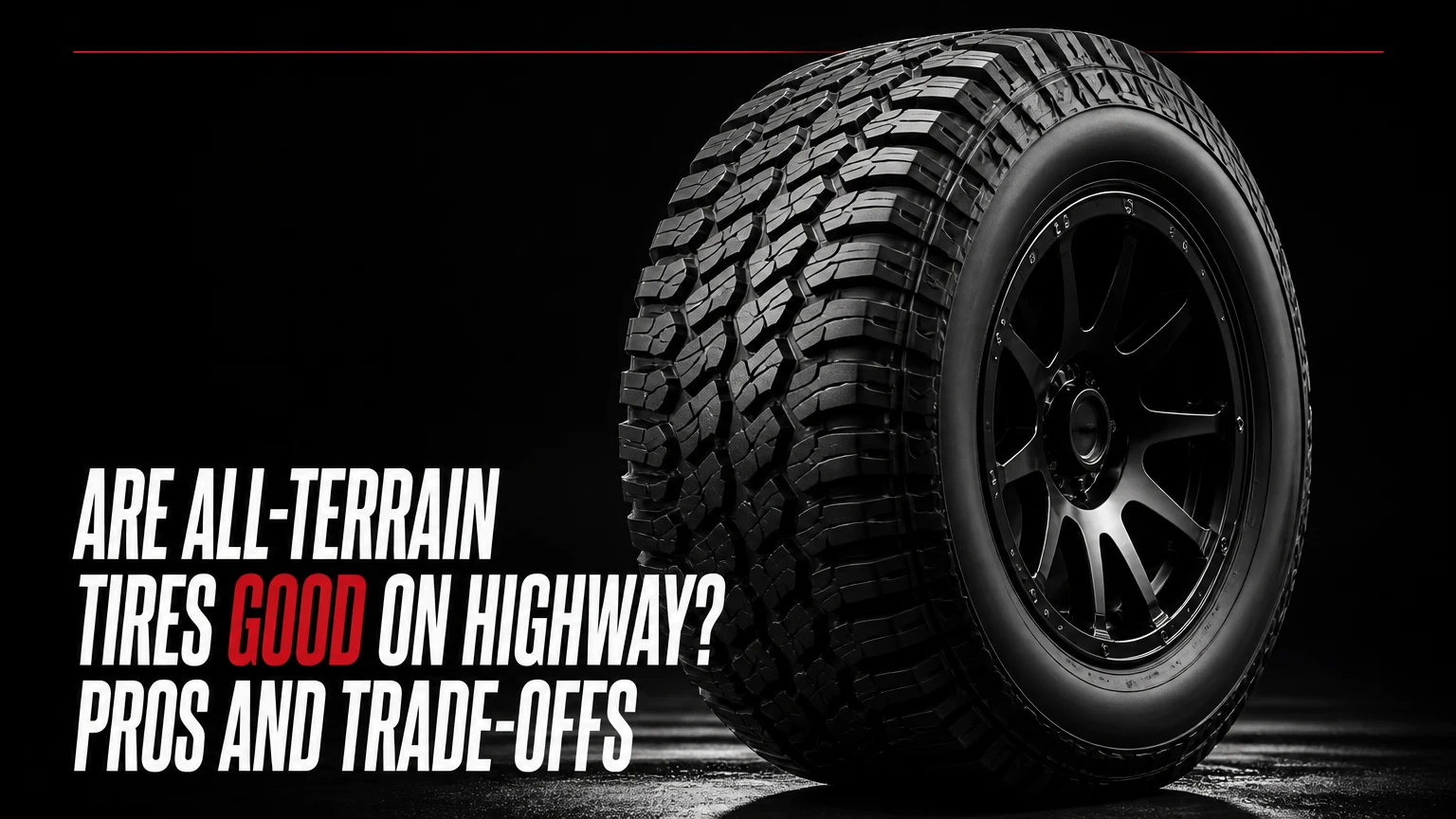
All-terrain tires are good on highways when a vehicle regularly combines paved driving with gravel, dirt, snow, or moderate trails. They offer acceptable dry and wet-road handling, but highway-terrain tires usually provide quieter operation, lower rolling resistance, better ride comfort, and stronger wet-braking performance. The right choice depends on how often off-pavement traction matters.
Key Facts at a Glance
All-terrain tires are a compromise between highway-terrain and mud-terrain designs.
Mild A/T tires can work well for daily highway driving, while rugged A/T and R/T tires create more noise and rolling resistance.
Typical A/T tires cost about $150-$350 each in common SUV and pickup sizes, before installation.
A/T tires commonly weigh 3-8 kilograms more per tire than comparable original-equipment H/T tires.
A 3PMSF symbol indicates a tire passed a severe-snow traction test; an M+S marking alone does not provide the same certification.
Tire pressure, alignment, rotation, load rating, and tread condition often affect highway safety more than the terrain label.
Are All-Terrain Tires Good on Highway?
All-terrain tires are suitable for highway travel, but they are not automatically the best highway tire. A mild or well-designed standard A/T tire can deliver stable steering, dependable dry grip, and reasonable wet performance at normal highway speeds, while an aggressive rugged-terrain tire may feel louder, heavier, and less precise.
The practical answer depends on the road split. Drivers who spend 80-100% of their time on pavement generally gain more from H/T tires unless they need extra sidewall protection, frequent gravel traction, or certified snow capability. Drivers who reach campsites, construction roads, ranch tracks, or snowy mountain routes often accept the A/T compromises because one tire covers several environments.
Michelin’s consumer tire guidance summarizes the safety relationship simply: “The only contact between your vehicle and the road is the tire.” That contact patch determines braking, steering, acceleration, and water evacuation, so the tread label alone cannot establish whether a tire is suitable for a particular vehicle.
What makes highway performance acceptable?
A/T highway behavior comes from several design compromises:
- Interlocking tread blocks support cornering and reduce block movement.
- Sipes create additional biting edges for wet pavement and light snow.
- A continuous or semi-continuous center rib improves straight-line tracking.
- Reinforced sidewalls resist cuts on rocks and rough shoulders.
- Computer-varied tread pitches can reduce repetitive humming.
Aggressive voids help clear mud, but they remove rubber from the road contact area. That usually increases noise and can reduce braking consistency on wet pavement. Open shoulders also do not prevent hydroplaning by themselves. Water evacuation depends on groove design, speed, inflation pressure, tread depth, road surface, and water depth.
How Do A/T Tires Behave at Highway Speeds?
All-terrain tires usually feel stable at highway speeds when their speed rating, load rating, inflation pressure, and wheel balance match the vehicle. The main highway penalties are typically more tread noise, slower steering response, greater rolling resistance, and a firmer ride, especially with heavy LT tires inflated near their maximum pressure.
A/T tires use larger tread blocks and deeper grooves than many H/T tires. Those features provide traction on loose surfaces, yet they can produce block movement and air-pressure pulses as each lug contacts the pavement. Manufacturers reduce the effect with staggered pitches, linked blocks, optimized compounds, and central ribs.
A tire’s speed rating is separate from its terrain category. Common ratings include R at 170 km/h, S at 180 km/h, and T at 190 km/h, but the vehicle manufacturer’s specification remains the governing requirement. A tire with a higher letter is not necessarily quieter, stronger, or better in rain.
Highway behavior by tire category
| Tire category | Typical tread depth | Typical noise level | Typical weight penalty | Highway use |
|---|---|---|---|---|
| Mild A/T | 10-13 mm | 68-73 dB | 1-4 kg per tire | Daily driving with gravel or light snow |
| Standard A/T | 12-16 mm | 72-78 dB | 3-8 kg per tire | Mixed pavement, trails, and winter travel |
| Rugged-terrain or R/T | 14-19 mm | 76-82 dB | 6-12 kg per tire | Work sites, rocks, and frequent off-road use |
| Mud-terrain or M/T | 15-21 mm | 79-86 dB | 8-15 kg per tire | Deep mud and technical off-road terrain |
Noise figures are typical comparative ranges, not universal laboratory results. Vehicle insulation, tire size, pavement texture, tread wear, and inflation pressure can change the cabin result substantially.
Do A/T tires reduce fuel economy?
A/T tires commonly reduce fuel economy by about 0.5-1.5 km/L compared with equivalent H/T tires, although the result varies with tire diameter, casing weight, tread design, vehicle aerodynamics, and speed. A heavier tire increases rotational inertia, while deeper voids and flexible blocks increase rolling resistance.
The penalty becomes more noticeable on large pickups with LT construction and oversized wheels. A driver traveling 25,000 highway kilometers annually could spend materially more on fuel, particularly when a heavy tire is paired with a lift kit, roof rack, low tire pressure, or larger-than-stock diameter.
Pressure matters. Underinflation increases sidewall flex and heat, while overinflation can reduce contact-patch consistency and ride quality. Use the vehicle placard pressure for normal driving, not the maximum pressure molded into the sidewall, unless a tire professional or the manufacturer specifies otherwise for a particular load.
Which A/T Tire Type Fits Highway Driving?
Mild A/T tires suit highway-focused drivers, standard A/T tires suit genuinely mixed-use vehicles, and rugged-terrain tires suit drivers who regularly prioritize off-road durability over comfort. The most aggressive option is rarely the most sensible choice for a vehicle that spends nearly every day on asphalt.
| Driver profile | Suitable category | Highway advantages | Off-road capability | Main sacrifice |
|---|---|---|---|---|
| 90% pavement, occasional gravel | Mild A/T | Lowest noise and rolling resistance | Gravel, grass, maintained tracks | Limited mud and rock traction |
| 60-80% pavement, weekend trails | Standard A/T | Balanced tracking and comfort | Gravel, sand, moderate rocks, light mud | More noise and fuel use |
| 40-60% pavement, rough work access | Rugged-terrain | Strong casing and sidewall protection | Rocks, ruts, construction surfaces | Wet grip, noise, weight |
| Mostly trail and deep mud | M/T | Acceptable short highway transfers | Deep mud and technical terrain | Braking, noise, wear, fuel economy |
Examples include the Continental TerrainContact A/T and Michelin LTX A/T2 in the mild or highway-biased category, the BFGoodrich All-Terrain T/A KO3 and Falken Wildpeak A/T4W in the standard category, and the Toyo Open Country R/T and Nitto Ridge Grappler in the rugged-terrain category. Exact sizes and constructions differ, so model names should never replace checking the vehicle fitment.
Are rugged-terrain tires good for highway use?
Rugged-terrain tires can be highway-legal and stable, but they are usually a poor value for a pavement-dominated commute. Their large shoulder lugs, reinforced construction, and deep voids improve resistance to cuts and impacts, while increasing humming noise, steering effort, unsprung mass, and wet-road compromises.
A rugged tire makes sense for a work truck that reaches rocky construction sites several times each week. It makes less sense for a crossover that drives 20,000 highway kilometers annually and visits a maintained campground once per year.
A/T Tires Compared With Highway and Mud Tires
A/T tires occupy the middle ground between H/T and M/T tires. Highway tires prioritize pavement efficiency and comfort, while mud tires maximize self-cleaning traction in deep soft terrain and accept substantial highway penalties.
| Criterion | Highway-terrain H/T | All-terrain A/T | Rugged-terrain R/T | Mud-terrain M/T |
|---|---|---|---|---|
| Typical price per tire | $140-$300 | $150-$350 | $190-$400 | $200-$450 |
| Typical service life | 65,000-100,000 km | 60,000-95,000 km | 45,000-75,000 km | 35,000-65,000 km |
| Highway noise | 65-72 dB | 68-78 dB | 76-82 dB | 79-86 dB |
| Wet-road braking | Strongest category | Moderate to strong | Moderate | Often weakest |
| Gravel traction | Moderate | Strong | Very strong | Strong |
| Deep-mud traction | Poor | Moderate | Strong | Strongest |
| Fuel economy effect | Lowest | 0.5-1.5 km/L penalty typical | 1-2 km/L penalty typical | Often above 1.5 km/L penalty |
| Winter certification | Model-dependent | Model-dependent | Model-dependent | Model-dependent |
These ranges are typical market and field-use figures, not guarantees. Tread compound, vehicle alignment, driving style, and regional pavement can shift results.
Are A/T tires better than H/T tires in rain?
A/T tires are not inherently better than H/T tires in rain. A modern H/T tire often has more optimized circumferential grooves, a larger continuous contact area, and a compound tuned specifically for wet pavement, while an A/T tire trades some of those characteristics for loose-surface traction.
A/T wet performance can still be strong when the tire has dense siping, well-designed grooves, and a current silica-rich compound. Tread depth does not guarantee wet grip. A worn A/T tire with hardened rubber can lose water evacuation and adhesion despite appearing visually rugged.
The winner for wet highways is usually an H/T tire. A mild A/T becomes the better decision when gravel, snow, sidewall damage, or trail access has enough value to justify the compromise.
Are A/T tires good in snow?
Some A/T tires perform well in packed snow, but winter capability depends on the 3PMSF marking, compound temperature behavior, tread design, and actual winter conditions. The Three-Peak Mountain Snowflake symbol means the tire passed a standardized severe-snow traction test; the M+S marking does not carry the same performance threshold.
A 3PMSF A/T tire can be a reasonable year-round choice in regions with moderate snow and clear paved roads. Dedicated winter tires remain superior on ice, polished intersections, and temperatures consistently below about 7°C because their compounds and siping remain more flexible.
Drivers in heavy-snow areas should compare local winter tire laws, stud restrictions, mountain weather, and storage practicality. A/T tires do not transform a rear-wheel-drive pickup into a high-traction winter vehicle, and four-wheel drive does not shorten braking distance.
What Specifications Matter Most for Highway Use?
Load index, speed rating, size, construction, and pressure are the most important specifications for highway safety. Buyers should match or exceed the vehicle manufacturer’s required load and speed ratings without selecting a casing so stiff that normal use becomes uncomfortable and mechanically unnecessary.
| Specification | Common examples | Highway implication | Buyer checkpoint |
|---|---|---|---|
| Speed rating | R 170 km/h, S 180 km/h, T 190 km/h | Sets tested speed capability under stated conditions | Meet the door-jamb or owner’s-manual requirement |
| Load range | C, D, E for LT tires | Higher capacity usually means more stiffness and weight | Match payload and towing needs |
| Tire construction | P-metric, LT-metric | LT casings resist loads but often ride harder | Use the vehicle-approved construction |
| 3PMSF | Snowflake mountain symbol | Certified severe-snow traction test | Choose for frequent snow travel |
| M+S | Mud and snow marking | Broad designation without severe-snow threshold | Do not treat it as a winter certification |
| Tread depth | 10-19 mm new, model-dependent | More reserve for loose surfaces and water channels | Replace before severe wear or damage |
| Section width and diameter | Example: 265/70R17 | Changes clearance, gearing, steering, and fuel use | Confirm fitment and speedometer effects |
Is an E-load A/T tire better for a light truck?
An E-load LT tire is better only when the truck’s payload, towing demand, terrain, or puncture risk justifies its capacity. On a lightly loaded half-ton pickup or SUV, an E-load tire can add several kilograms per corner and create a stiff ride, reduced compliance, and unnecessary rolling resistance.
Never inflate an E-load tire to 50-80 psi simply because the sidewall permits it. Normal pressure comes from the vehicle placard, while towing pressure should follow the vehicle manufacturer’s load tables or axle requirements. Maximum sidewall pressure is a limit, not a universal operating recommendation.
The tire must also support the axle. A suitable tire cannot compensate for exceeding the vehicle’s gross vehicle weight rating, gross axle weight rating, hitch rating, or payload limit.
How Much Do A/T Tires Cost and How Long Do They Last?
A/T tires typically cost $150-$350 each for common 16-20-inch SUV and pickup sizes, with a complete installed set often reaching $700-$1,700 after mounting, balancing, taxes, disposal, and alignment. Typical service life is 60,000-95,000 kilometers, but aggressive tread, high torque, poor alignment, and underinflation shorten that range.
| Expense or interval | Typical value | What changes it | Practical planning point |
|---|---|---|---|
| Mild A/T tire | $150-$280 each | Size, brand, load rating | Best for pavement-focused budgets |
| Standard A/T tire | $180-$350 each | 3PMSF, LT casing, warranty | Common mixed-use choice |
| R/T tire | $220-$400 each | Sidewall design and casing | Budget for higher fuel use |
| Mounting and balancing | $20-$45 per tire | Region and wheel size | Four tires usually take 45-60 minutes |
| Four-wheel alignment | $90-$180 | Vehicle and shop | Perform when wear is irregular |
| Rotation interval | 8,000-10,000 km | Drivetrain and wear pattern | Rotate earlier for severe use |
| Replacement age | Inspect at 5-6 years | Climate, storage, cracking | Follow tire-maker guidance and local rules |
Tread-life warranties can provide a useful comparison, but warranty conditions often require documented rotations, correct inflation, matching tires, and minimum remaining tread. A mileage promise is not a guarantee that every vehicle will achieve the stated distance.
An A/T tire that wears unevenly can become noisy long before its grooves disappear. Cupping, heel-and-toe wear, shoulder wear, and center wear each point toward different pressure, alignment, suspension, or rotation problems.
How Should A/T Tires Be Maintained for Highway Driving?
A/T tires should be checked monthly and before long trips, rotated at roughly 8,000-10,000 kilometers, and inspected for uneven wear, cuts, stones, cracks, and bead damage. Correct cold inflation pressure is the single routine check with the greatest effect on highway stability, heat generation, tread wear, and fuel use.
Use a reliable gauge when the tires are cold. Check the spare, because a full-size spare may age without accumulating mileage. Confirm that the TPMS warning system functions, but do not treat TPMS as a substitute for manual pressure checks because many systems warn only after pressure has fallen materially.
A practical maintenance sequence is:
- Check all five tires, if a full-size spare exists.
- Measure cold pressure against the door-jamb specification.
- Inspect inner and outer shoulders for irregular wear.
- Remove large stones lodged between tread blocks.
- Rotate according to the drivetrain and tire manufacturer’s pattern.
- Balance the assembly when vibration appears or tires are replaced.
- Align the vehicle after pothole impacts, suspension work, or persistent pull.
Why do A/T tires become noisy or vibrate?
A/T tire noise usually comes from tread design or irregular wear, while highway-speed vibration usually comes from imbalance, bent wheels, tire uniformity, or contamination inside the wheel. Cupped blocks can create a repeating hum that increases with speed and may remain after a simple rotation.
| Symptom | Likely cause | Inspection | Corrective action |
|---|---|---|---|
| Humming at 80-100 km/h | Cupping or heel-to-toe wear | Run a hand across tread blocks | Rotate, align, and inspect suspension |
| Steering shake at 90-110 km/h | Wheel imbalance or bent rim | Dynamic balance and radial check | Rebalance or repair the wheel |
| Vehicle pulls left or right | Unequal pressure or alignment | Pressure and alignment measurement | Correct pressure, then align |
| Center tread wear | Excessive inflation | Compare center depth with shoulders | Set cold pressure to placard value |
| Shoulder wear | Low pressure or hard cornering | Measure both shoulders | Correct pressure and check alignment |
| New vibration after mud use | Mud or stones inside wheel | Inspect inner barrel | Clean wheels and rebalance |
Do not mask a mechanical fault by replacing a tire immediately. A worn tie-rod end, damaged shock absorber, bent wheel, or loose bearing can destroy a new set and compromise control.
When Are A/T Tires the Wrong Choice?
A/T tires are the wrong choice for drivers who spend nearly all their time on smooth pavement and value minimum noise, shortest wet stopping distances, maximum fuel economy, and soft ride quality above occasional gravel capability. Highway-terrain tires usually serve that profile better.
A/T tires are also a poor substitute for specialized winter tires in areas with frequent ice, deep snow, or prolonged freezing temperatures. They are not ideal for deep mud compared with M/T tires, and they cannot compensate for insufficient vehicle clearance, poor recovery equipment, overloaded axles, or unsuitable driving technique.
Consider an alternative when:
- Annual off-pavement driving is below roughly 1,000-2,000 kilometers.
- The vehicle is a quiet crossover used mainly for commuting.
- Fuel cost and highway comfort matter more than sidewall resistance.
- The region has frequent ice or severe winter weather.
- The vehicle manufacturer does not approve the desired LT size or load range.
- The proposed tire changes diameter enough to affect clearance, gearing, or electronic systems.
All-weather tires may be a better alternative for a pavement-focused driver who needs certified snow performance but rarely leaves asphalt. H/T tires generally remain the most efficient choice for long-distance highway travel.
Which A/T Tire Should Each Driver Choose?
The best A/T category depends on the driver’s pavement percentage, off-road surface, annual mileage, winter conditions, and payload. A mild A/T suits the commuter, a standard 3PMSF A/T suits the mixed-use traveler, and an LT standard A/T suits regular hauling when the vehicle’s specifications support it.
Daily commuter with occasional camping
Choose a mild A/T with a highway-oriented tread, moderate sidewall reinforcement, and a P-metric construction when approved for the vehicle. A model such as the Continental TerrainContact A/T can preserve more ride comfort and steering precision than a heavy R/T tire.
Avoid paying for deep mud capability that the vehicle will not use. A gravel access road and a maintained campsite do not require the same tire as rocky desert trails.
High-mileage traveler in snow and gravel
Choose a standard A/T with 3PMSF certification, a strong wet-weather compound, and a warranty that matches the expected annual mileage. The Falken Wildpeak A/T4W and BFGoodrich All-Terrain T/A KO3 represent the type of balanced product this driver should compare, subject to exact size and vehicle fitment.
Check winter performance independently. The snowflake symbol is useful, but it does not make an A/T tire equivalent to a dedicated ice-and-snow tire.
Work truck carrying loads
Choose an LT-metric A/T with a load index that supports the actual axle load and a speed rating that meets the vehicle requirement. Confirm whether the selected C, D, or E load range is necessary, because excess casing stiffness can worsen ride quality and reduce compliance when the truck is empty.
Use the manufacturer’s towing pressure guidance and weigh the loaded truck when towing frequently. Tire capacity, axle capacity, hitch rating, and payload rating must all remain within limits.
How Do You Decide Between A/T and H/T Tires?
Use A/T tires when off-pavement traction, sidewall protection, or moderate snow capability affects at least several trips each month. Use H/T tires when highway mileage dominates and the main priorities are quietness, wet braking, comfort, and fuel economy.
A simple decision rule works well:
- Choose H/T if pavement accounts for 90% or more of driving and gravel is occasional.
- Choose mild A/T if pavement accounts for 75-90% of driving and gravel or snow is routine.
- Choose standard A/T if pavement accounts for 50-75% of driving and trails, rocks, or snow are regular.
- Choose R/T or M/T only when rough terrain repeatedly creates failures or traction problems.
The correct answer also depends on vehicle type. A compact SUV, half-ton pickup, heavy-duty truck, and body-on-frame 4×4 may use different constructions even when their tire sizes appear similar.
Frequently Asked Questions
Are A/T tires safe for long highway trips?
A/T tires are safe for long highway trips when they have the correct size, load index, speed rating, pressure, tread condition, and balance. Inspect pressure and sidewalls before departure, and stop after the first 50-100 kilometers to check for abnormal heat, vibration, or rubbing after a tire change.
Are all-terrain tires louder than regular tires?
Most A/T tires are louder than H/T tires because larger blocks and wider grooves create more tread impact and air movement. Mild A/T designs can remain relatively quiet, while R/T and M/T patterns commonly produce a noticeable hum that increases as the tread wears irregularly.
Can A/T tires hydroplane?
A/T tires can hydroplane when speed, water depth, low pressure, worn tread, and road conditions overwhelm the grooves’ ability to evacuate water. Deep tread helps preserve water channels, but no A/T tread eliminates hydroplaning. Reduce speed in standing water and maintain the recommended cold pressure.
Do I need four A/T tires on a four-wheel-drive vehicle?
Most four-wheel-drive and all-wheel-drive vehicles should use four matching tires with closely similar diameter and tread wear. Mixing substantially different rolling circumferences can stress driveline components and confuse traction-control systems. Follow the vehicle manufacturer’s replacement and matching requirements.
How much tread should an A/T tire have before replacement?
Replace an A/T tire at the legal limit in the relevant jurisdiction, and consider earlier replacement when wet performance has deteriorated, damage is present, or severe-weather traction matters. The 4 mm figure often used for rain and winter caution is a practical inspection threshold, not a universal legal limit.
Should I buy A/T tires for highway driving only?
Drivers who use highways only should usually buy H/T tires unless they need a specific A/T advantage, such as sidewall protection, frequent gravel access, or certified snow traction. A/T tires can work on pavement, but highway-only use rarely justifies their extra noise, weight, rolling resistance, and purchase cost.
The Bottom Line
Are all-terrain tires good on highway? Yes, when the vehicle regularly leaves pavement or encounters gravel, rough shoulders, and moderate snow. A/T tires are a balanced compromise, not a universal upgrade: H/T tires generally win for quietness, wet-road refinement, ride comfort, and fuel economy, while A/T tires win when varied surfaces and sidewall durability matter.
Select the mildest A/T design that covers your real conditions, verify load and speed ratings, choose 3PMSF certification for serious snow travel, and maintain pressure and alignment. For a highway-dominated vehicle with rare off-road use, a quality H/T or all-weather tire is usually the more rational choice.


