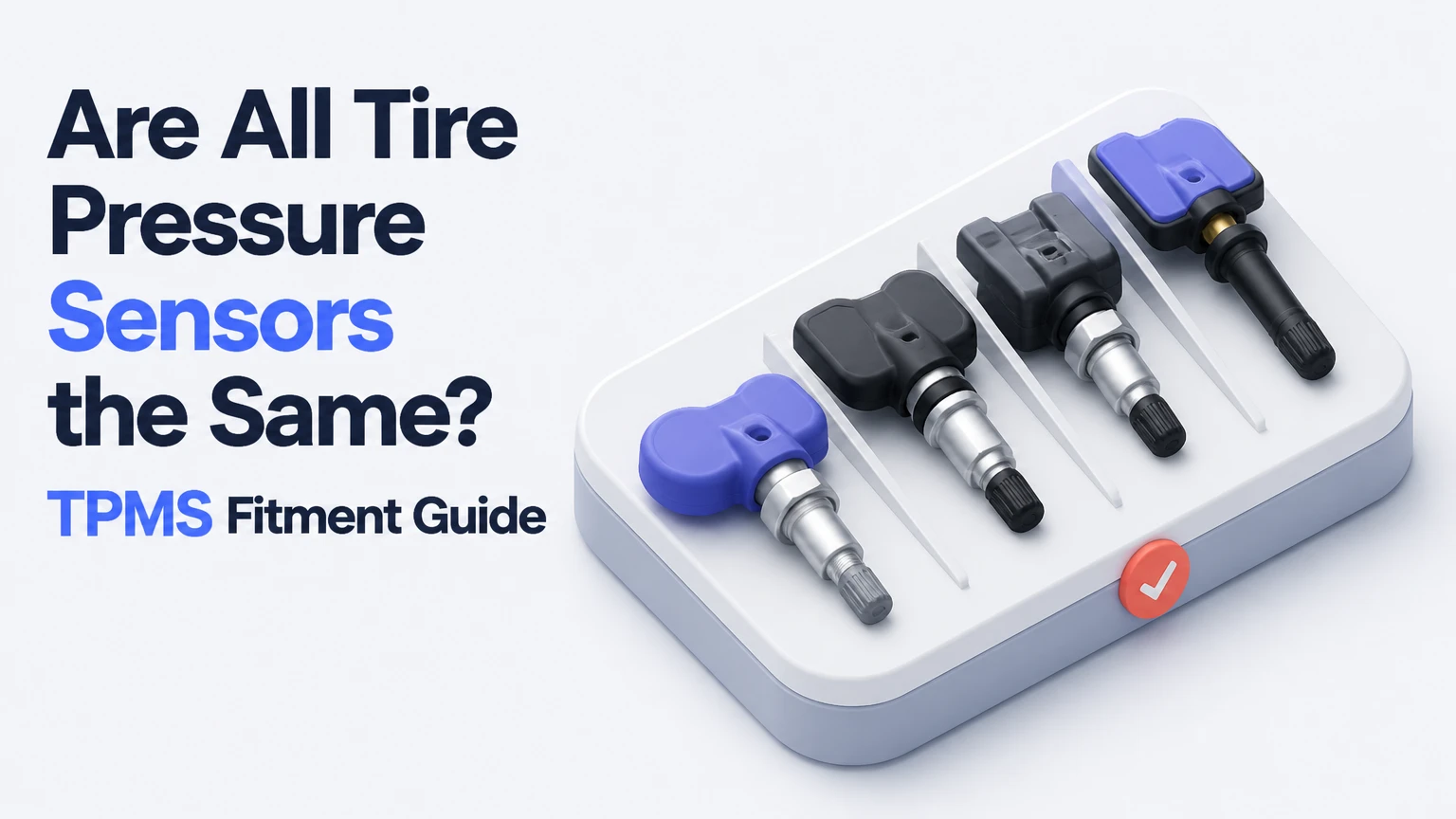
No, all tire pressure sensors are not the same. Tire pressure monitoring system (TPMS) sensors differ by system architecture, radio frequency, communication protocol, valve-stem design, pressure range, programming method, and vehicle fitment. A sensor that physically fits a wheel may still fail because the vehicle cannot recognize its signal or sensor ID.
Key Facts at a Glance
- Direct TPMS sensors measure pressure inside the wheel and transmit data to the vehicle.
- Indirect TPMS uses ABS wheel-speed information and has no pressure sensor inside the tire.
- A 315 MHz sensor and a 433 MHz sensor are not automatically interchangeable.
- Programmable universal sensors require vehicle-specific programming before installation.
- Programming gives a sensor the correct protocol; relearning teaches the vehicle to recognize its sensor ID.
- Most direct TPMS batteries last approximately 5-10 years, but the exact life depends on transmission behavior and temperature.
Are All Tire Pressure Sensors the Same?
Tire pressure sensors differ in both hardware and software, so replacement requires more than matching a valve stem or buying a sensor labeled “universal.” The correct part must match the vehicle’s TPMS architecture, frequency, protocol, pressure range, mounting style, sensor ID requirements, and relearn procedure.
The most important distinction is between direct and indirect TPMS. A direct system contains battery-powered sensors in the wheels. An indirect system calculates a likely pressure loss from wheel-speed changes through the ABS system, so it has no in-wheel pressure sensor to replace.
Even two direct sensors can be incompatible. A Toyota sensor, a Ford sensor, and a Volkswagen sensor may use different data formats, IDs, trigger methods, and frequency bands. Aftermarket programmable sensors reduce the number of physical parts needed, but they still require correct configuration with a compatible TPMS tool.
A useful workshop rule is simple: identify the vehicle by year, make, model, trim, and market before identifying the sensor. The wheel and tire are only part of the fitment equation.
What Does a Tire Pressure Sensor Measure?
A direct TPMS sensor normally measures tire pressure, internal air temperature, motion, and its own battery condition. The sensor’s microcontroller packages those readings with a unique identification number before transmitting them to the vehicle’s TPMS receiver.
Pressure may be reported in psi, bar, or kPa depending on the vehicle’s software and instrument display. The sensor does not decide the recommended inflation pressure. The door-jamb placard or vehicle manufacturer’s specification establishes that baseline.
Direct sensors usually remain dormant while parked to conserve battery power. Once the vehicle moves, an accelerometer wakes the sensor and transmission frequency increases. Exact intervals vary by supplier and vehicle, but typical driving transmissions occur every 30-90 seconds, while parked transmissions may occur every 15-60 minutes.
The warning threshold also belongs to the vehicle’s calibration. In the United States, Federal Motor Vehicle Safety Standard 138 generally requires a low-pressure warning at approximately 25% below the placard pressure, subject to the regulation’s testing conditions. A sensor may measure a gradual drop before the dashboard warning appears.
Which Types of TPMS Systems Exist?
There are two main TPMS architectures: direct TPMS, which measures pressure with in-wheel sensors, and indirect TPMS, which infers pressure loss through wheel-speed data. The two systems require different diagnostics and have different replacement costs.
| TPMS architecture | Measurement method | Replaceable in-wheel sensor | Typical dashboard information |
|---|---|---|---|
| Direct TPMS | Pressure and temperature sensor inside wheel | Yes, usually 4 | Actual or approximate pressure by tire |
| Indirect TPMS, first generation | Relative wheel-speed comparison | No | Low-pressure warning only |
| Indirect TPMS, advanced | Wheel-speed and tire-resonance analysis | No | Low-pressure warning, sometimes tire position |
| Hybrid system | Direct data combined with vehicle calculations | Vehicle-specific | Pressure data plus system diagnostics |
Direct TPMS
Direct TPMS uses a pressure sensor attached to the valve stem or mounted inside the wheel. The sensor transmits a radio signal containing pressure, temperature, sensor ID, and battery status to a receiver or TPMS control module.
Direct systems can identify the affected tire and may display individual pressures. They can also detect a similar pressure loss in all four tires, a condition that can defeat basic indirect systems because wheel-speed differences remain small.
Direct TPMS has service costs. Tire removal can damage a sensor, and a depleted battery usually requires sensor replacement because the battery is sealed into the housing.
Indirect TPMS
Indirect TPMS does not measure air pressure directly. The ABS wheel-speed sensors detect that an underinflated tire has a smaller rolling circumference and therefore rotates faster than the other tires.
Indirect systems avoid in-wheel batteries and sensor replacement. They still need calibration after inflation, tire rotation, wheel replacement, or a change in tire size. Calibration stores the current tire condition as the reference state.
Indirect TPMS is not a substitute for a handheld gauge. It may not provide a PSI reading, and it can respond poorly when all tires lose pressure together, tires have significantly different wear, or the vehicle uses mismatched tire sizes.
What Are the Main Direct TPMS Sensor Types?
Direct TPMS replacement sensors fall into three practical categories: OE-specific, programmable universal, and multi-application configurable sensors. The categories describe how the sensor receives the vehicle’s protocol, not necessarily how accurate the pressure measurement will be.
| Sensor category | Configuration method | Typical coverage | Technician requirement |
|---|---|---|---|
| OE-specific sensor | Factory-configured protocol | One vehicle family or limited applications | Install and perform vehicle relearn |
| Programmable universal sensor | Tool writes vehicle protocol and ID data | Hundreds of applications, tool dependent | Program before installation |
| Configurable multi-application sensor | Tool selects one stored protocol | Multiple makes and models | Activate correct application |
| Clone-capable replacement | Copies original sensor ID | Same vehicle and often same wheel position | Read old sensor before removal |
An OE-specific sensor is the least ambiguous choice when the correct part number is verified. It may arrive ready to communicate, although the vehicle can still require an automatic, stationary, manual, or OBD-assisted relearn.
A programmable universal sensor begins blank or with limited stored data. A technician uses a TPMS tool to select the vehicle application, program the protocol, and often assign or copy a sensor ID. A sensor that has not been programmed is not ready merely because its valve fits the wheel.
A clone-capable sensor can copy the original ID before the old sensor is removed. Cloning can avoid a formal relearn on some vehicles, but it is not universally supported. The replacement still needs the correct frequency, protocol, physical configuration, and pressure range.
Do TPMS Sensors Use the Same Frequency?
TPMS sensors do not all use the same radio frequency. The most common bands are approximately 315 MHz and 433 MHz, but frequency is only one compatibility attribute and cannot identify the correct sensor by itself.
North American applications commonly use 315 MHz, while many European applications use 433 MHz. Exceptions exist, and global vehicle platforms can vary by production market, model year, and control-module specification. Some newer aftermarket sensors support multiple frequency bands, but the tool must configure the correct one.
| Frequency or communication feature | Common application pattern | Compatibility warning |
|---|---|---|
| 315 MHz | Many North American vehicles | Not universal across all USA-market models |
| 433 MHz | Many European and Asian vehicles | Market and model-year exceptions exist |
| Dual-frequency aftermarket sensor | Selected universal platforms | Requires correct tool activation |
| Vehicle-specific protocol | Manufacturer-dependent | Frequency match alone is insufficient |
A 315 MHz sensor installed on a vehicle expecting 433 MHz will normally remain invisible to the receiver. A sensor with the correct frequency can still fail if its modulation, data structure, ID format, or protocol does not match the vehicle.
The reliable identification methods are the original sensor’s part number, a vehicle application catalog, a TPMS scan tool, and the vehicle service information. Do not select a sensor solely from a marketplace title or a frequency printed on the package.
Does Valve-Stem Design Matter?
Valve-stem design matters because the sensor must seal against the wheel, withstand the wheel’s operating conditions, and fit the wheel’s valve hole. Direct TPMS sensors commonly use rubber snap-in stems or metal clamp-in stems.
| Valve design | Common material | Typical application | Main service concern |
|---|---|---|---|
| Rubber snap-in | EPDM rubber stem | Passenger cars and standard wheels | Rubber aging and stem replacement |
| Metal clamp-in | Aluminum stem and seal | Factory alloy wheels and many premium applications | Correct nut torque and corrosion control |
| High-pressure metal | Reinforced metal assembly | Commercial vehicles and high-pressure tires | Pressure rating and locking hardware |
| Angled specialty stem | Aluminum or rubber assembly | Selected motorcycles and unusual wheels | Wheel-hole angle and clearance |
Rubber snap-in stems are inexpensive and flexible, but the rubber ages from ozone, heat, road chemicals, and ultraviolet exposure. The stem should be replaced when the sensor is serviced rather than reusing an old sealing surface.
Metal clamp-in sensors use a rubber grommet, washer, retaining nut, and valve core. The exact nut torque is vehicle and supplier specific. Many assemblies fall near 4-8 Nm, but the installation instructions control; overtightening can distort the seal or crack the sensor.
Use a nickel-plated valve core with aluminum stems and avoid incompatible brass components where the supplier warns against them. Galvanic corrosion can bond the core or cap to the stem, turning a routine valve service into a broken-sensor repair.
How Are TPMS Sensors Programmed and Relearned?
Programming configures the sensor to speak the vehicle’s language, while relearning registers the sensor’s unique ID with the vehicle. Programming and relearning are separate operations, although some vehicle procedures combine them.
A typical replacement sequence is:
- Identify the application. Confirm model year, make, model, trim, market, frequency, sensor style, and pressure range.
- Scan the original sensor. Record its ID, pressure reading, temperature, battery condition, and response status when possible.
- Program the replacement. Use a compatible tool to write the vehicle protocol and assign a new ID or clone the original.
- Install the sensor. Fit a new grommet, washer, nut, valve core, and cap where required. Tighten according to the sensor manufacturer’s specification.
- Inflate and test for leaks. Set cold pressure from the door placard, then immerse or soap-test the valve area.
- Perform the relearn. Follow the vehicle procedure, which may use automatic driving, a trigger tool, a dashboard sequence, or an OBD connection.
- Verify the warning system. Confirm each sensor ID, tire position, pressure display, and warning-light behavior.
A sensor can transmit successfully and still leave the TPMS warning active if the vehicle has not accepted its ID. Conversely, a correct relearn cannot make an incorrectly programmed sensor communicate.
What Relearn Methods Do Vehicles Use?
Vehicle manufacturers use several relearn methods. Automatic relearn may occur after driving for 10-20 minutes above a specified speed. Manual learning can require a sequence of ignition, lock, horn, or button actions, while OBD relearn writes sensor IDs into the control module.
Some vehicles automatically assign sensor positions based on the order in which sensors respond. Others require a scan tool to place each ID at the correct wheel. A spare tire may also require registration if it contains a TPMS sensor and participates in the system.
Always use the vehicle-specific procedure. Generic reset instructions can erase valid IDs, fail to activate learning mode, or create a false impression that the new sensors are defective.
How Much Does TPMS Sensor Replacement Cost?
A typical passenger-car replacement costs about $40-$120 per sensor for the part and approximately $20-$50 per wheel for mounting, programming, and relearning, although dealer pricing, vehicle design, and regional labor rates can raise the total.
| Service item | Typical US price | Typical time | What changes the price |
|---|---|---|---|
| OE-specific sensor | $50-$150 | 10-20 minutes installation | Brand and dealer markup |
| Programmable universal sensor | $30-$80 | 15-30 minutes | Tool coverage and programming |
| Valve service kit | $5-$25 | Added during tire service | Stem, grommet, core, cap, nut |
| Mounting and balancing | $20-$60 per wheel | 20-40 minutes | Wheel size and shop rates |
| Complete four-sensor service | $200-$600 | 1-2 hours | Sensor type, labor, relearn complexity |
These are typical planning ranges, not a universal price list. A tire shop may bundle programming with mounting, while a dealer may quote the sensor, installation, diagnostic scan, and relearn separately.
Replacing one failed sensor is reasonable when the other three are recent and test healthy. Replacing all four can reduce repeat labor when the sensors are original and already 7-10 years old, because the remaining batteries may fail soon after the first one.
Which TPMS Option Is Better for Different Drivers?
The best sensor choice depends on the vehicle, wheel set, service access, and tolerance for future programming. OE-specific sensors minimize configuration uncertainty, while universal sensors can reduce inventory and hardware cost when a qualified shop has the correct programming tool.
| Driver situation | Preferred option | Reason | Limitation |
|---|---|---|---|
| Factory wheels and one failed sensor | Verified OE-specific or premium universal | Lowest fitment risk | May require relearn |
| Four new sensors on an older car | Programmable universal set | Often lower total hardware cost | Tool coverage matters |
| Winter wheel set | Dedicated compatible sensors | Avoids seasonal tire demounting | Adds four sensors |
| Custom aftermarket wheels | Correct metal or compatible specialty sensor | Preserves clearance and sealing | Wheel hole may differ |
| Heavy-duty truck | High-pressure rated sensor | Handles commercial tire pressure | Passenger-car sensors are unsuitable |
| Fleet with many models | Configurable professional system | Reduces sensor inventory | Requires trained staff and updates |
Aftermarket wheels do not automatically need different sensors. The correct sensor must clear the wheel barrel, match the valve-hole diameter and angle, and use a stem intended for that wheel. A metal clamp-in sensor from the factory wheel may not seal correctly on an aftermarket wheel.
Electric vehicles use the same basic TPMS compatibility principles as internal-combustion vehicles. Their heavier curb weight, tire pressure specifications, and wheel packages make load rating, pressure range, and correct service procedures especially important.
What Happens When a TPMS Sensor Fails?
A failed direct TPMS sensor usually produces a flashing warning light for roughly 60-90 seconds followed by a steady light, although the exact display behavior varies by manufacturer. A steady warning light generally indicates low pressure, while a flashing-then-steady light commonly indicates a system fault.
| Symptom | Likely cause | Correct action |
|---|---|---|
| Steady TPMS light | Low tire pressure | Check all tires cold and inflate to placard pressure |
| Flashing light, then steady | Sensor, receiver, or system fault | Scan all sensors and inspect fault codes |
| Warning after tire installation | Missing ID or failed relearn | Program and relearn the replacement |
| Intermittent cold-weather warning | Pressure near threshold | Measure cold pressure, not visual appearance |
| One tire repeatedly loses pressure | Puncture, bead leak, or valve leak | Perform a tire and valve leak test |
| No pressure display from one wheel | Dead battery or communication fault | Trigger and test that sensor directly |
Cold weather reduces tire pressure approximately 1 psi for every 10 degrees Fahrenheit decrease in temperature as a practical rule of thumb. The exact change depends on starting temperature, tire volume, and atmospheric conditions, so the vehicle placard remains the correct inflation reference.
A TPMS warning does not identify the cause by itself. Check pressure with a reliable gauge before replacing electronics, because a leaking tire and a dead sensor can produce similar driver complaints.
Common TPMS Replacement Mistakes
The most expensive mistakes usually occur before the sensor is installed. Correct diagnosis and part identification prevent unnecessary tire removal.
- Matching only the frequency: A 315 MHz label does not prove protocol compatibility.
- Assuming “universal” means pre-programmed: Most programmable sensors need a tool before installation.
- Confusing programming with relearning: The vehicle may still need to register the new sensor ID.
- Reusing the service kit: Old grommets, cores, and nuts can create slow leaks.
- Using the wrong valve-core material: Aluminum stems can corrode when incompatible metals are used.
- Skipping the spare tire: Some vehicles monitor a full-size spare, while others do not.
- Replacing a sensor for every warning: Low pressure, a puncture, and a system fault require different repairs.
- Using a passenger sensor on a truck: Pressure rating and mechanical durability may be inadequate.
One counterintuitive workshop finding is that a sensor can pass a trigger test outside the tire but fail after installation if the valve is damaged, the wheel blocks the signal, or the sensor is programmed for the wrong market. Testing must include the installed assembly and the vehicle receiver.
Another practical rule is to scan all four sensors before replacing one. The scan can reveal weak batteries, duplicate IDs, incorrect wheel positions, or a second nonresponsive sensor that would otherwise require another tire removal.
Should You Replace One Sensor or All Four?
Replace one TPMS sensor when one unit has failed and the remaining sensors show healthy batteries, correct IDs, and stable readings. Replace the full set when the sensors are the same age, the vehicle has high mileage, or multiple batteries test weak.
A direct sensor battery is usually sealed and nonreplaceable. Typical battery life is 5-10 years, but heat, cold, frequent transmissions, storage conditions, and sensor design affect the result. A sensor that has sat unused for years may still have an aging battery.
The most economical strategy depends on labor. If the tire is already removed for a puncture repair, replacing an old sensor may cost less than paying for a second demounting later. If a shop charges substantial programming and relearn labor, a complete set can be more efficient when all four original sensors are near the end of their service life.
FAQ
Can I use universal TPMS sensors in any vehicle?
No. Universal TPMS sensors cover many vehicles only when their programming tool supports the vehicle’s protocol, frequency, ID format, and relearn process. Confirm coverage by model year and market before purchase. A universal sensor is a configurable replacement part, not a guaranteed plug-and-play component.
Do TPMS sensors need to be replaced when changing tires?
No, tire replacement alone does not require sensor replacement. The sensors should be inspected whenever a tire is removed, and the valve service kit should normally be renewed. Replace the sensor if its battery is weak, its housing is damaged, it leaks, or its pressure reading is inaccurate.
Can I drive without functioning TPMS sensors?
A vehicle may continue to drive mechanically without functioning direct TPMS sensors, but the warning system cannot provide reliable low-pressure notification. Check tire pressure manually until the fault is repaired. Some vehicles also disable related display or stability functions when a TPMS fault remains active.
Why does the TPMS light stay on after I add air?
The light may remain on because the tire is still below the placard pressure, the system has not completed its relearn drive, another tire or spare is low, or a sensor fault exists. Measure all tires cold, inspect for leaks, and follow the vehicle’s reset or relearn procedure.
Can I move TPMS sensors to another set of wheels?
Often, yes, if the sensors fit the second wheels and remain compatible with the vehicle. The vehicle may need a new position relearn after rotation or wheel-set installation. Dedicated winter sensors avoid repeated tire demounting, but they add four sensor costs and may require seasonal registration.
Are tire pressure sensors interchangeable between vehicle brands?
Usually not as direct replacements. Some programmable universal sensors can serve multiple brands after tool configuration, but the sensor must support each vehicle’s exact application. Physical fitment, frequency, protocol, pressure range, ID behavior, and relearn requirements all determine interchangeability.
The Bottom Line
Are all tire pressure sensors the same? No. Direct and indirect TPMS use different technologies, and direct replacement sensors differ by frequency, protocol, valve design, pressure rating, programming, battery condition, and vehicle-specific fitment.
Use the vehicle’s year, make, model, trim, market, original sensor data, and wheel type to select a replacement. Verify the sensor with a TPMS catalog or scan tool, install a new service kit, program the unit when required, and complete the correct relearn procedure. That process matters more than whether the package says OEM, universal, or 315 MHz.


