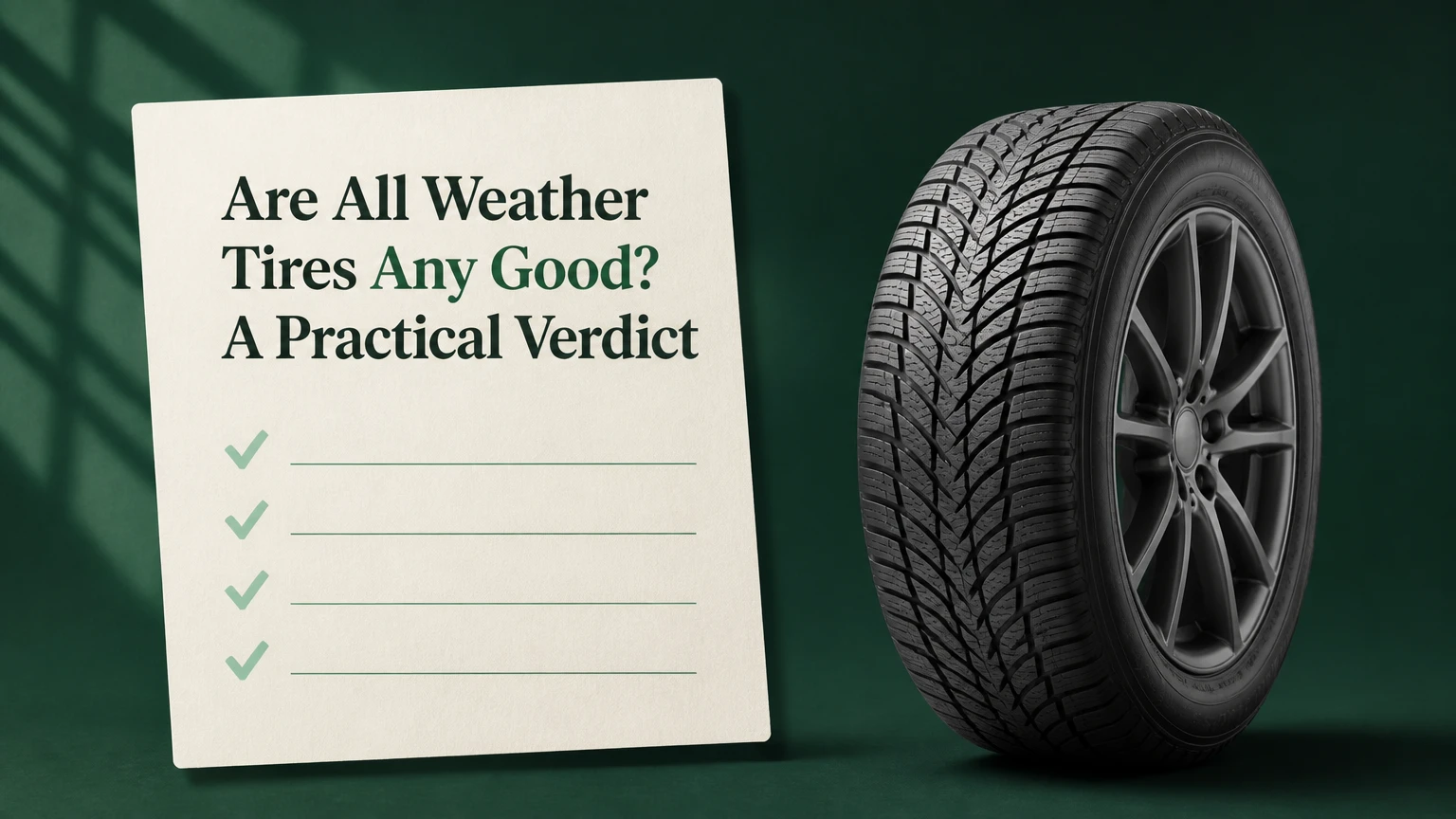
All-weather tires are good for drivers who face rain, occasional snow, slush, and freezing temperatures but want one tire set year-round. Their 3PMSF certification gives them a meaningful advantage over ordinary all-season tires in snow, although dedicated winter tires still provide better traction and braking on ice, deep snow, and prolonged severe cold.
Key Facts at a Glance
- All-weather tires are year-round tires with a winter-oriented compound and a 3PMSF mountain-snowflake marking.
- The 3PMSF symbol indicates standardized snow performance, not maximum ice traction or immunity from winter driving hazards.
- All-weather tires generally outperform ordinary all-season tires below about 7°C (45°F), especially in snow and slush.
- Dedicated winter tires remain the safer choice for frequent ice, unplowed roads, deep snow, and temperatures below approximately -15°C (5°F).
- Typical all-weather tires cost about $140-$270 per tire and often carry 50,000-60,000-mile treadwear warranties.
- All-wheel drive helps a vehicle accelerate, but it does not shorten braking distances on slippery roads.
What Are All-Weather Tires?
All-weather tires are hybrid tires designed to combine usable summer-road manners with genuine snow capability. In North America, the category usually describes tires with a winter-capable tread and compound that also meet the 3PMSF severe-snow-service requirement.
The name is not used identically by every tire company. Some manufacturers call a 3PMSF-marked tire “all-season,” while others reserve “all-weather” for a separate product category. The sidewall symbol and the tire’s documented specifications matter more than the product name.
The 3PMSF symbol shows a mountain with three peaks and a snowflake inside. In the United States and Canada, the symbol is associated with a regulated severe-snow test, primarily measuring traction on packed snow against a reference tire. It does not certify a particular stopping distance on ice, wet pavement, or deep unplowed snow.
An M+S marking means mud and snow, but M+S alone is not equivalent to 3PMSF. M+S tread geometry can qualify through its groove and void arrangement without proving the same level of snow traction.
How Do All-Weather Tires Work?
All-weather tires use a cold-flexible tread compound, numerous sipes, and grooves that evacuate water and slush. The compound remains more pliable than a conventional all-season tire in cold weather, while the tread blocks and casing are durable enough for warm-weather driving.
Sipes create additional biting edges as tread blocks contact snow. Circumferential channels and lateral grooves move water away from the contact patch. Directional designs often use V-shaped grooves, while asymmetric designs place winter-focused features on selected portions of the tread.
The trade-off is unavoidable. A tire designed to remain flexible in cold weather usually gives up some heat efficiency, summer steering precision, tread life, or cabin quietness compared with a warm-weather touring tire.
Are All Weather Tires Any Good for Snow?
All-weather tires are good for light to moderate snow, packed urban snow, and slush when the vehicle is driven at an appropriate speed. A 3PMSF tire offers materially more winter capability than an M+S-only all-season tire, but it does not match a dedicated winter tire in deep snow or repeated freezing conditions.
The most important distinction is between occasional snow and sustained winter exposure. A commuter whose roads are plowed within a day can often use all-weather tires successfully. A rural driver who must cross an unplowed road before sunrise faces a different risk profile.
Snow traction also depends on tread depth. A worn 3PMSF tire may retain its sidewall marking while losing the deep grooves and sharp edges that created its original snow performance. Replacing a tire near 4/32 inch of tread is a practical winter-safety rule, even when the legal minimum is lower.
All-Weather Versus All-Season Tires
All-weather tires are generally the better choice when winter snow and freezing temperatures are regular parts of the commute. Conventional all-season tires usually provide lower rolling resistance, longer treadwear, and quieter dry-road behavior in mild climates.
| Attribute | All-weather tire | Conventional all-season tire | Practical consequence |
|---|---|---|---|
| Winter marking | 3PMSF plus M+S on many models | Usually M+S; some newer models also carry 3PMSF | Check the sidewall before purchase |
| Cold-weather behavior | More flexible below 7°C (45°F) | Compound becomes less compliant as temperatures fall | All-weather tires retain more winter grip |
| Packed-snow traction | Standardized 3PMSF qualification | Varies widely; M+S alone proves less | All-weather is safer for recurring snow |
| Summer efficiency | Typically slightly lower | Typically higher | All-season may save fuel in hot climates |
| Typical warranty | 50,000-60,000 miles | 60,000-80,000 miles on touring models | All-season often lasts longer |
| Best environment | Four-season cities and mixed precipitation | Warm regions and mostly wet, dry roads | Climate should determine the choice |
The 7°C threshold is a useful rule of thumb, not a switch that changes every tire at one exact temperature. Tire design, road surface, inflation pressure, and tread wear also influence grip.
Are All-Weather Tires Better Than Winter Tires?
All-weather tires are more convenient and usually perform better than winter tires on warm, dry roads, but dedicated winter tires remain better for ice, deep snow, and prolonged cold. The right winner depends on whether winter traction or year-round simplicity carries greater safety value.
Dedicated winter tires use softer cold-weather compounds and tread patterns optimized for low temperatures. Many use more dense siping, flexible blocks, and casing designs that preserve contact on compacted snow and ice. Their disadvantages include seasonal storage, two installation appointments each year, faster warm-weather wear, and the cost of a second wheel or tire set.
| Driving condition | Best tire choice | Why | Main limitation |
|---|---|---|---|
| Dry roads above 10°C (50°F) | All-season or summer touring | Lower rolling resistance and sharper warm-road response | Weak winter snow performance |
| Occasional urban snow | All-weather | 3PMSF traction with one year-round set | Less ice grip than winter tires |
| Frequent packed snow | Dedicated winter | Softer compound and winter-focused tread | Requires seasonal changeover |
| Glazed ice and freezing rain | Dedicated winter, sometimes studs where legal | Better cold compound and ice-oriented siping | No tire makes high-speed ice safe |
| Deep, unplowed snow | Winter or suitable winter-rated all-terrain | More void space and snow-clearing ability | All-terrain designs may be noisy |
| Hot summer highways | All-season or summer tire | Better heat efficiency and wear resistance | Requires a winter solution elsewhere |
Consumer Reports has repeatedly emphasized that tire choice affects braking and handling more directly than drivetrain layout. Transport Canada similarly advises using winter tires in regions with sustained winter conditions rather than treating all-season labeling as proof of winter suitability.
How Good Are All-Weather Tires in Rain and Summer?
All-weather tires can be very good in rain and acceptable in summer heat, especially when they have deep circumferential grooves and a stable tread design. They may not equal a premium summer or touring tire in steering response, rolling resistance, tread longevity, or high-temperature braking consistency.
A directional V-shaped tread can clear standing water and slush effectively, but the result depends on groove depth and road speed. Hydroplaning risk rises with speed, water depth, inflation errors, and worn tread; no tread pattern eliminates the need to slow down in standing water.
Typical warm-weather compromises include a small fuel-economy reduction of roughly 1%-3% compared with a low-rolling-resistance touring tire, plus a slightly heavier steering feel. Actual results vary by tire size, vehicle weight, alignment, temperature, and driving style.
A tire’s heat rating, load index, speed rating, and manufacturer fitment remain important. A 3PMSF marking does not override the vehicle manufacturer’s requirements.
Which All-Weather Tire Design Fits Your Vehicle?
Grand-touring all-weather tires fit sedans, minivans, crossovers, and many EVs that spend most of their time on paved roads. All-terrain all-weather tires fit SUVs and pickups that need additional gravel, dirt, load, or towing capability.
| Tire design | Typical vehicle | Tread characteristics | Typical compromise |
|---|---|---|---|
| Grand touring directional | Sedan, crossover, EV | V-shaped grooves, dense siping, 17-21-inch sizes | Road hum and directional rotation limits |
| Grand touring asymmetric | Sedan, wagon, compact SUV | Quiet inner tread, winter-oriented outer features | Less aggressive slush evacuation on some models |
| Crossover all-weather | Compact SUV, minivan | Reinforced casing, 16-20-inch sizes | More weight and rolling resistance |
| All-terrain 3PMSF | Pickup, body-on-frame SUV | Open blocks, deeper voids, reinforced sidewalls | Noise, reduced fuel economy, slower steering |
| Performance all-season | Sport sedan, coupe | Fewer winter compromises, high-speed stability | Often lacks 3PMSF certification |
Examples in the market include the Michelin CrossClimate 2, Goodyear Assurance WeatherReady line, Pirelli Cinturato WeatherActive, Nokian WR-series products, and 3PMSF all-terrain models such as the Falken Wildpeak A/T4W. Availability, warranty, and exact sizing change by country and model year, so the vehicle placard and current manufacturer catalog should control the final selection.
Are All-Weather Tires Suitable for Electric Vehicles?
All-weather tires can suit electric vehicles when the tire has the correct load index and speed rating. EV weight, instant torque, and low cabin noise make tread durability, casing strength, rolling resistance, and acoustic behavior especially important.
An EV does not automatically require a special EV-branded tire. It does require a tire capable of carrying its axle loads, including battery weight, and the correct fitment for the wheel. Compare the tire’s load index with the placard, not merely its advertised size.
Heavy EVs can wear tires quickly if alignment is poor or acceleration is aggressive. Rotate according to the tire manufacturer’s schedule, often every 5,000-8,000 miles, and inspect tread depth at every service.
How Much Do All-Weather Tires Cost?
A typical all-weather tire costs $140-$270 or more, making a four-tire purchase approximately $560-$1,080 before installation, taxes, disposal, and alignment. Larger SUV, truck, run-flat, and high-load tires can exceed that range.
| Cost or ownership item | Typical range | Main price driver | Planning note |
|---|---|---|---|
| Passenger all-weather tire | $140-$220 | Brand, size, speed rating | 16-18-inch sizes often cost less |
| SUV or EV all-weather tire | $180-$300+ | Load index, casing, diameter | Heavy vehicles increase replacement cost |
| Mounting and balancing | $80-$160 per set | Local labor and wheel size | Run-flats may cost more |
| Four-wheel alignment | $90-$180 | Vehicle suspension and region | Useful after uneven wear |
| Treadwear warranty | 50,000-60,000 miles | Manufacturer and product class | Warranty terms require maintenance records |
| Seasonal swap avoided | 2 appointments yearly | Local storage and labor rates | One-set ownership reduces logistics |
A second set of winter tires may cost more initially, but it divides annual mileage between two sets. That can reduce wear on each set, although storage, wheels, mounting, and replacement timing still determine the total cost.
How Long Do All-Weather Tires Last?
All-weather tires typically last 40,000-60,000 miles when properly inflated, aligned, rotated, and used within their load limits. Aggressive driving, high temperatures, heavy vehicles, poor alignment, and underinflation can reduce that result substantially.
Treadwear warranties are not guaranteed mileage. Manufacturers usually require documented rotation, correct inflation, matching replacement tires, and a minimum usable tread depth before honoring a claim. Tire age also matters: inspect tires after six years and follow the manufacturer’s replacement guidance, even if tread remains.
Are All-Weather Tires Safe on Ice?
All-weather tires are safe only with conservative driving on ice, and they are less capable than dedicated winter tires on glare ice. The 3PMSF symbol measures snow performance, not a universal ice-braking standard.
Ice creates a thin, low-friction surface where tread flexibility and microscopic edges matter more than large water channels. Studded tires, where legal and appropriate, can improve grip on certain icy surfaces, while studless winter tires generally offer the strongest non-studded cold-weather performance.
Reduce speed before curves, increase following distance substantially, avoid abrupt steering, and leave traction-control systems enabled unless the vehicle manufacturer specifies otherwise. ABS helps preserve steering during braking, but it cannot create grip that the tire-road interface does not have.
What Are the Main Drawbacks?
The main disadvantages of all-weather tires are higher purchase prices than basic all-season tires, somewhat higher rolling resistance, possible tread noise, and weaker severe-winter performance than dedicated winter tires.
Three practitioner rules prevent most disappointments:
- Never judge winter capability from “all-season” wording alone. Check for the 3PMSF symbol.
- Never use AWD as a substitute for winter traction. AWD improves acceleration, not braking or cornering.
- Never mix one winter-capable tire with three ordinary tires. Use four matching tires unless the vehicle manufacturer explicitly permits another arrangement.
Directional tires create an additional maintenance issue. A tire marked with a rotation arrow must keep its forward rolling direction. Front-to-back rotation on the same side is normally possible, but diagonal rotation requires demounting and remounting the tire on the wheel.
Mismatched tread patterns can also destabilize a vehicle in wet or snowy conditions. If only two tires are replaced, many tire manufacturers and vehicle makers recommend placing the tires with greater tread depth on the rear axle, but the owner’s manual and tire-shop guidance should resolve the specific case.
Who Should Buy All-Weather Tires?
All-weather tires suit drivers whose climate includes recurring snow but whose roads are generally treated, cleared, or paved. They are especially practical for households that lack storage space or cannot schedule two tire changes each year.
The Four-Season Commuter
A commuter in the Pacific Northwest, Mid-Atlantic, Great Lakes, southern Canada, or New England may benefit from all-weather tires when snow arrives intermittently and roads are cleared within 24 hours. The 3PMSF rating adds a meaningful safety margin over an M+S-only tire.
The Mild-Climate Driver
A driver in Florida, southern Texas, coastal California, or another region with rare freezing temperatures usually gains more from a quiet, efficient touring all-season tire. An all-weather tire can work there, but its winter-oriented design may add cost and rolling resistance without providing a frequently used benefit.
The Rural or Mountain Driver
A rural driver who regularly encounters unplowed roads, steep grades, packed snow, black ice, or temperatures below -15°C (5°F) should generally choose dedicated winter tires. A winter-rated all-terrain tire may be appropriate for some trucks, but it is not automatically equal to a dedicated studless winter tire.
The Occasional Snow Traveler
A warm-climate driver who visits snow country only a few times each winter should check local chain-control laws before relying on all-weather tires. Some jurisdictions accept 3PMSF tires under certain conditions, while others require chains or traction devices during declared restrictions.
How Should You Choose All-Weather Tires?
Choose all-weather tires by verifying fitment, winter marking, load capacity, speed rating, warranty, and the exact climate in which the vehicle operates. Product reputation matters, but a highly rated tire in the wrong size or load range remains an incorrect purchase.
Use this checklist:
- Read the driver-door placard for approved size, cold inflation pressure, and load requirements.
- Confirm the 3PMSF symbol if snow performance is part of the reason for buying.
- Match or exceed the original load index and speed rating unless the vehicle manufacturer permits otherwise.
- Check whether the tread is directional, asymmetric, or nondirectional before planning rotations.
- Compare independent wet, dry, snow, and noise testing when available, rather than relying only on warranty mileage.
- Confirm the tire’s production date and avoid old inventory with significant storage age.
- Price installation, alignment, disposal, and warranty coverage, not only the online tire price.
- Verify local winter-tire, chain, and stud regulations before a mountain trip.
The best all-weather tire is the one that matches the vehicle’s axle load and the driver’s worst regular road, not the tire with the most aggressive-looking tread.
Frequently Asked Questions
Do all-weather tires need to be rotated?
All-weather tires generally need rotation every 5,000-8,000 miles, or at the interval specified by the tire manufacturer. Directional tires usually rotate front-to-back on the same side, while asymmetric or nondirectional tires may allow more rotation patterns. Uneven wear requires inspection of alignment, inflation, suspension, and tire position.
Can all-weather tires replace tire chains?
All-weather tires cannot universally replace tire chains. A 3PMSF tire may satisfy some traction-device rules, but chain-control laws vary by road authority and weather condition. Drivers traveling through mountain passes should carry approved chains or traction devices when regulations require them, even with four snowflake-marked tires.
Are all-weather tires noisy?
Some all-weather tires are noisier than touring all-season tires because deep grooves, open shoulders, and directional tread blocks generate more pattern noise. A typical difference is most noticeable on coarse concrete at highway speed. Uneven wear can create much louder hum or vibration and should not be dismissed as normal tread noise.
Can you use all-weather tires all year?
You can use all-weather tires all year when the tire has the correct summer speed, load, and vehicle fitment requirements. All-weather tires tolerate warm highways, but drivers in very hot climates may obtain longer tread life and better efficiency from a conventional touring or summer tire.
Are all-weather tires good for towing?
All-weather tires can be suitable for light towing when their load index, inflation pressure, and speed rating meet the vehicle and trailer requirements. Heavy towing, high tongue weight, or frequent gravel use may justify a 3PMSF all-terrain tire, although increased noise and rolling resistance are common trade-offs.
When should all-weather tires be replaced?
Replace all-weather tires when tread reaches the manufacturer’s limit, when winter traction has noticeably declined, or when the tire has age, cracking, impact damage, bulges, or repeated air loss. For winter use, many technicians treat approximately 4/32 inch as a practical replacement point because snow performance falls as grooves become shallow.
The Bottom Line
Are all weather tires any good? Yes, when the driver needs one year-round set for rain, cold pavement, slush, and recurring but manageable snow. Their 3PMSF marking makes them a substantially better winter compromise than ordinary all-season tires, while their summer performance remains practical for most normal road use.
They are not the best answer for every climate. Choose dedicated winter tires for frequent ice, deep snow, unplowed rural roads, mountain travel, or prolonged severe cold; choose conventional touring all-season tires where freezing conditions are rare. The correct decision comes from the vehicle’s fitment and the worst road you regularly drive.