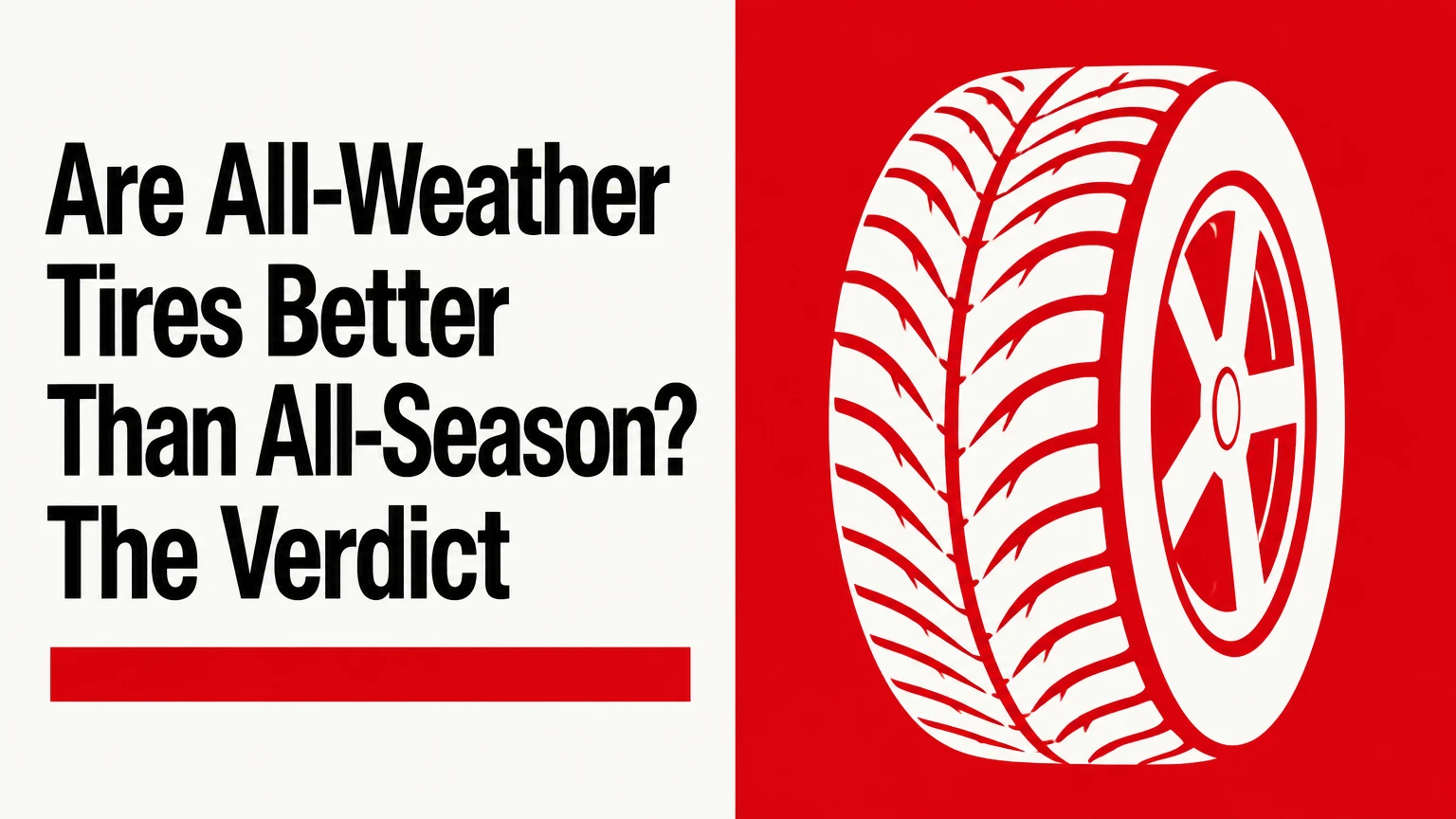
All-weather tires are better than all-season tires for drivers who regularly encounter freezing temperatures, snow, and slush, because all-weather tires use a winter-capable compound and carry the Three-Peak Mountain Snowflake, or 3PMSF, symbol. All-season tires usually provide longer tread life, lower cost, quieter operation, and better warm-weather efficiency.
Key Facts at a Glance
All-weather tires are the better one-set choice for recurring moderate snow and temperatures below freezing.
All-season tires are usually better for mild climates, high annual mileage, and predominantly warm pavement.
The 3PMSF symbol confirms a tire passed a severe-snow traction test; M+S lettering alone does not.
The 7°C, or 45°F, guideline is useful for planning, but tire grip changes progressively rather than switching at one exact temperature.
All-weather tires do not equal dedicated winter tires on ice, deep snow, or repeated sub-freezing mountain travel.
A typical all-weather tire costs about $140-$260, compared with approximately $100-$200 for a comparable all-season tire.
Are All-Weather Tires Better Than All-Season Tires?
All-weather tires are better when winter traction is a meaningful safety requirement, while all-season tires are better when low cost, long wear, fuel economy, and warm-weather refinement matter most. The decisive variable is not the tire name; it is the combination of winter severity, road maintenance, driving speed, and whether the vehicle must operate every day.
The terms create confusion because “all-season” sounds broader than it is. In North American tire terminology, an all-season tire is a compromise for dry roads, rain, mild cold, and occasional light snow. An all-weather tire is a more winter-focused compromise that remains usable through summer.
Quick Verdict by Driver Type
| Driver situation | Better choice | Reason | Main compromise |
|---|---|---|---|
| Phoenix, Dallas, or coastal Southern California | All-season | Warm pavement and rare snow favor tread life and efficiency | Limited snow traction |
| Chicago or Toronto city commuter | All-weather | Regular freezing, slush, and plowed snow justify 3PMSF traction | Higher price and wear |
| Rural mountain route | Dedicated winter | Deep snow, ice, and steep grades exceed hybrid capability | Seasonal storage and swaps |
| High-mileage highway driver | All-season | Long-wear touring models reduce replacement frequency | Weaker winter braking |
| One vehicle, no storage space, mixed weather | All-weather | One set covers moderate four-season use | Not ideal in severe ice |
The 3PMSF marking should decide many borderline cases. The symbol is a mountain outline containing a snowflake, and it indicates the tire met a regulated severe-snow traction performance requirement. It does not certify every aspect of winter behavior, and it does not make the tire equivalent to a studded or dedicated winter model.
What Is the Difference Between the Two Tire Categories?
All-season tires prioritize balanced dry handling, wet-road evacuation, low noise, and tread longevity. All-weather tires retain those goals but move the design toward cold-weather flexibility, snow-clearing tread geometry, and additional biting edges.
| Attribute | All-season tire | All-weather tire | Practical consequence |
|---|---|---|---|
| Typical winter marking | M+S, sometimes 3PMSF | 3PMSF on qualifying models | Check the sidewall, not the product name |
| Compound priority | Warm and moderate temperatures | Wider usable cold-weather range | All-weather remains more flexible in cold |
| Snow tread | Moderate siping | Dense siping and larger biting edges | Better acceleration and braking in snow |
| Dry summer response | Usually sharper and quieter | Usually slightly softer or louder | All-season favors warm commuting |
| Typical warranty range | 60,000-90,000 miles | 50,000-70,000 miles | Model warranties vary significantly |
| Typical purchase price | $100-$200 per tire | $140-$260 per tire | All-weather usually costs more |
| Best use | Mild winters and mixed pavement | Moderate winter and year-round use | Climate determines the winner |
M+S means mud and snow, but the designation does not require the same severe-snow performance as 3PMSF. Many conventional all-season, all-terrain, and truck tires carry M+S lettering. A buyer who needs dependable snow traction should look for 3PMSF and verify the tire’s independent test results.
How Do Tread and Rubber Change Winter Performance?
All-weather tires improve winter performance through compound flexibility, higher sipe density, and tread blocks that create more edges in compacted snow. All-season tires generally use larger, less heavily segmented blocks and a compound tuned more strongly toward warm-road wear and handling.
The 7°C rule is a planning shortcut, not a physical on-off switch. Michelin and other tire manufacturers commonly use 7°C as a practical point below which winter-oriented compounds can offer an advantage, but actual grip also depends on pavement temperature, tire design, speed, inflation, tread depth, and moisture.
Sipes are narrow cuts in tread blocks. They create extra edges and help the tread conform to irregular snow surfaces. Snow traction depends partly on snow-to-snow friction, but sipes do not magically create grip on polished ice.
All-weather tread patterns also manage water differently. A directional V-shaped design can move slush and water outward, while an asymmetric design may combine a rain-oriented outer shoulder with a more heavily siped inner region. Design varies by model, so category-level claims cannot replace model-level testing.
What Does 3PMSF Actually Prove?
The 3PMSF symbol proves that a tire met a defined snow-traction threshold in a standardized test, not that it delivers a fixed stopping-distance improvement in every vehicle or storm. Testing typically compares the tire with a reference tire under packed-snow conditions.
That distinction matters. A 3PMSF tire can outperform a non-3PMSF all-season tire in snow while remaining inferior to a dedicated winter tire on ice or in very cold conditions. The certification is a useful minimum filter, not a complete ranking.
The frequently repeated claim that all-weather tires stop 30-40% shorter than all-season tires should not be treated as universal. Results depend on tire models, vehicle anti-lock braking calibration, surface temperature, snow density, tread depth, and test procedure. Some comparisons show large gains; others show smaller differences.
Are All-Weather Tires Better in Rain and Summer?
All-season tires often have the advantage on warm, dry pavement, while the best all-weather tires can deliver excellent rain grip. All-weather tires are not automatically worse in rain, but their winter-focused tread can produce more noise, slightly slower steering response, and higher rolling resistance than a comparable touring all-season tire.
Rain performance depends on groove volume, contact pressure, compound silica content, tread depth, and hydroplaning resistance. A worn all-season tire with 3/32 inch of tread can be less safe in heavy rain than a new all-weather tire with 10/32 inch, even if the all-season design is theoretically more rain-focused.
Warm-weather differences are usually more noticeable during emergency lane changes and sustained highway driving than during ordinary urban travel. Drivers in hot climates may also consume slightly more fuel with all-weather tires because deeper, more heavily siped tread and softer compounds can increase rolling resistance.
| Road condition | Likely category winner | Why | Important exception |
|---|---|---|---|
| Dry pavement above 20°C, or 68°F | All-season | Firmer response and lower rolling resistance | Performance all-weather models can remain close |
| Heavy rain at 10°C, or 50°F | Model-dependent | Groove design and compound dominate | New tread depth may outweigh category |
| Light snow at -2°C, or 28°F | All-weather | More sipes and cold flexibility | AWD cannot compensate for poor tires |
| Packed snow at -10°C, or 14°F | All-weather or winter | Winter-oriented compound retains flexibility | Tread below 5/32 inch reduces snow grip |
| Glare ice near 0°C, or 32°F | Dedicated winter | Specialized compound and tread improve ice control | Studs may be restricted by local law |
| Hot highway travel above 30°C, or 86°F | All-season | Lower heat and rolling-resistance compromise | Correct pressure remains more important |
One expert rule is easy to miss: a tire’s category advantage shrinks as the tire wears. Sipes become less effective when tread depth is low, and the remaining compound may be less capable than the new-tire label suggests.
How Much Do All-Weather Tires Cost to Own?
All-weather tires typically cost 15%-30% more at purchase, but a one-set strategy can reduce seasonal service and storage costs. Two dedicated sets can still be financially and technically superior when each set lasts several seasons and winter safety is important.
| Ownership arrangement | Typical initial cost | Typical annual service | Best financial condition |
|---|---|---|---|
| Four all-season tires | $400-$800 | $80-$140 rotation and inspections | Mild climate, high mileage |
| Four all-weather tires | $560-$1,040 | $80-$160 rotation and inspections | Moderate winter, one-set ownership |
| All-season plus winter tires | $800-$1,600 | $100-$220 seasonal swaps | Severe winter and long ownership |
| Two sets on separate wheels | $1,100-$2,000 | $60-$140 seasonal change | Frequent winter use, home storage |
| Tire storage service | Not included | $60-$150 per season | No garage or basement space |
These are typical retail and service ranges, not universal prices. Tire size, load rating, vehicle type, region, promotions, and installation fees can change the total substantially.
A two-set system does not automatically pay for itself within two years. The calculation must include wheels, storage, mounting, balancing, and the fact that both sets age while stored. A driver paying $160 twice yearly for swaps may spend $320 annually, but a driver with home storage and separate wheels may spend far less.
All-weather tires may deliver lower total ownership cost for a driver who otherwise would buy winter tires but drives only moderate annual mileage. They are not a cost-saving substitute for winter tires when a collision, missed workday, or mountain-road closure carries a high consequence.
Which All-Weather Tires Are Worth Considering?
Michelin CrossClimate 2, Bridgestone WeatherPeak, Nokian WR G4, and Goodyear Assurance WeatherReady are recognizable all-weather examples, but the correct model still depends on size, load index, speed rating, vehicle fit, and independent testing. A brand name cannot override a tire that does not match the vehicle’s specification.
| Tire line | Common positioning | Winter marking | Typical strength | Typical limitation |
|---|---|---|---|---|
| Michelin CrossClimate 2 | Premium crossover and car | 3PMSF | Dry-road control with snow capability | Higher price and directional rotation limits |
| Bridgestone WeatherPeak | Quiet all-weather touring | 3PMSF | Wet-road manners and ride comfort | Not a dedicated ice tire |
| Nokian WR G4 | Snow-oriented year-round use | 3PMSF | Slush and cold-weather traction | Availability varies by size and region |
| Goodyear Assurance WeatherReady | Mainstream all-weather touring | 3PMSF | Evolving grooves and broad fitment | Warm steering feel may be less precise |
| Continental ExtremeContact DWS 06 Plus | All-season performance alternative | Usually not 3PMSF | Dry handling and wet performance | Not intended as a severe-snow replacement |
Product specifications change by tire size and generation. Confirm the exact sidewall marking and warranty for the size sold for your vehicle.
A practical buying method is to compare three sources: the vehicle placard, the tire manufacturer’s specification sheet, and independent testing from organizations such as Tire Rack or Consumer Reports. Manufacturer marketing establishes intended use, while independent tests reveal trade-offs between braking, handling, noise, and wear.
Should You Choose All-Weather, All-Season, or Winter Tires?
Choose all-weather tires for recurring moderate snow, freezing mornings, and roads that are usually plowed but not consistently dry. Choose all-season tires for warm climates or drivers who rarely face snow. Choose dedicated winter tires for frequent ice, deep snow, steep grades, rural roads, or temperatures that remain well below freezing.
Choose All-Season Tires If
All-season tires fit drivers in climates where snow is rare and winter roads are mostly wet or dry. A high-mileage commuter on maintained roads may value a 75,000-mile touring warranty, lower purchase price, and reduced rolling resistance more than occasional snow capability.
All-season tires are also reasonable when the vehicle can remain parked during storms. Parking the car is safer than asking any tire to handle conditions beyond its design.
Choose All-Weather Tires If
All-weather tires fit drivers who need one year-round set and encounter several snowfalls, freezing rain, slush, or temperatures below freezing. The category suits many city and suburban drivers in the Midwest, Northeast, southern Canada, and parts of the Pacific Northwest.
All-weather tires are especially practical for households without storage space. They provide a measurable snow advantage without requiring two complete tire sets, although the driver still gives up some warm-weather refinement and tread longevity.
Choose Dedicated Winter Tires If
Dedicated winter tires are the right choice for repeated unplowed snow, mountain passes, black ice, lake-effect snow, or sustained temperatures below approximately -10°C, or 14°F. Their softer cold-weather compound and heavily siped tread generally provide better braking and cornering than all-weather tires in severe conditions.
All-wheel drive does not change this decision. AWD helps a vehicle accelerate, but it does not shorten braking distance or create additional tire-road friction.
What Should Drivers Check Before Buying?
Drivers should match tire size, load index, speed rating, construction, and sidewall markings before comparing tread patterns or prices. Replacing only two tires can also create handling and drivetrain problems, especially on AWD vehicles.
Use this checklist:
- Read the vehicle placard. Record the original size, recommended cold pressure, and required load rating.
- Confirm the exact tire size. A 225/65R17 tire is not interchangeable with every nearby 225-size option.
- Check 3PMSF. Look for the mountain-and-snowflake symbol if snow performance matters.
- Match load and speed ratings. Never choose a lower rating unless the vehicle manufacturer explicitly permits it.
- Check tread depth. New all-weather tires often have approximately 10/32-12/32 inch, but models vary.
- Compare warranty exclusions. Alignment damage, irregular wear, and road hazards may not qualify.
- Buy four matching tires when possible. Four matching tires preserve balanced braking and cornering.
- Verify rotation requirements. Directional tires may need front-to-rear rotation only.
Electric vehicles and heavy SUVs deserve additional scrutiny. Instant torque can expose weak traction quickly, while battery weight increases load demands. Select a tire with the correct load index and, where available, an EV-specific construction, but do not assume an EV label guarantees superior snow performance.
How Should All-Weather Tires Be Maintained?
All-weather tires should be checked monthly, rotated according to the manufacturer’s interval, and replaced before winter traction falls below a practical threshold. A typical rotation interval is 5,000-8,000 miles, but the vehicle manual and tire warranty take priority.
Temperature changes alter pressure. The common rule is approximately 1 psi for every 10°F change, although actual change varies with tire volume and conditions. Check pressure when tires are cold, use the vehicle placard specification, and do not inflate to the maximum molded sidewall pressure unless directed.
Tread depth deserves seasonal attention. The legal replacement limit in many United States jurisdictions is 2/32 inch, but snow traction can deteriorate materially below about 5/32 inch. A tire can remain legally usable while no longer providing prudent winter performance.
Inspect for:
- Uneven shoulder wear caused by alignment or underinflation
- Center wear caused by overinflation
- Cracks, bulges, or puncture repairs
- Tread depth differences across AWD tires
- Age-related hardening after approximately six years, depending on storage and climate
An alignment problem can destroy a new set in a few thousand miles. Tire rotation cannot correct a bent suspension component or persistent underinflation.
What Are the Most Common Decision Mistakes?
The most common mistake is treating tire labels as weather guarantees. “All-season” does not mean equal performance in every season, while “all-weather” does not mean equal performance to a winter tire on every winter surface.
Four errors deserve special attention:
- Using M+S as proof of severe-snow capability. M+S is not equivalent to 3PMSF.
- Treating 7°C as a switch. Grip changes progressively, and pavement temperature can differ from air temperature.
- Ignoring tread depth before winter. A worn 3PMSF tire may perform worse than a newer, well-designed non-winter tire in some conditions.
- Replacing only two tires on AWD. Circumference differences can stress drivetrain components and reduce handling balance.
- Assuming studs solve every problem. Studs can improve certain ice conditions but may reduce dry-road grip, increase noise, and be restricted by law.
- Comparing only price per tire. Installation, storage, wheels, mileage, and replacement timing determine ownership cost.
The honest limitation is simple: no all-weather tire can remove the need to slow down, increase following distance, or avoid travel during extreme storms. Tire technology changes available grip; it does not repeal braking physics.
Frequently Asked Questions
Are all-weather tires safer than all-season tires in rain?
All-weather tires can be safer in cold rain and slush, especially when they carry 3PMSF and retain deeper tread. All-season tires may equal or exceed them on warm wet pavement, depending on the model. Tread depth, inflation, and hydroplaning design often matter more than the category name alone.
Do all-weather tires use more fuel?
All-weather tires may reduce fuel economy by roughly 1%-3% compared with low-rolling-resistance all-season tires, but the difference varies by model, pressure, temperature, vehicle weight, and driving speed. Correct inflation and wheel alignment can offset more efficiency loss than the category comparison suggests.
Can all-weather tires replace winter tires?
All-weather tires can replace winter tires for moderate snow and mostly plowed roads, but they are not a full replacement for severe winter equipment. Drivers facing frequent ice, deep snow, steep grades, or sustained sub-freezing temperatures should use dedicated winter tires.
Are all-season tires dangerous below 45°F?
All-season tires are not automatically dangerous below 45°F. The 45°F, or 7°C, point is a practical guideline indicating that many winter compounds begin gaining flexibility advantages. Actual safety depends on the tire model, road surface, tread depth, speed, and weather.
How long do all-weather tires usually last?
A typical all-weather tire may last approximately 40,000-70,000 miles, while many touring all-season tires carry warranties from 60,000-90,000 miles. Hot climates, aggressive cornering, underinflation, heavy vehicles, and poor alignment can shorten either category’s life substantially.
Are all-weather tires worth paying more for?
All-weather tires are worth the premium when a driver regularly encounters snow or freezing conditions but wants one tire set. All-season tires offer better value when snow is rare, while two tire sets offer better winter capability when severe conditions are frequent.
The Bottom Line
All-weather tires are better than all-season tires for drivers who face real winter conditions and want one year-round set. All-season tires remain better for mild climates, long tread life, low rolling resistance, and warm-weather comfort. The 3PMSF symbol is the most useful starting filter, but it does not make an all-weather tire equal to a dedicated winter tire on ice or deep snow.
For the target question, the answer is conditional but decisive: choose all-weather tires for recurring moderate winter weather, all-season tires for mostly mild conditions, and dedicated winter tires when winter is severe. Evaluate the exact model, tread depth, vehicle specifications, and local roads before purchasing.