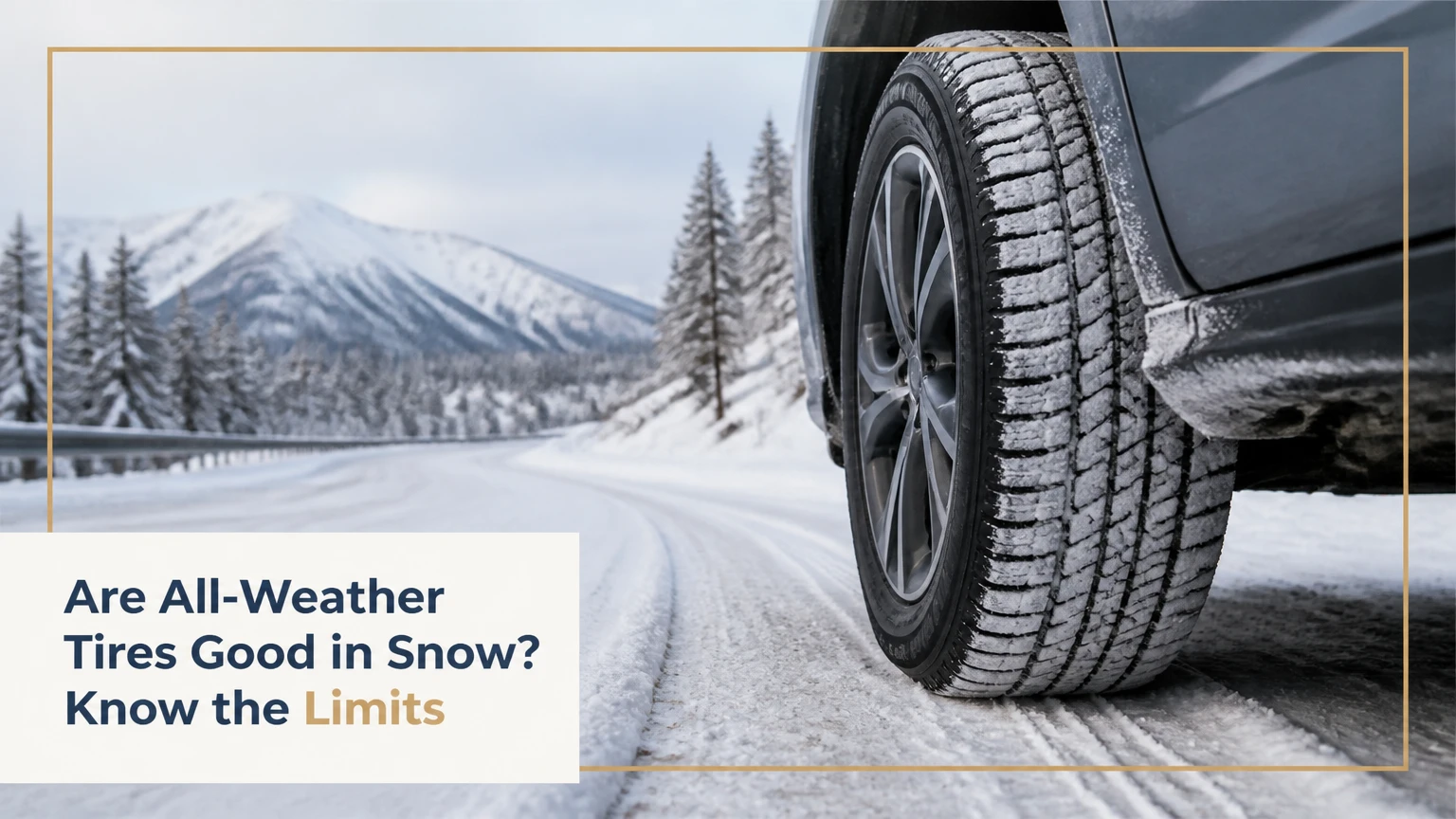
All-weather tires are good in light to moderate snow and usually provide much better cold-weather traction than standard all-season tires. Their 3-Peak Mountain Snowflake rating confirms tested severe-snow capability, but all-weather tires still brake and corner less effectively than dedicated winter tires on ice, deep snow, steep roads, and prolonged subfreezing surfaces.
Key Facts at a Glance
- All-weather tires typically carry the 3PMSF symbol, while many standard all-season tires carry only an M+S marking.
- The 3PMSF test measures acceleration traction on packed snow; it does not certify equal performance on ice, slush, or deep snow.
- All-weather tires remain usable in summer, but dedicated winter tires provide stronger cold-weather grip below freezing.
- A 45°F, or 7°C, comparison point is a useful rule of thumb, not a universal temperature at which every tire changes performance.
- Drivers should install four matching tires, because mixing seasonal categories can create unstable front-to-rear handling.
- All-weather tires suit plowed roads and variable climates; dedicated winter tires suit frequent snow, ice, hills, and severe cold.
Are All-Weather Tires Good in Snow?
All-weather tires are good in snow when roads receive regular plowing, snowfall is occasional or moderate, and temperatures vary across the year. An all-weather tire combines a cold-flexible compound, open grooves, numerous sipes, and a winter-service certification with enough dry-road stability for year-round use.
The category fills a real gap between conventional all-season tires and dedicated winter tires. A driver in Chicago, Toronto, Denver, or the Pacific Northwest may prefer one all-weather set when winter roads are usually treated and summer temperatures make winter-tire storage inconvenient.
The limitation is surface severity. All-weather tires cannot erase the physics of packed ice, freezing rain, steep grades, or snow deeper than the tire’s tread and ground clearance can manage. A 3PMSF marking indicates a minimum severe-snow performance threshold, not a ranking above every winter tire.
The best practical verdict is conditional: all-weather tires are a strong one-set solution for mixed climates, but dedicated winter tires remain the safer choice for repeated severe winter driving.
How Do All-Weather Tires Create Snow Traction?
All-weather tires create snow traction through a combination of compound flexibility, tread voids, biting edges, and directional water evacuation. The tire must remain pliable in cold air while preserving enough tread stability for dry pavement and warm-weather braking.
Cold-weather rubber compound
Rubber becomes less flexible as temperature falls. Tire manufacturers tune all-weather compounds to retain useful compliance in cold conditions, although dedicated winter compounds remain more pliable at very low temperatures.
The often-repeated 7°C threshold is a rule of thumb used to explain why summer-oriented or conventional all-season tires may lose winter grip. It is not a chemical cliff. Sun exposure, pavement temperature, tire construction, speed, inflation, and compound design also affect traction.
Sipes and tread blocks
Sipes are narrow cuts in tread blocks. They create extra edges that can interlock with compacted snow and help the tread conform to uneven surfaces. All-weather tires generally use more winter-oriented siping than touring all-season tires.
Open grooves provide space for snow and slush to move away from the contact patch. Directional patterns, such as the V-shaped design on the Michelin CrossClimate 2, can improve evacuation, but tread direction alone does not determine winter performance.
Tread depth and wear
Snow traction declines as tread depth decreases. A tire with 8/32 inch remaining tread does not behave like the same model at 11/32 inch, even when both remain legally usable.
As a practical inspection rule, replace a winter-oriented tire before it reaches the legal minimum when winter traction is a priority. In the United States, the legal limit is commonly 2/32 inch, but many tire professionals recommend substantially more tread for snow performance.
What Does the 3PMSF Symbol Prove?
The 3-Peak Mountain Snowflake symbol proves that a tire met a standardized severe-snow traction requirement under laboratory testing. The symbol does not prove that the tire matches a dedicated winter tire on ice braking, packed-snow cornering, deep snow, or every vehicle.
The marking shows a mountain with three peaks and a snowflake. In North America, the designation is associated with the tire industry’s severe-snow performance criteria; in Europe, the Alpine symbol is tied to UNECE regulations. The test evaluates traction relative to a reference tire on packed snow.
That distinction matters. A tire can earn 3PMSF while manufacturers position it as an all-weather, all-terrain, or winter product. The symbol answers one question, namely whether the tire reached the severe-snow threshold. It does not answer whether the tire is the best choice for a steep, icy commute.
| Marking | What it indicates | What it does not guarantee |
|---|---|---|
| M+S | Tread pattern intended for mud and snow | Strong cold-weather braking |
| 3PMSF | Certified severe-snow traction threshold | Winter-tire-level ice grip |
| Stud-compatible symbol or specification | Approved use with certain studs | Legal stud use in every location |
| DOT identification code | U.S. compliance and production information | Current rubber condition or remaining life |
An important correction to simplified buying advice is that 3PMSF is not exclusive to all-weather and dedicated winter tires. Some all-terrain tires also carry it, and not every tire marketed in every country uses identical labeling. Read the complete sidewall and manufacturer specification.
Are All-Weather Tires Better Than All-Season Tires?
All-weather tires are generally better than standard all-season tires in cold, snow, and slush, while all-season tires may deliver lower noise, longer tread life, and more predictable warm-weather comfort. The right comparison depends on winter severity and how often the vehicle encounters untreated roads.
| Decision factor | Standard all-season | All-weather | Dedicated winter |
|---|---|---|---|
| Typical snow certification | M+S, sometimes 3PMSF | Usually 3PMSF | Usually 3PMSF |
| Cold-road behavior | Hardens sooner | Cold-flexible design | Most flexible compound |
| Light snow | Fair | Good | Very good |
| Packed snow | Fair to poor | Good | Excellent |
| Glare ice | Poor | Fair | Best available without chains |
| Hot-weather use | Strong | Safe, with added wear possible | Poor |
| Tire changes per year | 0 | 0 | 2 |
| Typical complete-set price | $450-$900 | $600-$1,100 | $650-$1,300 plus wheels or service |
Price ranges are typical retail estimates for common 16-18-inch passenger-car and crossover sizes, excluding taxes, mounting, balancing, and regional promotions. Performance and price vary substantially by load index, speed rating, vehicle size, and manufacturer.
The most important mistake is treating “all-season” as a technical synonym for “all-weather.” In North American retail language, all-season usually describes a three-season compromise. The sidewall marking and product documentation matter more than the label printed in an advertisement.
How Do All-Weather Tires Perform on Ice?
All-weather tires perform acceptably on occasional light ice but remain inferior to dedicated winter tires on glare ice and repeated freezing conditions. Their tread features help, yet the compound and contact behavior of a winter tire are designed specifically for temperatures and surfaces where all-weather compromises become apparent.
Ice offers very little mechanical interlock. Sipes can help evacuate a microscopic water film and create edges, but no tread pattern can provide normal pavement friction on polished ice. Speed, stopping distance, tire temperature, and ABS intervention become decisive.
Dedicated winter tires commonly use specialized compounds and tread designs that preserve flexibility at temperatures well below freezing. Studded winter tires can add mechanical traction on certain icy surfaces, although stud restrictions, road damage, noise, and dry-road compromises vary by jurisdiction.
Drivers who regularly encounter freezing rain should treat all-weather tires as a compromise rather than an ice solution. Reduce speed, increase following distance, and carry approved traction devices when local conditions and vehicle instructions permit.
Can All-Weather Tires Handle Deep Snow and Hills?
All-weather tires can handle moderate snow on suitable roads, but deep snow and steep hills can exceed their traction and clearance limits. Tire diameter, tread depth, vehicle weight distribution, ground clearance, drivetrain, road treatment, and driver inputs all affect the outcome.
A front-wheel-drive sedan with fresh 3PMSF tires may climb a plowed suburban street more reliably than a heavy SUV on worn all-season tires. Conversely, an all-wheel-drive crossover with all-weather tires may still slide downhill because AWD improves propulsion, not braking.
Use this decision guide:
- Plowed urban roads: All-weather tires are usually appropriate.
- Several inches of fresh snow on residential roads: All-weather tires may work with cautious speeds and adequate tread.
- Unplowed roads above the bumper or wheel hubs: Dedicated winter tires, chains, or postponing travel may be necessary.
- Steep mountain routes: Dedicated winter tires offer a larger safety margin.
- Packed snow with ice beneath it: Winter tires are strongly preferred.
- Mud, deep snow, and off-road terrain: Compare a 3PMSF all-terrain tire with a winter tire based on actual use.
Tread can also pack with snow when voids are too narrow. A more aggressive appearance does not automatically mean better braking, because large blocks can reduce dry-road stability and increase noise.
Do All-Weather Tires Work Below 45°F?
All-weather tires continue to work below 45°F because their compounds are designed for cold conditions, but no universal temperature guarantees equal traction across brands. The 45°F, or 7°C, guideline mainly explains why some summer and conventional all-season tires lose flexibility earlier.
Dedicated winter tires generally gain their largest advantage as temperatures approach freezing and surfaces become snow-covered or icy. On cold, dry pavement, the difference may be smaller than on ice. On warm, dry pavement, winter tires can feel less precise and wear faster.
| Surface and temperature | Likely best category | Reason |
|---|---|---|
| Dry pavement at 55°F | All-season | Quiet, efficient, stable |
| Wet pavement at 35°F | All-weather or winter | Better cold-weather compliance |
| Packed snow at 25°F | Winter | Highest snow-specific traction |
| Glare ice at 20°F | Studded or premium winter | Specialized ice traction |
| Dry highway at 75°F | All-season or all-weather | Better heat tolerance |
| Deep snow at 10°F | Winter with adequate tread | Flexible compound and snow pattern |
These are category tendencies, not guarantees. Independent tire tests can reverse individual rankings, so model-level test results and manufacturer fitment data deserve more weight than category slogans.
When Are Winter Tires the Better Choice?
Dedicated winter tires are the better choice when a driver regularly encounters snow, ice, subfreezing roads, steep grades, or unplowed routes. Winter tires also make sense when the cost of missing work, losing vehicle control, or closing a mountain route outweighs the inconvenience of seasonal storage.
Choose a dedicated winter set if you:
- Drive weekly on untreated roads during winter.
- Live where temperatures remain below freezing for long periods.
- Travel mountain passes or steep rural roads.
- Need the shortest practical braking distances on snow and ice.
- Tow, carry heavy loads, or drive a vehicle with limited winter stability.
- Face local rules requiring winter-rated tires or chains.
Choose all-weather tires instead when snowfall is intermittent, roads are usually plowed, and temperatures swing between freezing winters and hot summers. A one-set arrangement also avoids seasonal mounting, storage, and scheduling.
No tire category makes unsafe speed safe. Tire choice increases available traction; it does not replace visibility, following distance, functioning lights, or conservative driving.
Which Drivers Should Buy All-Weather Tires?
Urban commuters, suburban drivers, and warm-climate travelers who occasionally visit snow country are the strongest candidates for all-weather tires. Mountain residents with frequent severe winter exposure usually gain more from dedicated winter tires.
| Driver profile | Recommended setup | Typical reason |
|---|---|---|
| Plowed-city commuter | All-weather, one set | Occasional snow and no storage space |
| Warm-climate ski traveler | All-weather, verify route rules | Hot home climate and periodic snow trips |
| Rural northern commuter | Dedicated winter plus summer | Frequent untreated roads |
| Mountain resident | Dedicated winter, chains as required | Grades, ice, deep snow |
| Low-mileage mild-climate driver | Quality all-season or all-weather | Limited annual winter exposure |
| Performance-oriented driver | Separate summer and winter sets | Better dry and cold-weather specialization |
A warm-climate driver traveling to a ski resort should check the destination’s chain-control rules. Some jurisdictions require chains or approved traction devices regardless of 3PMSF status, and rental vehicles may have restrictions that affect the plan.
How Should You Choose an All-Weather Tire?
Choose an all-weather tire by verifying vehicle size, load index, speed rating, 3PMSF certification, tread depth, warranty terms, wet braking reputation, and local availability. Model selection matters because two tires in the same category can differ in noise, ice performance, steering response, and wear.
Commonly considered models include the Michelin CrossClimate 2, Goodyear Assurance WeatherReady, Nokian WR G4, Nokian WR SUV, and Firestone WeatherGrip. Availability and model names vary by country, vehicle size, and production year.
| Example model | Typical 16-18-inch price per tire | Notable design focus | Main trade-off |
|---|---|---|---|
| Michelin CrossClimate 2 | $190-$270 | V-shaped directional tread | Higher purchase price |
| Goodyear Assurance WeatherReady | $170-$240 | Evolving traction grooves | Road noise may increase with wear |
| Nokian WR G4 or WR SUV | $140-$220 | Cold-weather and slush performance | Availability varies by market |
| Firestone WeatherGrip | $130-$185 | Winter-oriented tread pattern | Less refined than premium rivals |
| 3PMSF all-terrain option | $170-$300 | Snow-rated open tread | Noise and fuel-use penalty |
Typical prices exclude installation and may change with tire size. Confirm the exact product version, because a passenger-car model and SUV model can have different construction, warranty, and test results.
Check the vehicle placard inside the driver’s door for the required size and pressure. Never select a tire solely because its advertised width appears more aggressive, since changing diameter or load capacity can affect speedometer accuracy, clearance, TPMS behavior, and handling.
How Much Do All-Weather Tires Cost?
A complete set of four all-weather tires typically costs $600-$1,100 for common passenger-car and crossover sizes, with installation adding roughly $80-$180. Larger SUVs, light trucks, run-flat construction, premium compounds, and low-profile sizes can raise the total substantially.
A separate winter setup costs more initially because the driver buys another tire set and may add wheels, mounting, balancing, storage, and seasonal service. The financial advantage of all-weather tires depends on local shop rates and whether the owner would otherwise pay for two annual changeovers.
| Expense | Typical all-weather setup | Separate winter setup |
|---|---|---|
| Tires at purchase | $600-$1,100 | $1,200-$2,400 for two sets |
| Initial installation | $80-$180 | $160-$360 total |
| Seasonal service | $0 | $100-$240 per year |
| Storage | $0-$150 per year | $0-$200 per year |
| Replacement timing | One tread cycle | Two tread cycles, usage-dependent |
These figures are planning ranges, not guaranteed quotes. A winter set does not automatically cost twice as much over its full life because each set accumulates miles during only part of the year.
How Long Do All-Weather Tires Last?
All-weather tires commonly carry treadwear warranties of about 50,000-65,000 miles, but real service life depends on alignment, inflation, rotation, climate, driving style, vehicle weight, and summer heat. A warranty is a pro-rated contractual threshold, not a promise that the tire will remain winter-effective for that mileage.
Rotate tires according to the manufacturer’s schedule, often every 5,000-7,500 miles, and inspect tread wear at each service. Check pressure monthly and before long trips because cold weather reduces inflation pressure as air temperature falls.
Replace tires for age or condition before the tread reaches its legal limit when cracking, bulges, vibration, irregular wear, or loss of cold-weather traction appears. Tire and Rubber Association guidance and tire manufacturers commonly advise inspecting tires after five years and considering replacement around six years, while some products carry a maximum age recommendation of ten years from manufacture.
The manufacturing date appears in the DOT code on the sidewall. A tire made in week 18 of 2024 carries the four-digit code 1824.
What Mistakes Reduce Snow Performance?
The most damaging mistakes are using only two winter-capable tires, relying on M+S as proof of severe-snow performance, ignoring tire age, and driving as though AWD eliminates stopping limits. Correcting those assumptions improves safety more than choosing a visually aggressive tread pattern.
Installing only two winter-rated tires
Install four matching tires whenever possible. Two winter tires can create a major difference in grip between axles, causing oversteer or understeer during braking and cornering.
For vehicles with an all-wheel-drive system, follow the manufacturer’s allowable circumference difference. Some AWD systems require nearly identical tread depths across all four positions.
Ignoring pressure and alignment
Underinflation increases sidewall flex, heat, rolling resistance, and steering delay. Misalignment can destroy the tread shoulder and remove the snow edges that the tire needs.
Use the vehicle placard pressure, not the maximum pressure molded into the tire sidewall. Check pressure when the tires are cold.
Confusing traction with control
AWD can help a vehicle accelerate, but it does not shorten the braking distance available from the road surface. Electronic stability control can help manage a slide, but it cannot create friction where ice provides almost none.
Using worn tires in severe weather
A worn 3PMSF tire may remain legal while losing the tread depth needed to clear snow. Replace earlier when winter performance, rather than minimum legal operation, is the priority.
What Alternatives Improve Severe-Snow Traction?
Dedicated winter tires provide the most consistent improvement for snow and ice, while tire chains or approved cable devices can provide additional traction when conditions and vehicle instructions allow. Studded tires may help on ice but are restricted or regulated in some locations.
Use alternatives according to the actual problem:
- Frequent snow and ice: Purchase dedicated winter tires.
- Short severe-weather trips: Carry vehicle-approved chains or cables.
- Occasional mountain travel: Confirm chain-control requirements before departure.
- Deep snow on unplowed roads: Increase clearance and consider postponing travel.
- Aging all-weather tires: Replace them rather than compensating with aggressive driving.
- A vehicle with mismatched tires: Correct the set before winter begins.
Read the owner’s manual before fitting chains. Clearance around suspension components, brake lines, wheel wells, and electronic systems differs by vehicle. Some vehicles permit chains only on one axle or prohibit them on certain tire sizes.
FAQ
Are all-weather tires safe for highway driving in snow?
All-weather tires can be safe on highways with light or moderate snow when they carry 3PMSF certification, have adequate tread, and the driver reduces speed. Highway wind, lane changes, slush ruts, and sudden braking still require extra following distance. Severe storms, ice, and untreated routes favor dedicated winter tires.
Are all-weather tires better than AWD in snow?
All-weather tires provide the tire-road traction that AWD cannot create, while AWD can distribute engine torque across multiple wheels. An AWD vehicle with poor all-season tires may accelerate less reliably than a front-wheel-drive vehicle with fresh 3PMSF tires. AWD does not replace winter-rated tires or improve braking on ice.
Can all-weather tires be used year-round in hot climates?
All-weather tires can be used year-round in hot climates, but prolonged heat may increase wear compared with a touring all-season tire. Drivers who spend most of the year above 80°F and rarely encounter snow may prefer an all-season tire for noise, comfort, and longevity. Check the tire warranty’s operating conditions.
Do all-weather tires need to be rotated?
All-weather tires need regular rotation, commonly every 5,000-7,500 miles unless the vehicle or tire manufacturer specifies another interval. Directional tires must remain on the correct rotation direction, which can limit rotation patterns. Uneven wear reduces wet and snow performance and can produce increasing cabin noise.
Are 3PMSF tires legally accepted as winter tires?
3PMSF tires are accepted as winter-rated tires in many jurisdictions, but legal definitions differ by country, state, province, road authority, and weather event. Some chain-control zones require chains even when a vehicle has 3PMSF tires. Check the current local rule before a winter trip rather than relying on the sidewall symbol alone.
The Bottom Line
Are all-weather tires good in snow? Yes, all-weather tires are good for light to moderate snow, cold wet roads, and plowed winter commutes, especially when the tire has the 3PMSF symbol and retains adequate tread. They are not equivalent to dedicated winter tires on ice, deep snow, steep grades, or sustained subfreezing roads.
Choose all-weather tires for year-round convenience in a variable climate. Choose dedicated winter tires when winter traction is a frequent, high-consequence requirement. Install four compatible tires, maintain their pressure and alignment, and treat the 3PMSF symbol as a minimum severe-snow qualification rather than a guarantee of maximum winter grip.