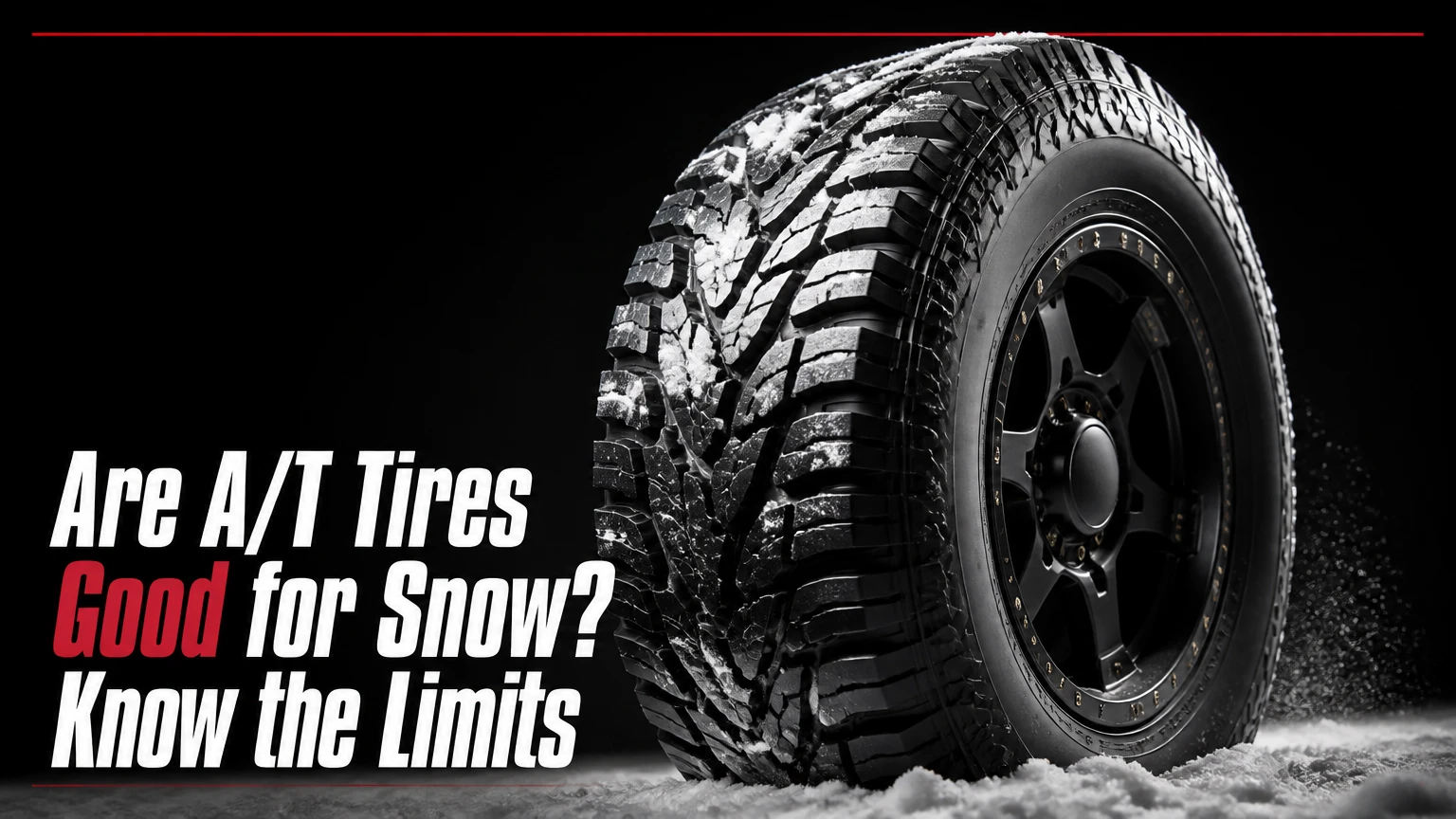
All-terrain (A/T) tires are adequate for light-to-moderate loose snow, but standard A/T tires are a weak choice for frequent ice, packed snow, or sustained temperatures below 45°F (7°C). A/T tires with the Three-Peak Mountain Snowflake (3PMSF) symbol perform better in winter, while dedicated winter tires remain the safest choice for repeated icy or severe conditions.
Key Facts at a Glance
- A/T tires usually outperform highway tires in deep, loose snow because their open tread can compact and eject snow.
- The M+S marking does not prove that a tire passed a standardized winter traction test.
- The 3PMSF symbol identifies a tire that met a regulated severe-snow traction requirement, but it does not make an A/T tire equal to a dedicated winter tire on ice.
- The 7°C (45°F) guideline describes when many all-season compounds begin losing flexibility; tire performance declines progressively rather than switching off at one temperature.
- Four-wheel drive and all-wheel drive improve traction while accelerating, but they do not create additional tire grip for braking or cornering.
- A winter tire with 6/32 inch of usable tread can be safer on ice than a deeper A/T tire with a less flexible compound.
Are A/T Tires Good for Snow?
A/T tires are good for occasional light snow and useful in deeper, unpacked snow when the tread has adequate depth. Standard A/T tires are not the best snow tires for icy intersections, freezing rain, polished packed snow, or roads that remain below freezing for long periods.
The reason is a trade-off in the tread and compound. Large A/T blocks create more edges than a highway tire and leave larger channels for loose snow, gravel, and mud. Those features help a truck or SUV move through fresh snow, especially at low speed.
The same A/T tire can feel much less secure after a plow compresses the snow into a hard surface. Standard all-terrain compounds prioritize wear resistance, heat tolerance, and summer-road stability, whereas winter compounds remain more flexible in low temperatures and use many more biting edges.
A useful practical verdict is simple: choose an A/T tire for mixed driving with occasional snow, choose a 3PMSF A/T tire for year-round versatility with regular snow, and choose a dedicated winter tire for recurring ice or severe winter travel.
How Do A/T Tires Work in Snow?
A/T tires gain snow traction through tread-block edges, voids, and snow-on-snow friction. A tire does not grip loose snow because rubber sticks strongly to it; the tread packs snow into its grooves, allowing compacted snow to interact with the snow beneath the tire.
Tread depth also provides clearance. A typical new A/T tire starts around 10/32 to ’en? 12/32 inch, although the exact specification depends on size and model. As grooves wear, they hold less snow and lose the edges needed to cut through slush and loose powder.
Sipes create smaller gripping edges. Winter tires generally use a much higher density of zigzag sipes, while A/T tires use fewer, wider cuts to preserve block stability during dry-road driving. That distinction matters most on hard-packed snow and ice, where the tire needs many small edges rather than only large blocks.
Why does temperature matter?
Rubber flexibility declines as temperatures fall, and many tire manufacturers use 7°C (45°F) as a practical point for considering winter tires. The 7°C value is not a universal legal cutoff or a sudden failure temperature. A/T traction changes continuously with temperature, tire age, road surface, speed, and compound design.
A three-year-old A/T tire stored outdoors may feel less compliant than a newer tire in the same size. Cold inflation pressure also falls by roughly 1 psi for every 10°F temperature decrease, so winter pressure checks matter even when the tire itself remains suitable.
What happens on ice?
Ice provides very little texture for a tire to use. Winter compounds, dense siping, and specialized tread designs improve the number of microscopic edges touching the surface, but no ordinary tire makes ice safe at normal dry-road speeds.
A/T tread that works well in six inches of fresh snow can provide disappointing braking on a polished intersection. That counterintuitive result explains why deep tread alone cannot identify a good winter tire.
What Do M+S and 3PMSF Mean?
M+S means Mud and Snow, but the marking is primarily a design classification and does not prove severe-winter traction. The 3PMSF symbol, a mountain outline containing a snowflake, means the tire passed a defined severe-snow performance test under the applicable North American or European regulatory system.
The M+S designation historically relates to tread geometry and a specified proportion of open tread, but it does not require the same standardized snow-traction performance test used for 3PMSF. Many ordinary all-season and A/T tires carry M+S.
The 3PMSF test compares the candidate tire with a standard reference tire on medium-packed snow. The requirement is commonly described as a traction index of at least 1.10, or 110% of the reference tire’s performance. That result is meaningful, but it covers a particular snow test and does not certify ice braking, wet handling, dry-road comfort, or every winter condition.
Michelin’s winter-tire guidance uses the 7°C rule of thumb: “When temperatures drop below 7°C, winter tyres offer better grip than summer tyres.” That statement addresses winter-oriented rubber against summer rubber, not a guarantee that every 3PMSF A/T tire will outperform every non-3PMSF tire in every test.
Which sidewall markings should you check?
| Marking or feature | What it indicates | What it does not prove | Buying implication |
|---|---|---|---|
| M+S | Tread classified for mud and snow use | Severe-snow, ice, or cold-compound performance | Acceptable only for mild winter use when conditions are limited |
| 3PMSF | Passed a standardized severe-snow traction test | Dedicated winter-tire performance on ice | Minimum useful marking for regular snow travel |
| Stud symbol or stud holes | Possible use with approved winter studs, depending on model | Legal use in every state or province | Check local stud rules and manufacturer approval |
| UTQG rating | Treadwear, traction, and temperature grades for applicable tires | Winter traction in all conditions | Compare wear expectations, not winter capability alone |
| Tire age code | Manufacturing week and year on the DOT sidewall | Remaining tread quality by itself | Replace or inspect aged tires even with deep tread |
How Do Tire Types Compare in Winter?
Dedicated winter tires win on ice and packed snow, while 3PMSF A/T tires offer the strongest compromise for drivers who also need gravel, highway, and light off-road capability. Standard A/T tires are more versatile than winter tires in warm weather, but their winter margin is smaller.
| Tire category | Fresh snow traction | Packed snow and ice | Typical new tread | Typical price per tire |
|---|---|---|---|---|
| Standard A/T | Moderate to good | Fair to poor | 10/32-12/32 in | $150-$350 |
| 3PMSF A/T | Good | Moderate | twaalf? 12/32-18/32 in | $180-$400 |
| Dedicated winter | Very good to excellent | Very good to excellent | 10/32-13/32 in | $140-$350 |
| Rugged-terrain R/T | Good to very good | Fair to poor | 12/32-18/32 in | $200-$450 |
| Mud-terrain M/T | Very good in deep powder | Poor on ice | 15/32-21/32 in | $220-$500 |
Prices are typical U.S. retail ranges for common light-truck and SUV sizes, excluding mounting, balancing, taxes, and disposal fees. Large 20-inch truck sizes, commercial load ranges, and premium brands can exceed these figures.
| Decision factor | Standard A/T | 3PMSF A/T | Dedicated winter | R/T or M/T |
|---|---|---|---|---|
| Year-round use | Strong | Strong | Poor in warm weather | Strong |
| Ice braking | Weak | Fair | Strongest | Weak |
| Deep unplowed snow | Good with momentum | Good | Good, but less durable off-road | Very good at low speed |
| Highway noise | Moderate | Moderate | Low to moderate | High |
| Typical service life | 50,000-70,000 miles | 40,000-60,000 miles | 20,000-40,000 miles | 30,000-50,000 miles |
| Seasonal change required | No | No | Yes | No |
| Best surface | Pavement, gravel, light trails | Pavement, snow, gravel | Cold pavement, snow, ice | Rock, mud, deep snow |
Are 3PMSF A/T tires as good as winter tires?
3PMSF A/T tires are not generally as good as dedicated winter tires on ice and packed snow. A 3PMSF rating confirms severe-snow test performance, but winter tires usually combine a cold-weather compound with more siping, narrower groove geometry, and a carcass tuned for cold pavement.
A 3PMSF A/T tire can be the better ownership choice for a driver who travels gravel roads, carries heavy equipment, or cannot store a second wheel set. The compromise is measurable in control rather than convenience: the tire may last longer and handle dry roads better, but it normally gives up winter braking and cornering grip.
Are mud-terrain tires good for snow?
M/T tires can move through deep, loose snow because their large voids resist packing and their tall lugs clear debris. M/T tires are usually poor on packed snow and ice because large, rigid blocks provide fewer small biting edges and often have limited siping.
R/T tires occupy the middle ground. Their shoulder lugs and heavy construction suit deep snow, towing, and rough roads, but they remain a poor substitute for winter tires on glazed pavement. A severe-snow-rated R/T can improve the compromise, although the 3PMSF symbol still does not certify ice performance.
Which Winter Setup Fits Your Driving?
The safest choice depends on the surface encountered most often, not the deepest snow you might see once each year. A commuter who brakes on treated urban roads has a different requirement from a rural driver who must cross an unplowed road.
| Driver situation | Recommended tire setup | Reason | Important limitation |
|---|---|---|---|
| Occasional snow, mostly wet or dry pavement | Standard A/T or all-weather tire | Lower cost and no seasonal change | Limited ice margin |
| Weekly snow on paved roads | 3PMSF A/T or all-weather tire | Better snow traction with year-round use | Inferior to winter tires on ice |
| Daily freezing rain and packed snow | Dedicated winter tire | Best cold-surface braking and steering | Requires spring removal |
| Ski trips and maintained mountain roads | 3PMSF A/T plus approved chains | Snow rating and mixed-surface durability | Local chain laws still apply |
| Rural unplowed roads | 3PMSF A/T, winter tire, or approved studded tire | Deeper snow capability and cold grip | Clearance and recovery equipment may matter |
| Mud, rocks, and occasional snow | 3PMSF R/T or A/T | Stronger casing and open tread | Noise and ice performance remain compromises |
Should a city commuter use A/T tires?
A city commuter who regularly encounters black ice, freezing rain, or polished intersections should use dedicated winter tires rather than standard A/T tires. If snow is infrequent and roads are promptly treated, a 3PMSF all-weather or A/T tire may provide a reasonable year-round compromise.
Road treatment changes the decision. Salt, brine, and frequent plowing reduce loose-snow demand but do not eliminate ice, especially at intersections, bridges, ramps, and shaded streets. Urban drivers often need short stopping distances more than deep-snow flotation.
Are A/T tires suitable for mountain travel?
A 3PMSF A/T tire suits mountain travel when the route includes cleared pavement, gravel, occasional unplowed sections, and mild off-road use. Drivers should confirm local requirements because a 3PMSF marking does not automatically exempt a vehicle from chain restrictions or temporary traction-control rules.
Mountain roads add downhill braking, changing elevation, shade, and rapidly forming ice. Carry the correct chains or approved traction devices, verify wheel-well clearance, and practice installation before a storm. Four-wheel drive does not replace those preparations.
Does AWD or 4WD make A/T tires safe?
AWD and 4WD help a vehicle transmit engine torque when accelerating, but they do not materially increase the friction available for braking or cornering. A heavy truck with four driven wheels can still slide straight through an icy stop sign if its tires cannot grip the surface.
Electronic stability control and ABS help the driver retain control, but those systems work within the tire’s available traction. Use four matching tires with compatible size, load index, and speed rating, especially on AWD vehicles where rolling-circumference differences can stress the drivetrain.
How Should You Inspect A/T Tires Before Winter?
Inspect tread depth, age, pressure, wear pattern, sidewalls, and the 3PMSF marking before the first sustained cold period. A tire with legal tread can still be a poor winter tire if it is aged, hardened, unevenly worn, or incorrectly inflated.
Use a tread-depth gauge rather than relying only on the wear bars. The legal replacement threshold in many U.S. jurisdictions is 2/32 inch, but practical snow performance declines earlier. Many tire professionals recommend replacing winter-use tires near 5/32 or 6/32 inch because shallow grooves clear less snow.
Winter inspection checklist
- Read the sidewall. Confirm the full tire size, load index, speed rating, DOT date code, and 3PMSF symbol.
- Measure all four tires. Record tread depth at the inner, center, and outer grooves; differences indicate alignment or suspension problems.
- Check cold pressure. Inflate to the vehicle manufacturer’s door-jamb specification, not the maximum molded on the tire.
- Inspect damage. Look for bulges, cuts, exposed cords, bead damage, and repairs near the sidewall.
- Verify matching equipment. Avoid mixing winter, A/T, and worn all-season tires across an axle.
- Rotate appropriately. Follow the vehicle and tire manufacturer’s pattern, commonly every 5,000-8,000 miles.
The success checkpoint is even wear, correct cold pressure, usable tread above the winter replacement guideline, and four tires with compatible traction characteristics. A common mistake is adding air after driving to a warm shop, which can leave the tires underinflated once they cool.
How much does an A/T winter setup cost?
A four-tire A/T installation typically costs $700-$1,800 before tax, depending on tire size and brand. Mounting and balancing commonly add $80-$180, while seasonal storage may cost $50-$150 per season.
A second set of wheels increases the initial cost but reduces repeated mounting on the same rims. Dedicated winter tires commonly last 3-5 seasons when removed during warm weather, stored away from sunlight, and replaced before tread becomes too shallow.
| Service or item | Typical quantity | Typical U.S. cost | Typical timing |
|---|---|---|---|
| A/T tires | 4 | $600-$1,600 | Purchase |
| Mount and balance | 4 | $80-$180 | 45-90 minutes |
| Four-wheel alignment | 1 | $100-$200 | 60-90 minutes |
| Winter wheel set | 4 wheels | $400-$1,200 | One-time purchase |
| Seasonal storage | 1 season | $50-$150 | Per season |
| Snow chains | 1 vehicle set | $80-$300 | Keep in vehicle |
These are planning figures rather than guaranteed quotes. Commercial truck sizes, run-flat construction, TPMS service, disposal fees, and remote locations can change the total.
What Problems Do A/T Tires Have in Snow?
The most common A/T winter failures are poor ice braking, slush buildup, low pressure, worn tread, and driver overconfidence from four-wheel drive. Each failure has a different remedy, and accelerating harder rarely solves a traction problem.
Sliding at an icy intersection
A standard A/T tire may slide at a packed intersection because its compound is too stiff and its tread has too few fine edges for the thin water film on ice. Reduce speed before the intersection, increase following distance, and use smooth steering and braking inputs.
Do not deliberately lower tire pressure on public roads to create a larger contact patch. Use the manufacturer’s cold-pressure specification unless a qualified off-road procedure specifically applies, because underinflation can increase heat, sidewall flex, steering delay, and bead damage.
Floating in wet slush
Slush can overwhelm grooves when speed is too high or the tire has worn tread. The driver may feel the steering become light before the vehicle begins to yaw, which is an immediate signal to reduce speed smoothly without abrupt steering or braking.
Correct pressure and adequate tread help, but neither eliminates slush planing. Clear packed snow from wheel wells when safe, because buildup can interfere with steering or suspension movement.
Pulling to one side
A vehicle that pulls during winter driving may have uneven pressure, mismatched tires, alignment damage, or one tire with different tread depth. Check pressure first, then measure tread and inspect alignment after striking a pothole or curb.
Expert rules that prevent winter mistakes
- Tread depth does not rank above compound on ice. A deep M/T tire can stop worse than a moderately worn winter tire on polished pavement.
- The rear axle needs the strongest traction. Installing better tires only on the drive axle can promote oversteer; replace tires as a matched set and follow vehicle-maker guidance.
- Temperature is not the only variable. Wet pavement near freezing can be more hazardous than dry snow below 20°F because water reduces the tire-road friction available for braking.
- A tire’s rating is not a driving permission slip. 3PMSF helps identify severe-snow capability, but speed, visibility, road grade, and stopping space still determine safety.
When Should You Replace A/T Tires?
Replace A/T tires when tread reaches the manufacturer’s winter-use limit, when damage appears, or when age and cracking reduce flexibility. Many drivers replace tires around six years from manufacture, while some manufacturers recommend removal at ten years regardless of remaining tread; the tire maker’s guidance controls.
Check the DOT date code on the sidewall. The final four digits identify the production week and year, such as 3523 for the 35th week of 2023. Surface cracks between tread blocks, in the shoulder, or around the bead require professional inspection.
A/T tires used heavily on gravel or off-road terrain may lose winter performance through chipped edges and irregular wear before reaching the legal tread limit. Rotation, alignment, correct pressure, and suspension maintenance extend service life, but they cannot restore worn siping or a hardened compound.
FAQ
Can I use A/T tires year-round?
You can use A/T tires year-round if the tire’s temperature range, speed rating, and vehicle requirements fit your climate. Standard A/T tires work well for warm-weather highway and gravel use, while 3PMSF A/T tires provide a stronger winter compromise. Dedicated winter tires remain preferable where ice is frequent.
Are wider A/T tires better in snow?
Wider A/T tires are not automatically better in snow. A narrower tire can place more contact pressure through loose snow and fit into existing tire tracks, while a wider tire may float better in deep powder. Use the vehicle manufacturer’s approved sizes, because changing width affects clearance, gearing, speedometer accuracy, and handling.
Should I buy all-weather or 3PMSF A/T tires?
Choose an all-weather tire when paved-road winter grip, quiet operation, and wet handling matter more than off-road durability. Choose a 3PMSF A/T tire when gravel, trail access, towing, or truck load capacity also matter. Both should carry 3PMSF for regular snow travel, but neither equals a dedicated winter tire on ice.
Can I put winter tires only on the drive wheels?
Do not install winter tires only on the drive wheels unless the vehicle and tire manufacturer explicitly permits that configuration. Different front and rear traction can cause oversteer or understeer, particularly during braking. Four matching winter tires provide the predictable balance required for ABS and stability-control systems.
Do tire chains work better than A/T tires?
Approved tire chains can provide more traction than A/T tires in deep snow, steep grades, and legally controlled mountain conditions. Chains do not replace suitable tires on clear pavement, and they have speed limits, clearance requirements, and installation restrictions. Follow the vehicle handbook and local road authority instructions.
The Bottom Line
Are A/T tires good for snow? Standard A/T tires are acceptable for occasional loose snow, but they are not the safest choice for regular ice, packed snow, or prolonged cold. A 3PMSF A/T tire is the practical year-round compromise for mixed road and off-road use; a dedicated winter tire provides the strongest braking and steering grip when winter conditions dominate.


