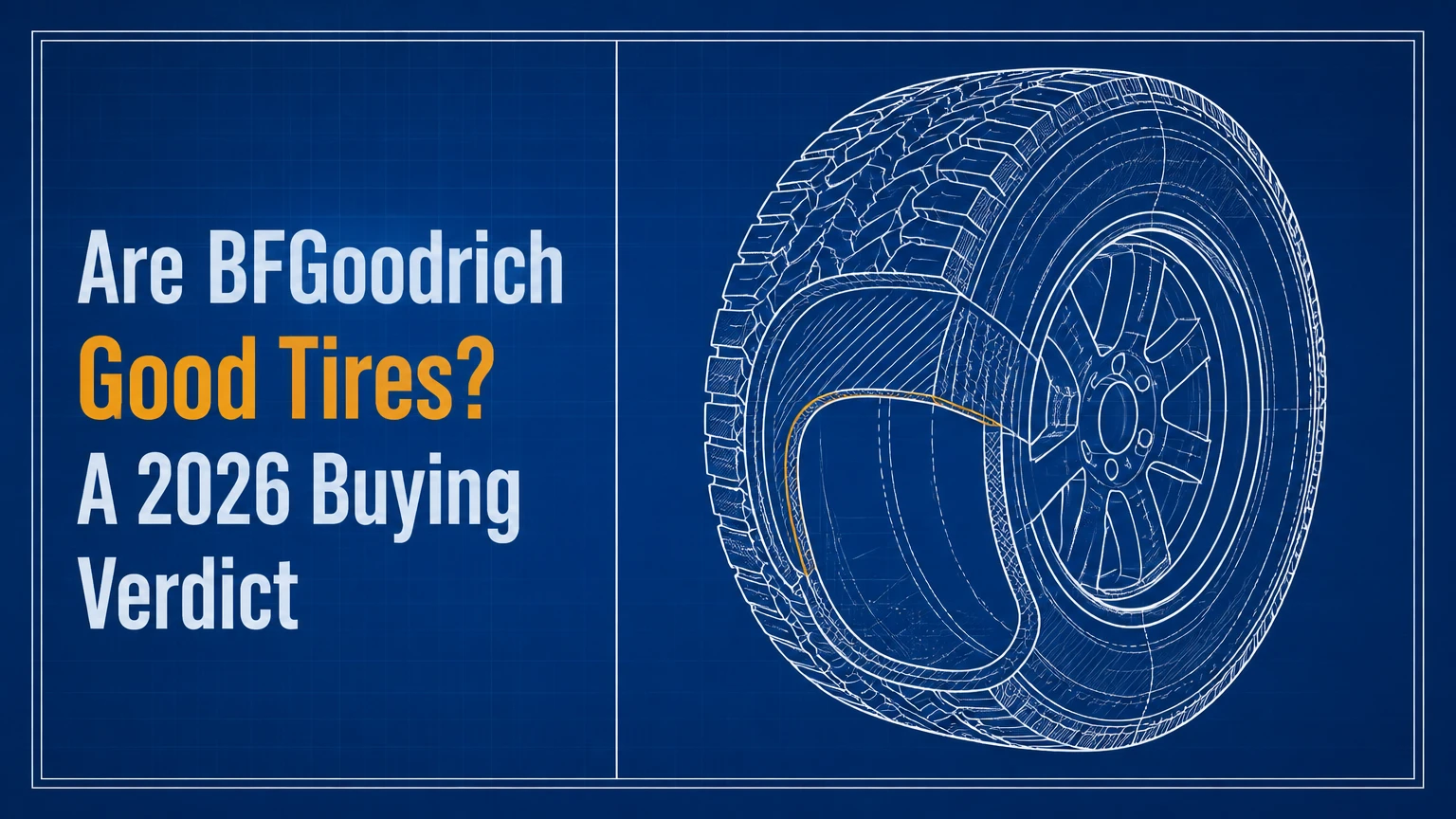
BFGoodrich tires are good tires when durability, all-terrain traction, and rugged construction matter more than maximum quietness or luxury-car comfort. BFGoodrich is especially strong for pickups, Jeeps, and SUVs, while its touring and performance lines are competent rather than automatically best-in-class. The right model matters more than the brand name.
Key Facts
BFGoodrich has operated since 1870 and has been owned by Michelin since 1990.
BFGoodrich is strongest in all-terrain, mud-terrain, and light-truck applications.
All-terrain tires usually trade some highway quietness and fuel economy for stronger gravel, snow, and dirt-road traction.
The All-Terrain T/A KO3 generally suits mixed road and trail use better than the Mud-Terrain T/A KM3.
A 3-Peak Mountain Snowflake symbol indicates a tire passed a severe-snow traction test, but it does not make the tire equivalent to a dedicated winter tire.
Tire pressure, alignment, rotation, load rating, and vehicle fitment determine real-world performance as much as the brand does.
What Kind of Tire Brand Is BFGoodrich?
BFGoodrich is a premium-oriented American tire brand with its clearest expertise in off-road and light-truck tires. The company traces its history to 1870, and Michelin acquired BFGoodrich in 1990, giving the brand access to Michelin’s testing, manufacturing, and distribution resources while retaining a more rugged product identity.
BFGoodrich is not a single tire personality. The product range includes grand-touring all-season tires, ultra-high-performance tires, all-terrain tires, and mud-terrain tires. A BFGoodrich Advantage Control on a compact sedan has a very different purpose from a BFGoodrich Mud-Terrain T/A KM3 on a rock-crawling Jeep.
BFGoodrich’s off-road reputation comes from motorsport and desert-racing experience, including participation in Baja events. The company’s marketing emphasizes race-derived construction, but racing heritage alone does not predict wet braking, noise, or tread life on a commuter vehicle. Those attributes depend on the individual tread compound, carcass, size, load range, and vehicle.
What Are BFGoodrich Tires Best At?
BFGoodrich tires are best at resisting damage and maintaining traction on gravel, dirt, rocks, sand, and uneven surfaces. The All-Terrain T/A family is the brand’s best-known range because it combines road legality with substantially more off-road capability than a typical highway all-season tire.
A BFGoodrich all-terrain tire makes the most sense for a driver who regularly reaches campsites, construction sites, forest roads, snow-covered access roads, or rough rural routes. It makes less sense for a small sedan that spends nearly every mile on smooth pavement, where a touring tire will normally provide lower noise, better ride quality, and longer tread life.
How Do BFGoodrich Tire Technologies Work?
BFGoodrich uses reinforced sidewall construction, interlocking tread blocks, open grooves, and specialized rubber compounds to improve traction or puncture resistance. These features improve performance in defined conditions, but each one introduces a trade-off in weight, rolling resistance, noise, ride, or tread wear.
CoreGard technology, associated with BFGoodrich truck tires such as the KO2 and KO3, reinforces vulnerable sidewall and lower-sidewall areas. Krawl-TEK, used in the KM3 mud-terrain range, uses a flexible compound and tread design to maintain contact on rocks. UltiGrip branding appears on selected passenger and performance products and refers to tread features intended to maintain road contact in wet and dry conditions.
BFGoodrich engineers describe the KO2 as “the toughest all-terrain tire,” a product claim that explains the design priority but should not be treated as a universal independent ranking. A thick sidewall can resist a sharp rock better, yet the same heavy construction can increase unsprung mass and reduce steering crispness on pavement.
Which BFGoodrich Tire Should You Buy?
The best BFGoodrich tire depends on the percentage of pavement, the vehicle’s required load rating, the climate, and the level of off-road damage risk. The table below separates models by intended use rather than assuming the most aggressive tread is the best choice.
| BFGoodrich model | Best application | Typical road-to-trail use | Main trade-off |
|---|---|---|---|
| Advantage Control | Sedan, minivan, compact SUV | 95% road / 5% light dirt | Less off-road grip |
| Trail-Terrain T/A | Crossover, Outback, RAV4, light SUV | 80% road / 20% dirt | Less rock and mud traction |
| All-Terrain T/A KO3 | Pickup, Jeep, overlanding SUV | 60% road / 40% trail | More noise and weight |
| All-Terrain T/A KO2 | Older fitments and mixed-use trucks | 60% road / 40% trail | Older wet and gravel design |
| Mud-Terrain T/A KM3 | Rock, mud, and severe trail use | 20% road / 80% trail | Loudness and pavement wear |
| g-Force COMP-2 A/S PLUS | Performance car and muscle car | 98% road / 2% performance use | Not a dedicated winter tire |
| g-Force Phenom T/A | Warm-weather performance driving | 95% road / 5% track | Poor cold-weather suitability |
Is the BFGoodrich KO3 Better Than the KO2?
The KO3 is the newer all-terrain design and is generally the better choice when the price and correct vehicle fitment are similar. BFGoodrich developed the KO3 to improve wet-road behavior, gravel durability, and tread performance as the KO2 platform aged, although KO2 remains a reasonable option when it is substantially cheaper or better suited to a specific size.
The KO3 is not automatically superior in every measurable category. Tire size, load range, production date, inflation pressure, and vehicle alignment affect results, and a heavy LT-rated KO3 can ride more firmly than a lighter P-metric tire. Verify the exact sidewall markings rather than comparing model names alone.
| Decision factor | KO2 | KO3 | Practical interpretation |
|---|---|---|---|
| Product generation | Earlier design | Newer design | KO3 has the development advantage |
| Typical tread warranty | About 50,000 miles | About 50,000 miles | Warranty is similar in many fitments |
| Gravel durability | Strong | Revised for improvement | KO3 is preferable for frequent gravel |
| Wet-road tuning | Adequate | Updated design | KO3 is the safer default for mixed weather |
| Severe-snow marking | Size dependent | Size dependent | Check the actual sidewall and specification |
| Used-market availability | Broad | Increasing | KO2 may cost less during clearance sales |
Is the KM3 Good for Daily Driving?
The KM3 is good for drivers who actually use mud and technical trails, but it is usually a poor daily-driver purchase for mostly paved commuting. Its open tread evacuates mud and its flexible tread elements can grip irregular rock, while the same pattern produces more hum, vibration, rolling resistance, and irregular wear on highways.
Mud-terrain tires also have less predictable behavior on wet pavement than a road-oriented all-season tire. A driver who chooses the KM3 for appearance may pay more for fuel and replace it sooner without using the capability that justified the purchase. For a truck that travels to a trail every weekend, the compromise can be worthwhile.
Is Trail-Terrain Better for a Crossover?
The Trail-Terrain T/A is usually better for a crossover than a KO2 because it provides a quieter, lighter, more road-oriented package for gravel roads and moderate snow. The model targets vehicles such as the Subaru Outback, Toyota RAV4, Honda Passport, and similar SUVs that need occasional trail access rather than rock-crawling strength.
Trail-Terrain remains more rugged than a conventional touring tire, but it cannot replace a true mud-terrain tire in deep mud or a dedicated winter tire on packed ice. Its value is balance: useful dirt-road traction without the full highway penalty of an aggressive LT all-terrain tire.
How Much Do BFGoodrich Tires Cost?
BFGoodrich tires typically cost about $165-$240 per tire for passenger and crossover applications and about $250-$450 or more per tire for large truck and SUV sizes. A complete four-tire purchase commonly reaches $700-$1,100 for passenger models or $1,000-$1,800 for truck models before mounting, balancing, taxes, disposal fees, and alignment.
Actual pricing changes with wheel diameter, load range, speed rating, retailer, rebates, and regional supply. A 17-inch P-metric crossover tire can cost far less than a 20-inch LT tire with the same model name.
| Product category | Typical price per tire | Typical four-tire total before tax | Common extra service |
|---|---|---|---|
| Advantage Control | $165-$220 | $660-$880 | Mounting and balancing |
| Trail-Terrain T/A | $190-$280 | $760-$1,120 | Alignment if wear is uneven |
| KO2 or KO3 | $250-$400 | $1,000-$1,600 | TPMS service and rotation |
| KM3 | $280-$450+ | $1,120-$1,800+ | Road-force balance may help |
| COMP-2 A/S PLUS | $180-$300 | $720-$1,200 | Performance alignment check |
Treadwear warranties are not mileage guarantees. BFGoodrich warranty documents commonly list approximately 45,000 miles for selected performance tires, about 50,000 miles for many all-terrain sizes, and roughly 65,000-75,000 miles for selected touring products. The exact warranty depends on the model, size, speed rating, rotation records, and regional terms.
Are BFGoodrich Tires Good in Rain and Snow?
BFGoodrich tires can perform well in rain and moderate snow when the model is correctly chosen, but all BFGoodrich tires do not share the same wet or winter ability. Touring tires generally prioritize road contact and water evacuation, while mud-terrain tires prioritize open tread and off-road self-cleaning.
The 3-Peak Mountain Snowflake, or 3PMSF, symbol means the tire passed a standardized severe-snow traction test. The symbol does not measure braking on ice, cornering on packed snow, or stopping distance against a dedicated winter tire. Drivers in areas with prolonged freezing temperatures should still compare a winter tire with a 3PMSF all-terrain tire.
| Driving condition | More suitable BFGoodrich option | Why | Important limitation |
|---|---|---|---|
| Heavy rain on pavement | Advantage Control | Road-focused tread and compound | Not an off-road tire |
| Mixed rain and gravel | Trail-Terrain T/A | More open and reinforced design | Less mud capability |
| Snowy rural roads | KO3, if 3PMSF marked | Stronger snow and trail traction | Ice performance remains limited |
| Deep mud after rain | KM3 | Open mud-clearing tread | Wet-road noise and braking trade-off |
| Packed snow and ice | Dedicated winter tire | Softer cold-weather compound | Seasonal changeover required |
How Long Do BFGoodrich Tires Last?
BFGoodrich tires often last approximately 40,000-70,000 miles, depending on model, axle load, alignment, inflation, rotation frequency, road surface, and driving style. KO2 and KO3 owners may reach 50,000-60,000 miles with regular rotation and mostly moderate pavement use, while aggressive off-road driving can reduce that figure substantially.
A warranty estimate should not be mistaken for a forecast. Towing, low pressure, high-speed cornering, concrete highways, and frequent sharp turns can remove thousands of miles from expected tread life. An LT tire may also wear differently from a P-metric version of a similar model because construction and vehicle load differ.
Rotate all-terrain tires about every 5,000-7,000 miles, or follow the vehicle and tire manufacturer’s schedule when it is more frequent. Inspect tread depth, shoulder wear, cupping, sidewall cuts, and irregular wear at every rotation.
What Causes BFGoodrich Tires to Become Noisy?
Cupping, uneven shoulder wear, aggressive tread blocks, and incorrect pressure commonly cause BFGoodrich tires to become noisy. Some hum is normal with KO2, KO3, and KM3 designs, but a sudden rhythmic roar usually indicates a maintenance or balance problem rather than normal tread sound.
Use this diagnostic sequence:
- Run the cold pressure listed on the vehicle door placard.
- Inspect the tread by hand for scalloped high and low spots.
- Check alignment, especially toe settings.
- Rotate the tires if the wear pattern permits it.
- Request a road-force balance if vibration remains.
- Check wheel damage, bent rims, and suspension play.
A normal balance corrects weight distribution. Road-force balancing also helps identify stiffness variation that can be noticeable with heavy truck tires.
How Do BFGoodrich Tires Compare With Alternatives?
BFGoodrich is usually the stronger choice than a budget tire when sidewall protection and trail traction matter, but it is not automatically better than every competitor. Michelin generally offers a quieter touring experience, while Falken, Toyo, Cooper, and General each provide competitive options in selected all-terrain and highway-terrain categories.
| Brand or model family | Strongest attribute | Typical weakness | Better choice for |
|---|---|---|---|
| BFGoodrich KO3 | Trail durability and mixed terrain | Weight and tread noise | Overlanding and rough access roads |
| Michelin Defender | Quiet highway touring | Limited technical off-road ability | Commuters and family sedans |
| Michelin CrossClimate2 | Snow and wet-road road use | Higher price and road-only focus | Cold, wet urban climates |
| Falken Wildpeak A/T4W | Balanced all-terrain behavior | Can be heavy in LT sizes | Snow-prone truck owners |
| Toyo Open Country A/T III | Stable road manners | Fitment and price vary | Highway and trail balance |
| Cooper Discoverer AT3 | Value-oriented mixed use | Less aggressive extreme-trail grip | Light-duty pickups |
| General Grabber A/TX | Snow and dirt-road versatility | Road noise as tread wears | Budget-conscious SUV owners |
BFGoodrich Versus Michelin: Which Is Better?
Michelin is usually better for quietness, ride comfort, wet-road touring, and refined passenger-car handling. BFGoodrich is usually better for aggressive all-terrain construction, trail durability, and a broader rugged-truck identity, even though Michelin owns the brand.
The parent-company relationship does not mean BFGoodrich and Michelin tires are identical. Product engineering, tread compounds, carcass construction, and target drivers differ. A Michelin Defender is not an alternative to a KO3 for rock and gravel, and a KO3 is not a direct replacement for a Defender on a quiet commuter sedan.
What Should You Check Before Buying BFGoodrich Tires?
Check the vehicle placard, owner’s manual, tire size, load index, speed rating, construction type, and intended terrain before ordering. The correct BFGoodrich model in the wrong load range can create ride, clearance, handling, or payload problems.
P-Metric Versus LT Tires
P-metric tires are designed primarily for passenger vehicles and lighter-duty SUV use. LT tires have stronger construction and higher load capability, but they can weigh more, ride more firmly, cost more, and require careful pressure selection.
A heavy-duty pickup used for towing may require LT tires, while a crossover may be designed for P-metric tires. Never select an LT tire solely because its sidewall looks tougher. Match the replacement tire to the vehicle manufacturer’s required load index and placard pressure.
Inspect the DOT Date and Fitment
Check the DOT date code before installation. The final four digits identify the production week and year, so a code ending in 2525 indicates the 25th week of 2025. A tire retailer should provide recent stock, but buyers should still inspect the sidewall and confirm the size.
Also verify:
- Tire width, aspect ratio, and wheel diameter
- Load index and speed symbol
- P, LT, XL, or other construction marking
- 3PMSF symbol when severe-snow capability is needed
- Vehicle clearance at full steering lock
- TPMS compatibility
- Warranty terms in the purchase region
What Are the Common BFGoodrich Problems?
The most common BFGoodrich complaints involve highway noise, vibration, uneven wear, sidewall damage from misuse, and expectations that an aggressive tire will behave like a touring tire. Most problems become easier to prevent when the tire is matched to the vehicle and maintained on schedule.
Brown sidewalls are usually tire blooming, a normal migration of protective antioxidants to the rubber surface. A mild tire cleaner and soft brush can remove the discoloration; harsh solvents, petroleum-based dressings, and abrasive tools can damage the rubber.
Vibration after installation deserves attention. Heavy all-terrain tires may need precise balancing, but persistent vibration can also indicate a bent wheel, out-of-round tire, worn suspension component, or alignment issue. Do not accept severe vibration as an unavoidable feature of the BFGoodrich brand.
When Are BFGoodrich Tires a Bad Choice?
BFGoodrich is a poor choice when the priority is the quietest highway ride, lowest rolling resistance, maximum icy-road grip, or the lowest purchase price. A city commuter may get better overall value from a touring all-season tire, and a driver in a snowy climate may need a dedicated winter set.
BFGoodrich is also a poor choice when the buyer selects a KM3 for appearance but drives almost entirely on pavement. The tire’s off-road capability cannot compensate for unnecessary noise, reduced comfort, and faster irregular wear in that situation.
Which BFGoodrich Tire Fits Each Driver?
- Daily sedan commuter: Choose Advantage Control for road mileage, wet-weather commuting, and a lower operating compromise.
- Crossover owner using gravel roads: Choose Trail-Terrain T/A when pavement dominates and occasional dirt access is the requirement.
- Pickup or Jeep owner: Choose KO3 for mixed highway, snow, gravel, and trail driving after confirming size and load rating.
- Technical off-road driver: Choose KM3 when mud and rock traction outweigh highway comfort.
- Performance-car driver: Choose COMP-2 A/S PLUS for year-round street performance in moderate climates.
- Summer performance driver: Choose Phenom T/A for warm-weather dry grip, not freezing temperatures or winter travel.
Frequently Asked Questions
Are BFGoodrich tires as good as Michelin tires?
BFGoodrich tires can match or exceed Michelin products in off-road durability and all-terrain traction, while Michelin usually leads in touring comfort, quietness, and refined wet-road behavior. The brands target different uses, so a KO3 should be compared with an all-terrain competitor, not automatically with a Michelin Defender.
Do BFGoodrich tires make a lot of noise?
BFGoodrich touring tires can be relatively quiet, but KO2, KO3, and especially KM3 tires produce more tread noise than highway or grand-touring tires. Increasing hum may indicate cupping, poor alignment, uneven inflation, or imbalance, particularly when the noise changes with rotation or speed.
Are BFGoodrich tires good for highway driving?
BFGoodrich tires are suitable for highway driving when the model matches the vehicle and the driver accepts its trade-offs. Advantage Control is road-focused, Trail-Terrain is crossover-friendly, and KO3 is highway-capable but heavier and louder. KM3 is the least comfortable option for frequent long-distance pavement travel.
Do BFGoodrich tires need frequent rotation?
BFGoodrich all-terrain tires should commonly be rotated every 5,000-7,000 miles, subject to the vehicle manufacturer’s instructions. Regular rotation reduces shoulder wear and cupping, preserves tread life, and helps reveal alignment problems before they create severe vibration or noise.
Are BFGoodrich tires worth the money?
BFGoodrich tires are worth the money when their puncture resistance, all-terrain traction, or rugged construction will be used. They are less cost-effective for drivers who never leave pavement, because a touring tire may provide lower noise, better fuel economy, and a longer road-oriented service life for similar money.
The Bottom Line
Yes, BFGoodrich tires are good tires, particularly for drivers who need durable all-terrain, mud-terrain, or light-truck performance. The KO3 is the strongest general recommendation for mixed truck and Jeep use, Trail-Terrain suits road-biased crossovers, and Advantage Control fits ordinary commuting. BFGoodrich is not automatically the best choice for every vehicle, climate, or budget, so compare the model, load rating, 3PMSF marking, warranty, and driving conditions before buying.