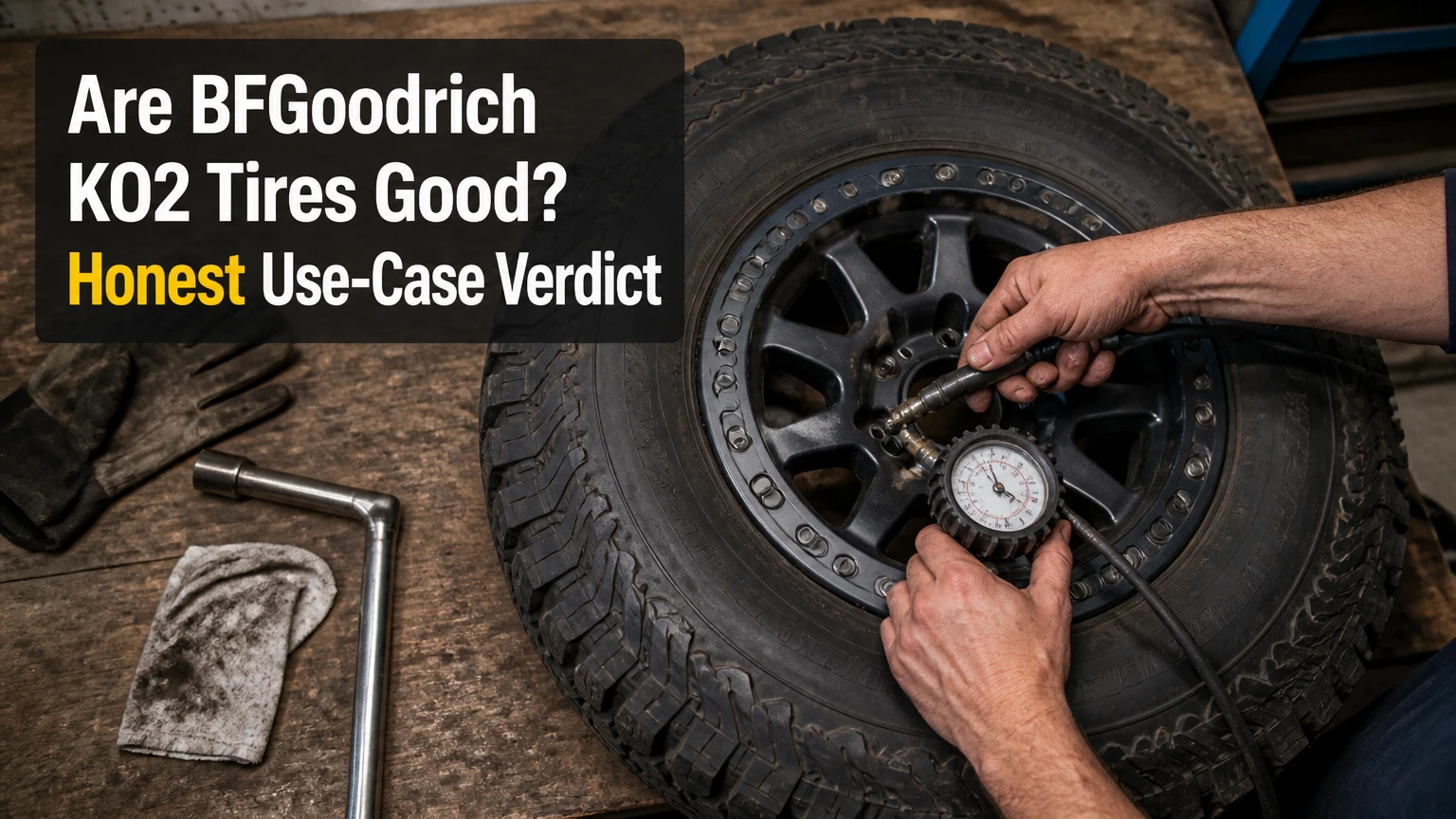
BFGoodrich All-Terrain T/A KO2 tires are good for drivers who prioritize off-road durability, gravel traction, and severe-service construction over quiet highway manners and strong wet-pavement braking. They are a proven choice for pickups, SUVs, Jeeps, and towing applications, but a highway tire or newer all-terrain design is usually better for a vehicle used almost entirely on wet pavement.
Key Facts at a Glance
- BFGoodrich KO2 is a light-truck all-terrain tire designed for pickups, SUVs, and Jeeps.
- The KO2’s strongest attributes are sidewall durability, gravel resistance, and traction on dirt, rocks, and deep snow.
- KO2 road noise usually increases as the tread wears, especially when rotation is neglected or the tread cups.
- Wet braking and hydroplaning resistance are weaker than those of touring tires and several newer all-terrain competitors.
- Load Range C and Load Range E describe load capacity and casing stiffness, not literal six-ply or ten-ply construction.
- A typical properly maintained KO2 set can reach approximately 50,000-65,000 miles, although alignment, rotation, vehicle weight, and terrain change the result.
What Kind of Tire Is the BFGoodrich KO2?
The BFGoodrich All-Terrain T/A KO2 is a premium all-terrain light-truck tire with an aggressive tread, reinforced sidewalls, and a construction intended for mixed pavement and off-road use. BFGoodrich positions the tire for roughly equal on-road and off-road service, but that description should be treated as a design target rather than a promise that every surface will receive equal performance.
The KO2 fits a wide range of pickups, sport utility vehicles, Jeeps, and overland vehicles. Depending on size, the tire may carry LT, P-metric, or flotation sizing, different speed ratings, and different load ranges. Those markings matter more than the tread appearance when matching a tire to a vehicle.
| KO2 characteristic | Typical specification or behavior | Practical consequence |
|---|---|---|
| Tire category | Light-truck all-terrain | Mixed pavement, gravel, dirt, and rocky terrain |
| Wheel diameters | Commonly 15-22 inches, size dependent | Fitment must be checked by vehicle and exact size |
| Tread life | Typical 50,000-65,000 miles | Rotation and alignment strongly affect mileage |
| Severe-snow marking | 3PMSF on qualifying sizes | Better deep-snow capability than an M+S-only tire |
| Intended vehicles | Pickups, SUVs, Jeeps | Not automatically ideal for small cars or crossovers |
| Main compromise | Aggressive tread and heavy casing | More noise, weight, and wet-road trade-offs |
The KO2 is not a mud-terrain tire, a dedicated winter tire, or a low-rolling-resistance highway tire. Its value comes from balancing several environments while giving unusual attention to casing protection.
Why Does the KO2 Resist Off-Road Damage?
The KO2 resists many common off-road injuries through a combination of reinforced sidewalls, interlocking tread blocks, siping, stone ejectors, and shoulder geometry. BFGoodrich describes its CoreGard technology as a tougher sidewall compound and protective sidewall design developed to reduce splitting and bruising compared with the original KO.
That protection helps when a tire contacts sharp shale, exposed roots, rock edges, and broken gravel. It does not make the tire puncture-proof. A sharp object can still penetrate the tread or sidewall, and driving too quickly with insufficient pressure can damage the casing even when the rubber remains intact.
The interlocking tread elements limit excessive block movement under acceleration and braking. Three-dimensional locking sipes create additional edges for snow and loose-surface grip, while stone ejectors reduce the chance that gravel will remain embedded in the grooves and drill into the casing.
Mud performance has a narrower limit. The KO2 can move through moderate mud, but its voids do not clean as aggressively as a dedicated mud-terrain pattern. Thick clay can pack the tread and remove much of the available traction.
What Does CoreGard Actually Protect?
CoreGard primarily reduces the likelihood of sidewall bruising, splitting, and cosmetic damage during severe off-road contact. The technology does not increase the vehicle’s legal load capacity, permit arbitrary underinflation, or replace safe line selection on rocks.
Airing down can enlarge the contact patch and improve grip, but pressure depends on vehicle weight, tire size, wheel design, terrain, and speed. Many trail users experiment in the 15-25 psi range, while 10-15 psi may be appropriate only for carefully controlled, slow rock work with bead retention and suitable equipment. Reinflate before returning to pavement.
How Do KO2 Tires Perform on Different Surfaces?
KO2 tires perform best on gravel, rocky trails, packed dirt, and deep snow, where their tread edges and reinforced casing provide useful mechanical grip. They perform adequately on dry pavement and ordinary rain, but they give up wet braking, hydroplaning resistance, and low noise compared with road-focused tires.
| Surface | KO2 behavior | Better choice when this surface dominates |
|---|---|---|
| Dry highway | Stable center tracking and predictable steering | Highway all-season or highway all-terrain tire |
| Wet pavement | Usable at normal speeds, weaker emergency braking | BFGoodrich KO3, Falken Wildpeak A/T4W, highway tire |
| Gravel | Strong bite and casing protection | KO2 remains a strong fit |
| Rocky trail | Excellent sidewall confidence and aired-down grip | KO2 or a specialist off-road tire |
| Deep snow | Strong forward traction on qualifying 3PMSF sizes | Dedicated winter tire for ice and polished snow |
| Thick mud | Moderate performance, possible groove packing | Mud-terrain tire |
| Sand | Usable when pressure and momentum are managed | Flotation-size all-terrain or sand-oriented setup |
Are KO2 Tires Good in Rain?
KO2 tires are acceptable in ordinary rain when correctly inflated and driven conservatively, but wet braking is one of their clearest weaknesses. The open, aggressive tread and heavy all-terrain casing cannot generally match a road tire’s water evacuation, compound tuning, or contact consistency on wet asphalt.
The practical risk appears during sudden stops, standing-water crossings, and worn-tread conditions. A KO2 with 4/32 inch of remaining tread may still look rugged, yet it has much less water-channel capacity than a new tire. Speed reduction matters more with an aggressive all-terrain tire because hydroplaning begins when the tread cannot remove water quickly enough.
Drivers in regions with frequent heavy rain should compare independent wet-braking tests when available, not rely on sidewall appearance. The Falken Wildpeak A/T4W, BFGoodrich KO3, and Toyo Open Country A/T III are reasonable alternatives to investigate, although exact performance varies by size and test.
Are KO2 Tires Good in Snow and Ice?
KO2 tires are strong in deep and loose snow when the exact size carries the Three-Peak Mountain Snowflake marking. The 3PMSF symbol indicates that the tire passed a standardized severe-snow traction test, but it does not mean the tire will stop like a dedicated studless winter tire on ice.
Deep snow rewards tread depth, open shoulders, and forward bite. Ice rewards a soft cold-weather compound, dense siping, and a tread engineered for microscopic friction. The KO2’s 3D sipes help, but its all-terrain compound remains a compromise across temperatures.
Check the sidewall of the exact tire before purchase. Severe-snow certification can vary by product size and specification, so an assumption based on another KO2 size is unsafe.
Which Load Range Should You Buy?
Choose the load range that meets the vehicle manufacturer’s axle and tire requirements without adding unnecessary stiffness. Load Range C is typically more compliant for lighter trucks and SUVs, while Load Range E offers greater payload and heat resistance for heavy-duty towing, but an E-rated tire can feel unnecessarily harsh on a light vehicle.
“Six-ply equivalent” and “ten-ply equivalent” are historical load-range descriptions, not guaranteed physical ply counts. Modern radial tires use different casing materials and construction methods, so the sidewall load index, tire placard, and manufacturer specifications control the fitment decision.
| Load range | Common use case | Typical ride and operating effect |
|---|---|---|
| C | Tacoma, Frontier, Wrangler, lighter SUV applications | More flexible casing and lower unsprung weight |
| D | Intermediate truck and moderate payload applications | Firmer ride with increased load reserve |
| E | F-250, Ram 2500, heavy towing and payload work | Stiffer casing, higher weight, harsher empty ride |
| XL or P-metric equivalent | Crossover and lighter SUV fitments, size dependent | More road comfort, less severe-service reserve |
Never inflate an E-rated KO2 to its maximum sidewall pressure merely because the vehicle is carrying an E-rated tire. Set cold pressure according to the vehicle placard unless a qualified tire professional or manufacturer-specific load calculation requires another value. The maximum pressure supports the tire’s maximum rated load; it is not a universal operating recommendation.
How Comfortable and Noisy Are KO2 Tires?
KO2 tires provide acceptable highway stability but are usually louder and heavier than highway-terrain or touring tires. The tread produces a low hum that often becomes more noticeable with mileage, and improper rotation can create scalloping or cupping that turns normal tread noise into a pronounced vibration.
A heavier tire can also reduce fuel economy by increasing unsprung mass and rolling resistance. The effect depends on the original tire, wheel diameter, vehicle powertrain, inflation, and driving cycle, so a universal miles-per-gallon penalty would be misleading. Many owners notice a small reduction after moving from a highway tire to an LT all-terrain tire, especially in larger Load Range E sizes.
Rotation discipline matters. A practical interval is every 5,000 miles, or sooner if the vehicle manufacturer specifies a shorter period. A five-tire rotation requires a full-size matching spare and a spare rated for the same service.
How Long Can KO2 Tires Last?
A properly maintained KO2 commonly lasts about 50,000-65,000 miles in mixed use, but heavy towing, frequent gravel, poor alignment, low pressure, and high heat can shorten that range substantially. Mileage is a planning estimate, not a warranty of remaining safety.
Inspect tread depth, shoulder wear, cracks, punctures, vibration, and irregular wear rather than using mileage alone. A tire can age out before its tread wears away, particularly on a lightly driven vehicle parked outdoors.
BFGoodrich advises owners to inspect tires regularly and follow applicable replacement guidance. The U.S. Tire Manufacturers Association recommends replacing tires that show damage or severe aging, and many tire professionals use six years as a serious inspection point and ten years as an outer age limit from manufacture, although vehicle and tire-maker guidance should take priority.
How Does the KO2 Compare With the KO3?
The KO3 is the newer BFGoodrich all-terrain design and generally targets the KO2’s wet-road, snow, noise, and wear compromises. The KO2 remains attractive when its lower price, proven off-road casing, or available size makes it a better value than paying more for the successor.
| Decision factor | BFGoodrich KO2 | BFGoodrich KO3 | Practical winner |
|---|---|---|---|
| Off-road casing reputation | Established CoreGard design | Updated protection and tread design | KO2 for proven history, KO3 for newer design |
| Wet-road development | Adequate, not class-leading | Newer compound and evacuation focus | KO3 |
| Deep-snow capability | Strong on qualifying 3PMSF sizes | Updated snow-oriented tread features | KO3, size dependent |
| Highway noise | Noticeable hum, more with wear | Designed for improved refinement | KO3 |
| Discount availability | Often discounted during transition | Usually higher purchase price | KO2 |
| Inventory age risk | Greater for old warehouse stock | More likely recent production | KO3 |
| Off-road appearance | Aggressive sidewall and shoulder styling | Similar aggressive positioning | Tie |
The KO3 is not automatically better for every owner. A lightly used KO2 manufactured recently, sold at a substantial discount, may deliver better value than a KO3 whose benefits the owner will rarely use. Conversely, a rainy-climate commuter has a stronger reason to choose the newer model or a road-biased competitor.
Which Alternatives Deserve Consideration?
Falken Wildpeak A/T4W is a strong comparison for drivers who want all-terrain appearance with a greater emphasis on wet-road control and everyday comfort. Toyo Open Country A/T III is another widely considered option for balanced pavement and trail use. A highway-terrain tire remains the better alternative when off-road travel means occasional gravel roads rather than rock, mud, or sharp terrain.
| Alternative | Best suited to | Main advantage over KO2 | Main compromise |
|---|---|---|---|
| BFGoodrich KO3 | Mixed use with frequent rain | Newer wet-weather and refinement focus | Higher price or limited availability |
| Falken Wildpeak A/T4W | Daily driving plus trails | Strong road comfort and wet behavior | Less traditional KO2 sidewall look |
| Toyo Open Country A/T III | Balanced truck and SUV use | Smooth mixed-surface manners | Different size, load, and warranty availability |
| Highway-terrain tire | 80-95% pavement use | Lower noise and better road efficiency | Less sidewall and loose-surface protection |
| Mud-terrain tire | Frequent deep mud and rock crawling | Greater self-cleaning and aggressive bite | Worse noise, wet manners, and fuel economy |
No alternative wins every category. The correct comparison starts with the surface that causes the most risk or inconvenience, not the surface shown in advertising photographs.
What Do KO2 Tires Cost?
KO2 pricing commonly falls around $220-$380 per tire in larger truck and SUV sizes, with a four-tire set often costing approximately $900-$1,600 before installation, taxes, disposal fees, alignment, and optional road-hazard coverage. Smaller sizes can cost less, while large LT, flotation, and specialty sizes can exceed that range.
| Purchase item | Typical amount | What changes the amount |
|---|---|---|
| One smaller KO2 tire | $180-$260 | Wheel diameter and passenger or LT construction |
| One large LT KO2 tire | $260-$380+ | Load Range E, flotation sizing, retailer stock |
| Four-tire set | $900-$1,600 | Size, rebates, shipping, and local pricing |
| Mount and balance | $20-$45 per tire | Wheel size, local labor, tire-pressure service |
| Alignment | $90-$180 | Vehicle type and regional labor rate |
| Disposal and fees | $3-$15 per tire | State, province, and retailer policy |
Check the DOT date code before paying for old inventory. The final four digits identify the production week and year, so “2524” means the 25th week of 2024. Old stock is not automatically unsafe, but a buyer should know the age and inspect for cracking before installation.
How Should You Maintain KO2 Tires?
Maintain KO2 tires with vehicle-placard inflation, frequent visual inspection, rotation about every 5,000 miles, and prompt alignment correction. Maintenance determines whether the tire produces its expected mileage and noise level more reliably than a tread compound claim alone.
Use this operating routine:
- Check cold pressure monthly. Measure before driving or after several hours parked, and use the pressure on the driver-door placard.
- Rotate at 5,000 miles. Rotate earlier if front and rear wear rates differ or if feathering appears.
- Inspect after trail use. Remove lodged stones, examine sidewalls, and look for cuts, bulges, exposed cords, or punctures.
- Check alignment after impacts. A bent wheel or shifted toe setting can destroy the shoulders within a few thousand miles.
- Reinflate after airing down. Do not drive highway speeds at trail pressure.
- Monitor the spare. A five-tire rotation requires matching size, load rating, tread pattern, and compatible pressure.
A chalk test can help evaluate contact-patch behavior during controlled setup work, but it should not override the vehicle maker’s pressure requirement or the tire manufacturer’s load table. Overinflating an E-rated KO2 on a light Jeep commonly creates a harsh ride and center wear; underinflating a heavily loaded truck creates heat and casing stress.
What Problems Should Buyers Watch For?
The most common KO2 ownership problems are noise, cupping, uneven shoulder wear, wet-road overconfidence, excessive weight, and aging-related cracking. Most are preventable through correct pressure, rotation, alignment, speed selection, and inspection.
Cupping and Feathering
Cupping produces alternating high and low tread areas that cause vibration and a rhythmic roar. Worn shocks, imbalance, loose suspension parts, incorrect pressure, or long rotation intervals can cause it. Measure tread depth across several points, inspect suspension components, balance the wheels, and rotate only after correcting the underlying fault.
Gravel Retention
KO2 grooves can retain small stones, especially after driving loose pea gravel. Stones may eject at speed or strike nearby vehicles. Remove large embedded stones when safe, and avoid assuming that every tread object requires immediate tire replacement unless it has penetrated the casing.
Sidewall Cracking
Fine surface cracks can result from age, ultraviolet exposure, ozone, and harsh chemical dressings. Deep cracks, bulges, exposed cords, or cracking that reaches structural areas require professional inspection and usually replacement. Store tires away from direct sun and avoid petroleum-based cleaners.
Wet-Weather Overconfidence
The KO2’s stable steering can make normal rain feel controlled even when emergency wet braking remains weaker than a road tire’s. Increase following distance and reduce speed in standing water, especially with a heavily worn tread or a loaded truck.
Who Should Choose KO2 Tires?
The best KO2 buyer is a truck, SUV, or Jeep owner who regularly drives gravel, trails, rocky access roads, deep snow, or towing routes where casing durability matters. A driver who spends almost every mile on smooth wet pavement should select a quieter road-focused design instead.
| Driver profile | KO2 recommendation | Reason |
|---|---|---|
| Trail and overland driver | Strong choice | Sidewall protection and loose-surface traction |
| Daily commuter in rainy climate | Conditional | Wet braking and noise require acceptance |
| Heavy-duty towing owner | Strong choice when correctly sized | Load Range E options and stable casing |
| Snow-belt driver on maintained roads | Conditional | Deep snow capable, ice performance limited |
| Crossover owner with rare gravel use | Usually unnecessary | Added weight and noise provide little benefit |
| Mud-focused enthusiast | Consider another tire | Mud-terrain tread cleans more effectively |
One counterintuitive point matters: the toughest tire is not always the safest tire for a particular vehicle. A heavy E-rated casing on a lightweight SUV can reduce ride compliance, increase braking load, and encourage incorrect inflation. Match construction to axle load, not to the most aggressive visual option.
Frequently Asked Questions
Are KO2 tires suitable for a Jeep Wrangler?
KO2 tires are suitable for many Jeep Wrangler applications when the size, load index, wheel clearance, and pressure match the vehicle. Load Range C is often more comfortable for a lightly loaded Wrangler than Load Range E. Check suspension modifications, spare-tire weight, gearing, and the Wrangler’s tire placard before changing size.
Can KO2 tires be used year-round?
KO2 tires can be used year-round in many regions, particularly when the exact tire carries the 3PMSF severe-snow symbol. Year-round use does not make the KO2 equal to a dedicated winter tire on ice, packed snow, or temperatures near freezing. Drivers facing frequent icy roads should consider winter tires.
Do KO2 tires affect gas mileage?
KO2 tires can reduce fuel economy when they replace lighter highway tires because aggressive tread and reinforced casing add weight and rolling resistance. The change varies by vehicle and size, but owners commonly notice a small decrease rather than a predictable universal percentage. Correct pressure and alignment limit the penalty.
Should you buy old KO2 inventory at a discount?
Old KO2 inventory can be worth buying when the discount is meaningful, the DOT date is disclosed, and the tires show no cracking or storage damage. Ask the retailer for the manufacturing week, inspect all four tires, and compare the savings with a newer KO3 or competing all-terrain model.
Are KO2 tires good for towing?
KO2 tires are good for towing when their load index, load range, inflation, and size match the truck’s requirements. Load Range E versions can improve casing stability under heavy payloads, but maximum sidewall pressure is not automatically correct. Use the truck’s placard and the manufacturer’s load-inflation information.
The Bottom Line
Are BFGoodrich KO2 tires good? Yes, for owners who value off-road durability, gravel and rock traction, deep-snow capability, and a recognizable light-truck all-terrain design. The KO2 is a weaker choice for drivers who prioritize wet braking, quiet highway travel, low rolling resistance, or frequent icy-road performance.
Choose the KO2 when its reinforced casing solves a real driving problem. Choose the KO3, Falken Wildpeak A/T4W, Toyo Open Country A/T III, or a highway-terrain tire when wet-road refinement matters more than maximum trail durability. The right answer depends less on the tire’s reputation than on the vehicle’s load, the exact size, the climate, and the surfaces driven each week.