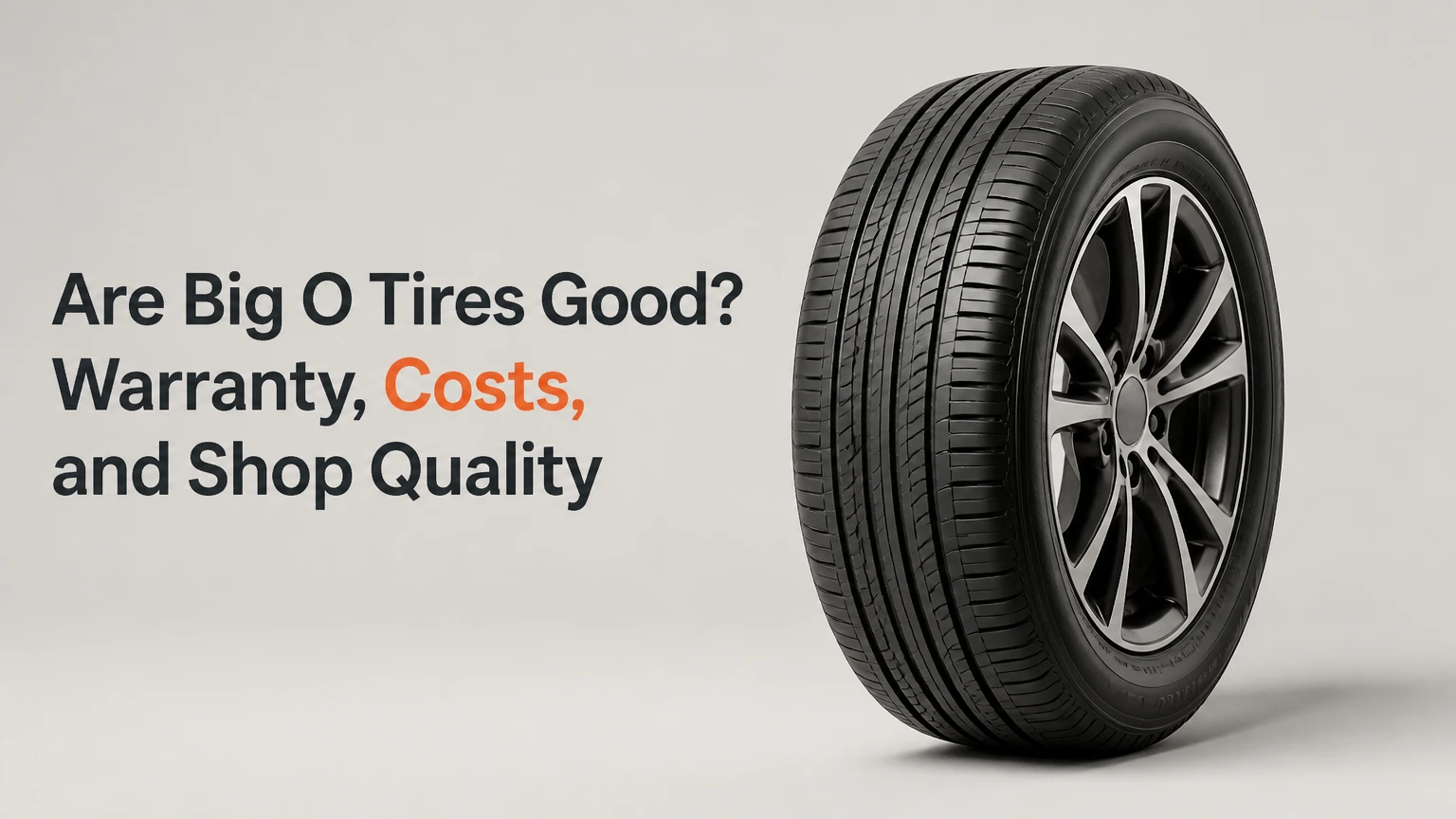
Big O Tires is a reasonable choice for budget-conscious commuters who want tires, installation, rotations, and ordinary maintenance from one local shop. Big O Tires is not automatically the best choice for every vehicle because franchise ownership creates meaningful differences in workmanship, pricing, inventory, and diagnostic skill between locations.
Key Facts at a Glance
- Big O Tires is a TBC Corporation tire and automotive-service brand founded in 1962.
- Big O stores sell Big O house-brand tires plus brands such as Michelin, Goodyear, Continental, Yokohama, and BFGoodrich.
- A typical four-tire installation takes 1-1.5 hours when the tires are in stock and the appointment starts on time.
- Typical wheel-alignment pricing is about $99-$150, while a multi-year alignment package may cost less for high-mileage drivers.
- Big O’s house-brand warranty and road-hazard terms vary by tire, location, and current policy, so the written warranty controls.
- The local franchise is the deciding factor for service quality, especially for brakes, suspension, steering, and electronic calibration.
What Is Big O Tires?
Big O Tires is a retail tire and automotive-service network with franchised and corporate-owned locations in the United States and Canada. TBC Corporation owns the brand, while individual operators generally manage the daily customer experience, staffing, equipment, pricing, and repair recommendations.
The company began in 1962 and built its identity around tire sales combined with installation and vehicle maintenance. A Big O store can typically mount and balance tires, repair eligible punctures, rotate tires, perform alignments, change oil, replace brakes, and inspect suspension components. Service menus differ by location.
That structure explains the mixed reputation. A well-managed store can provide efficient tire service and convenient warranty support, while a poorly managed store can create delays, disputed recommendations, or installation defects. National ownership does not make every branch operationally identical.
Big O Tires is best understood as a local automotive business operating under a shared brand, rather than as one uniform national workshop. The distinction matters when a customer is deciding whether to trust a store with steering, suspension, drivetrain, or electronic systems.
Are Big O Tires Good for Everyday Drivers?
Big O Tires is usually good for ordinary commuters when the chosen store has strong recent reviews, transparent estimates, and technicians who correctly match the tire to the vehicle. The strongest value comes from combining a competitive tire price with included rotations, puncture support, and convenient maintenance at one location.
A commuter driving a compact sedan 12,000 miles per year may reasonably prioritize wet braking, low noise, tread life, and a predictable installed price. That driver does not necessarily benefit from a premium performance tire or a long list of additional repairs. Big O’s house brands can fit the brief when their published specifications and warranty terms meet the vehicle’s needs.
The value calculation changes for unusual vehicles. A luxury sedan with staggered wheels, an electric vehicle with high curb weight, a sports car requiring precise alignment settings, or a truck carrying heavy loads deserves a tire and service decision based on manufacturer specifications, not a promotion alone.
Quick Verdict by Driver Type
| Driver situation | Big O verdict | Best buying condition | Main caution |
|---|---|---|---|
| Commuting sedan, 10,000-15,000 miles yearly | Often suitable | Written installed quote and four matching tires | Avoid choosing by discount alone |
| Family SUV in mild climate | Usually suitable | Touring or highway tire with correct load index | Check wet-weather and snow limits |
| Frequent highway road trips | Suitable with conditions | Road-hazard terms and accessible locations | Confirm warranty documentation |
| Performance or luxury vehicle | Conditional | Premium tire and alignment printout | Verify equipment and calibration skill |
| Severe-snow or off-road use | Store-dependent | Severe Snow rating or suitable all-terrain model | House-brand fit may be limited |
What Tires Does Big O Sell?
Big O Tires sells proprietary Big O tires alongside third-party brands, so the store is not limited to one quality tier. The correct comparison is between a specific tire model, its construction, performance category, warranty, and installed price, rather than between the Big O name and every premium tire.
Examples of Big O-branded products include the Legacy Tour Plus for passenger-car touring use and the Bigfoot A/T Three for light trucks and SUVs. Product availability, sizes, speed ratings, and current specifications must be checked for the exact vehicle.
| Tire category | Example or brand | Typical use | Selection checkpoint |
|---|---|---|---|
| House-brand touring | Big O Legacy Tour Plus | Sedans and commuter vehicles | Confirm wet grip, size, speed rating, and warranty |
| House-brand all-terrain | Big O Bigfoot A/T Three | Light trucks, SUVs, gravel roads | Confirm load range, noise, and winter limitations |
| Premium touring | Michelin, Continental | Quiet highway and wet-weather driving | Compare treadwear warranty and tested performance |
| Premium all-terrain | BFGoodrich, Yokohama | Mixed pavement, gravel, light trails | Match load index and intended terrain |
| National mainstream | Goodyear and other stocked brands | Broad everyday use | Compare model-level ratings, not logo prestige |
Are Big O House-Brand Tires Worth Buying?
Big O house-brand tires can be worth buying when the vehicle is used for routine paved-road driving, the tire has the required load and speed ratings, and the installed price is meaningfully below comparable national brands. A lower price does not automatically mean unsafe construction, but it usually involves trade-offs in noise, wet grip, tread life, or refinement.
Ask for the exact model name and size before approving the sale. The sidewall should match the vehicle placard’s dimensions and meet or exceed the required load index and speed symbol unless a qualified tire professional identifies an approved alternative.
House brands are a weaker choice for drivers who regularly encounter heavy rain, mountain snow, high-speed driving, towing, or rough roads. In those situations, a proven premium or application-specific tire may reduce stopping distance, improve control, or last longer under the actual workload.
How Much Does Big O Tires Cost?
Typical Big O pricing ranges from about $90-$160 per house-brand tire and $180-$320 or more per premium tire, before vehicle-specific fees and optional services. A complete four-tire purchase can therefore range from roughly $500 to more than $1,500 after mounting, balancing, disposal, taxes, TPMS parts, and alignment.
Prices vary with wheel diameter, tire size, regional labor rates, availability, and promotional terms. A 15-inch passenger tire and a 22-inch performance SUV tire do not represent the same cost category, even when both are described as all-season products.
| Service or purchase | Typical price range | Typical time | Main price variables |
|---|---|---|---|
| Big O house-brand tire | $90-$160 each | Stock-dependent | Size, load rating, promotion |
| Premium tire | $180-$320+ each | Stock-dependent | Brand, performance class, diameter |
| Four-tire mounting and balancing | $80-$180 total | 1-1.5 hours | Labor rate, disposal, package |
| Wheel alignment | $99-$150 | 45-60 minutes | Vehicle design and adjustment needs |
| Three-year alignment package | About $155 | Multiple visits | Store policy and covered adjustments |
| Full-synthetic oil change | $65-$90 | About 45 minutes | Oil capacity, filter, coupon |
| Rotation and rebalance | $20-$30 if purchased elsewhere | 20-40 minutes | Store policy and tire origin |
The figures above are typical planning ranges, not guaranteed quotes. Big O’s online coupons and buy-three-get-one promotions can lower the ticket, but customers should compare the final installed total against Discount Tire, Costco, an independent tire dealer, and the vehicle manufacturer’s recommended service provider.
Financing deserves separate scrutiny. A zero-interest offer only helps when the balance is paid within the promotional period and the account terms do not add deferred interest or costly fees. A discount should never justify selecting an unsuitable tire.
What Does Big O’s Warranty Cover?
Big O warranty protection can include limited treadwear coverage, workmanship protection, puncture repair, and road-hazard benefits, but the exact coverage depends on the tire model, purchase date, location, and written terms. Big O’s warranty information should be treated as the controlling document, not a salesperson’s summary.
Road-hazard protection generally addresses eligible damage caused by ordinary road debris, while workmanship coverage addresses defects connected to manufacturing or installation. Neither category normally covers every flat, curb impact, improper inflation event, collision damage, racing use, or neglected maintenance.
Prorated treadwear coverage also matters. A tire that has been substantially used may receive only partial credit based on remaining usable tread and the warranty formula. Customers should ask whether labor, mounting, balancing, taxes, and replacement disposal are included in a claim.
Big O commonly ties treadwear protection to maintenance records such as rotations performed at stated intervals. Keep invoices and inspection records. A warranty dispute becomes harder when the owner cannot show inflation checks, rotations, alignment history, and the date of the alleged failure.
Warranty Questions to Ask Before Paying
- What is covered for punctures, sidewall damage, and road debris?
- Is replacement prorated, and what tread-depth threshold applies?
- Does the warranty include mounting, balancing, disposal, and labor?
- Which rotation interval preserves treadwear eligibility?
- Can another Big O location process a claim during travel?
- What exclusions apply to underinflation, overloading, uneven wear, and alignment damage?
Is Big O Good for Alignments and Repairs?
Big O Tires is generally suitable for routine alignments, brake work, oil changes, and suspension inspections when the location has properly maintained equipment and experienced technicians. Big O Tires is a less certain choice for advanced diagnostics, ADAS calibration, electronically controlled suspension, complex drivability faults, or brand-specific programming.
A tire installation does not automatically require an alignment. Alignment is justified when the vehicle pulls, the steering wheel is off-center, suspension parts were replaced, pothole impact occurred, or tread wear indicates incorrect geometry. A shop should explain the measured condition rather than use alignment as an automatic add-on.
Request the before-and-after alignment printout. It should show camber, caster, toe, and thrust angle against the manufacturer’s allowable ranges. A green result is not enough if the steering wheel remains crooked or the vehicle still pulls.
Tire and repair equipment also varies. Ask whether the store has a modern tire changer for the wheel design, a balancing machine appropriate for the vehicle, and the scan tools needed for the proposed repair. A tire retailer can be excellent at tires without being the right diagnostic specialist.
How Should You Evaluate a Local Big O Store?
Evaluate the specific Big O franchise using recent location reviews, a written quote, equipment questions, and the shop’s response to technical questions. Local performance is more predictive than the national brand because franchise staffing, management, workload, and quality-control practices differ.
Use this five-minute screening process before booking:
- Read the newest 20-30 reviews, not only the average score.
- Search reviews for repeated terms such as vibration, alignment, scratched wheels, delays, and warranty.
- Request an itemized out-the-door quote listing tire model, size, installation, disposal, taxes, TPMS parts, and alignment.
- Ask whether the tires are physically in stock and whether the date code can be inspected.
- Ask for the alignment printout and a written explanation for recommended repairs.
- Photograph wheels, center caps, and existing damage before handing over the vehicle.
A strong store answers specific questions without pressure. A weak store cannot identify the tire model, refuses to provide measurements, or presents urgent repairs without explaining symptoms, test results, or safety consequences.
Big O Tires Compared With Alternatives
Big O Tires is strongest when one shop must handle tires and ordinary maintenance at a competitive local price. Discount Tire often has a sharper tire-service focus, Costco may offer strong member pricing and a limited service menu, and a dealership or specialist may be better for brand-specific diagnostics.
| Buying option | Tire selection | Routine service | Warranty experience | Best fit |
|---|---|---|---|---|
| Big O Tires | House brands plus national brands | Oil, brakes, alignment, suspension | Location and tire terms vary | One-stop local service |
| Discount Tire | Broad national-brand inventory | Tire-focused, limited mechanical work | Centralized tire-service model | Fast tire support |
| Costco | Selected national brands | Tire installation and limited maintenance | Membership and policy dependent | Members comparing installed price |
| Independent tire shop | Store-dependent brands | Often broad mechanical capability | Owner-managed policy | Local technical relationship |
| Dealership or specialist | OEM and premium options | Brand-specific repairs and calibration | Vehicle-specific process | Warranty or complex systems |
The comparison is not absolute. A disciplined Big O operator can outperform a disorganized independent shop, while a highly capable independent store can exceed a weak franchise. Obtain comparable installed quotes and compare the tire model, not only the retailer’s headline price.
What Can Go Wrong After Installation?
Post-installation problems usually fall into balancing, alignment, TPMS, wheel damage, or incorrect inflation categories. Most should be reported promptly because a short return interval makes it easier for the store to connect the symptom with the work performed.
| Symptom after service | Likely cause | First action | Escalation threshold |
|---|---|---|---|
| Steering vibration at 60-75 mph | Balance error, wheel runout, lost weight | Request a re-balance and road test | Persistent vibration after documented re-balance |
| Vehicle pulls left or right | Alignment, tire conicity, pressure mismatch | Check cold pressures and request printout | Pull remains after alignment verification |
| Steering wheel is off-center | Incorrect toe or steering-centering procedure | Return for alignment correction | Store cannot produce measurements |
| TPMS warning appears | Incorrect reset, sensor damage, low pressure | Verify placard pressures and request scan | Warning returns after sensor test |
| Uneven wear develops | Inflation, toe, suspension, or rotation neglect | Photograph tread and inspect records | Tread damage appears before warranty limit |
| Scratched wheel or missing cap | Handling or installation damage | Compare pre-service photos and invoice | Manager refuses documented inspection |
A highway vibration is not normal after new tires. The store should check tire seating, wheel balance, wheel runout, and lug-nut torque rather than simply increase tire pressure. A persistent pull may originate from a tire’s conicity, road crown, brake drag, or worn suspension, so alignment values alone may not explain it.
Do not continue driving at highway speed if a tire has a bulge, exposed cord, severe pressure loss, or suspected loose lug nuts. Those conditions require immediate inspection.
What Are the Most Common Big O Buying Mistakes?
The most expensive mistakes occur when shoppers compare promotions instead of complete specifications and when they accept repairs without measurements. Four practices reduce most avoidable disputes.
Choosing the cheapest tire without checking specifications
Confirm size, load index, speed rating, construction, season designation, and vehicle application. A cheap tire that does not suit towing, snow, high-speed travel, or an EV’s axle load is a poor value.
Assuming an alignment is always required
Ask for the measured reason. New tires can reveal existing wear, but installation alone does not prove damaged alignment geometry.
Ignoring maintenance records
Warranty protection may require rotations, pressure maintenance, and documented inspections. Store invoices in one folder and record tread depth when uneven wear appears.
Comparing only the advertised tire price
Compare the final total. TPMS service kits, disposal, road-hazard coverage, alignment, taxes, and labor can change the apparent winner by $100 or more per vehicle.
Expecting national consistency
A high-rated branch and a low-rated branch can operate under the same brand. Reviews should be recent, location-specific, and detailed enough to reveal how the store handles comebacks and warranty claims.
Which Big O Services Are Best for Different Drivers?
Big O Tires is a strong candidate for a commuter or road-tripper who values bundled tire maintenance, provided the local franchise documents its work. A performance owner, snow-belt driver, or complex-repair customer should place tire category and technical competence ahead of convenience.
Choose Big O when
- The store offers a competitive installed price for the exact tire model.
- Reviews repeatedly mention accurate balancing and straightforward warranty handling.
- You want rotations, puncture support, alignment, and basic maintenance together.
- The house-brand tire meets the vehicle’s load, speed, climate, and mileage requirements.
- The store can provide measurements for alignment or repair recommendations.
Consider another provider when
- The vehicle needs ADAS calibration, specialized programming, or unusual suspension work.
- The store cannot provide a tire model, written quote, or alignment results.
- Repeated reviews describe the same unresolved vibration or damage issue.
- You need a rare tire size that another retailer has in stock sooner.
- A dealer or specialist has a stronger record with the vehicle’s specific system.
FAQ
Do Big O Tires install tires purchased elsewhere?
Some Big O locations install customer-supplied tires, but policies, labor prices, disposal fees, and warranty coverage vary. Ask for the complete installation price before transporting the tires. A store may provide balancing and mounting without extending its standard tire-purchase benefits to products bought elsewhere.
Does Big O Tires price match online retailers?
Price-matching rules vary by location and promotion. Request a written comparison using the identical brand, model, size, speed rating, load index, shipping cost, installation fee, and warranty. An online tire price without installation is not an equivalent quote.
How long do Big O house-brand tires last?
Expected life depends on the model, alignment, inflation, rotation frequency, climate, load, and driving style. Use the model’s published treadwear warranty as a planning reference, not a guarantee. Replace tires at the legal or manufacturer safety threshold, regardless of the mileage estimate.
Are Big O Tires good in snow?
Big O Tires can supply suitable winter, all-season, or all-terrain products, but the store name does not determine snow performance. Drivers in severe winter conditions should check for the Three-Peak Mountain Snowflake symbol and select a tire designed for repeated snow and ice exposure.
Should I buy the Big O alignment package?
The package can make financial sense for drivers expecting several alignments over its coverage period, especially on pothole-heavy roads. Compare the package price with the store’s individual alignment rate and verify what adjustments, inspections, and vehicle exclusions the plan actually includes.
Can Big O repair a flat tire for free?
Eligible puncture repairs may be free under the tire’s protection plan or store policy, but sidewall damage, oversized punctures, run-flat limitations, improper previous repairs, and tires purchased elsewhere may be excluded. Do not drive on a visibly flat tire because internal damage can make repair unsafe.
The Bottom Line
Are Big O Tires good? Big O Tires is a good practical option when a specific local store provides a competitive installed quote, sells the right tire for the vehicle, documents alignment measurements, and explains warranty conditions clearly. The brand is less dependable as a blanket recommendation because franchise execution varies.
Choose the house brand for ordinary commuting only after checking specifications and total cost. Choose a premium tire for demanding rain, snow, highway, towing, or performance use when its added capability matches your driving. Before paying, confirm the tire model, out-the-door price, warranty exclusions, maintenance requirements, and return process. Those details determine whether Big O Tires is genuinely good for your vehicle.