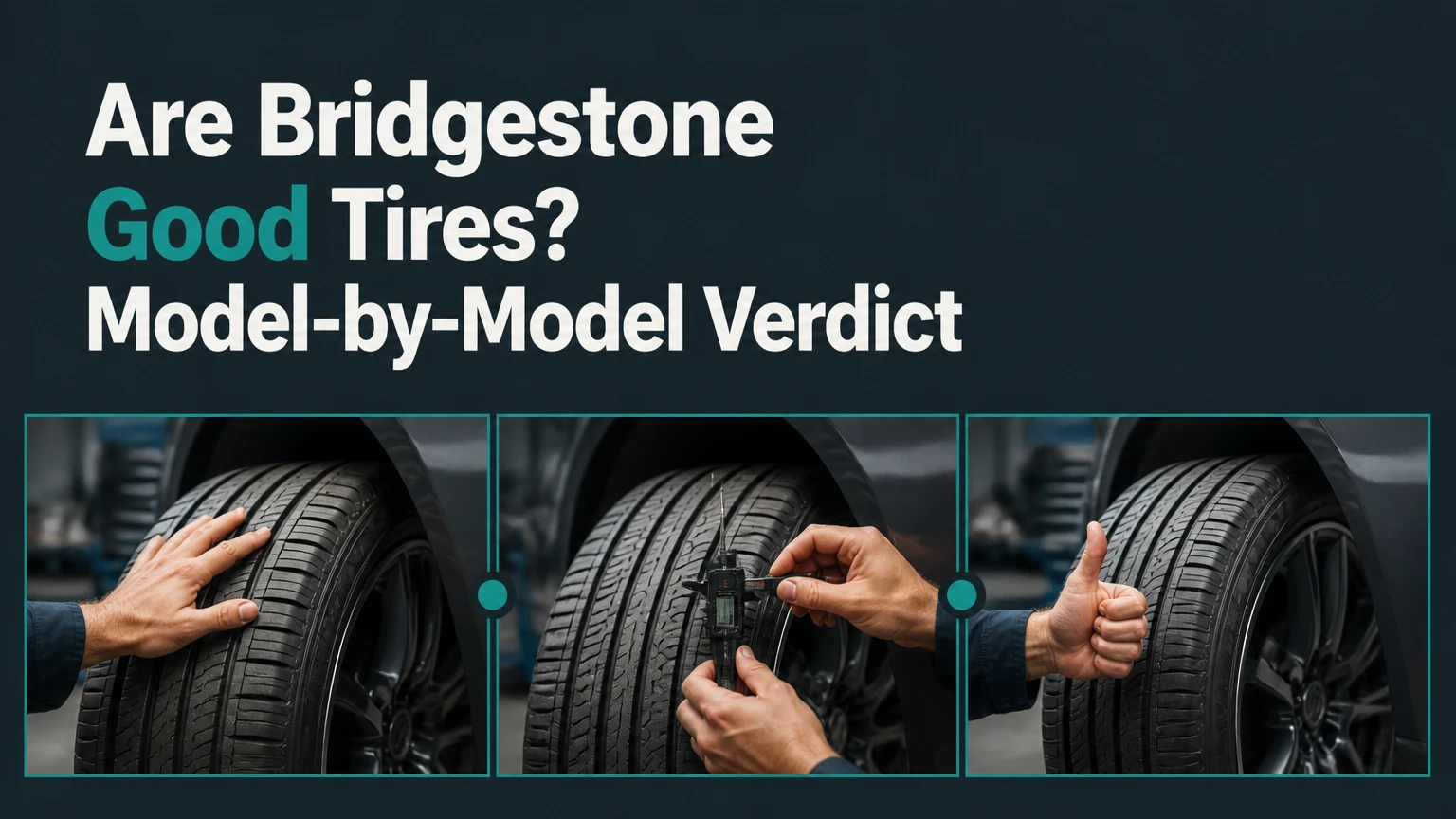
Yes, Bridgestone makes good tires, and many models belong in the premium tier. Bridgestone is especially strong in winter traction, original-equipment fitments, performance tires, and truck applications, but quality is not identical across every product. The correct verdict depends on the specific model, vehicle, climate, road surface, and price.
Key Facts at a Glance
- Bridgestone is a premium tire manufacturer, but a premium brand does not make every model best in every category.
- Blizzak winter tires are designed for freezing conditions, snow, and ice, while standard all-season tires have more limited cold-weather grip.
- Bridgestone treadwear warranties commonly range from approximately 40,000 to 80,000 miles, depending on model and fitment.
- A tire’s load index, speed rating, OE specification, and size must match the vehicle manufacturer’s requirements.
- Typical Bridgestone retail pricing runs from about $100-$150 for small passenger sizes to $250-$380 or more for large truck and SUV sizes.
- Tire pressure, alignment, rotation, vehicle weight, and driving style can change real-world service life more than the brand name.
Are Bridgestone Good Tires for Your Car?
Bridgestone tires are a strong choice when the selected model matches the vehicle and driving conditions. The brand’s clearest advantages are winter products such as Blizzak, performance products such as Potenza, and many touring and truck products developed for specific original-equipment applications.
Bridgestone is not automatically the best value. Some Michelin and Continental competitors deliver a quieter ride or stronger wet braking for similar applications, while Hankook, General, and Kumho can reduce purchase cost. Independent rankings also vary because they evaluate different models, sizes, and performance categories rather than one universal Bridgestone specification.
The practical answer is simple: buy a particular Bridgestone model for a defined need, not merely because the sidewall says Bridgestone. A Turanza suited to a commuter sedan should not be judged by the same criteria as a Potenza Sport, Dueler all-terrain tire, or Blizzak snow tire.
Why Does Bridgestone Have a Strong Reputation?
Bridgestone has a strong reputation because the company develops tires for narrow applications, supplies original equipment to vehicle manufacturers, and invests in rubber compounds, casing design, testing, and rolling-resistance reduction. Original-equipment approval means a tire has met the vehicle maker’s requirements for that specific fitment, although it does not prove that every replacement model is superior.
A modern pneumatic tire contains rubber compounds, fabric, steel belts, bead materials, inner liners, and other components. Bridgestone’s NanoPro-Tech process is intended to control interaction between polymers and silica, while ENLITEN is a design and manufacturing approach focused on lower mass and reduced rolling resistance. Those technologies can support efficiency and handling, but they do not eliminate compromises between grip, comfort, noise, durability, and price.
NHTSA’s tire-safety guidance uses a useful practical description: “Tires are the only thing connecting your vehicle to the road.” That connection makes correct size, inflation, condition, and replacement timing more important than a brand badge.
What Do Bridgestone Technologies Actually Change?
| Technology or construction | Intended engineering effect | Driver-visible consequence | Important limitation |
|---|---|---|---|
| NanoPro-Tech | More controlled silica and polymer interaction | Potentially improved wet grip and rolling efficiency | Compound benefits vary by model and temperature |
| ENLITEN | Lower tire mass and rolling resistance | Possible efficiency gain and reduced rotating weight | Not available in every product or market |
| Run-flat sidewall | Supports limited travel after pressure loss | Mobility after a puncture, often up to 50 miles at 50 mph under conditions | Firmer ride, higher cost, and vehicle compatibility requirements |
| Steel belt package | Stabilizes tread and contact patch | Better high-speed control and wear consistency | Added mass and stiffness can affect comfort |
| Multicell winter compound | Creates microscopic voids and flexible cold-weather grip | Improved traction on ice and packed snow | Winter compounds wear faster in warm weather |
Technology names describe engineering objectives, not guaranteed results. A lower rolling-resistance tire may sacrifice some steering response, while a reinforced run-flat tire may transmit more impact harshness through the suspension.
Which Bridgestone Model Fits Your Driving?
The best Bridgestone model depends on the vehicle category and the dominant road condition. Potenza prioritizes handling, Turanza emphasizes touring comfort, Alenza targets crossovers and SUVs, Dueler covers truck and utility use, Blizzak handles severe winter conditions, and Ecopia focuses on efficiency.
| Bridgestone family | Typical application | Notable examples | Main strength | Main compromise |
|---|---|---|---|---|
| Potenza | Sports cars and performance sedans | Potenza Sport, RE980AS | Dry steering response and cornering | Faster wear, firmer ride, higher cost |
| Turanza | Sedans and grand-touring cars | QuietTrack, EverDrive | Highway comfort and noise control | Less aggressive handling than Potenza |
| Alenza | Crossovers and luxury SUVs | Alenza AS Ultra, Alenza Plus | Refined road manners and SUV fitment | Premium price and limited off-road ability |
| Dueler | Pickups, SUVs, and utility vehicles | A/T Ascent, H/L Alenza | Load support and mixed-road capability | All-terrain patterns can add noise |
| Blizzak | Snow, ice, and freezing climates | WS90, DM-V2 | Cold-weather traction | Seasonal storage and replacement cost |
| Ecopia | Efficiency-oriented daily driving | Ecopia EP422 Plus | Low rolling resistance | Handling and winter grip are not the primary goals |
Are Turanza Tires Good for Daily Driving?
Turanza tires are good for drivers who prioritize quiet highway travel, predictable all-season behavior, and long tread life over sharp cornering. Touring models such as Turanza QuietTrack are commonly offered with long mileage warranties, with some applications advertised around 80,000 miles.
Warranty mileage is a conditional maximum, not a promise that every set will reach that distance. Urban braking, underinflation, misalignment, heavy vehicles, and infrequent rotations can shorten service life substantially. Turanza is a sensible sedan choice when the vehicle’s placard size and the model’s load rating match.
Are Potenza Tires Good for Performance Driving?
Potenza tires are good for dry-road handling, steering precision, and high-speed stability. Potenza Sport is aimed at drivers who accept more tread noise, a firmer ride, and faster wear in exchange for stronger cornering behavior.
Ultra-high-performance tires are often a poor choice for an ordinary commuter that encounters frequent snow, rough pavement, or long highway mileage. Potenza models can also cost more than grand-touring tires and may have shorter treadwear warranties. Performance tires should be selected by speed rating, wet performance, temperature range, and actual driving behavior rather than appearance.
Are Dueler and Alenza Tires Good for SUVs?
Dueler and Alenza tires are good SUV choices when the vehicle spends most of its time on paved roads and the buyer selects the correct load capacity. Alenza products generally favor road comfort and highway refinement, whereas Dueler all-terrain products provide more traction on gravel, dirt, and light mud.
Neither family turns a crossover into a dedicated off-road vehicle. Drivers who regularly encounter deep mud, rocks, or severe trails need a tire with an appropriate all-terrain or mud-terrain design, sidewall protection, and load rating. Large SUVs and pickups also generate more heat and shoulder stress, which can make alignment and pressure checks especially important.
How Do Bridgestone Tires Compare With Rivals?
Bridgestone competes most directly with Michelin, Continental, Goodyear, Pirelli, Hankook, General, and Kumho. No universal brand ranking settles the comparison because tire tests measure different sizes and categories; a winter test, a wet-braking test, and a comfort survey reward different designs.
| Brand or family | Strongest typical area | Common alternative to | Typical price position | Best buyer fit |
|---|---|---|---|---|
| Bridgestone Blizzak | Snow and ice traction | Michelin X-Ice, Continental VikingContact | Premium, about $150-$280 per tire | Drivers facing regular winter conditions |
| Bridgestone Turanza | Touring comfort and mileage | Michelin Defender, Continental PureContact | Premium, about $140-$250 | Sedan and highway commuters |
| Bridgestone Potenza | Dry performance | Michelin Pilot Sport, Continental ExtremeContact | Premium, about $180-$350 | Enthusiasts and performance cars |
| Hankook Kinergy or Ventus | Value with balanced performance | Mid-priced Bridgestone touring or performance models | Mid-tier, about $110-$220 | Buyers balancing cost and capability |
| General Altimax or Grabber | Lower purchase price | Bridgestone commuter or SUV models | Value, about $100-$200 | Budget-focused drivers |
| Goodyear Assurance or Wrangler | Broad North American coverage | Turanza or Dueler products | Mid-to-premium, about $130-$280 | Drivers prioritizing local availability |
Michelin often wins buyer comparisons for ride refinement, wet-road balance, and broad product consistency, but its advantage depends on the exact tire. Continental frequently performs strongly in wet braking and handling. Bridgestone can be the better choice for severe winter traction, a specific OE fitment, or a truck application where the Dueler design fits the vehicle’s use.
How Do Bridgestone Tires Perform in Rain?
Bridgestone tires can perform very well in rain when the tread design, compound, and remaining tread depth suit the vehicle. Wide grooves evacuate water, sipes create additional edges, and the contact patch maintains traction, but worn tread and incorrect pressure can overwhelm those design advantages.
Wet performance differs sharply between a Potenza performance tire, a Turanza touring tire, and an Ecopia efficiency tire. A driver should compare independent wet-braking results for the exact size whenever available instead of accepting a brand-wide claim. Hydroplaning risk also rises with speed, standing water, worn grooves, and uneven wear.
A practical replacement threshold is 2/32 inch of tread for legal minimum in many United States jurisdictions, but wet-weather performance can decline before that point. Drivers who regularly face heavy rain should replace tires earlier if braking confidence, groove depth, or visible wear has deteriorated.
Is All-Season the Same as All-Weather?
All-season and all-weather tires are different categories. A conventional all-season tire is designed for moderate conditions and may lose flexibility in sustained cold, while an all-weather tire carries the Three-Peak Mountain Snowflake, or 3PMSF, symbol after meeting a standardized severe-snow traction test.
The familiar 7°C, or 45°F, threshold is a useful rule of thumb for when winter compounds begin to offer an advantage, not a legal cutoff or universal physical switch. Blizzak winter tires remain preferable for frequent ice, packed snow, and prolonged temperatures below freezing because their compounds and tread designs target those conditions.
| Tire category | 3PMSF marking | Typical temperature role | Snow and ice ability | Warm-weather trade-off |
|---|---|---|---|---|
| Standard all-season | Usually no | Above approximately 45°F | Light snow only | Balanced wear and comfort |
| All-weather | Yes | Year-round moderate climates | Better severe-snow capability | More noise and wear than touring all-season |
| Dedicated winter | Yes | Repeated freezing conditions | Highest cold, snow, and ice traction | Must be removed in warm seasons |
| Summer performance | No | Warm weather above approximately 45°F | Poor in snow and cold | Strong dry and wet warm-weather grip |
Bridgestone’s WeatherPeak and newer regional all-weather offerings should be checked by market and current catalog because names, sizes, and successor products change. The sidewall symbol matters more than the marketing category.
Are Bridgestone Tires Suitable for Electric Vehicles?
Bridgestone tires can suit electric vehicles when the tire has the correct load index, speed rating, dimensions, and vehicle approval. EVs can accelerate tread wear because battery mass increases vehicle weight and instant motor torque places greater stress on the tread and shoulders.
ENLITEN and low-rolling-resistance designs may support range efficiency, but efficiency should not override load capacity or wet traction. EV-specific markings are not universal across all Bridgestone products, and the vehicle manufacturer’s approved fitment remains the primary reference.
Heavy EVs also magnify small maintenance errors. A tire that loses several pounds per square inch, carries excessive toe misalignment, or runs on rough urban roads can develop shoulder wear far sooner than its mileage warranty suggests. Rotate according to the vehicle manual, inspect tread regularly, and avoid assuming an 80,000-mile warranty predicts EV service life.
How Much Do Bridgestone Tires Cost?
Typical Bridgestone retail pricing is approximately $100-$150 per tire for small passenger sizes, $150-$250 for many sedan and crossover sizes, and $250-$380 or more for large truck, SUV, run-flat, and performance fitments. A complete installed set can cost roughly $500-$1,700 before taxes, disposal fees, alignment, and optional protection plans.
| Vehicle and tire type | Typical tire price | Typical four-tire cost | Common added charges |
|---|---|---|---|
| Compact car, 14-16 inch | $100-$150 | $400-$600 | $80-$160 installation and disposal |
| Sedan or CUV, 17-19 inch | $150-$250 | $600-$1,000 | $100-$220 installation and alignment |
| Performance sedan, 18-20 inch | $180-$350 | $720-$1,400 | $120-$280 mounting and balancing |
| Pickup or large SUV, 20-22 inch | $250-$380+ | $1,000-$1,520+ | $140-$300 installation and disposal |
| Dedicated winter package | $150-$280 | $600-$1,120 | $80-$200 seasonal change or storage |
Prices vary by tire size, regional inventory, rebates, run-flat construction, OE specification, retailer, and installation package. Compare the complete invoice rather than the advertised tire price, especially when a vehicle needs TPMS service, road-hazard coverage, or a four-wheel alignment.
How Long Do Bridgestone Tires Last?
Bridgestone tires commonly last about 40,000-80,000 miles in touring applications, while performance, winter, all-terrain, and run-flat products often provide shorter usable mileage. Calendar age matters too: Bridgestone recommends replacing tires at 10 years from manufacture at the latest, with inspection by a qualified professional after five years.
Many tire specialists recommend earlier retirement when rubber shows cracking, bulges, repeated puncture damage, vibration, or severe uneven wear. A six-year replacement policy is conservative and may be required by a fleet, vehicle manufacturer, or retailer, but it is not a universal federal rule in the United States.
| Factor | Typical effect on life | What to inspect or change |
|---|---|---|
| Underinflation | Faster shoulder wear and heat buildup | Check cold pressure monthly |
| Misalignment | Feathering, cupping, or one-sided wear | Measure alignment after impact or uneven wear |
| Heavy EV or SUV | Higher load and shoulder stress | Use approved load index and rotate regularly |
| Potenza performance use | Faster tread loss under hard cornering | Track tread depth, not warranty alone |
| Blizzak used in summer | Rapid compound wear | Remove when temperatures stay warm |
| Long storage or age | Cracking and oxidation risk | Read DOT date and inspect sidewalls |
The DOT code on the sidewall identifies the week and year of manufacture. For example, “2524” means the tire was made in the 25th week of 2024. New tread does not erase age.
What Should You Check Before Purchase?
Confirm the vehicle placard size, load index, speed rating, OE marking, construction type, and intended season before paying for Bridgestone tires. A tire can fit the wheel physically and still be unsuitable because its load capacity, diameter, speed rating, or rolling circumference differs from the vehicle requirement.
Use this purchase sequence:
- Read the driver-door placard and owner’s manual.
- Match the complete size, including XL or reinforced construction.
- Confirm front and rear specifications on staggered vehicles.
- Decide whether standard all-season, 3PMSF all-weather, summer, or winter traction fits the climate.
- Compare installed prices, warranty terms, return policies, and DOT dates.
- Request professional mounting, balancing, valve inspection, and TPMS verification.
- Recheck cold pressure after installation and again after the first 50-100 miles.
Do not mix different tire models across an axle unless the vehicle manufacturer and tire installer approve the combination. All-wheel-drive vehicles can be especially sensitive to rolling-circumference differences, so replacing only two tires may require matching tread depth or replacing all four.
Why Do Bridgestone Tires Become Noisy?
Bridgestone tires that develop a humming, thumping, or rhythmic noise often have cupping, feathering, imbalance, alignment error, or worn suspension components rather than a simple tread-noise defect. Inspect the tread by running a hand across the blocks, then check pressure, balance, alignment, wheel bearings, shocks, and bushings.
Cupping produces alternating high and low patches around the circumference. Feathering creates tread blocks that feel smooth in one direction and sharp in the other. Both conditions can increase road noise even when substantial tread remains.
A tire shop should measure tread depth at several points, inspect inner shoulders, and road-test the vehicle. Rotating a damaged tire may move the noise without fixing its cause. Continuing to drive with severe vibration or a bulge is unsafe and requires immediate inspection.
When Are Blizzak Winter Tires Worth Buying?
Blizzak winter tires are worth buying when a driver regularly encounters snow, ice, freezing rain, or temperatures near freezing, particularly on untreated roads. Blizzak WS90 targets passenger cars, while DM-V2 is designed for many SUVs and light trucks, but exact sizing and fitment must be verified.
Dedicated winter tires use flexible cold-weather compounds and dense siping that remain more compliant than ordinary all-season rubber in low temperatures. They still require conservative speeds, adequate following distance, and proper pressure because no tire can eliminate ice-related stopping risk.
Blizzaks are usually a poor choice for year-round use in hot climates. Warm pavement accelerates wear, and winter tread can feel less precise during summer braking and cornering. A second wheel set can reduce seasonal mounting costs and protect both tire sets.
What Is Bridgestone Not Good For?
Bridgestone is not automatically the best choice for buyers seeking the lowest price, maximum off-road performance, or the quietest ride in every vehicle category. Premium construction can cost substantially more than General, Kumho, or Hankook alternatives, while a performance Potenza may be unnecessarily harsh for a family sedan.
Bridgestone also cannot compensate for a defective suspension, bent wheel, neglected rotation schedule, or chronic underinflation. Mileage warranties exclude many causes of premature wear and usually require documented maintenance. Read the warranty conditions before treating the mileage figure as a financial guarantee.
An experienced rule of thumb is to spend more on the tire category that controls your greatest risk. A snow-belt driver should prioritize winter traction, while a mild-climate highway commuter may gain more from quietness and wear than from maximum cornering grip.
How Should You Maintain Bridgestone Tires?
Maintain Bridgestone tires by checking cold inflation monthly, rotating at the vehicle manufacturer’s interval, inspecting tread and sidewalls, and correcting alignment after pothole impacts or abnormal wear. Pressure should be set to the vehicle placard specification, not the maximum pressure molded into the tire sidewall.
Check these conditions during routine inspection:
- Measure tread depth across inner, center, and outer grooves.
- Look for cuts, bulges, exposed cords, cracks, and embedded objects.
- Confirm the TPMS warning light remains off after startup.
- Rotate tires only in the pattern permitted by the tread direction and vehicle drivetrain.
- Have vibration, pulling, or new noise diagnosed rather than masked by rotation.
- Replace tires with visible structural damage, even when tread remains.
Directional tires must rotate in the arrow direction. Asymmetric tires require the sidewall marked “OUTSIDE” to face outward. Incorrect installation can reduce water evacuation and handling stability.
FAQ
Are Bridgestone tires better than Michelin?
Neither brand wins every category. Michelin often receives strong marks for ride quality, wet-road balance, and broad touring performance, while Bridgestone has a particularly strong reputation for Blizzak winter tires, selected performance products, and certain truck or OE applications. Compare the exact models in the correct size, not the logos alone.
Are Bridgestone tires made in the United States?
Bridgestone manufactures tires in multiple countries, including the United States and other global production locations. The plant of origin varies by model and size. Read the sidewall for country-of-origin information, and judge the tire by its specification, date code, warranty, and fitment rather than assuming every Bridgestone tire comes from one factory.
Can I repair a Bridgestone run-flat tire?
A Bridgestone run-flat may or may not be repairable, depending on the puncture location, damage, distance driven without pressure, and manufacturer or retailer policy. Run-flat sidewalls can hide internal damage after pressure loss. Have the tire removed and inspected by a qualified technician instead of relying on an external plug.
Should I replace two Bridgestone tires or all four?
Replace all four tires when tread-depth differences could affect an all-wheel-drive system or when the remaining pair is substantially worn. Replacing two may be acceptable on some two-wheel-drive vehicles if the new tires are installed on the rear axle and the vehicle manufacturer permits it. Follow the owner’s manual and installer’s recommendation.
Do Bridgestone tires include a mileage warranty?
Many Bridgestone touring and passenger tires include limited treadwear warranties, but coverage varies by model, size, speed rating, and region. Performance and winter tires usually carry lower mileage expectations than touring products. Warranty claims commonly require proof of purchase, regular rotation, correct inflation, and even wear.
How do I know which Bridgestone tire size I need?
Use the vehicle’s door-jamb placard and owner’s manual as the primary sources for tire size, load index, speed rating, and inflation pressure. The current sidewall can confirm the existing specification, but it should not override the vehicle manufacturer if a previous owner installed an incorrect tire.
The Bottom Line
Are Bridgestone good tires? Yes, Bridgestone makes many excellent tires, but the model must fit the driving problem. Choose Blizzak for recurring severe winter conditions, Turanza for quiet sedan travel, Potenza for performance handling, Alenza for refined crossover use, and Dueler for suitable truck and mixed-road applications.
Compare the installed price, independent test results, treadwear warranty, DOT date, load rating, and climate performance before buying. Bridgestone is a credible premium choice, not a universal guarantee of the quietest ride, longest life, or lowest ownership cost.


