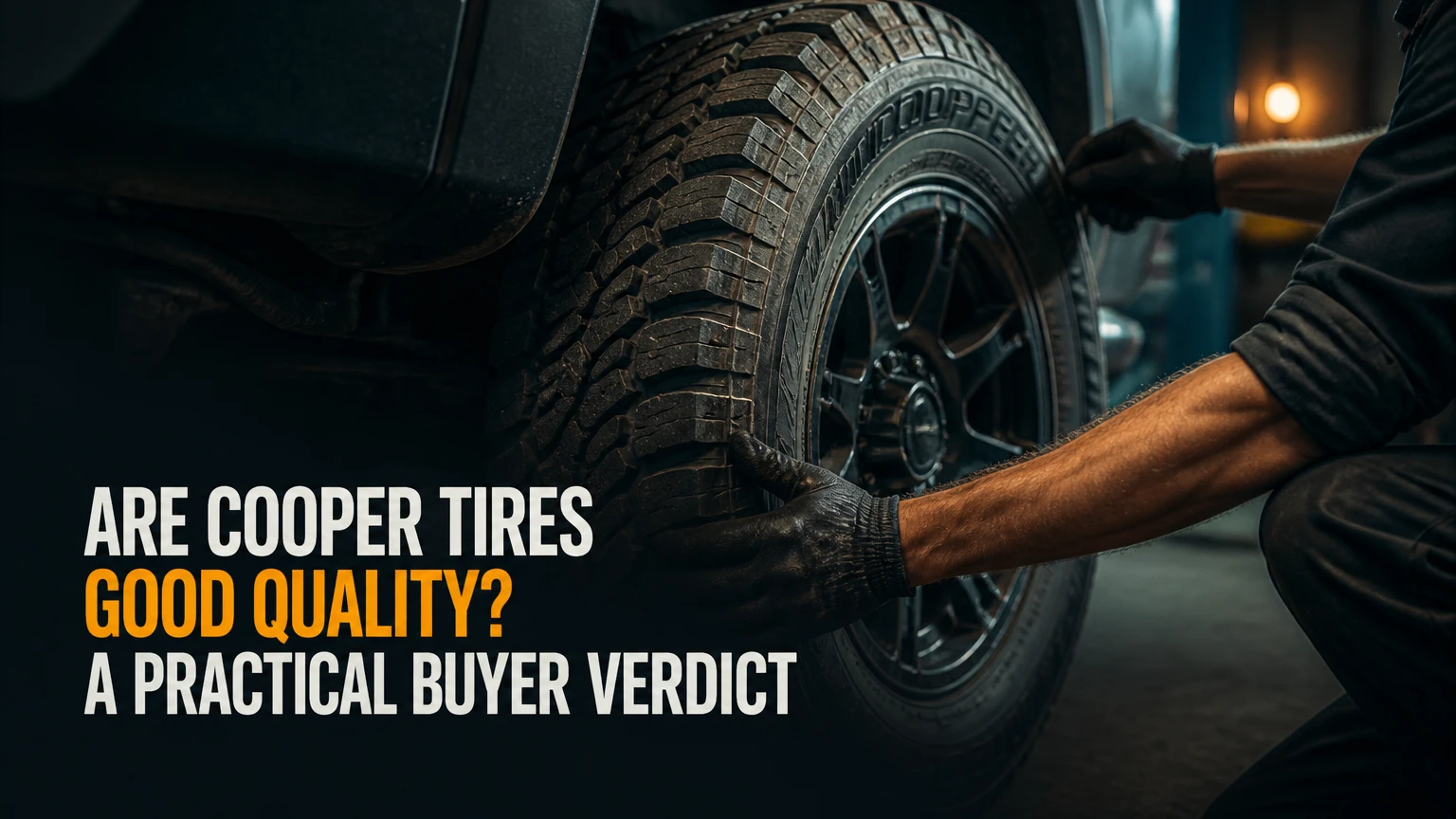
Cooper Tires are generally good-quality mid-range tires that provide dependable commuting, highway, SUV, and light-truck performance without premium-brand pricing. Cooper is not consistently the quietest, longest-lasting, or best-performing option in every category, but the right model can deliver strong value when its size, load rating, climate rating, and intended use match the vehicle.
Key Facts at a Glance
Cooper Tires has operated since 1914 and became part of Goodyear in 2021.
Cooper occupies the value-to-mid-tier market, between low-cost private labels and premium brands such as Michelin and Continental.
Typical retail pricing is approximately $80-$250 per tire before installation, depending on size, construction, and model.
Cooper treadwear warranties commonly range from about 45,000 to 80,000 miles, but coverage varies by product and terms.
A standard all-season tire is not a substitute for a severe-snow-rated winter or all-weather tire.
Correct inflation, rotation, alignment, load rating, and tire age can affect safety more than small differences between reputable brands.
What Quality Level Are Cooper Tires?
Cooper Tires are a credible mid-tier brand, with the strongest value appearing in mainstream all-season, all-terrain, and light-truck applications. Cooper usually costs less than Michelin, Continental, or Bridgestone while offering more established engineering and warranty support than many budget-label tires.
Quality is not a single brand-wide measurement. Tire quality includes wet braking, dry handling, ride comfort, noise, tread longevity, casing strength, winter traction, manufacturing consistency, and warranty support. A Cooper Discoverer all-terrain tire and a Cooper Evolution passenger tire solve different problems, so one cannot fairly represent the entire catalog.
Goodyear completed its acquisition of Cooper in 2021. That ownership gives Cooper access to a larger corporate distribution and development network, but Cooper remains a distinct brand with its own product positioning and model names. Buyers should still compare the exact tire model, not assume that Goodyear and Cooper tires perform identically.
The National Highway Traffic Safety Administration states that “tires are the only part of your vehicle that makes contact with the road.” That principle explains why fitment and condition matter: a well-chosen Cooper tire at the correct pressure can outperform a premium tire that is incorrectly sized, overloaded, worn, or unsuitable for the climate.
How Do Cooper Tires Work?
Cooper Tires use tread grooves to evacuate water, sipes to create biting edges, rubber compounds to balance grip and wear, and internal belts to maintain shape under load. The contact patch changes with inflation pressure, vehicle weight, speed, temperature, and steering input.
Passenger tires commonly contain an inner liner, casing plies, steel belts, bead components, sidewalls, and a tread package. During production, rubber compounds are mixed, shaped through extrusion, assembled with textile and steel reinforcement, cured in a mold, and inspected for defects. Those steps are standard across modern tire manufacturing, although the compound formulas, mold designs, reinforcement packages, and quality-control procedures differ by model.
Groove design matters most on wet roads. Wide circumferential channels move standing water away from the contact patch, while lateral grooves and sipes help maintain road contact. Sipes also support light snow traction, but numerous sipes do not automatically make an all-season tire suitable for packed snow or ice.
The internal structure determines how a tire carries weight and responds to steering. A higher load range or reinforced construction can help a pickup carry cargo, but it may also produce a firmer ride. A driver should never select a tire solely by diameter because load index, speed rating, rim width, sidewall construction, and vehicle clearance also affect safe fitment.
Which Cooper Tire Families Fit Different Drivers?
The best Cooper tire depends on the vehicle and operating conditions, not the Cooper name alone. Evolution and ProControl products generally target cars and crossovers, Discoverer products cover SUVs and trucks, Zeon products target performance driving, and True North targets winter conditions.
| Cooper family or model | Intended vehicle | Typical strength | Main limitation |
|---|---|---|---|
| Evolution Tour | Sedan, compact crossover | Quiet daily commuting and fuel-conscious use | Limited severe-snow capability |
| ProControl | Sedan, crossover, touring vehicle | Balanced wet handling and highway wear | Less suited to aggressive off-road use |
| Discoverer AT3 | Pickup, SUV, crossover | Mixed pavement, gravel, and moderate trails | More tread noise than touring tires |
| Discoverer STT Pro | Truck and serious off-road vehicle | Mud, rocks, and loose terrain | Reduced on-road refinement and fuel economy |
| Zeon RS3-G1 | Sport sedan and performance crossover | Dry cornering and steering response | Winter and ride comfort are secondary |
| Discoverer True North | Car, crossover, and SUV in winter regions | Snow and cold-weather traction | Seasonal use may require a second tire set |
Product names and availability vary by market and vehicle size. The Discoverer AT3 is not one universal tire, either: versions such as the AT3 4S, AT3-XLT, and AT3 LT have different construction and load applications. Confirm the complete model name before comparing reviews or warranties.
Are Cooper Tires Good for Daily Commuting?
Cooper Tires are good for daily commuting when the buyer prioritizes reasonable cost, predictable wet handling, and long warranty mileage over the quietest ride. A touring-oriented model such as the Evolution Tour or ProControl is usually a better commuter choice than an aggressive all-terrain tire.
A commuter should compare the tire’s UTQG rating, warranty, wet-grip reviews, rolling resistance, replacement cost, and noise. The Uniform Tire Quality Grading treadwear number is a relative comparison within a manufacturer’s testing framework; it is not a mileage promise. A 700 treadwear rating does not guarantee 70,000 miles.
Short trips can create a different wear pattern from highway driving. Frequent cold starts, tight turns, potholes, and neglected pressure checks can reduce service life even when annual mileage is low. For a vehicle that travels 12,000 miles annually, a properly maintained 60,000-mile tire might provide roughly four to five years of use, but age, climate, alignment, and tread depth can end service sooner.
Are Cooper Tires Good for Trucks and SUVs?
Cooper Tires are often a strong value for trucks and SUVs, especially when the vehicle spends time on pavement, gravel, work roads, or moderate trails. Discoverer all-terrain models offer more sidewall and surface versatility than passenger touring tires, while LT-rated versions are designed for heavier loads and harsher service.
The trade-off is measurable in use. An all-terrain tire typically produces more tread noise and rolling resistance than a highway-terrain tire, and a mud-terrain design can reduce wet-road braking and fuel economy further. A half-ton pickup used for commuting and occasional camping may suit an all-terrain tire, while a heavily loaded work truck may require an LT tire with an appropriate load range.
Never replace a truck’s original LT tire with a lighter passenger tire merely because the dimensions match. The replacement must meet or exceed the vehicle manufacturer’s load and speed requirements, and towing pressure should follow the vehicle placard or owner’s manual rather than a generic internet recommendation.
How Much Do Cooper Tires Cost?
Cooper Tires typically cost about $80-$250 per tire before mounting, balancing, disposal fees, taxes, and alignment. A complete set commonly reaches $450-$1,200 installed, with large truck sizes, run-flat construction, and premium all-terrain designs occupying the upper end.
| Use case | Typical Cooper price per tire | Typical installed set | Common warranty range |
|---|---|---|---|
| Compact-car touring | $80-$125 | $380-$600 | 45,000-65,000 miles |
| Sedan or crossover touring | $105-$170 | $480-$760 | 60,000-80,000 miles |
| SUV all-season | $130-$210 | $600-$950 | 50,000-65,000 miles |
| Light-truck all-terrain | $160-$250 | $750-$1,150 | 45,000-65,000 miles |
| Performance or winter fitment | $140-$250 | $650-$1,200 | 35,000-50,000 miles |
These are typical retail ranges, not fixed Cooper prices. Tire size, local inventory, seasonal promotions, installation packages, and regional taxes can change the final invoice. The cheapest quote can also omit road-hazard protection, valve stems, TPMS service, disposal, or alignment.
Cooper warranties generally cover workmanship and materials for a defined period, while treadwear warranties set a prorated expectation under specified conditions. Warranty claims can be reduced by irregular rotation, improper inflation, misalignment, uneven wear, commercial use, mismatched tires, or insufficient maintenance records.
How Long Do Cooper Tires Last?
Cooper Tires commonly last about four to six years in ordinary service, while the mileage outcome may range from roughly 40,000 to 80,000 miles depending on model and maintenance. A treadwear warranty indicates the product’s intended wear category, not a guaranteed replacement date.
The five-year point deserves particular attention because rubber ages even when a vehicle is driven lightly. Heat, ultraviolet exposure, ozone, underinflation, long storage, and repeated loading accelerate aging. Many tire manufacturers and industry organizations recommend professional inspection once tires reach five years and replacement around ten years from manufacture, regardless of remaining tread, unless a manufacturer specifies a stricter limit.
Find the Department of Transportation identification number on the sidewall. The final four digits identify the production week and year, so “2324” indicates the 23rd week of 2024. A tire with deep tread but an unknown history should not be treated as equivalent to a new tire.
What Actually Reduces Tread Life?
The most damaging routine error is incorrect inflation. Underinflation flexes the sidewalls, increases heat, and wears the outer shoulders; overinflation reduces the effective contact area and can wear the center tread. The correct cold pressure appears on the driver-door placard, not necessarily on the maximum-pressure marking molded into the sidewall.
Alignment also matters. Excessive toe error can scrub tread rapidly, while worn suspension components can create cupping or scalloped blocks. Rotate tires at the vehicle manufacturer’s interval, often around 5,000-8,000 miles, but follow the directional pattern, staggered fitment, and drivetrain requirements for that vehicle.
How Do Cooper Tires Compare With Premium and Value Brands?
Cooper Tires usually offer a better price-to-performance balance than premium tires, while premium brands often lead in low noise, wet braking, comfort, and independent test results. Cooper can be the smarter purchase when the price difference is substantial and the driver’s needs are ordinary, but premium tires justify their cost for demanding weather or refinement priorities.
| Brand position | Typical price per tire | Common advantage | Common compromise |
|---|---|---|---|
| Cooper | $80-$250 | Value, broad truck and passenger range | Model-dependent noise and wet performance |
| Michelin | $130-$350 | Comfort, refinement, wet and highway performance | Higher purchase price |
| Continental | $120-$320 | Wet braking and handling technology | Fewer low-cost size options |
| Goodyear | $100-$300 | Broad availability and OEM coverage | Performance varies widely by line |
| Hankook | $90-$240 | Competitive pricing and original-equipment fitments | Budget lines may sacrifice longevity |
| Private-label budget | $55-$150 | Lowest upfront cost | Variable testing, warranty, and casing quality |
Is Michelin Better Than Cooper?
Michelin is usually better for drivers who value quietness, comfort, wet-road braking, and polished highway behavior above purchase price. Cooper is often the better value when a comparable size costs substantially less and the vehicle is used for ordinary commuting rather than maximum refinement.
The difference is not universal. A particular Cooper touring tire may be preferable to an older or poorly matched Michelin design, and a Michelin all-season tire is not automatically a winter tire. Compare exact models, test conditions, warranty terms, and independent results from organizations such as Tire Rack rather than comparing logos.
Is Cooper Better Than Hankook?
Cooper and Hankook occupy overlapping mid-range territory, so the better choice depends on the exact tire and local price. Hankook often has strong original-equipment applications and competitive touring products, while Cooper provides a broad selection for trucks, all-terrain driving, and value-focused replacement purchases.
A $40-per-tire difference equals $160 across a set before installation. That difference may justify choosing the tire with stronger wet-road testing, a higher load rating, or a longer warranty, but a longer warranty should not override poor winter suitability or an incorrect fitment.
Is Cooper Better Than Goodyear?
Cooper is not automatically better or worse than Goodyear because both brands sell multiple categories with different compounds and constructions. Goodyear often has broader premium and original-equipment coverage, while Cooper can deliver a lower purchase price for a comparable mainstream application.
Goodyear ownership does not mean a Cooper tire has Goodyear’s exact compound, tread design, warranty, or testing history. Read the model-level product document and verify the tire’s severe-snow symbol, load index, speed rating, and warranty exclusions.
Are Cooper Tires Good in Rain and Snow?
Cooper Tires can perform well in rain when the tread is new, correctly inflated, and designed for wet-road use, but ordinary all-season Cooper tires have limited ice and deep-snow capability. Drivers in frequent snow should choose a three-peak mountain snowflake tire or a dedicated winter tire rather than relying on the word “all-season.”
Wet traction declines as grooves become shallow. Hydroplaning risk also rises with speed, standing water depth, tire width, and tread wear, so no tread pattern makes reckless speed safe. A touring tire may provide a quieter and more predictable wet commute than an all-terrain tire because its tread blocks and compound are optimized for pavement.
| Driving condition | Cooper category to consider | What it can handle | What it cannot replace |
|---|---|---|---|
| Warm rain and highway | Touring all-season | Wet pavement and normal commuting | A worn tire with low tread depth |
| Light occasional snow | All-season with adequate tread | Brief light snowfall | Frequent ice or packed snow |
| Regular winter roads | True North or another 3PMSF model | Cold, snow, and winter routes | Safe driving judgment and chains where required |
| Gravel and mixed surfaces | Discoverer AT3 | Dirt roads and moderate trails | Dedicated mud tire for deep mud |
| Deep snow and ice | Dedicated winter tire | Low-temperature grip and snow traction | Summer or performance tire |
Winter rubber remains flexible at lower temperatures than many all-season compounds. The severe-snow symbol indicates that a tire meets a defined snow-traction performance threshold, but it does not mean equal performance among all 3PMSF tires. Ice braking, steering feel, and packed-snow traction still vary by model.
Which Cooper Tire Should You Choose?
Choose a Cooper touring tire for normal commuting, a Discoverer AT3 variant for mixed pavement and trails, a Zeon model for dry-road response, and a True North winter tire for sustained cold and snow. The final choice must match the vehicle placard, wheel size, load index, speed rating, climate, and driving pattern.
| Driver profile | Recommended direction | Why it fits | Avoid if |
|---|---|---|---|
| Daily sedan commuter | Evolution Tour or ProControl | Touring ride, wet-road balance, warranty value | You drive in severe winter conditions |
| Crossover highway driver | ProControl or vehicle-specific touring model | Lower noise and stable highway manners | You regularly use rocky trails |
| Pickup with gravel travel | Discoverer AT3 or AT3 4S | Mixed-surface traction and casing strength | Maximum fuel economy is the priority |
| Heavy-duty towing user | Correctly sized Discoverer LT model | Load-focused construction | The tire lacks the required load index |
| Enthusiastic sport driver | Zeon RS3-G1 where available | Steering response and dry grip | Snow, ice, or soft ride is the priority |
| Frequent snow-region driver | Discoverer True North or another 3PMSF model | Cold-weather and snow capability | You need one tire for hot summer performance too |
A practitioner’s rule is to choose the category before the brand. Start with the vehicle’s original size and load requirement, then identify the road surface and temperature range, and only afterward compare Cooper with competing models.
Cooper is a poor choice when the buyer selects a passenger tire for heavy towing, expects an all-season tire to equal a winter tire on ice, or prioritizes the lowest possible cabin noise. Cooper is also a poor choice when local service support, replacement availability, or the exact required size is weak.
What Problems Can Cooper Tires Develop?
Cooper Tires can develop the same common problems as other pneumatic tires, including irregular wear, vibration, punctures, sidewall damage, aging, and tread separation caused by impact or extended underinflation. A symptom should be diagnosed by pattern and timing rather than blamed on the brand automatically.
| Symptom | Likely cause | Immediate action | Repair or replacement trigger |
|---|---|---|---|
| Steering vibration at 55-70 mph | Wheel imbalance, bent rim, radial force variation | Inspect and rebalance | Replace tire or wheel if damage remains |
| Outer shoulder wear | Low pressure or hard cornering | Set cold pressure to placard value | Alignment check if wear is uneven |
| Center tread wear | Chronic overinflation | Correct pressure before driving | Replace if tread is below limit |
| One inner edge worn | Toe or camber misalignment | Schedule alignment inspection | Suspension repair may be necessary |
| Cupped tread blocks | Worn shock, imbalance, or alignment issue | Limit speed and inspect suspension | Replace after correcting the cause |
| Sidewall bulge | Internal impact damage | Do not drive on the tire | Immediate replacement required |
A tire pressure monitoring system can warn about significant pressure loss, but TPMS does not replace a gauge check. Temperature changes alter pressure, and a slow puncture may remain above the warning threshold for days.
An expert rule of thumb is to inspect the tire after any pothole impact that changes steering feel, produces a new vibration, or causes a pressure loss. Internal belt damage may not be visible from the outside. A tire shop should inspect the casing and wheel before the vehicle returns to highway speed.
How Should You Maintain Cooper Tires?
Maintain Cooper Tires by checking cold pressure monthly, rotating them at the vehicle’s prescribed interval, inspecting tread and sidewalls, and correcting alignment or balance problems promptly. Maintenance records also matter because many treadwear warranties require evidence of regular service.
Use a tread-depth gauge rather than judging tread visually. In the United States, 2/32 inch is the common legal replacement threshold, but wet traction can decline well before that point, especially in heavy rain. Replace tires with cuts, exposed cords, bulges, or irreparable shoulder punctures.
Do not mix substantially different tire types on the same axle. If replacing only two tires, the newer pair is generally installed on the rear axle on vehicles where the tire manufacturer and vehicle maker permit that arrangement, because rear traction helps reduce oversteer on wet roads. Confirm the policy with the installer for all-wheel-drive vehicles, which may require closely matched rolling circumference.
A second expert rule is to photograph the tread and DOT date at installation. Those records establish the starting condition, help identify uneven wear early, and simplify warranty discussions if the tire develops a documented defect.
FAQ
Are Cooper Tires safe for long highway trips?
Cooper Tires are suitable for long highway trips when they have the correct size, load and speed ratings, adequate tread, even wear, and no visible damage. Check cold pressure before departure, inspect the spare, and recheck pressure after a major temperature change or heavy loading.
Do Cooper Tires come with a mileage warranty?
Many Cooper models include a limited treadwear warranty, commonly ranging from 45,000 to 80,000 miles, but coverage differs by model, size, replacement market, and use. Warranty mileage is conditional and can be reduced by poor alignment, missed rotations, incorrect pressure, commercial service, or irregular wear.
Are Cooper tires made in the United States?
Cooper Tires are produced in multiple facilities and markets, so country of origin varies by model and size. The sidewall identifies the applicable manufacturing information. A USA-founded brand is not evidence that every current tire was manufactured in the United States.
Can Cooper Tires be used on an electric vehicle?
Cooper Tires can be used on an electric vehicle only when the tire meets the EV’s required size, load index, speed rating, and manufacturer specifications. EV weight and instant torque can increase wear, while low rolling resistance and noise may require a model designed or approved for that application.
Should I replace all four Cooper Tires at once?
Replacing all four Cooper Tires is usually best on all-wheel-drive vehicles and whenever tread depths differ substantially. Replacing two may be acceptable on some two-wheel-drive vehicles, but the new pair should generally go on the rear axle, subject to the vehicle and tire manufacturer’s guidance.
How can I verify whether a Cooper tire is the right fit?
Verify the complete tire size, load index, speed rating, construction type, winter certification, and vehicle manufacturer approval. The driver-door placard and owner’s manual provide the starting specification. A tire retailer can then confirm rim width, clearance, axle matching, and availability for the exact vehicle.
The Bottom Line
Are Cooper Tires good quality? Yes, Cooper Tires are generally good mid-range tires that offer sensible pricing, broad passenger and truck coverage, and dependable performance when the model matches the job. Cooper is not the automatic winner for maximum comfort, severe winter traction, sport handling, or heavy towing, so compare the exact tire’s construction, ratings, warranty, climate suitability, and independent test results before buying.


