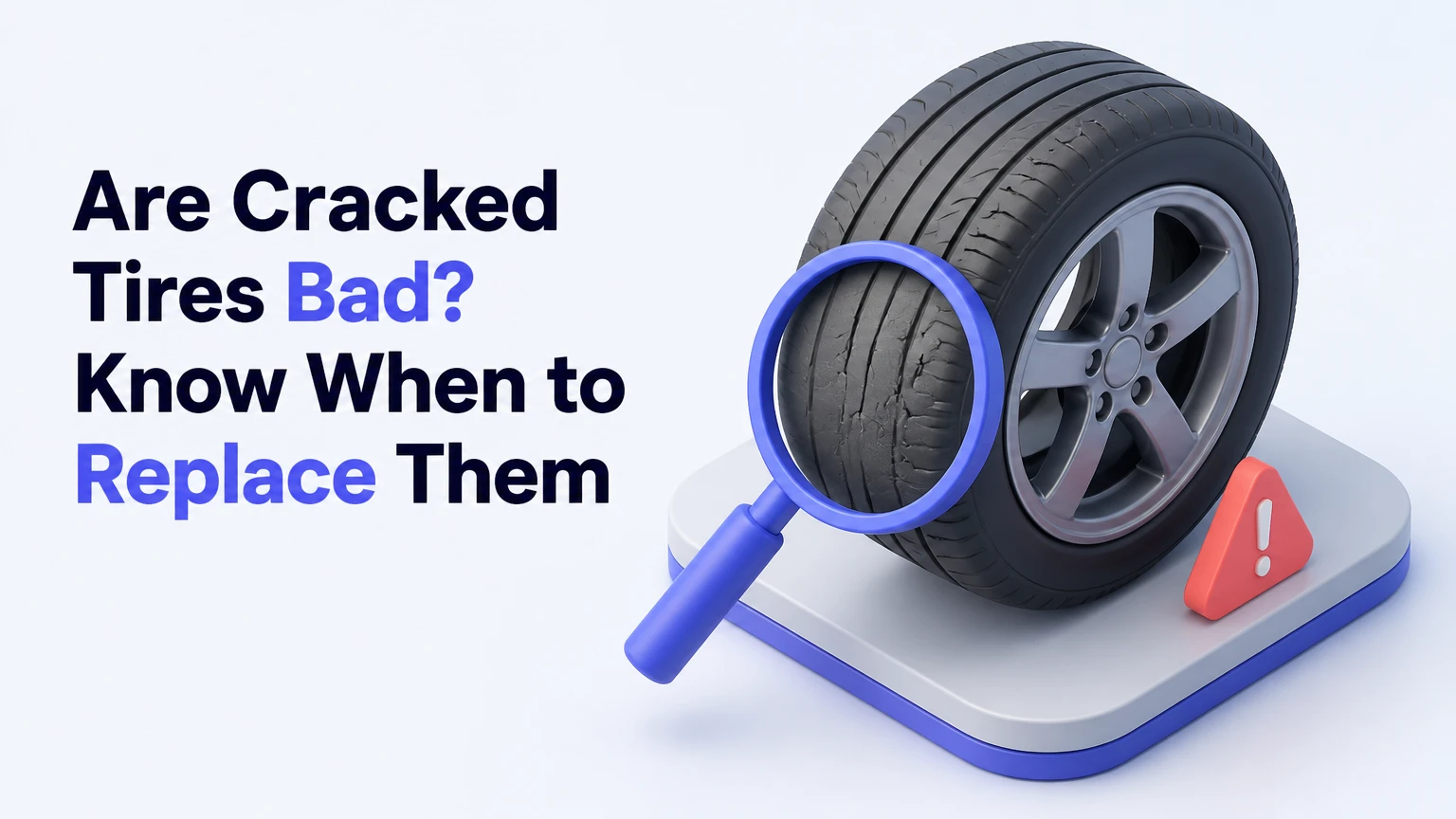
Cracked tires are potentially dangerous because visible fissures indicate that the rubber compound is aging and losing elasticity. Fine surface checking may be cosmetic, but cracks that widen with flexing, reach the sidewall structure, expose fabric, or accompany bulges and air loss require immediate replacement, especially before highway driving.
Key Facts at a Glance
Tire cracking, also called weather checking or dry rot, results from oxidation, ozone, ultraviolet exposure, heat, and aging.
Sidewall cracks are more concerning than shallow marks on tread-block surfaces because the sidewall flexes continuously.
No universal consumer rule makes every crack over exactly 1 millimeter or 3 millimeters automatically unsafe; tire manufacturers and technicians assess depth, location, age, and damage together.
The DOT date code gives the tire’s manufacture week and year. A code ending in 2421 means the 24th week of 2021.
NHTSA recommends inspecting tires for aging signs and following the tire manufacturer’s replacement guidance; many manufacturers recommend replacement around 10 years from manufacture, regardless of tread.
A tire dressing can improve appearance, but no spray, sealant, or conditioner restores degraded rubber strength.
What Are Cracked Tires?
Cracked tires have visible splits or fissures in the rubber surface, usually caused by weathering rather than a single puncture. The damage may appear between tread blocks, along the sidewall, near the bead, or around the shoulder where the tread transitions into the sidewall.
Shallow, short lines that remain confined to the outer rubber may be early weather checking. Deep openings, branching cracks, exposed cords, rubber flakes, tread separation, or a crack that opens when the tire is flexed indicate a more serious condition. A visual inspection cannot establish the full internal condition of a tire, so uncertain cases require a tire professional.
Tire cracking is different from normal tread wear. Tread wear removes rubber through use, while weather cracking makes the remaining rubber brittle. A tire can therefore have legal-looking tread depth and still have an unacceptable age-related safety problem.
Why do tires crack?
Tire rubber cracks when oxidation and ozone attack polymer chains and protective additives, reducing elasticity at the surface. Ultraviolet radiation, high temperatures, repeated heating and cooling, low inflation, chemical contamination, and long periods without movement can accelerate the process.
Tire manufacturers add antioxidants and antiozonants to slow deterioration. Those additives gradually migrate toward the surface, where they help protect the rubber, but sunlight, oxygen, and ozone eventually consume or deplete that protection. Parking a vehicle for months can worsen surface aging because protective compounds are not redistributed through regular flexing.
Long storage is not the only cause. A vehicle parked outdoors in a hot climate can develop checking sooner than a regularly driven vehicle stored under cover, while an older spare tire may age despite having almost no road mileage.
Can You Drive on Cracked Tires?
You should not drive at highway speed on visibly cracked tires until a qualified tire technician has assessed them. A short trip to a nearby tire shop may be reasonable only when cracks are superficial, the tire holds pressure, no cords or bulges are visible, and the technician agrees that the tire can be driven safely.
Do not drive the vehicle if a crack is deep or open, cords are visible, a sidewall bulge is present, the tread is separating, the tire repeatedly loses air, or the tire has suffered an impact. Use a spare that is correctly inflated, arrange mobile tire service, or have the vehicle towed.
High speed increases heat and cyclic flexing. Underinflation increases sidewall deflection further, and the combination can enlarge existing fissures or trigger a rapid structural failure. A tire does not need to look dramatically damaged immediately before it loses air.
What warning signs make cracked tires urgent?
| Visible or measurable condition | Likely significance | Recommended action |
|---|---|---|
| Fine lines only in outer tread rubber | Early surface weather checking | Arrange a professional inspection soon |
| Cracks opening when sidewall is flexed | Rubber has lost elasticity | Replace before highway use |
| Sidewall split with fabric or cords visible | Structural reinforcement may be exposed | Do not drive; replace immediately |
| Bulge, blister, or localized deformation | Possible internal separation or impact damage | Stop driving and replace |
| Tread-block cracks with missing rubber | Tread integrity is compromised | Replace the affected tire |
| Crack plus pressure loss within 24 hours | Air-retention or casing damage | Do not continue driving; replace or tow |
| Cracks on a tire over 10 years old | Beyond many manufacturers’ maximum age guidance | Replace regardless of tread depth |
The often-repeated 1-millimeter depth and 3-millimeter length rules should not be treated as universal safety limits. Tire construction, crack location, manufacturer guidance, tire age, and internal damage matter more than a ruler measurement alone.
Which Cracks Require Tire Replacement?
Sidewall cracks, cracks that expose cords, and cracks associated with bulges or air loss require replacement rather than repair. Tread-surface checking is less urgent only when it remains shallow, stable, and isolated on a relatively young tire with no other damage.
| Crack location or pattern | Risk level | Why it matters | Decision |
|---|---|---|---|
| Sidewall between bead and shoulder | High | Sidewalls flex under steering, braking, and load | Replace if visibly open, branching, or widespread |
| Bead area near the rim | High | Damage can affect the airtight seal and casing | Professional inspection; replacement is common |
| Shoulder transition | Moderate to high | High flexing and heat concentration occur here | Replace when cracks deepen or spread |
| Tread grooves between blocks | Moderate | Cracks can expose belts or precede chunking | Inspect promptly; replace if deep or widening |
| Fine lines across outer tread surface | Low to moderate | May represent early weather checking only | Monitor briefly and obtain professional assessment |
| Cracks around a puncture repair | High | Repair area may no longer have sound surrounding rubber | Replace if casing integrity is uncertain |
A tire professional may reject a tire that looks acceptable in a photograph because inspection also includes the inner sidewall, bead, inflation history, load rating, and signs of belt separation. The inner sidewall is particularly easy for vehicle owners to overlook.
When are small tire cracks a concern?
Small tire cracks become concerning when they are numerous, branching, deep enough to catch a fingernail, visible on both sidewalls, or located in a flexing area. Isolated hairlines on the outer tread of a young tire may not require immediate removal, but they justify monitoring and a professional inspection.
Clean the tire with water and inspect it in bright light. Do not use solvent to make the rubber look darker, because a cosmetic product can hide the condition without correcting it. Gently flexing the sidewall can reveal whether a line is merely printed-looking surface texture or an opening fissure, but do not force the tire or place your face near it.
The fingernail check is only a screening method. It cannot determine whether belts, cords, or the inner liner are damaged, and it should never override a manufacturer’s replacement recommendation.
Why Do Tires Crack and Dry Rot?
Tires crack because environmental exposure and mechanical stress gradually reduce the rubber’s ability to stretch and recover. Ozone attacks exposed rubber, ultraviolet radiation accelerates surface oxidation, heat speeds chemical reactions, and low pressure adds flexing stress that generates more heat.
The usual progression is:
- Microscopic surface fissures develop.
- Fissures become visible in tread grooves or sidewalls.
- Repeated flexing causes the openings to widen.
- Moisture and oxygen reach deeper rubber and reinforcement layers.
- Cords, belts, or the surrounding rubber may weaken.
- The tire can lose air, separate, or fail under load.
That sequence is a risk model, not a guaranteed timetable. Many tires with mild surface checking never reach carcass failure before replacement, while a tire with little visible cracking can have internal damage from impact, underinflation, overloading, or a manufacturing defect.
Does driving prevent dry rot?
Regular driving can slow some surface aging by flexing the tire and redistributing protective compounds, but driving does not reverse age-related deterioration. Heat, ultraviolet exposure, vehicle load, tire pressure, climate, and storage conditions determine whether the net effect is beneficial or harmful.
A parked RV or trailer is a special concern. Its tires may sit in one position, carry a static load, and receive direct sunlight for months. A collector car’s tires can look nearly new because they have low mileage while being older and more weathered than the owner expects.
How Does Tire Age Affect Safety?
Tire age is measured from the manufacture date, not from the date of installation or the date the vehicle was purchased. NHTSA advises owners to inspect tires for aging and follow the tire maker’s guidance; several major manufacturers recommend replacing tires at 10 years from manufacture, while some recommend earlier inspection or replacement.
Age does not create one universal failure date. Climate, storage, inflation, loading, speed, and tire design change the risk. A five-year-old tire stored outdoors in intense heat may deserve more scrutiny than a seven-year-old tire kept indoors, but neither comparison permits an owner to ignore the date code.
The U.S. Department of Transportation requires a DOT Tire Identification Number on many road tires. The final four digits identify the production week and year. For example, 1819 means the tire was manufactured in the 18th week of 2019.
Step 1: Find the tire’s DOT date code
Locate the letters “DOT” on the sidewall, followed by a longer identification string. The complete code may appear on only one side of the tire, so inspect the inner sidewall if the outer side does not show four final digits.
Record all four digits, then calculate the tire’s age from the current date. Do not confuse a partial serial number, load marking, or speed rating with the date code.
Step 2: Compare age with condition and usage
| Tire age from manufacture | Typical condition decision | Highway recommendation | Extra inspection |
|---|---|---|---|
| Under 5 years | Condition remains the main factor | Do not use if structural cracks appear | Check pressure, wear, damage, and sidewalls |
| 5-6 years | Increased aging review is sensible | Obtain a professional inspection if cracked | Follow the manufacturer’s guidance |
| 7-9 years | Replacement becomes increasingly prudent | Replace if weathering is visible | Inspect at least annually, including the inner sidewall |
| 10 years or more | Many manufacturers’ maximum age guidance | Replace before further road use | Replace regardless of remaining tread |
These are practical age bands, not a legal universal schedule. The vehicle handbook, tire manufacturer, commercial-vehicle rules, and local inspection law may impose different requirements.
Can a Cracked Tire Be Repaired?
Most weather-cracked tires cannot be safely repaired because the problem affects the rubber compound or casing rather than one isolated puncture. A plug or patch can close a puncture in an approved tread-repair zone, but it cannot restore a cracked sidewall, brittle shoulder, degraded inner liner, or weakened belt package.
Repair is also inappropriate when cracks accompany:
- Exposed cords or steel belts
- Tread separation or missing tread chunks
- A sidewall bulge or impact mark
- Repeated pressure loss
- Severe uneven wear
- An age beyond the manufacturer’s limit
- Chemical swelling or contamination
A tire shop may inspect and inflate a questionable tire for diagnosis, but that temporary inspection is not a repair. Do not inject sealant into a weather-cracked tire and assume it has become roadworthy. Sealant may complicate later inspection and cannot rebuild damaged rubber.
What Prevents Further Tire Cracking?
Proper inflation, shade, moderate storage temperature, and regular inspection slow tire weathering, but prevention cannot reverse cracks already present. Use the vehicle manufacturer’s cold-inflation pressure, keep tires away from ozone-producing electrical equipment, and protect parked tires from direct sunlight.
Useful practices include:
- Check cold pressure monthly and before long trips.
- Inspect both sidewalls, the tread grooves, and the bead area.
- Keep tires clean with mild soap and water.
- Use opaque tire covers on stored RVs, trailers, and collector cars.
- Store tires indoors, upright or as recommended by the manufacturer.
- Remove unnecessary static load from stored equipment when appropriate.
- Avoid petroleum solvents, strong acids, and unapproved tire dressings.
- Replace tires according to age and condition, not tread depth alone.
Tire shine is cosmetic. It can darken rubber and make small lines harder to see, while some solvent-based products may damage rubber or remove surface protectants. A dressing cannot replenish antiozonants or repair internal reinforcement.
How Should RV, Trailer, and Spare Tires Be Handled?
RV and trailer tires deserve stricter inspection because long stationary periods, direct sun, heavy loads, and underinflation can combine. Replace visibly cracked tires before a long trip, even when tread depth appears plentiful, and confirm the tire’s load range matches the actual axle load.
A spare tire also ages while unused. Owners often inspect the four road tires and forget the spare mounted beneath the vehicle, where heat, moisture, road salt, and limited visibility can accelerate deterioration.
| Vehicle situation | Main aging stress | Practical inspection interval | Safer decision |
|---|---|---|---|
| Daily passenger car | Heat cycles, speed, urban impacts | Monthly pressure and visual check | Replace visible structural weathering |
| Highway commuter | Sustained heat and high speed | Before every long trip | Do not gamble with sidewall cracks |
| RV or travel trailer | Static load and sunlight | Monthly during storage and before travel | Replace cracked or age-limited tires |
| Collector vehicle | Long storage and low mileage | Every 3 months | Cover tires and track manufacture date |
| Agricultural equipment | Load, ozone, rough surfaces | Before seasonal use | Keep off public roads if condition is uncertain |
| Mounted spare | Heat, road grime, neglect | Every 6 months | Include age and pressure in service planning |
Low-speed off-road use can reduce consequences compared with highway travel, but it does not make degraded rubber sound. A cracked agricultural or utility tire can still fail under load, damage equipment, or cause injury.
How Much Does Tire Replacement Cost?
Typical U.S. replacement cost is about $100-$250 per passenger-car tire installed, while premium, performance, light-truck, run-flat, and specialty tires can cost $200-$500 or more each. The final price depends on tire size, brand, shipping, mounting, balancing, valve stems, disposal fees, taxes, and whether a four-wheel-drive vehicle requires matched circumference.
| Replacement category | Typical tire price | Typical installed price | Common use |
|---|---|---|---|
| Budget passenger tire | $60-$120 | $90-$160 | Compact cars and low annual mileage |
| Midrange touring tire | $100-$200 | $140-$260 | Sedans, crossovers, and commuting |
| Premium touring tire | $160-$300 | $210-$380 | Long highway use and wet-weather priorities |
| Light-truck or SUV tire | $150-$350 | $210-$450 | Pickups, SUVs, and heavier loads |
| Performance or run-flat tire | $200-$500+ | $280-$650+ | Sport vehicles and manufacturer-specific fitments |
Typical inspection fees range from free to about $30 at tire retailers, although a mobile visit or detailed commercial inspection may cost more. Replacing one tire can create a tread-depth mismatch, especially on all-wheel-drive vehicles, so ask whether the vehicle requires two or four tires or whether a new tire can be shaved to match.
What Should You Do Before a Highway Trip?
Check the DOT age, cold pressure, tread condition, sidewalls, valve stems, and spare before leaving. If any tire has an open crack, bulge, cord exposure, tread separation, or unexplained pressure loss, replace it or arrange a professional inspection before traveling.
A practical pre-trip sequence takes approximately 10-15 minutes:
- Check all four cold pressures against the door-jamb label.
- Inspect the outer and inner sidewalls for cracks and bulges.
- Look between tread blocks for deep fissures or missing rubber.
- Confirm the DOT date on every tire, including the spare.
- Check for nails, uneven wear, and exposed belts.
- Verify the TPMS warning light is off after starting.
- Recheck pressure after loading passengers or cargo.
If a tire fails while driving, hold the steering wheel firmly, release the accelerator gradually, avoid sudden braking, and move to a safe location. Do not continue at reduced speed on a visibly damaged tire simply because it still holds air.
Common Questions About Cracked Tires
Are cracked tires worse on the sidewall or tread?
Sidewall cracks are generally more concerning because the sidewall flexes during steering, braking, acceleration, and load transfer. Tread cracks can also be dangerous when they reach belts, cause chunking, or spread through grooves. Location alone does not determine safety, so a technician should assess deep or widespread cracking in either area.
Can tire cracks disappear after applying tire dressing?
No. Tire dressing can change the color and shine of rubber, but it cannot restore elasticity, replace depleted protective additives, or repair casing damage. Some solvent-based products may worsen rubber aging, and glossy products can make visual inspection less reliable. Clean tires with mild soap and water instead.
Are used tires with small cracks safe?
Used tires with small cracks may be acceptable only after a professional inspects their age, tread, repair history, inner sidewall, and casing. Ask for the complete DOT date code before buying. A low price does not compensate for unknown storage conditions, and a used tire with visible structural weathering should be rejected.
Should I replace all four tires if one is cracked?
Replace all four when the tires are similarly aged, similarly weathered, or fitted to an all-wheel-drive vehicle that requires closely matched rolling circumference. Replacing one may be reasonable when the other tires are substantially newer and the vehicle manufacturer permits the tread-depth difference. Confirm the choice with the tire shop.
How long can a parked car sit before tires crack?
There is no dependable universal parking period because sunlight, temperature, humidity, ozone, tire age, and inflation change the rate. Several months of outdoor storage can accelerate checking, especially on RVs and trailers. Inflate to the specified pressure, use covers, inspect before driving, and do not treat low mileage as proof of safety.
Does deep tread mean a cracked tire is safe?
No. Tread depth measures remaining groove rubber, not the elasticity of the sidewall, inner liner, belts, or carcass. An eight-year-old tire with deep grooves can be less trustworthy than a newer tire with moderate wear. Age-related cracking, bulges, pressure loss, and separation signs require decisions beyond a tread-depth gauge.
The Bottom Line
Are cracked tires bad? They can be, and visible sidewall cracking, open fissures, exposed cords, bulges, tread separation, or pressure loss should be treated as replacement conditions. Fine surface checking on a young tire may allow a short monitoring period, but a tire professional should confirm that judgment before highway travel.
Check the DOT date, inspect every sidewall, maintain the specified cold pressure, and replace tires according to condition and manufacturer age guidance. Cracked rubber cannot be made structurally safe with tire shine, sealant, or extra tread depth.