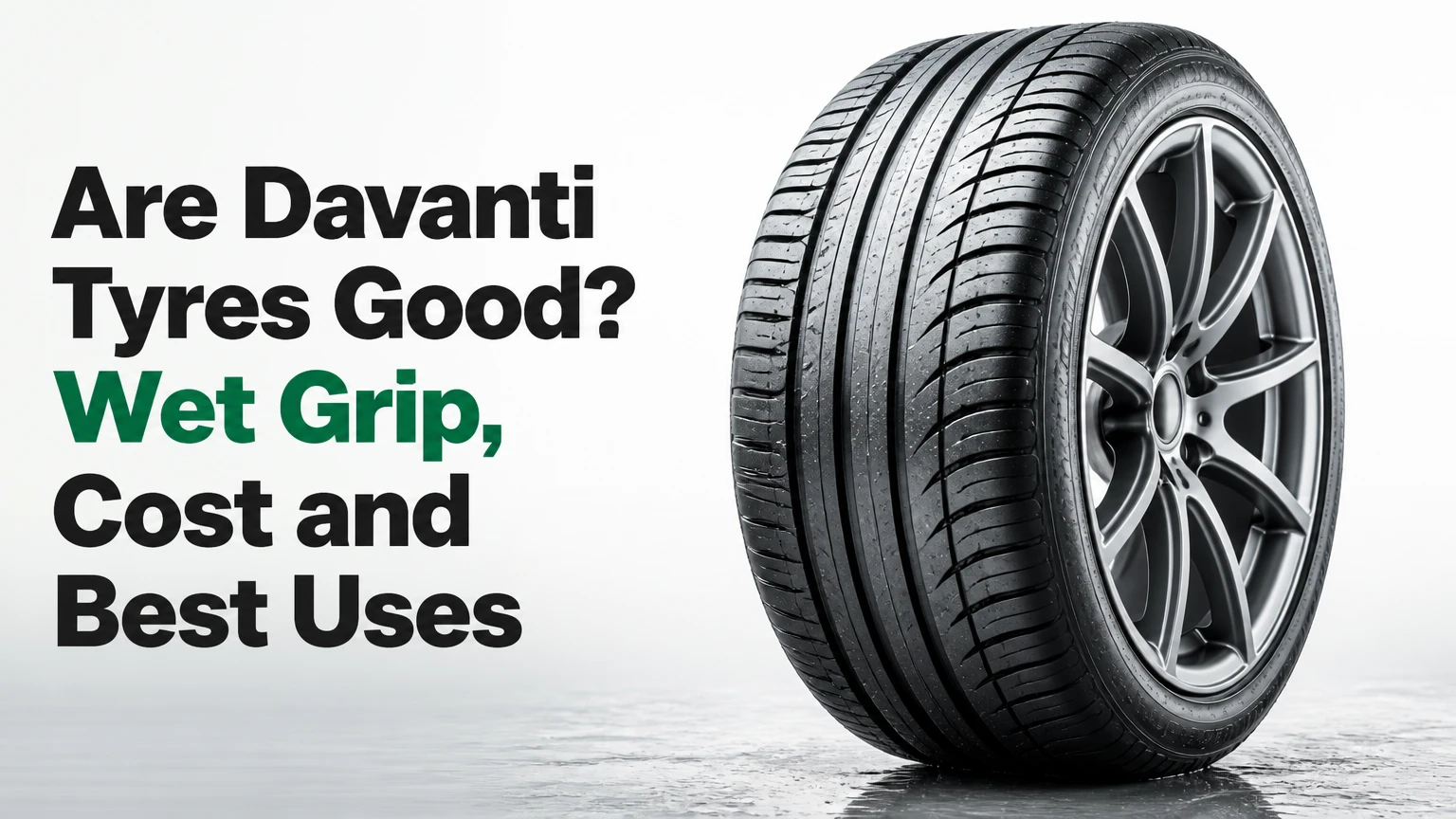
Davanti tyres are reasonable budget-to-mid-range tyres for everyday commuting, especially when low price, quiet running, and dry-road braking matter most. Davanti tyres generally do not match premium or stronger mid-range rivals for wet cornering, aquaplaning resistance, steering precision, or consistent high-speed handling, so frequent rain, heavy vehicles, and enthusiastic driving justify spending more.
Key facts at a glance
Davanti tyres typically cost about £55-£95 or €65-€110 each before fitting, depending on size and model.
Davanti touring tyres prioritise low noise, dry braking, and affordable replacement costs.
Independent test results reported for the DX640 and Protoura Sport identify wet handling and dynamic balance as important weaknesses.
Example EU labels for passenger models include B fuel efficiency, B wet grip, and 68 dB external noise.
Reported lifespan figures range from approximately 15,139 miles for some touring applications to around 40,000 miles for carefully maintained, lightly used all-season applications.
Davanti tyres suit calm commuting better than high-performance driving, severe wet weather, towing, or heavily loaded vehicles.
What Kind of Tyre Brand Is Davanti?
Davanti is a UK-based tyre brand established in 2015, with product development associated with its European Development Center in Spain and physical production in China. The manufacturing country alone does not establish whether a tyre is safe or durable; design, quality control, certification, compound consistency, and the exact model matter more.
Davanti positions its products between low-cost budget tyres and established mid-range brands. Its published development material refers to silica-infused compounds, testing at Applus+ IDIADA in Spain, and winter testing in Ivalo, Finland. Those activities indicate a structured development programme, but manufacturer testing is not equivalent to a neutral tyre comparison.
TyreSafe accurately describes the practical importance of tyre choice: “Tyres are the only part of your vehicle in contact with the road.” That contact patch is small, and a tyre’s acceptable dry performance cannot compensate fully for weak wet-corner behaviour.
The brand’s catalogue covers touring, ultra-high-performance, all-season, winter-oriented, SUV, and all-terrain applications. Consequently, “Are Davanti tyres good?” has no single model-independent answer. A DX640 used on a small commuter hatchback faces a different task from a Protoura Sport fitted to a powerful rear-wheel-drive car.
Are Davanti Tyres Good on Dry Roads?
Davanti tyres are generally competent on dry roads, where short braking distances and quiet cruising are more important than sharp steering feedback. The DX640 and similar touring products can provide predictable everyday braking for urban traffic, ordinary motorway speeds, and lightly loaded family cars.
Dry performance is the clearest strength in the supplied independent-test summary. The trade-off is softer turn-in and a less informative steering feel than drivers usually receive from Continental, Michelin, Hankook, or a comparable premium tyre. That difference matters less during a school run than during an emergency lane change.
The Protoura range changes the use case. Protoura Sport targets fast passenger cars, while Protoura Race uses a shallow-tread, 200-treadwear compound intended for track applications. A 200TW tyre can deliver stronger dry grip, but shallow tread, heat sensitivity, road noise, wet-weather compromises, and faster wear make it a poor universal road tyre.
Dry-road verdict: Davanti is adequate to good for normal commuting, but the performance range should not be judged by touring models and touring models should not be treated as performance tyres.
How Do Davanti Tyres Perform in Rain?
Davanti tyres are acceptable for straight-line wet braking when new, but wet cornering and aquaplaning resistance are the main reasons cautious buyers may prefer a stronger mid-range or premium tyre. Drivers in persistently wet regions should treat wet handling as the deciding criterion, not the EU label alone.
The supplied test summary reports the Protoura Sport finishing last for wet handling and wet cornering-circle performance in a 2026 Tire Reviews comparison. It also reports the DX640 finishing fifth of five in a 2026 AutoView mid-range comfort test because of dynamic-balance weaknesses. Those specific future-dated results should be checked against the original test pages, tyre sizes, production dates, and vehicle configurations before being treated as universal evidence.
The underlying concern is credible even when test rankings vary. Budget compounds and tread designs can provide respectable new-tyre braking while losing progressive cornering grip as water depth, speed, temperature, and tread wear increase. A tyre may stop acceptably in a straight line but still feel abrupt when a wet roundabout loads its outer shoulder.
Davanti describes wide circumferential grooves and inner-groove projections that help move water from beneath the contact patch. Tread grooves can reduce water pressure, but no groove design prevents aquaplaning at every speed. Speed, water depth, inflation pressure, tread depth, alignment, and vehicle weight remain decisive.
What Tread Depth Is Safe for Wet Use?
Davanti tyres should be replaced well before the legal minimum when wet performance has deteriorated, particularly below approximately 4 mm of remaining tread in demanding rainy use. The legal limit differs by country, and a legal tyre can still have materially less aquaplaning margin than a new tyre.
A reported Alltoura long-term observation described roughly 1.5 mm of wear over 10,000 miles, while a reported DX640 average of 15,139 miles illustrates how vehicle weight, alignment, driving style, and axle position can reduce life. These figures are not a warranty. Measure each groove with a tread-depth gauge rather than estimating wear from mileage.
Wet-road verdict: Davanti works for moderate rain and conservative driving, but wet cornering, standing water, and worn tread expose the brand’s largest practical disadvantage.
Are Davanti Tyres Quiet and Comfortable?
Davanti touring tyres are often a strong choice for low cabin noise at their price, with some examples carrying a 68 dB external-noise label. Variable tread-block pitch and enclosed outer grooves are intended to spread noise frequencies instead of allowing one repetitive pattern to dominate the cabin.
Noise depends on more than tread design. A stiff XL construction, incorrect pressure, uneven wear, coarse asphalt, wheel alignment, and suspension condition can overwhelm a quiet tread pattern. Some drivers also report that a soft budget casing feels comfortable over smooth surfaces but transmits sharper impacts over potholes.
A low external pass-by figure is useful for comparison, but it is not a direct measurement of interior noise. EU tyre labels measure regulated external rolling noise under specified conditions, not every surface, speed, load, or cabin configuration.
Comfort verdict: Davanti’s touring products are often quieter than their price suggests, although quietness should not be mistaken for superior grip or refined handling.
Which Davanti Tyre Fits Each Driving Situation?
The correct Davanti model depends on vehicle type, weather, load, speed, and road surface. The table below separates the product families instead of treating the Davanti name as a single performance level.
| Davanti family | Main use | Relevant design or rating | Best fit | Important limitation |
|---|---|---|---|---|
| DX640 | Passenger touring | Example labels include B fuel, B wet, 68 dB | Small and medium commuter cars | Soft response and weaker wet-limit confidence |
| DX390 | Passenger and SUV touring | Road-biased comfort construction | Daily cars and compact SUVs | Check exact size, load index, and test evidence |
| Protoura Sport | Ultra-high-performance road use | Sport-oriented tread and compound | Drivers wanting affordable dry-road performance | Wet handling may lag premium alternatives |
| Protoura Race | Track-focused driving | 200 treadwear, shallow tread | Track days and dry performance use | Faster wear and compromised everyday wet use |
| Alltoura 4-Seasons | Year-round road use | Available 3PMSF-certified versions | Mild climates with occasional snow | Not a substitute for dedicated winter tyres |
| Alltoura H/T | Highway SUV use | Highway-touring orientation | Road SUVs and light-duty highway travel | Less suitable for mud, rocks, or severe snow |
| Terratoura A/T | Mixed road and light off-road | Reinforced sidewalls and all-terrain tread | Rural tracks, gravel, light mud | Noise, wet-road compromise, and limited extreme-terrain ability |
Are Davanti All-Season Tyres Good in Winter?
Davanti Alltoura 4-Seasons versions carrying the Three-Peak Mountain Snowflake symbol are more suitable for certified winter conditions than ordinary summer tyres, but they remain compromises between summer and winter performance. The 3PMSF mark confirms a regulated snow-traction threshold; it does not mean equal performance to a dedicated winter tyre.
All-season Davantis make sense where winters bring occasional snow, temperatures fluctuate, and drivers cannot store two tyre sets. Dedicated winter tyres remain preferable for repeated sub-7°C conditions, mountain travel, packed snow, ice, or emergency braking in cold weather.
Can Terratoura A/T Tyres Handle SUVs and Rural Roads?
Terratoura A/T tyres are intended for SUVs, light trucks, agricultural vehicles, and mixed road surfaces, with stronger sidewalls than ordinary touring tyres. They can suit gravel, farm tracks, grass, and light mud, but all-terrain branding does not guarantee rock-crawling strength, deep-mud traction, or heavy towing stability.
Check the tyre’s load index, speed rating, rim protection, and vehicle approval before fitting. A heavier all-terrain tyre can increase rolling resistance, steering effort, braking distance, and suspension load compared with a road-biased SUV tyre.
How Much Do Davanti Tyres Cost?
Davanti passenger tyres typically cost about £55-£95 or €65-€110 per corner before fitting, with larger wheels, SUV load ratings, run-flat construction, and performance compounds raising the price. A complete fitted set therefore commonly costs approximately £260-£500 after valves, balancing, disposal, and local labour.
The purchase price is often 40%-50% below a comparable Michelin or Continental product, although the gap changes by size and promotion. Price per mile can narrow if a heavier vehicle wears a budget tyre quickly, so compare expected mileage rather than invoice price alone.
| Purchase factor | Typical Davanti figure | Cost consequence | Check before buying |
|---|---|---|---|
| Passenger tyre, small rim | £55-£75 | £220-£340 for four fitted tyres | Exact size and local fitting fee |
| Passenger tyre, larger rim | £75-£110 | £320-£500 for four fitted tyres | XL, run-flat, and speed rating |
| Premium comparison | 40%-50% higher typical price | Greater upfront spend | Same size and equivalent rating |
| Balancing and valves | £10-£25 per wheel, typical | £40-£100 per set | Whether disposal is included |
| Rotation interval | 5,000-6,000 miles, typical | Small maintenance cost | Vehicle manufacturer’s layout |
| Accidental damage cover | Usable tread-life basis | Possible replacement credit | Exclusions and claim procedure |
Davanti advertises an Accidental Damage Guarantee for certain unrepairable puncture or impact damage during normal legal road use. Coverage may depend on remaining tread, purchase documentation, inspection, and exclusions, so obtain the current written terms rather than relying on a retailer’s summary.
Davanti Versus Premium and Mid-Range Alternatives
Davanti is a sensible price-led choice when annual mileage is modest, driving is calm, and roads are mostly dry. Hankook or Kumho usually provide a stronger middle ground, while Continental and Michelin generally offer more mature wet handling, steering consistency, and model-specific test evidence at a higher price.
| Option | Typical position | Strongest reason to choose | Main trade-off | Suitable buyer |
|---|---|---|---|---|
| Davanti | Budget to lower mid-range | £55-£95 typical passenger price | Wet-limit performance uncertainty | Calm commuter |
| Kumho | Mid-range | Balanced price and road handling | Fewer sizes in some markets | Value-focused daily driver |
| Hankook | Upper mid-range | Wet and dry balance | Usually costs more than Davanti | Frequent motorway user |
| Continental | Premium | Wet braking and handling development | Higher purchase price | Rainy climate or safety priority |
| Michelin | Premium | Long-term refinement and broad range | Highest typical upfront cost | High-mileage or demanding driver |
| Budget alternatives | Entry-level | Lowest invoice price | Greater variation in grip and wear | Very low-mileage second car |
The fairest comparison uses the same tyre size, vehicle, load rating, weather, tread depth, and test method. An EU B wet-grip label is a useful threshold, but it cannot rank cornering control, steering feel, snow traction, or wear against every competitor.
Who Should Buy Davanti Tyres?
Davanti tyres suit a secondary car, city commuter, school-run vehicle, or low-mileage hatchback where purchase price and low noise outweigh ultimate wet handling. Davanti tyres are a weaker choice for drivers who regularly encounter standing water, carry heavy loads, tow trailers, drive fast on motorways, or use a powerful performance vehicle.
Budget-Conscious Commuter
Choose Davanti when annual mileage is moderate, the vehicle is lightly loaded, and replacement cost is the main constraint. Select the correct load and speed rating, then replace the tyres early if wet grip declines.
High-Mileage Motorway Driver
A stronger mid-range tyre may provide better value despite its higher invoice price. Frequent motorway driving increases exposure to heavy rain, emergency lane changes, heat, and sustained casing stress.
Performance-Car Owner
Skip touring Davanti products for spirited road driving. Protoura Sport or Protoura Race may offer a more relevant dry-performance specification, but the Protoura Sport’s reported wet-test weakness and the Race’s 200TW track bias require careful use.
Rural SUV Owner
Terratoura A/T can fit gravel, farm access, and light off-road travel. Choose a road-biased H/T tyre instead when the vehicle spends nearly all its time on asphalt, because it will usually produce less noise and rolling resistance.
Driver in a Severe-Winter Region
Use dedicated winter tyres when snow, ice, mountain roads, or prolonged freezing temperatures are normal. A 3PMSF all-season tyre is a compromise, not an equivalent replacement.
What Problems Do Davanti Tyres Develop?
Davanti tyre problems usually arise from wet-limit grip, uneven wear, incorrect fitment, or vehicle setup rather than from the brand name alone. Drivers should investigate vibration, rapid shoulder wear, wet slides, and pressure loss immediately because those symptoms can also indicate alignment, suspension, or wheel damage.
Wet Cornering Feels Abrupt
Reduce speed before wet roundabouts and increase following distance if the car feels vague or snaps toward the outside of a bend. Check tread depth across the full width, tyre age, pressure, and alignment; replacing only the visibly worn tyre may leave a mismatched axle.
Front Tyres Scrub Faster
Front-wheel-drive cars commonly wear their front tyres faster because those tyres steer, drive, and handle much of the braking load. A typical 5,000-6,000-mile rotation can equalise wear when the vehicle maker permits front-to-rear rotation and all four tyres share compatible specifications.
Steering Wheel Vibrates
Vibration after fitting often points to dynamic imbalance, a bent wheel, tyre road-force variation, or incorrect seating on the hub. Request balancing and a wheel inspection rather than increasing pressure or assuming the tread pattern is defective.
Outer Shoulders Wear Quickly
Outer-shoulder wear can result from underinflation, aggressive cornering, excessive load, or incorrect camber. Use the vehicle placard pressures, increase pressure only according to the manufacturer’s load guidance, and do not adopt a generic 28-35 psi range without checking the car.
Tyres Are Mixed Across Axles
Never place markedly better tyres only on the front while leaving worn, low-grip tyres on the rear unless a qualified professional and vehicle manufacturer specifically support the arrangement. Many vehicles behave more predictably when the best pair is installed on the rear axle, because rear grip loss can produce difficult-to-correct oversteer.
How Should Davanti Tyres Be Maintained?
Maintain Davanti tyres with monthly pressure checks, tread measurements, alignment inspections after impacts, and rotation at the vehicle maker’s interval. Maintenance cannot turn a weak wet-handling model into a premium tyre, but it can prevent avoidable wear and preserve its designed performance.
- Check pressures when cold. Use the door-jamb or handbook specification, not the maximum pressure moulded into the sidewall. Inspect before long trips and whenever load changes.
- Measure tread depth. Record inner, centre, and outer readings across every tyre. Uneven readings indicate alignment, pressure, suspension, or rotation issues.
- Inspect for damage. Look for bulges, cuts, exposed cords, lodged objects, and sidewall cracking. A bulge indicates casing damage and requires replacement, not repair.
- Rotate only when permitted. Follow the manufacturer’s directional, staggered-size, and asymmetric-tread instructions. Mark the mileage and keep the installation pattern documented.
- Check age and storage history. Read the DOT date code where applicable. Replace tyres affected by significant ageing, cracking, or long-term outdoor storage even when tread remains.
- Rebalance after symptoms. Correct vibration, pulling, or steering shake before extended motorway use. Confirm wheel torque after fitting.
A practitioner rule matters here: tyre pressure should be checked cold, because driving heat can raise measured pressure and conceal an underinflated tyre. Another counterintuitive point is that a quiet tyre can still have poor wet-limit behaviour, since external noise and cornering grip come from different design compromises.
The Bottom Line: Are Davanti Tyres Good?
Davanti tyres are good enough for price-sensitive everyday driving when the car is lightly loaded, annual mileage is moderate, and the driver accepts weaker wet handling than premium alternatives. They are not the strongest choice for severe rain, high-speed driving, towing, heavy SUVs, performance cars, or drivers who prioritise progressive grip above purchase price.
Choose Davanti after checking the exact model, tyre size, load index, speed rating, manufacturing date, EU label, independent test data, and guarantee terms. If the price difference to Hankook or Kumho is manageable, those brands often offer a safer balance; if wet-weather confidence is the priority, Continental or Michelin deserves the additional cost.
Frequently Asked Questions
Are Davanti tyres legal and certified?
Davanti tyres sold through legitimate dealers must meet the applicable market approval requirements, including required markings, load ratings, speed ratings, and labelling. Legal approval does not rank a tyre’s handling against competitors. Confirm the correct marking and specification for the vehicle, country, and intended axle before purchase.
Do Davanti tyres wear quickly?
Some reported touring applications average about 15,139 miles, while a reported Alltoura observation suggested approximately 40,000 miles under lighter, carefully maintained conditions. Davanti tyre life depends heavily on alignment, pressure, vehicle weight, torque, driving style, road surface, and rotation, so mileage estimates cannot replace tread measurements.
Are Davanti tyres suitable for electric cars?
Davanti tyres can be suitable for an electric vehicle only when the exact size, load index, speed rating, and manufacturer approval are correct. EV weight and instant torque can accelerate wear, while low rolling resistance and acoustic requirements may favour an EV-specific tyre over a generic passenger model.
Should I fit four Davanti tyres at once?
Fitting four matching Davanti tyres is preferable when the existing set has substantially different tread depth, age, or grip. If replacing two tyres, follow the vehicle manufacturer’s guidance and have the stronger pair installed on the rear in many conventional layouts, while preserving compatible sizes and ratings.
Are Davanti tyres good for towing?
Davanti tyres can tow within the vehicle’s legal load limits when the selected tyre has the required load index and speed rating. Regular towing, heavy caravans, high motorway speeds, or hot climates justify a tyre with stronger casing control and more predictable wet handling than a low-cost touring option.