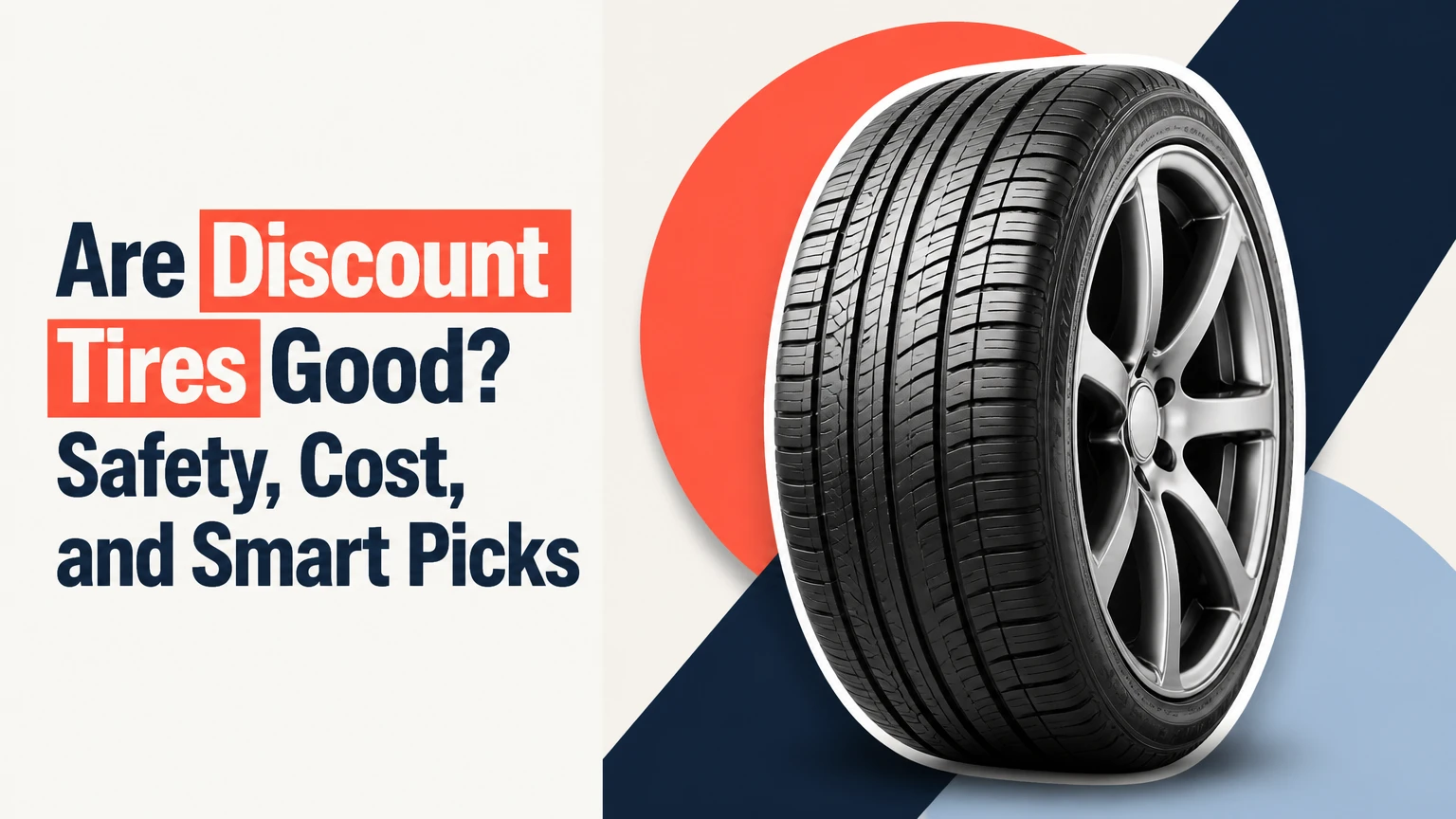
Discount tires can be good enough for a carefully chosen, correctly rated replacement, but the cheapest unknown-brand tire is rarely the best value for a daily driver. Discount Tire, the retailer, is generally a strong place to buy and maintain tires; “discount tires” as a product category requires evaluation of wet braking, load rating, tread life, age, warranty, and independent test results.
Key Facts at a Glance
- Discount Tire and discount tires are different subjects: one is a retailer, while the other describes lower-priced tire products.
- A budget tire can meet legal standards yet deliver weaker wet braking, snow traction, noise control, or tread life than a premium tire.
- The correct replacement must match the vehicle’s size, load index, speed rating, construction, and seasonal requirements.
- Discount Tire commonly provides free air checks, flat repairs, and tire rotations, but service terms and certificate coverage vary by tire and location.
- A four-digit DOT code identifies a tire’s production week and year, such as 1024 for the tenth week of 2024.
- Mid-range tires from established manufacturers often reduce purchase price without accepting the full compromises of an obscure bargain brand.
What Does “Discount Tires” Mean?
“Discount tires” can mean either Discount Tire, the US retailer, or low-priced replacement tires from budget brands. The distinction matters because a reputable retailer may sell premium, mid-range, and budget products, while a cheap tire can be sold through many different channels.
Discount Tire operates a large US store network and acquired Tire Rack in 2021. Its value comes primarily from selection, installation, maintenance access, and customer-service policies. The store’s reputation does not automatically make every tire on its website equally capable.
Budget tires are usually manufactured to meet applicable regulatory requirements at a lower purchase price. Manufacturers may reduce costs through simpler tread designs, less expensive rubber compounds, shorter mileage warranties, or fewer independent performance tests. Those trade-offs matter most during heavy rain, emergency maneuvers, high temperatures, winter driving, and long highway trips.
The National Highway Traffic Safety Administration describes tires as “the only part of your vehicle that makes contact with the road.” That contact patch is small, so tire choice affects acceleration, steering, braking, fuel consumption, noise, and ride comfort simultaneously.
How Does Discount Tire Work?
Discount Tire lets shoppers enter vehicle information, choose a tire, purchase online or in a store, and schedule installation. The retailer typically mounts and balances the tires, installs them on the vehicle, checks inflation, and provides access to ongoing services such as air checks and rotations.
A typical purchase follows this sequence:
- Confirm fitment. Use the door-jamb placard, owner’s manual, or current sidewall size instead of relying only on a license-plate search.
- Compare complete installed prices. Include mounting, balancing, valve stems, disposal, taxes, certificates, and any TPMS service.
- Book installation. Appointments usually reduce waiting, while walk-ins can take substantially longer during weekends and seasonal rushes.
- Inspect the work. Confirm the tire size, rotation direction, inflation pressure, wheel-lug torque, and TPMS warning-light status.
- Record the warranty terms. Keep the invoice and confirm whether free rotations, mileage coverage, road-hazard certificates, or prorated replacement apply.
Discount Tire advertises free lifetime rotations and balancing on eligible tires, along with free air checks and flat repairs under stated conditions. Policies can change, and free service does not mean every repair or replacement is covered. Ask the store to state exclusions before paying.
Are Discount Tire’s Prices Competitive?
Discount Tire prices are often competitive after installation and price matching, but the lowest advertised tire price is not always the lowest final cost. A competitor’s price must usually be verifiable, available for the same size and exact tire model, and comparable after shipping, fees, installation, and rebates.
Typical US installation charges often fall near $20-$30 per tire before optional protection and taxes. The exact total varies by wheel size, vehicle, tire type, local labor rates, and whether a TPMS sensor or specialty service is required.
What Are Discount Tire Certificates?
Discount Tire certificates are optional road-hazard protection plans that may cover repair or replacement for qualifying accidental tire damage. Coverage commonly depends on the tire’s condition, remaining tread, purchase documentation, and the specific certificate terms in effect when the tire was bought.
Certificates are more defensible for low-profile tires, expensive performance tires, vehicles driven through construction zones, and drivers who cannot tolerate an unexpected replacement. They are less compelling when the tire is inexpensive, the vehicle is lightly driven, or the buyer has enough emergency savings to absorb one replacement.
Do not treat a certificate as a manufacturer defect warranty. Defects, improper inflation, collision damage, vandalism, racing, irregular wear, and neglect may be excluded or handled under separate policies.
Are Discount Tires Good for Daily Driving?
Budget tires can work for short, low-speed driving in mild weather, but established mid-range tires are usually the safer compromise for daily commuting. A daily driver encounters wet pavement, highway speeds, sudden braking, temperature changes, and uneven roads, so wet traction and predictable handling deserve more weight than the initial price.
The legally required UTQG markings provide useful but limited information. Treadwear is a comparative rating within a manufacturer’s system, traction indicates wet-braking performance categories, and temperature indicates resistance to heat generation. UTQG ratings do not replace independent testing, and treadwear numbers cannot be compared perfectly across brands.
A cheap tire may feel acceptable in dry city driving because dry grip is often adequate at moderate speeds. The difference appears when water separates the tread from the pavement, when a vehicle must change lanes quickly, or when the tire loses performance as the compound ages.
What Makes a Budget Tire Risky?
The main risks are weaker wet braking, less consistent handling, faster wear, greater noise, poor winter traction, and uncertain quality control among obscure brands. Risk rises when the tire lacks credible test data, has a low load rating, is old stock, or is installed on a heavy SUV, sports car, or frequently loaded vehicle.
No single country of manufacture proves that a tire is unsafe. The better questions are whether the manufacturer has a traceable warranty, publishes complete specifications, supplies the correct load and speed rating, and has credible independent test results.
Budget, Mid-Range, and Premium Tires Compared
The following figures are typical market ranges, not guarantees for every model. Tire size, alignment, climate, driving style, vehicle weight, inflation, and road surface can change results substantially.
| Tire tier | Typical price per tire | Typical tread life | Best-fit driving |
|---|---|---|---|
| Budget, obscure brand | $55-$110 | 20,000-40,000 miles | Low-mileage city use in mild climates |
| Budget, established manufacturer | $75-$140 | 30,000-50,000 miles | Basic commuting with moderate annual mileage |
| Mid-range, major-brand subsidiary | $100-$180 | 45,000-65,000 miles | Daily commuting, highway use, mixed weather |
| Premium major brand | $150-$280+ | 60,000-80,000 miles | Long trips, demanding weather, high refinement |
Premium tires do not always last twice as long, and a high mileage warranty does not guarantee that the tire will reach that mileage. Rotation records, alignment, inflation, suspension condition, and even driving style influence actual life.
Which Tire Attributes Matter Most?
For most drivers, wet braking, correct load capacity, predictable handling, and service support matter more than the lowest price. Noise, ride comfort, fuel efficiency, winter traction, tread warranty, and high-temperature durability become more important according to the vehicle and climate.
| Attribute | What to check | Why it changes the decision |
|---|---|---|
| Size | Example: 225/65R17 | Incorrect sizing can affect clearance, speedometer accuracy, and handling |
| Load index | Example: 102, 1,874 pounds per tire | A low rating can overload the tire on SUVs or loaded vehicles |
| Speed rating | Example: H, 130 mph | The rating must meet the vehicle maker’s specification |
| Wet traction | UTQG traction grade plus independent tests | Wet braking is a frequent safety trade-off |
| Winter marking | 3PMSF symbol for severe snow service | All-season labeling does not equal winter capability |
| Tread warranty | Example: 50,000 miles, prorated terms | Warranty value depends on maintenance requirements |
| Production date | DOT code, such as 1024 | Older inventory has less usable aging margin |
The 3PMSF symbol indicates a tire passed a standardized severe-snow traction test. It does not make the tire equivalent to a dedicated winter tire on ice or in deep snow.
Which Budget Tire Options Are Safer?
The strongest budget strategy is to move one tier above the absolute cheapest tire and choose a model from a manufacturer with a traceable warranty and published specifications. Examples include BFGoodrich or Uniroyal under Michelin, General Tire under Continental, Firestone under Bridgestone, and other established regional brands.
Retailer-exclusive labels such as Pathfinder or Arizonian may offer reasonable value, but the underlying manufacturer, model specification, warranty, and independent reviews should be verified for the exact tire. Ownership relationships and production suppliers can change, so a brand name alone is not a technical guarantee.
| Lower-cost path | Example brands | Typical advantage | Main limitation |
|---|---|---|---|
| Michelin family alternative | BFGoodrich, Uniroyal | Established warranty and dealer support | Model may use older technology |
| Continental family alternative | General Tire, selected Barum models | Balanced price and touring options | Availability varies by size |
| Bridgestone family alternative | Firestone | Broad US availability | Ride and wet performance vary by model |
| Retailer-exclusive option | Pathfinder, Arizonian | Competitive installed price | Exact maker and test data require verification |
| Premium closeout | Previous-year Michelin or Continental | Premium construction at reduced price | Limited size or inventory selection |
Do not mix two different tire models on the same axle unless the vehicle maker and tire professional approve the arrangement. If replacing only two tires, the deeper-tread pair generally belongs on the rear axle, including many front-wheel-drive vehicles, because rear traction helps resist oversteer on wet roads.
What Does a Set of Tires Really Cost?
A four-tire purchase often costs $300-$1,200 before tax, depending on size and tier. Installation can add roughly $80-$120, while certificates may add around 10%-20% of the tire purchase price when offered as a percentage-based option.
| Purchase choice | Tire price each | Four tires | Typical installed total before tax |
|---|---|---|---|
| Basic budget | $70 | $280 | $360-$420 |
| Established budget | $105 | $420 | $500-$570 |
| Mid-range | $145 | $580 | $660-$750 |
| Premium | $210 | $840 | $920-$1,030 |
A lower purchase price can lose its advantage if the tires wear quickly. For example, two $420 sets lasting 35,000 miles each cost $840 over 70,000 miles, while one $580 mid-range set lasting 55,000 miles still requires another partial replacement before covering the same distance. The cheaper option is not automatically cheaper per mile.
Use this simple calculation:
Cost per 10,000 miles = total tire and installation cost divided by expected miles, multiplied by 10,000.
Include alignment, rotations, puncture repairs, and premature replacement when those costs are reasonably foreseeable.
Should You Buy the Road-Hazard Warranty?
Buy road-hazard coverage when replacement risk is high and the covered tire would be expensive; skip it when the premium approaches the cost of a replacement you could comfortably fund. Construction debris, low-profile sidewalls, poor roads, and high annual mileage make certificates more valuable.
A certificate does not prevent a flat. It transfers some replacement risk to the retailer under written conditions. Verify the coverage limit, tread-depth threshold, prorating rules, mounting charges, time period, and exclusions before purchase.
Financing requires separate caution. A promotional credit card offer can use deferred interest, meaning interest may be calculated from the original balance if the full promotional amount is not paid by the deadline. Compare the cash price with the financed price and divide the balance across the promotional months before accepting the offer.
Which Tires Fit Different Drivers?
The correct tire tier changes with driving exposure, not simply with income or vehicle age. A two-mile grocery trip in dry Arizona creates different demands from a 70-mile commute through rainy Seattle, even if both drivers own the same sedan.
| Driver situation | Recommended tier | Example direction | Reason |
|---|---|---|---|
| Daily highway commuter | Mid-range touring | General, BFGoodrich, Yokohama | Wet braking, comfort, and stable wear |
| Sports car owner | Premium performance | Michelin Pilot Sport, Bridgestone Potenza | Steering response and high-speed stability |
| Heavy SUV or truck use | Established all-season or highway tire | Load-rated General, Firestone, or equivalent | Load capacity, heat resistance, and durability |
| Low-mileage secondary car | Established budget | Correctly rated value model | Lower annual exposure reduces cost pressure |
| Snow-belt driver | 3PMSF all-weather or winter tire | Model with severe-snow rating | Snow traction exceeds ordinary all-season capability |
| Construction-zone commuter | Mid-range or premium plus coverage | Road-hazard plan after terms review | Higher probability of sidewall and tread damage |
A “beater” car still needs adequate wet traction, correct load capacity, and sound casing condition. A low purchase price does not justify a tire with a mismatched rating or visible damage.
How Do You Inspect New Tires?
Inspect the exact tire before installation and confirm its age, size, rating, and condition. The four-digit DOT date code uses the first two digits for the production week and the last two for the year, so 1024 means week 10 of 2024.
Use this checklist:
- Compare the sidewall size with the door placard.
- Confirm load index and speed rating meet or exceed the vehicle requirement.
- Check the DOT code on each tire, not only one tire.
- Reject cuts, bulges, exposed cords, bead damage, or uneven storage deformation.
- Confirm directional arrows or outside/inside markings are installed correctly.
- Check cold inflation against the vehicle placard, not the maximum sidewall pressure.
- Verify the TPMS light turns off after the system relearns.
- Schedule a rotation according to the vehicle manual, commonly every 5,000-7,500 miles.
There is no universal rule that every tire older than two years must be rejected. Tires stored correctly can remain saleable, but buyers should request a fresher set when possible and follow the vehicle and tire manufacturer’s age recommendations. NHTSA advises replacing tires at ten years from manufacture, including unused spare tires, while several manufacturers recommend earlier replacement inspections.
Why Do New Tires Vibrate?
New tires can vibrate because of imbalance, a bent wheel, improper bead seating, excessive radial force, hub corrosion, incorrect lug torque, or a suspension problem. A vibration that begins around 50-70 mph should be inspected promptly rather than dismissed as normal break-in.
Return to the installer and request:
- A conventional rebalance and inspection for missing weights.
- Verification that the wheel is centered correctly on the hub.
- A check for bent rims and tire runout.
- A road-force balance if ordinary balancing does not solve the problem.
- A torque check using the vehicle manufacturer’s specification.
Road-force balancing measures how the tire and wheel behave under load, so it can identify combinations that spin-balancing misses. It cannot repair a damaged wheel, defective tire, worn bearing, or alignment problem.
What Maintenance Protects Tire Value?
Correct inflation and alignment protect both safety and the money spent on tires. Underinflation increases heat and shoulder wear, while overinflation can reduce the contact patch and accelerate center wear.
Check pressure monthly and before long trips, using a reliable gauge when the tires are cold. Rotate at the interval in the owner’s manual, inspect for irregular wear, and repair punctures only when the damage is within the repairable tread area. A sidewall puncture generally requires replacement rather than a plug or patch.
Mileage warranties often require documented rotations and correct alignment. Free retailer rotations do not remove the owner’s responsibility to monitor pressure, load, tread depth, and damage.
What If a Tire Loses Tread Early?
Record the mileage, pressure history, rotation dates, alignment results, and tread-depth measurements across all four tires. Uneven wear usually points to alignment, inflation, suspension, or rotation problems rather than a simple mileage-warranty claim.
Ask the retailer or manufacturer to inspect the tire before replacing it. A prorated warranty may provide a credit based on unused tread, but labor, taxes, installation, and replacement coverage differ by policy.
Common Buying Mistakes
- Choosing by price alone. Compare installed cost per expected mile, not the online tire price.
- Ignoring the load index. A passenger tire may be unsuitable for a heavily loaded crossover or pickup.
- Assuming all all-season tires perform alike. All-season is a category, not a standardized wet or snow performance score.
- Replacing only one tire without checking tread depth. Large tread differences can affect handling and drivetrain systems.
- Buying old inventory without asking. A tire’s production date reduces the remaining aging margin.
- Treating a warranty as maintenance. Certificates and tread warranties do not cover neglect, incorrect pressure, or every type of damage.
One practitioner rule is especially useful: spend more on the tires that face the harshest combination of speed, rain, load, and annual mileage. Saving $100 on a set matters less when one emergency stop, premature replacement, or damaged wheel can erase that saving.
FAQ
Are cheap tires safe on the highway?
Cheap tires can be legally compliant and usable on the highway when correctly sized, properly inflated, and in good condition. Established mid-range tires remain the better choice for frequent highway travel because wet braking, heat management, noise, and tread consistency matter more at sustained speed.
How many miles do budget tires usually last?
Budget tires commonly last about 20,000-40,000 miles, while established budget and mid-range models often reach 30,000-65,000 miles under suitable conditions. Inflation, alignment, rotation frequency, vehicle weight, climate, and driving style can reduce or extend those ranges substantially.
Can I put budget tires on an SUV?
You can put budget tires on an SUV only when the tire meets the vehicle’s required size, load index, speed rating, and seasonal performance needs. Heavy loads, towing, frequent rain, snow, or long highway trips justify an established mid-range or premium tire.
How old can unused tires be?
Unused tires should be inspected for age and storage condition before installation. The DOT code identifies production week and year, while NHTSA recommends replacing tires at ten years from manufacture; tire makers may recommend earlier inspections or replacement.
Are Discount Tire certificates worth the cost?
Discount Tire certificates are most useful for expensive, low-profile tires, rough roads, construction zones, and high-mileage driving. They are less attractive for inexpensive tires or drivers with low exposure to road hazards. Read the current certificate terms because tread limits and exclusions determine the real value.
The Bottom Line
Are discount tires good? The answer is yes only when “discount” means a correctly rated, traceable tire selected for the vehicle and driving conditions, not simply the cheapest available model. Discount Tire is generally a convenient retailer with useful maintenance services, but the retailer’s service quality cannot compensate for weak wet traction, incorrect load capacity, old inventory, or poor maintenance.
For most daily drivers, an established mid-range tire is the practical target. Choose premium tires for demanding weather, performance vehicles, long highway use, or expensive vehicles where predictable handling matters most. Compare the complete installed price, expected mileage, warranty conditions, tire age, and road-hazard exposure before deciding.