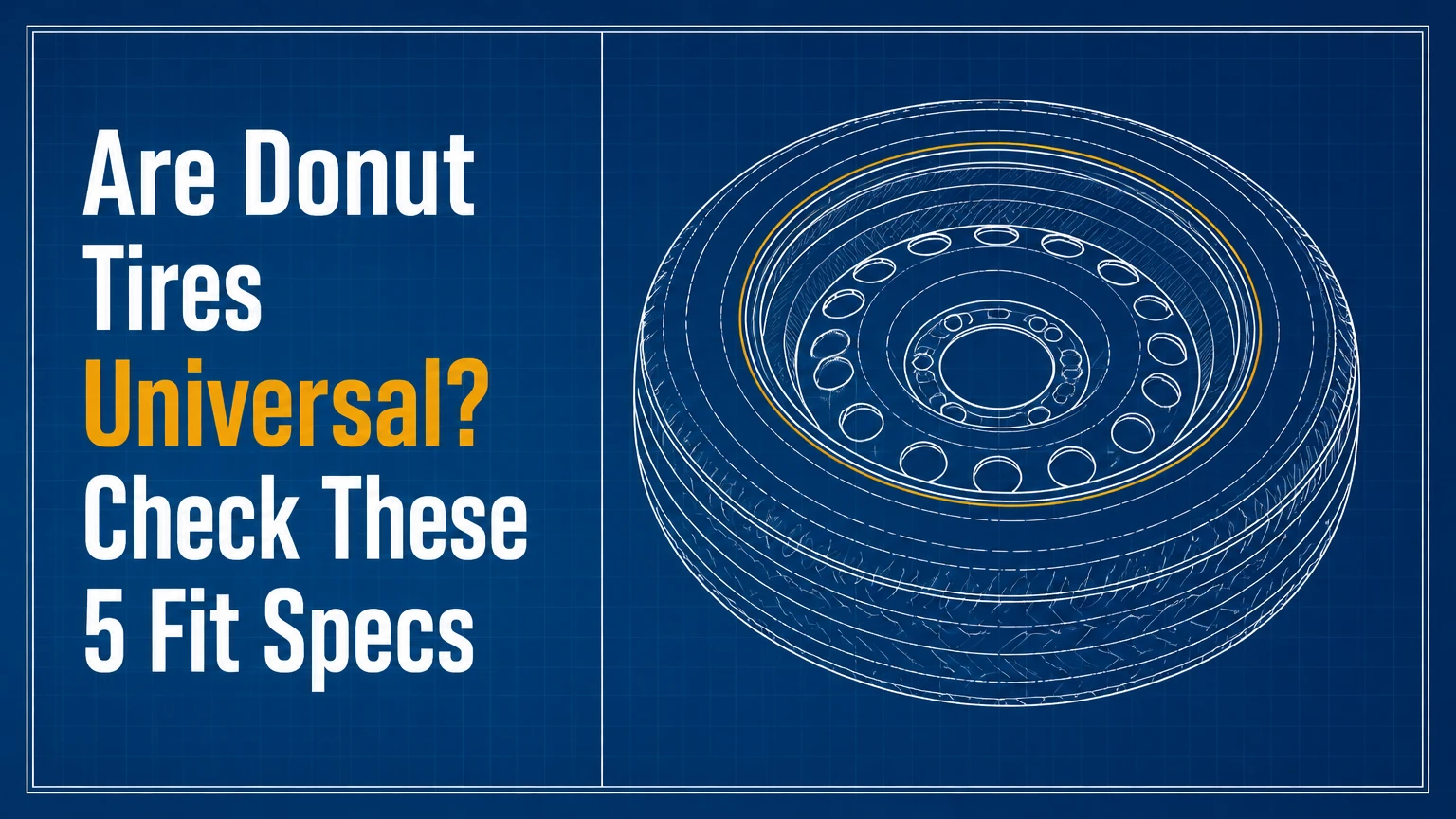
No, donut tires are not universal. A donut tire, also called a compact temporary spare, must match your vehicle’s wheel fitment, brake clearance, load rating, and rolling circumference; a spare from another car may fail to bolt on or may damage the drivetrain. Always confirm the owner’s manual and the spare’s sidewall limits.
Key Facts at a Glance
A donut spare must match the vehicle’s bolt pattern, hub interface, offset, brake clearance, and load rating.
The correct inflation pressure is printed on the spare or vehicle label and commonly falls near 60 PSI.
Many temporary spares carry a maximum speed of 50 mph, or 80 km/h, but the vehicle label controls.
Temporary spares are for reaching a repair facility, not for normal commuting or long-distance travel.
AWD and some 4WD vehicles require special circumference limits, a matching full-size spare, or dealer guidance.
Tire age, cracks, corrosion, and pressure matter even when the spare has never touched the road.
Why Are Donut Tires Not Universal?
Donut tires are not universal because the wheel is an engineered interface, not merely a round tire with matching lug holes. The wheel must attach securely to the hub, clear the brake assembly, support the vehicle’s corner load, and maintain an acceptable rolling circumference for the drivetrain and electronic safety systems.
A compact spare from a 2018 Honda Civic, for example, may have a five-lug pattern that resembles a spare from another Honda or Toyota, yet the hub bore, offset, lug-seat design, or brake-caliper clearance can differ. A wheel that physically mounts is not automatically a safe wheel.
Temporary spares also use vehicle-specific tire dimensions. The sidewall may show a marking such as T125/70D16 or T135/80D17, but that marking identifies the tire, not every vehicle on which its wheel is safe. The rim width, offset, center bore, load index, and brake clearance still require confirmation.
What Does a Donut Tire Do?
A donut tire is a narrow, lightweight temporary spare designed to replace one damaged road wheel for a limited trip. Its narrow tread reduces trunk weight and storage volume, while its specialized construction permits a compact wheel-and-tire assembly.
A compact spare generally has less wet-weather grip, a shorter tread life, and less stable handling than a full-size road tire. Many use high inflation pressure, often around 60 PSI, because the small tire carries a substantial portion of the vehicle’s load.
The term “donut” describes the narrow appearance. It does not mean every donut has the same diameter, width, pressure, or wheel fitment.
Which Fitment Specifications Must Match?
Five major specifications must match: bolt pattern, hub bore, offset, brake clearance, and load capacity. A sixth check, lug-nut compatibility, is often overlooked because the original lug nuts may not seat correctly on a temporary steel wheel.
| Fitment specification | What it controls | Example or check |
|---|---|---|
| Bolt pattern, or PCD | Lug-hole count and circle diameter | 5×114.3 must match 5×114.3 |
| Center bore | Wheel location on the hub | 64.1 mm bore cannot safely center on a 66.1 mm hub |
| Offset | Inner and outer wheel position | ET45 may place the rim differently from ET35 |
| Brake clearance | Caliper and rotor space | 16-inch wheel may not clear a large 17-inch brake package |
| Load rating | Maximum supported corner load | Compare wheel and tire ratings with the door-jamb label |
| Lug-seat and thread | Nut engagement and clamping | M12x1.5 thread does not substitute for M12x1.25 |
Bolt pattern is the first filter, not the final answer. A 5×114.3 wheel has five lug holes arranged on a 114.3 mm pitch circle, but it can still have the wrong center bore or offset.
Center bore matters because a hub-centric wheel uses the vehicle hub to center the assembly. A wheel with a smaller bore cannot fit over the hub. A much larger bore may require a correctly engineered centering ring, although temporary-spare applications should follow the vehicle or wheel manufacturer’s instructions rather than improvisation.
Offset and brake clearance determine whether the spare touches suspension components, the strut, steering knuckle, or brake caliper. Measuring only the outside diameter misses these inner-clearance problems.
How Do You Confirm a Donut Will Fit?
Confirm a donut spare through the vehicle identification number, owner’s manual, original spare part number, wheel markings, and a fitment catalog that lists the exact year, trim, engine, drivetrain, and brake package. The door-jamb label supplies tire pressure and road-tire information, but it may not list every spare-wheel dimension.
Use this order:
- Identify the exact vehicle trim and drivetrain.
- Find the factory spare specification or part number.
- Compare bolt pattern, center bore, offset, wheel diameter, width, and lug hardware.
- Confirm brake-caliper clearance for that trim.
- Check tire load index and the spare-wheel load rating.
- Compare the spare’s rolling circumference with the manufacturer’s limit.
- Confirm the temporary spare’s pressure, speed, and distance instructions.
A tire shop can verify fitment with a catalog and physical clearance check. Do not rely on a marketplace listing that says “fits most vehicles.”
How Are Temporary Spares Different?
Temporary spare designs differ in storage method, operating limits, and vehicle application. A conventional compact spare arrives inflated on a narrow steel wheel; a collapsible spare stores flat and needs an approved compressor before use.
| Spare type | Typical construction | Main advantage | Main limitation |
|---|---|---|---|
| Compact temporary spare | Narrow tire on steel wheel | Ready to install quickly | Usually limited to 50 mph and short distance |
| Full-size matching spare | Road tire on matching wheel | Preserves normal circumference and handling | Requires more weight and storage space |
| Collapsible spare | Flat tire with compressor | Maximizes trunk capacity | Cannot be driven until inflated |
| Sealant and compressor kit | Sealant bottle and 12V compressor | Lightest storage solution | Cannot repair sidewall or large tread damage |
| Run-flat tire system | Reinforced road tire and TPMS | Can continue after pressure loss | Replacement cost and handling limits vary |
A collapsible spare is not interchangeable with a standard compact spare merely because both are temporary. The collapsible tire needs the specified inflation process, compressor, valve equipment, and operating instructions.
Some modern vehicles provide no spare at all. The manufacturer may instead supply sealant, a compressor, roadside assistance, or run-flat tires. Sealant generally cannot repair a sidewall cut, separated tread, bent wheel, or puncture beyond the kit’s stated size.
What Are the Typical Donut Tire Specifications?
Typical compact-spare limits are about 50 mph, 50-70 miles, 60 PSI, and $50-$150 for a tire alone, but those figures are not universal operating rules. The sidewall, vehicle placard, and owner’s manual override generic ranges because manufacturers set different limits for each vehicle.
| Metric | Typical compact-spare range | Where to verify |
|---|---|---|
| Inflation pressure | 50-60 PSI | Spare sidewall or vehicle manual |
| Maximum speed | 50 mph, 80 km/h | Spare sidewall or warning label |
| Intended distance | 50-70 miles | Owner’s manual |
| Tire-only price | $50-$150 | Tire retailer |
| Wheel-and-tire kit | $150-$300 | Vehicle-specific supplier |
| Replacement age concern | Inspect around 6 years, replace commonly by 6-10 years | DOT date and manufacturer guidance |
The 50-70-mile figure is a practical temporary range, not permission to drive that distance routinely. A nearby tire shop may be safe; a mountain pass, high-speed interstate trip, or remote trail is a different risk.
The 60 PSI figure is also typical, not mandatory. Some temporary spares specify a different pressure. Underinflation can overheat the tire and alter handling, while overinflation can reduce the contact patch and make the vehicle unstable.
Does a Donut Tire Have a Smaller Diameter?
A donut tire is usually narrower and lighter, but its overall diameter may be close to the original tire rather than dramatically smaller. Vehicle engineers often choose a temporary-spare diameter that limits drivetrain and electronic-system disruption while preserving trunk space.
The correct comparison is rolling circumference, not the rim diameter alone. A 17-inch compact spare can have a different tire diameter from a 17-inch road tire because tire sidewall height changes the total assembly size.
Measure only if the manufacturer provides a permissible difference. For AWD systems, even a modest circumference mismatch can create continuous speed differences between axles, increasing clutch or differential heat.
Can You Drive a Donut on Any Axle?
A donut can be used on the axle specified by the vehicle manufacturer, but axle placement is not universal. Front-wheel-drive vehicles often handle a front puncture differently because the temporary spare may have inadequate traction or may be incompatible with the front brake assembly.
For a typical front-wheel-drive vehicle with a front flat, the accepted procedure is often to move a full-size rear wheel to the front drive axle and install the donut on the rear. This preserves a full-size tire on the powered and steering axle, but the owner’s manual controls because some vehicles prohibit this maneuver.
Rear-wheel-drive cars may have different traction concerns. A temporary spare on the rear drive axle can reduce acceleration grip, while a front-mounted spare can affect steering and braking. Four-wheel-drive systems may impose stricter rules.
Never place a spare on an axle where its wheel does not clear the brake caliper. Do not rotate wheels automatically without checking directional-tire requirements, staggered wheel sizes, or different front and rear tire specifications.
Can You Use a Donut on AWD or 4WD?
AWD and 4WD vehicles require manufacturer-specific guidance because unequal tire circumference can keep the center coupling, transfer case, or differentials compensating continuously. Some vehicles permit a temporary spare only on one axle or for a very short distance; others prohibit it entirely.
The risk depends on the drivetrain design. A part-time 4WD system may need 4WD disengaged on dry pavement, while an always-on AWD system may monitor wheel-speed differences and generate warning lights. Tire circumference tolerance varies by vehicle, so a generic “a few miles is fine” rule is unsafe.
| Vehicle situation | Safer default | Reason |
|---|---|---|
| FWD with front flat | Follow manual, often move rear full-size tire forward | Keeps full-size tire on steering and drive axle |
| RWD with rear flat | Verify rear axle load and traction guidance | Rear axle carries drive torque |
| Always-on AWD | Use matching full-size spare when specified | Limits coupling and differential speed difference |
| Part-time 4WD | Keep 4WD disengaged unless manual permits it | Prevents driveline wind-up on high-grip surfaces |
| Staggered performance car | Use only approved spare position | Front and rear sizes may be intentionally different |
If an AWD vehicle has a flat, read the manual before driving away. A tow may cost less than a transfer-case repair.
Donut Tire Versus Full-Size Spare: Which Is Better?
A full-size matching spare is better for long-distance, rural, AWD, towing, severe-weather, and frequent-driving use. A compact spare is better for vehicles where trunk space and weight matter, provided the driver can reach a repair facility promptly.
| Decision factor | Compact donut | Full-size matching spare | Best choice |
|---|---|---|---|
| Typical maximum speed | 50 mph | Vehicle road-tire limit | Full-size |
| Storage volume | Small, often under trunk floor | Large, sometimes cargo-area mounted | Donut |
| Short emergency trip | 50-70 miles typical | Normal temporary use possible | Depends on vehicle |
| AWD circumference control | Often restricted | Closest factory match | Full-size |
| Weight to lift | Commonly 20-35 lb | Commonly 35-60 lb | Donut |
| Wet-weather handling | Reduced tread and stability | Normal tire design | Full-size |
| Typical wheel-and-tire cost | $150-$300 | Often $250-$600 or more | Donut |
| Long-term road use | Not permitted | Suitable if maintained | Full-size |
A full-size spare still needs correct pressure and age inspection. A full-size tire that is six years old, cracked, or underinflated is not automatically safer than a maintained compact spare.
Who Should Choose a Full-Size Spare?
Choose a full-size matching spare if the vehicle travels far from tire shops, carries heavy loads, uses AWD, has staggered tires, or regularly drives through snow and rain. A full-size spare also makes sense for vehicles with fragile low-profile tires and expensive specialty replacements.
Cargo space is the main penalty. Confirm that the wheel fits the spare well, the retaining hardware secures it, and the vehicle’s tire-pressure monitoring system can recognize the sensor.
How Do You Install a Donut Safely?
Install a compact spare on level, stable ground using the vehicle’s marked jack point, then torque the lug nuts to the manual’s specification. The job typically takes 20-30 minutes, but traffic exposure, soft ground, damaged studs, and roadside weather can make roadside assistance safer.
- Move away from traffic. Turn on hazard lights, engage the parking brake, select Park or first gear, and place warning triangles if local conditions permit.
- Secure the vehicle. Chock a wheel opposite the flat, remove the spare and tools, and keep the jack on solid ground.
- Loosen the lug nuts. Break each nut loose by about half a turn before lifting the vehicle. Do not remove them.
- Raise at the marked jack point. Lift until the damaged tire clears the ground. Never place any part of your body beneath a vehicle supported only by a jack.
- Mount the spare. Remove the nuts, pull off the wheel, install the donut, and hand-thread every nut to prevent cross-threading.
- Lower and tighten. Lower the vehicle until the spare contacts the ground, then tighten in a star pattern to the specified torque.
- Check before moving. Confirm pressure, tool removal, lug security, warning lights, and clearance. Drive directly to a repair facility.
The success checkpoint is firm, even lug-nut seating with no wheel wobble or contact noise. A common mistake is using an impact tool without a torque check, which can damage studs or leave the wheel insufficiently clamped.
What Problems Can a Donut Cause?
A donut can reduce braking and cornering performance, activate ABS or traction-control warnings, increase stopping distance, and strain a drivetrain when the temporary tire differs substantially from the other tires. These risks increase with speed, rain, snow, heavy loading, and abrupt steering.
Why Does a Donut Affect ABS and Handling?
ABS and traction control compare wheel-speed signals to detect slip. A smaller rolling circumference rotates more times per mile, so the system may interpret the difference as wheel slip or a sensor fault, while the narrow tread supplies less lateral grip.
The vehicle may brake safely enough for a controlled trip, but emergency stopping behavior changes. Avoid hard cornering, sudden lane changes, cruise-control use on slippery roads, and heavy cargo beyond the vehicle’s load limit.
Can You Drive in Rain or Snow?
A compact spare can be driven in light rain only with substantially reduced speed and increased following distance, while snow and ice may make a temporary spare unsuitable. Shallow tread and a narrow contact patch reduce water evacuation and winter traction.
If conditions are severe, stop in a safe location and request a tow. The 50 mph maximum is an upper limit under favorable conditions, not a target for wet or icy roads.
How Long Can a Donut Stay in Storage?
Inspect a stored donut at every oil change or at least twice yearly, and replace it according to the tire manufacturer’s age guidance, commonly around 6-10 years. Check the DOT date code, sidewall cracks, tread damage, valve condition, wheel corrosion, and pressure.
A spare can lose pressure while unused. TPMS may not monitor a spare stored in the trunk, and some systems require sensor relearning after installation. A pressure gauge is therefore necessary even when the dashboard shows no warning.
What If the Correct Donut Is Unavailable?
If no verified spare fits, use roadside assistance or a tow rather than testing a random wheel. A tire plug, sealant kit, or used spare may be appropriate only when the damage and vehicle instructions support that solution.
Before buying a used compact spare, inspect:
- DOT date code and storage history.
- Sidewall cracking, bulges, punctures, and exposed cords.
- Wheel flange damage, bent steel, and severe corrosion.
- Correct lug-seat shape and thread engagement.
- Tire pressure and load index.
- Part number, bolt pattern, center bore, offset, and brake clearance.
A used spare with an unknown history can fail from age-related rubber deterioration even if its tread appears unused. A vehicle-specific new kit usually costs more, but it reduces fitment uncertainty.
The Bottom Line
Are donut tires universal? No. A compact temporary spare is safe only when its wheel and tire match the vehicle’s attachment pattern, hub interface, brake clearance, load requirement, rolling circumference, and manufacturer operating limits.
Use the factory spare or an exact vehicle-specific replacement, verify pressure before driving, keep speed at or below the stated limit, and travel only to a repair facility. AWD owners, rural drivers, and frequent long-distance travelers should strongly consider a matching full-size spare.
FAQ
Can I use a donut tire with a different brand of tire?
Yes, brand matching is usually less important than correct fitment and operating limits, but the temporary spare must have the specified size, load rating, wheel dimensions, and circumference. The vehicle manufacturer may impose additional restrictions for AWD, ABS, staggered tires, or performance vehicles.
Can I put a larger donut tire on my car?
Do not install a larger temporary spare unless the vehicle manufacturer or a qualified fitment source approves it. A larger assembly can contact the suspension or body, alter wheel-speed readings, exceed clearance, or create a front-to-rear circumference mismatch.
Will a donut tire damage my transmission?
A donut can contribute to drivetrain damage when its rolling circumference differs significantly from the other tires, especially on AWD vehicles or when driven beyond the manual’s limits. A brief, slow trip with an approved spare is normally the intended use, but the vehicle manual determines the acceptable distance.
Does every donut tire need 60 PSI?
No. Many compact spares specify about 60 PSI, but the correct pressure is the number printed on that spare’s sidewall or listed in the owner’s manual. Standard road-tire pressure from the door placard may not apply to the temporary spare.
Can I replace only the donut tire and keep the original wheel?
Usually, yes, if the wheel is undamaged and the replacement tire has the exact approved size, construction, load rating, and speed rating. A tire shop should inspect the wheel, valve, and bead seat before mounting a replacement compact-spare tire.
Is a tire repair kit better than a donut?
A repair kit is lighter and saves storage space, but it cannot fix sidewall damage, a bent wheel, a large puncture, or a separated tire. A donut offers a more dependable temporary solution when it fits correctly, while roadside assistance may be the safest option for severe damage or hazardous conditions.