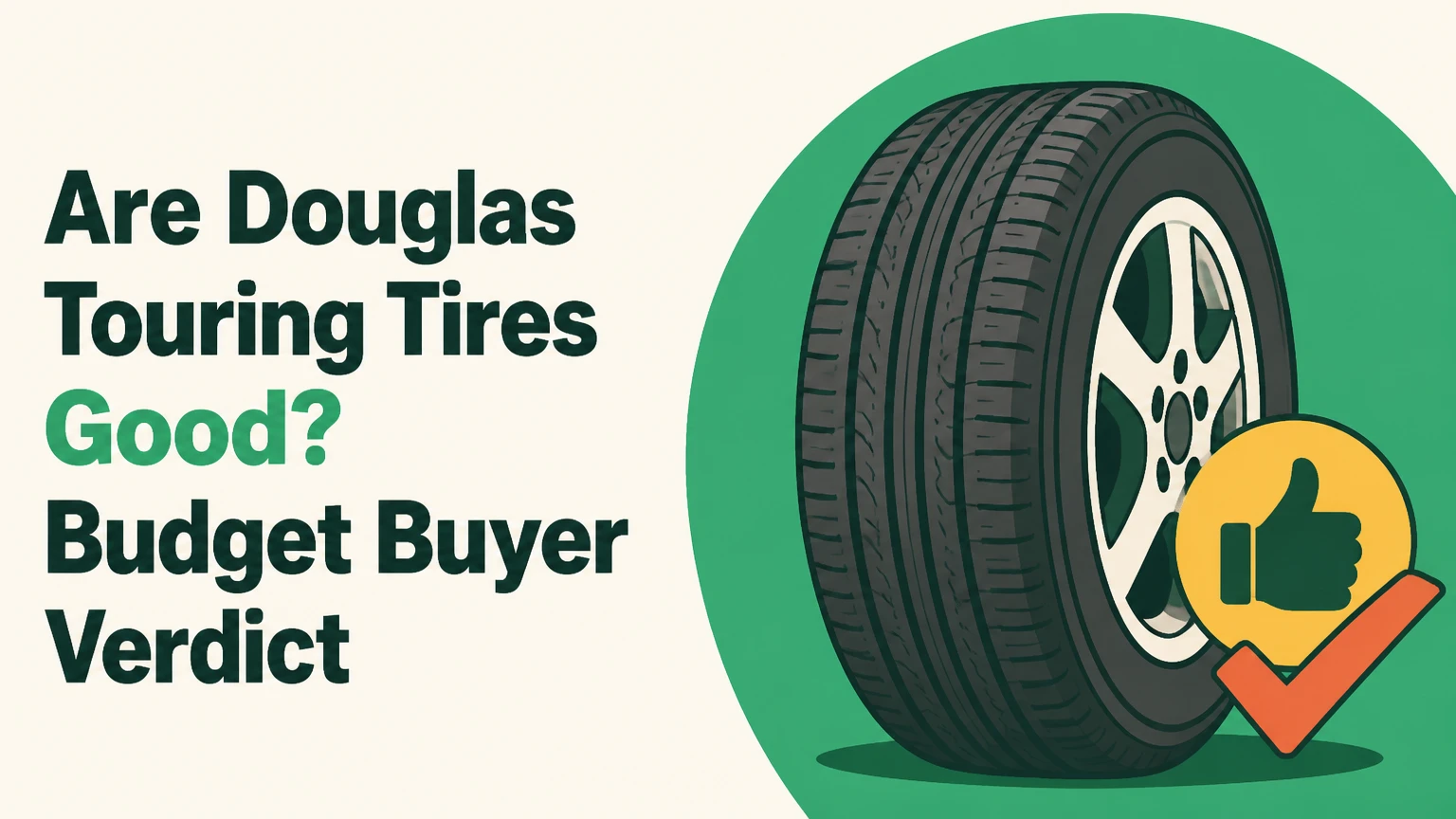
Douglas Touring A/S tires are good for cost-conscious drivers who need new, properly matched tires for ordinary city, suburban, and moderate highway use. They offer acceptable dry-road comfort and basic wet-weather traction at a low price, but they do not match premium tires for braking, tread life, winter grip, noise control, or high-speed handling.
Key Facts at a Glance
- Douglas Touring A/S is a budget all-season touring tire line sold primarily through Walmart and Walmart.com.
- Typical pricing is about $60-$105 per tire, with many four-tire installed purchases landing near $350-$450 before variable taxes or add-ons.
- A commonly listed treadwear warranty is 45,000 miles, although the exact warranty depends on the tire model and current product documentation.
- Realistic service life is often approximately 30,000-40,000 miles when alignment, inflation, rotation, and vehicle condition are satisfactory.
- Douglas Touring tires are suitable for light snow, but they are not dedicated winter tires and may lack the Three-Peak Mountain Snowflake certification.
- The correct tire size, load index, speed rating, inflation pressure, and DOT production date matter more than the low purchase price.
What Are Douglas Touring A/S Tires?
Douglas Touring A/S tires are entry-level, all-season touring tires intended for passenger cars, minivans, and some smaller crossovers. The Douglas name is a Walmart private-label brand, so the retail relationship is more important than treating Douglas as a standalone premium tire manufacturer with a broad independent dealer network.
“Touring” describes the intended balance: reasonable ride comfort, everyday steering response, and usable traction across dry pavement, rain, and limited snow. “All-season” does not mean equal performance in every season. The category prioritizes moderate versatility over the cold-weather grip of a winter tire or the sharper response of a performance tire.
Douglas product listings vary by size and specification. A Douglas Touring A/S in 205/55R16 may have a different speed rating, load index, tread pattern revision, or warranty language from a Douglas tire in 225/60R16. Verify the exact sidewall markings and product listing instead of applying one specification to every Douglas Touring tire.
Who Makes Douglas Tires?
Douglas tires have long been associated with Goodyear manufacturing and Goodyear’s Kelly-Springfield operations, but a brand association does not mean every Douglas tire has the same compound, testing program, construction, or performance as a Goodyear Assurance or Michelin Defender. Manufacturing origin can also vary by product and production period.
The reliable way to identify a particular tire’s origin is its sidewall and DOT Tire Identification Number. The final four digits identify the week and year of manufacture, such as 3524 for the 35th week of 2024. The DOT code helps establish age, but it does not by itself prove quality or suitability.
How Do Douglas Touring Tires Perform?
Douglas Touring A/S tires perform adequately for routine driving because their tread design uses circumferential channels for water evacuation, lateral grooves for edge control, and sipes that create additional biting edges. The design addresses ordinary transportation needs, but its budget construction leaves less margin during hard braking, standing water, freezing temperatures, and aggressive cornering.
The practical verdict is narrower than “safe” or “unsafe.” A new Douglas tire with correct fitment, good inflation, and a healthy vehicle is generally a more defensible choice than a worn or aged used tire. However, a premium tire usually delivers shorter wet-braking distances, more predictable handling, and better wear consistency when conditions become difficult.
Dry-Road Ride and Handling
Douglas Touring tires usually provide a compliant ride on ordinary roads, particularly on family sedans with moderate sidewall height. Their softer response can reduce impact harshness over patched pavement, but the same flexibility may make steering feel less immediate during quick lane changes.
Drivers of a Toyota Corolla, Honda Civic, Chevrolet Malibu, or similar vehicle will normally notice adequate commuting behavior rather than sporty precision. Drivers of a BMW 3 Series, performance sedan, or heavily loaded crossover may notice more sidewall movement and less steering accuracy.
Wet-Road Performance
Douglas Touring tires are acceptable in routine rain when the tread is new and the vehicle is driven conservatively. Circumferential grooves help move water away from the contact patch, while tread sipes create edges that support traction on damp pavement.
Wet performance declines as tread depth falls, inflation becomes incorrect, or water depth increases. A tire that feels fine in light rain can hydroplane sooner in standing water than a premium tire with a more advanced compound and tread design. Reduce speed in heavy rain, keep both hands available for steering corrections, and replace tires before the wear bars become level with the tread.
Light Snow and Freezing Temperatures
Douglas Touring A/S tires can provide limited traction in light snow, but they are not a substitute for winter tires. All-season rubber becomes less flexible as temperatures fall, and the tread cannot generate the same ice and packed-snow grip as a winter compound.
Look for the Three-Peak Mountain Snowflake symbol on the sidewall if severe-snow certification matters. The symbol identifies a tire that meets a defined severe-snow traction performance requirement; the absence of the symbol means the tire should not be treated as a severe-winter product. In regions with frequent ice, mountain travel, or repeated snowfall, use dedicated winter tires or a certified all-weather tire.
Which Douglas Touring Specifications Matter?
The correct Douglas Touring tire is the one that matches the vehicle placard and manufacturer requirements, not simply the one with the lowest price. Check the driver-door placard for tire size and cold inflation pressure, then match the load index and speed rating shown for the vehicle.
A marking such as 205/55R16 91H contains several separate facts:
- 205 is the nominal section width in millimeters.
- 55 is the sidewall height as a percentage of width.
- R identifies radial construction.
- 16 is the wheel diameter in inches.
- 91 is the load index.
- H is the speed rating.
| Specification | Example | What it controls | Buyer rule |
|---|---|---|---|
| Tire size | 205/55R16 | Width, sidewall, wheel fitment | Match the door placard |
| Load index | 91 | Maximum load per tire | Never install below the placard rating |
| Speed rating | H | Rated speed category | Match or exceed the vehicle requirement |
| XL construction | Extra Load | Higher permitted load at specified pressure | Use only when vehicle fitment allows it |
| UTQG treadwear | 500 | Relative wear index | Compare within the same manufacturer system |
| DOT date | 3524 | 35th week of 2024 | Prefer fresh inventory and inspect older stock |
UTQG ratings require careful interpretation. A 500 treadwear grade does not promise 500,000 miles, and a 700-rated tire will not necessarily last 40 percent longer in every vehicle. The rating is a comparative test value, while alignment, pressure, rotation, temperature, road surface, and driving style determine actual wear.
How Long Do Douglas Touring Tires Last?
Douglas Touring tires commonly last about 30,000-40,000 miles in everyday service, although the 45,000-mile limited treadwear warranty is a different figure with conditions. A warranty maximum is not a mileage guarantee, and improper alignment, underinflation, suspension damage, or missed rotations can reduce service life sharply.
A high-mileage driver should calculate cost per usable mile rather than comparing only the checkout price. For example, a $280 set that lasts 35,000 miles costs about 0.8 cents per mile before installation. A $600 set lasting 65,000 miles costs about 0.92 cents per mile, so the premium tire may cost more per mile while offering better wet braking, quieter wear, or longer replacement intervals.
| Driving pattern | Typical Douglas service life | Main wear risk | Better buying approach |
|---|---|---|---|
| City trips, smooth roads | 30,000-40,000 miles | Braking and curb impacts | Budget tire can be reasonable |
| 15,000 highway miles annually | 2-3 years | Noise and irregular wear | Compare a 60,000-80,000-mile tire |
| Aggressive cornering | 20,000-30,000 miles | Shoulder wear | Choose stronger touring or performance rubber |
| Poor alignment | Under 10,000-20,000 miles | One-sided tread loss | Repair alignment before installation |
| Seasonal low use | 5-7 years by age limit | Rubber aging | Inspect age, cracks, and storage conditions |
Replace a tire when tread reaches the legal limit in your jurisdiction, when damage cannot be repaired, or when age-related cracking appears. Many tire manufacturers advise inspection after six years and replacement around ten years from manufacture, regardless of remaining tread, but the tire maker’s own age guidance should control.
What Do Douglas Touring Tires Cost Installed?
Douglas Touring tires typically cost about $60-$105 each, while a four-tire purchase with mounting and balancing often totals approximately $350-$450 before local taxes and optional protection. The final invoice can include installation, valve stems, tire disposal, road-hazard coverage, TPMS service, taxes, and alignment.
Walmart installation pricing changes by store and service package, so check the current local quote rather than relying on a national estimate. A road-hazard plan may be useful for drivers who regularly encounter potholes, construction debris, or poorly maintained urban roads, but its exclusions and replacement-credit rules deserve review before purchase.
| Tire size example | Typical tire price | Four tires before services | Common vehicle examples |
|---|---|---|---|
| 175/65R14 | $60-$70 | $240-$280 | Older compact cars |
| 205/55R16 | $70-$90 | $280-$360 | Civic, Corolla, Jetta |
| 225/60R16 | $75-$95 | $300-$380 | Accord, Malibu, Camry |
| 225/65R17 | $85-$105 | $340-$420 | CR-V, RAV4, Escape |
| 235/55R17 | $90-$105 | $360-$420 | Larger sedans and crossovers |
A low tire price does not justify skipping alignment. A four-wheel alignment commonly costs more than the tread destroyed by a few thousand miles of misalignment, particularly on a front-wheel-drive car that already places heavy wear on the front axle.
How Should You Buy and Install Douglas Touring Tires?
Buy Douglas Touring tires only after confirming vehicle fitment, tire age, local installation terms, and the final out-the-door price. The process normally takes 1-3 hours if the tires are in stock, although shipping, appointment availability, and alignment work can extend the visit.
- Read the door placard. Record the exact size, load index, speed rating, and recommended cold pressure. Do not use the maximum pressure molded into the sidewall as the vehicle’s normal setting.
- Inspect the online listing. Confirm the exact Douglas model, size, rating, warranty, seller, and available DOT date information.
- Compare the complete invoice. Add mounting, balancing, valve stems, disposal, taxes, TPMS service, road-hazard coverage, and alignment if needed.
- Install four matching tires when possible. Replacing only one tire can create tread-depth and handling differences; if replacing two, the deeper-tread pair generally belongs on the rear axle.
- Check the finished work. Confirm the cold pressures, valve caps, wheel torque, TPMS operation, and absence of vibration during a controlled test drive.
- Schedule rotation. A practical interval is every 5,000-7,500 miles, or the vehicle manufacturer’s specified interval.
You will know the installation succeeded when the steering wheel remains centered, the vehicle tracks straight, the TPMS warning clears, and no vibration appears between roughly 55 and 75 mph. A new tire should not require a “break-in” period to correct a persistent shake.
Douglas Versus Alternative Tires
Douglas Touring tires win on purchase price, while mid-range and premium tires usually win on wet braking, noise control, tread longevity, and consistency. The best alternative depends on whether the driver values minimum initial cost, long annual mileage, snow traction, or vehicle handling.
| Option | Typical set price before installation | Typical warranty range | Best use | Main limitation |
|---|---|---|---|---|
| Douglas Touring A/S | $240-$420 | About 45,000 miles | Basic commuting | Shorter life and weaker severe-weather margin |
| General Altimax RT45 | $400-$600 | Often 65,000-75,000 miles | High-mileage family cars | Higher initial purchase cost |
| Goodyear Assurance All-Season | $450-$700 | Model-dependent, often 65,000 miles | Mainstream daily driving | More expensive than Douglas |
| Michelin Defender2 | $650-$900 | Commonly up to 80,000 miles | Long-term ownership | Highest upfront cost |
| Certified all-weather tire | $550-$850 | Model-dependent | Frequent snow with one tire set | More road noise or rolling resistance |
| Dedicated winter tire | $500-$900 plus wheels | Usually limited mileage coverage | Ice and recurring snow | Requires seasonal changes and storage |
Douglas Versus Goodyear-Branded Tires
A Goodyear-branded tire generally offers a broader engineering program, more detailed independent testing coverage, stronger warranty support, and a larger range of compounds and constructions. Douglas may share a corporate or manufacturing connection with Goodyear, but buyers should not assume identical wet braking, casing design, tread life, or quality level.
Choose Goodyear when the vehicle regularly travels at highway speeds, carries heavy loads, or faces frequent rain. Choose Douglas when the vehicle is older, annual mileage is low, and the purchase budget is the dominant constraint.
Douglas Versus Michelin
Michelin touring tires usually provide a quieter ride, more stable handling, stronger wet-weather performance, and longer projected tread life. The price difference can exceed $300 for a set, which may be difficult to justify on an older vehicle with low resale value.
Michelin becomes more rational when the car is retained for several years, travels 20,000 or more miles annually, or carries occupants on long highway journeys. Douglas remains rational when replacing tires prevents a financially disruptive repair delay and driving conditions are moderate.
Who Should Buy Douglas Touring Tires?
Douglas Touring tires suit low- to moderate-mileage drivers who need affordable replacement tires for an ordinary passenger vehicle and do not routinely drive through severe winter weather. They are a practical option for an older Corolla, Civic, Sentra, or similar car when the tire size and rating match the placard.
Good Fit for These Drivers
- Budget commuter: Drives 8,000-12,000 miles annually on city and suburban roads.
- Student or first-car owner: Needs four new tires without the cost of a premium set.
- Lease-return driver: Needs compliant, correctly sized replacement tires for a short remaining ownership period.
- Older-car owner: Has a vehicle worth modestly more than a premium tire set and plans ordinary local use.
- Temporary transportation buyer: Needs predictable mobility for one or two years.
Poor Fit for These Drivers
- High-mileage highway driver: Drives 20,000 or more miles annually and values low noise and long replacement intervals.
- Mountain or snow-belt driver: Frequently encounters ice, packed snow, steep grades, or temperatures below freezing.
- Performance-car owner: Needs precise steering response, high lateral grip, or manufacturer-specific handling balance.
- Heavy-load user: Regularly carries maximum passengers, cargo, or trailer loads without confirming the correct load rating.
- Emergency-response driver: Needs the shortest available wet or dry stopping distance.
The honest limitation is simple: Douglas Touring A/S tires are transportation tires, not performance equipment. They can be a responsible budget purchase, but choosing them for a luxury sedan or severe-weather commute trades away capability that may matter more than the initial savings.
What Problems Should You Watch For?
The most common Douglas Touring tire complaints involve noise, vibration, irregular wear, and reduced snow traction. Those symptoms do not automatically prove a tire defect, because wheel balance, alignment, shocks, tire pressure, bent rims, and worn suspension parts can create the same behavior.
| Symptom | Likely cause | Immediate check | Appropriate remedy |
|---|---|---|---|
| Steering-wheel shake at 55-75 mph | Wheel imbalance or bent rim | Recheck balance and rim runout | Rebalance, repair, or replace |
| Humming that changes with speed | Cupping or heel-toe wear | Inspect tread by hand | Rotate, align, inspect shocks |
| One shoulder worn smooth | Toe or camber misalignment | Compare both front tires | Alignment and suspension repair |
| Pulling to one side | Pressure difference or alignment | Measure all four cold pressures | Correct pressure, then align |
| Poor snow traction | All-season limitations or low tread | Check symbol and tread depth | Slow down or use winter tires |
| Repeated pressure loss | Puncture, bead leak, or valve fault | Soap-test valve and tread | Repair if eligible or replace |
A new tire that vibrates after balancing should receive a road-force or uniformity check, when available. Ask the installer to inspect for an out-of-round tire and bent wheel instead of accepting repeated balancing as the only diagnosis.
Expert Maintenance Rules
Inflation controls wear more than brand reputation. Underinflation increases heat and shoulder wear, while overinflation reduces the contact patch and can make the ride harsher. Check pressures monthly with a gauge when the tires are cold.
Rotation cannot repair an alignment problem. Rotation redistributes wear, but it does not correct toe, camber, worn tie rods, bent control arms, or failing struts. If one edge is disappearing, diagnose the vehicle before installing another tire.
Rear-axle placement matters in wet handling. When only two tires are replaced, placing the deeper-tread pair on the rear generally helps preserve rear stability on wet roads, even on front-wheel-drive vehicles. Follow the tire shop’s fitment procedure and the vehicle manufacturer’s guidance.
Are Douglas Touring Tires Good for Your Car?
Douglas Touring tires are good enough for a low-cost, ordinary-use vehicle when the correct size and rating are installed and the car is mechanically sound. They are not the best choice for severe winter climates, high annual mileage, performance driving, or owners who prioritize maximum wet braking and long tread life.
Use this decision test:
- Check climate: Choose another category if snow and ice are routine.
- Check annual mileage: Compare long-warranty tires above roughly 15,000-20,000 miles per year.
- Check vehicle condition: Repair alignment, suspension, wheel, or TPMS faults first.
- Check total cost: Compare the complete installed price, not the tire-only listing.
- Check fitment: Match size, load index, speed rating, and pressure requirements.
- Check age: Reject unusually old inventory and inspect the DOT code.
Frequently Asked Questions
Are Douglas tires safe for highway driving?
Douglas Touring tires can be used for normal highway driving when their speed rating, load index, inflation, and condition meet the vehicle requirements. They are less suitable for frequent high-speed travel because budget tires may provide less steering precision, wet-road margin, and noise control than premium touring tires.
Are Douglas tires good in the rain?
Douglas Touring tires provide basic rain performance through circumferential water channels and tread sipes, but they are not class leaders for wet braking or hydroplaning resistance. Slow down in standing water, maintain the door-placard pressure, and replace the tires before tread reaches the wear bars.
Can Douglas Touring tires fit a Toyota Corolla or Honda Civic?
Douglas Touring tires can fit a Toyota Corolla or Honda Civic only when the exact size, load index, and speed rating match the vehicle’s placard or an approved fitment. Common sizes include 205/55R16, but model year, trim, wheel diameter, and regional specification can change the required tire.
Should I buy Douglas tires instead of used tires?
New Douglas tires are usually a safer budget choice than unknown used tires because new tires have unused tread and no hidden repair or age history. A used tire can be acceptable only when its DOT date, tread depth, repair history, sidewalls, and internal condition are professionally verified.
How often should Douglas Touring tires be rotated?
Rotate Douglas Touring tires about every 5,000-7,500 miles unless the vehicle manufacturer specifies a different interval. Rotate sooner if front-tire wear is visibly faster, the tread develops a sawtooth pattern, or the vehicle has front-wheel drive and heavy urban use.
What is the best alternative to Douglas Touring tires?
The best alternative depends on the problem the Douglas tire cannot solve. General Altimax or Goodyear Assurance tires better suit higher mileage, Michelin Defender tires suit long-term ownership, certified all-weather tires suit frequent snow, and dedicated winter tires suit recurring ice and severe winter roads.
The Bottom Line
Are Douglas Touring tires good? Yes, for the right driver: a budget-conscious owner of a normal passenger car who drives moderately, maintains the vehicle, and faces mostly dry, wet, or lightly snowy roads. Douglas Touring tires are not equivalent to premium Goodyear or Michelin products, despite their Goodyear association, and they usually surrender tread life, wet-weather margin, quietness, and winter capability to reach the lower price.
Choose Douglas when the complete installed cost is the deciding factor and the vehicle’s use is ordinary. Choose a mid-range, premium, all-weather, or winter tire when annual mileage, highway exposure, severe weather, or handling performance makes the added capability worth paying for.