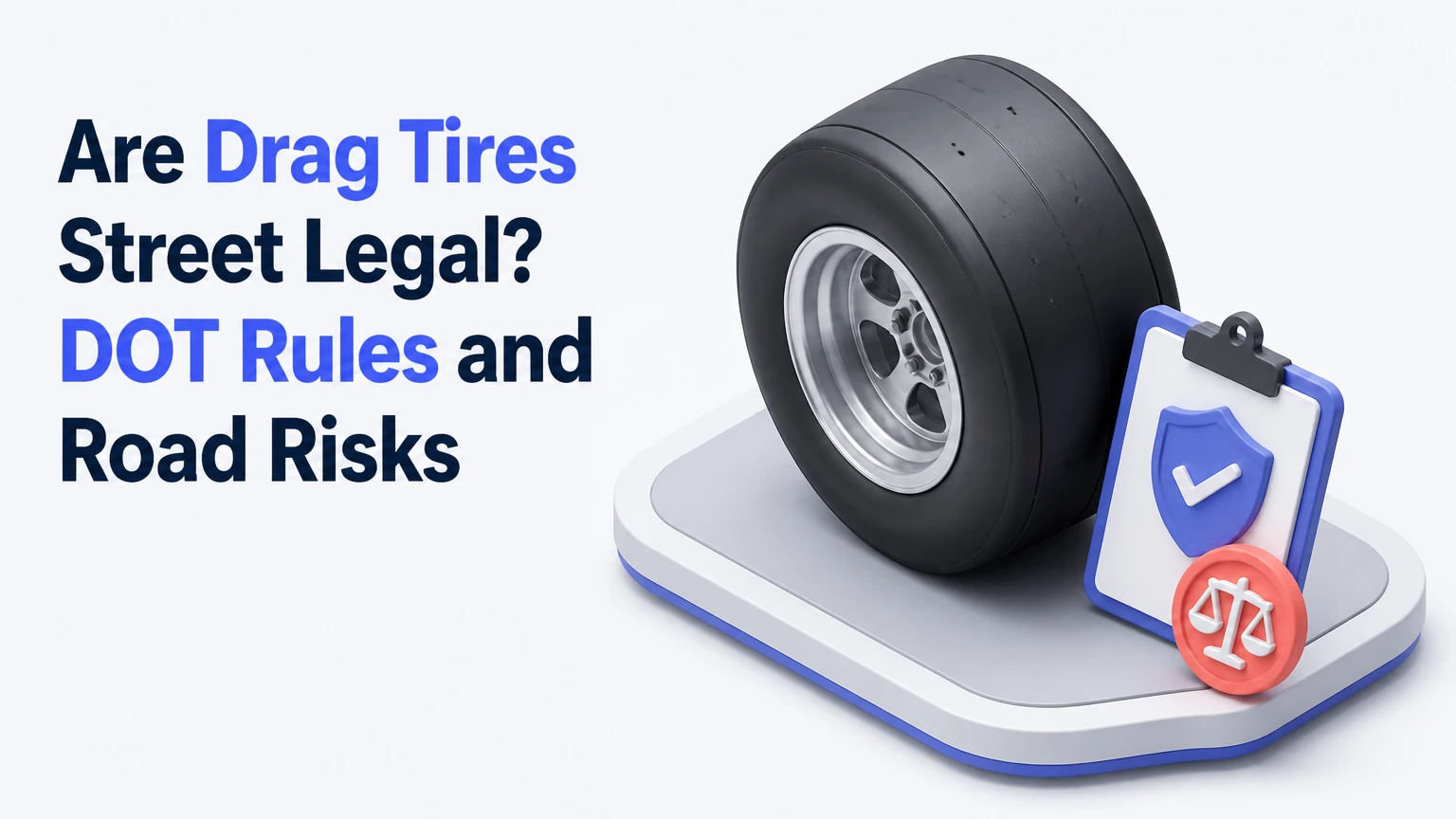
Some drag tires are street legal in the United States, but a DOT marking alone does not guarantee legal road use everywhere. A DOT-marked drag radial or qualifying cheater tire may be used on public roads when its manufacturer permits highway use and the tire meets federal, state, vehicle, inspection, load, speed, and equipment requirements. Full racing slicks marked “Not for Highway Use” are not street legal.
Key Facts at a Glance
- A DOT symbol identifies a tire manufactured to applicable U.S. tire safety requirements; it is not a government-issued approval certificate for every driving situation.
- A full drag slick with no usable grooves and a “Not for Highway Use” marking is intended for closed-course racing, not public roads.
- DOT drag radials are usually legal only in dry, controlled conditions from a safety perspective, because shallow tread clears water poorly.
- State law can impose requirements beyond federal tire construction rules, including minimum tread, visible wear bars, load capacity, speed rating, and inspection compliance.
- Tire-maker instructions control the approved pressure, temperature range, wheel fitment, and highway-use status for a specific model.
- A second wheel set or a trailer is often safer and less expensive than commuting daily on a competition compound.
What Does Street Legal Mean for a Drag Tire?
Street legality means a tire can lawfully be operated on public roads under the applicable federal, state, and local rules. For a drag tire, that conclusion requires more than finding “DOT” molded into the sidewall.
The federal framework comes from the National Highway Traffic Safety Administration, or NHTSA, through Federal Motor Vehicle Safety Standards such as FMVSS No. 109 for many passenger-car tires and FMVSS No. 139 for newer radial light-vehicle tires. The manufacturer certifies compliance and places the required markings on the tire. NHTSA does not generally pre-approve each consumer tire before sale.
A legal road tire also needs suitable size, load capacity, speed rating, wheel compatibility, and vehicle clearance. State rules may require a minimum tread depth, intact tread across specified grooves, matching tires on an axle, and equipment that passes inspection. A tire can therefore carry a DOT marking and still be unsuitable or unlawful for a particular vehicle or state.
How Do You Verify a Drag Tire’s Road Status?
Verify the exact model’s sidewall and manufacturer documentation before mounting it. Look for a DOT tire identification number, size and load markings, speed information, and the absence of a “Not for Highway Use” or equivalent race-only warning.
Use this verification sequence:
- Identify the complete model name and size.
- Read the manufacturer’s technical page and warranty document.
- Confirm highway use is permitted, not merely DOT marked.
- Check the state’s tread, inspection, fender, and equipment rules.
- Confirm the tire’s load index and speed rating exceed the vehicle’s requirements.
- Inspect the date code, damage, wear bars, and sidewall condition.
A retailer’s label saying “DOT approved” is not enough. The model-specific manufacturer statement has greater practical value.
How Do Drag Radials Work on the Street?
A drag radial trades wet-weather and cornering capability for a larger, softer launch footprint. Its shallow tread, flexible sidewall, and heat-sensitive compound help transmit engine torque on dry pavement, but those same traits reduce water evacuation, steering precision, and service life.
A conventional performance tire uses multiple tread blocks and grooves to move water away from the contact patch. A drag radial has fewer grooves and more nearly continuous rubber, which increases dry-surface contact. The flexible sidewall can deform during acceleration, reducing the initial shock that would otherwise spin the tire.
Many competition compounds become more adhesive when warmed. At a drag strip, drivers use a controlled burnout to remove debris and raise tread temperature. That procedure does not make a drag radial safer on a wet public road, and a burnout on ordinary pavement can damage the tire, roadway, drivetrain, or surrounding property.
Why Does Sidewall Construction Matter?
Radial and bias-ply drag tires respond differently to acceleration, braking, steering, and road irregularities. A radial uses cords arranged primarily perpendicular to the direction of travel with belt reinforcement under the tread, while a bias-ply tire uses crossing cord layers that allow different carcass movement.
Bias-ply cheater slicks can wrinkle more aggressively at launch, which benefits some manual-transmission race cars. On the street, the same construction can feel vague during lane changes and can interact poorly with radial tires elsewhere on the vehicle. Follow the vehicle and tire manufacturer’s mixing instructions rather than assuming a DOT marking resolves the handling issue.
Which Drag Tires Are Legal?
DOT drag radials are the most common street-strip option, while some DOT-marked cheater or Quick Time tires may qualify for limited road use. Full drag slicks are race tires and should be treated as illegal for public roads, regardless of whether a seller describes them as “streetable.”
| Tire category | Typical construction | Road-use status | Main limitation |
|---|---|---|---|
| DOT drag radial | Steel or nylon-belted radial, shallow grooves | Potentially legal if highway use is allowed | Poor wet traction and rapid wear |
| DOT bias-ply cheater slick | Cross-ply nylon carcass, limited grooves | Model and jurisdiction dependent | Wandering, mixed-construction risk |
| Full drag slick | Unbelted or specialized race casing, no grooves | Not legal for public roads | No water evacuation and race-only marking |
| Extreme-performance street tire | Radial casing, full road tread | Generally road legal | Less launch grip than a drag compound |
Examples commonly sold for street-strip use include the Mickey Thompson ET Street S/S, Nitto NT555RII, and Toyo Proxes R series. Product names and sizes change, so verify the current sidewall and manufacturer specification before purchase. The Mickey Thompson ET Street R, for example, is a competition-oriented tire whose permitted use and operating conditions must be checked for the exact size and version.
Are Cheater Slicks Legal on Public Roads?
A DOT-marked cheater slick may be road legal in some circumstances, but the term “cheater slick” describes a design category rather than a universal legal classification. Shallow grooves, a DOT identification number, and a race-oriented carcass do not override a manufacturer’s highway-use warning or a state’s equipment rules.
Bias-ply street driving also creates a handling question. A vehicle with radial front tires and bias-ply rear tires may develop different response during braking, cornering, and lane changes. Many racers use a trailer or install the bias-ply race wheels at the track instead of commuting on them.
Are Drag Tires Street Legal in Every State?
No. United States drag-tire legality depends on the tire, vehicle, road, and jurisdiction. Federal compliance addresses tire manufacture and required performance standards, while states regulate vehicle equipment and road operation through statutes, inspection programs, and enforcement practices.
Check the following items with the state department of motor vehicles or inspection authority:
- Minimum legal tread depth and how the state measures it.
- Whether exposed wear bars, cuts, cords, bulges, or sidewall damage fail inspection.
- Required load rating and speed rating.
- Rules for tire size, fender coverage, protruding tread, and wheel spacers.
- Whether the vehicle must retain a particular tire type or manufacturer rating.
- Insurance consequences after a crash involving a race-oriented tire.
- Seasonal restrictions, especially in regions with snow, ice, or freezing temperatures.
A tire that passes a casual roadside inspection may still be a poor legal position after a collision. Keep the manufacturer’s documentation and use a road-oriented tire when weather or local rules are uncertain.
How Do Drag Radials Compare With Other Street Tires?
Drag radials provide more dry launch traction than ordinary street tires, but extreme-performance street tires remain the better all-weather compromise. Full slicks can provide the highest prepared-track grip, yet they lose the road features required for normal public-road operation.
| Attribute | Conventional street tire | DOT drag radial | Full drag slick |
|---|---|---|---|
| Typical usable tread depth | 8-11/32 inch | 4-7/32 inch | 0-2/32 inch |
| Typical dry launch grip | Moderate | Very high | Highest on prepared track |
| Wet-road water evacuation | Strong | Limited | None or negligible |
| Typical service life | 25,000-60,000 miles | 1,500-8,000 miles | About 20-100 passes |
| Typical price per tire | $120-$350 | $220-$500 | $250-$700 |
| Cornering response | Predictable | Soft and less precise | Unstable for road use |
| Highway-use marking | Usually permitted | Model dependent | Usually prohibited |
These are typical market and practitioner ranges, not guarantees. Compound, size, horsepower, alignment, temperature, burnout frequency, road surface, and storage can move the result substantially.
Which Tire Is Best for a Street-Strip Car?
The best choice depends on road mileage, weather exposure, power delivery, and transmission shock. A moderate-power automatic car driven to occasional events may suit a more deeply grooved drag radial, while a high-power manual car may need a dedicated bias-ply race set that never sees public roads.
| Driver situation | More suitable choice | Reason | Better avoided |
|---|---|---|---|
| Daily commuting, occasional dry launches | Extreme-performance street tire | Predictable rain and cornering behavior | Full slick |
| Weekend street-strip car, mostly dry roads | DOT drag radial | Strong launch traction with road markings | Race-only slick |
| 500-800 horsepower automatic | Wide DOT drag radial, if properly sized | Radial consistency and reduced tire shock | Undersized tire |
| Manual transmission with hard clutch hit | Track-only bias-ply set | Greater wrinkle and shock absorption | Mixed radial/bias street setup |
| Frequent rain or cold-weather driving | Conventional street tire | Tread and compound remain usable | Soft competition compound |
No tire makes a high-powered car safe when the driver exceeds the road, weather, or vehicle limits.
What Specifications Should You Check Before Buying?
Check load index, speed rating, size, construction, tread pattern, temperature range, pressure limits, and date code before comparing compound softness. Horsepower alone does not determine the correct tire because vehicle weight, gearing, torque converter behavior, launch control, and surface preparation also control wheelspin.
The tire placard on the vehicle provides the baseline cold pressure and required size. The tire sidewall and manufacturer guide provide the maximum pressure, load relationship, mounting limits, and operating instructions. Track pressure is not automatically a safe highway pressure.
| Specification | Typical drag-radial range | Why it matters |
|---|---|---|
| Treadwear rating | 000-100 when listed | Low rating signals rapid wear, not a legal status |
| Street cold pressure | Often 24-35 psi, manufacturer-specific | Controls casing support and heat generation |
| Track starting pressure | Often 12-20 psi, setup-specific | Changes footprint and launch behavior |
| New tread depth | About 4-7/32 inch | Limited water clearance and shorter life |
| Usual replacement window | 1,500-8,000 miles | Depends heavily on launches and alignment |
| Common purchase price | $220-$500 each | Size and compound drive price |
Do not lower a tire to a generic 14-16 psi setting without the manufacturer’s guidance and a controlled test plan. A lightweight car, heavy car, radial, bias-ply, and wheel design can require very different pressures.
Does DOT Mean the Tire Is Fully Approved?
No. DOT marking means the manufacturer certifies compliance with applicable federal standards; it does not mean NHTSA has tested and endorsed the tire for every vehicle or weather condition. The National Highway Traffic Safety Administration explains that tire manufacturers, rather than the agency, are responsible for certifying compliance with federal tire standards.
That distinction matters because “DOT approved” is often used by retailers as shorthand. A tire may meet the federal marking requirement while remaining unsuitable for rain, freezing temperatures, long highway travel, high-speed cornering, or a specific wheel application.
How Should You Drive Drag Radials to the Track?
Drive a street-legal drag radial to the track only after inspecting it, setting a manufacturer-supported street pressure, and confirming dry, warm conditions. At the track, make pressure changes incrementally, record the result, and restore road pressure before leaving.
Use this street-to-track workflow:
- Inspect before departure. Check tread, sidewalls, valve stems, wheel torque, and the DOT date code. Reject any tire with cords, bulges, deep cuts, bead damage, or cracking.
- Confirm fitment. Match tire construction as recommended, verify clearance through full steering and suspension travel, and confirm load and speed ratings.
- Set cold pressure. Use the vehicle placard and tire manufacturer’s recommendation as the starting point, not a universal 25-30 psi rule.
- Drive conservatively. Avoid standing water, abrupt lane changes, aggressive cornering, and extended high-speed travel.
- Adjust at the track. Lower pressure in small increments only within the tire maker’s race setup range, then monitor 60-foot times, wear pattern, and sidewall behavior.
- Perform the burnout correctly. Follow the tire manufacturer and track procedure. Bias-ply and radial tires may require different water-box practices.
- Inspect after each pass. Look for tread separation, unusual wear, bead movement, cuts, or excessive heat.
- Restore road pressure. Inflate before entering public roads and torque the wheels to the vehicle specification.
A paint mark across the tire sidewall and wheel lip can reveal rotation on the rim. Mark movement indicates a mounting or bead-retention problem that requires professional correction, not simply a higher pressure guess.
What Problems Make Drag Tires Unsafe?
The main risks are hydroplaning, cold-weather cracking, rim slip, premature wear, poor cornering, and incorrect pressure. Drag tires are engineered around dry straight-line acceleration, so their weakest road behaviors appear during water, low temperature, braking, and lateral loading.
Rain and Standing Water
Shallow grooves cannot move water like a conventional street tread. Hydroplaning speed has no universal fixed threshold because water depth, tire inflation, tread, vehicle weight, road texture, and speed all change the result. Do not rely on a claim that a particular drag tire becomes unsafe at exactly 40 or 45 mph.
If rain begins, reduce speed smoothly, increase following distance, avoid standing water, disable unnecessary traction-control experiments, and stop driving when visibility or grip deteriorates. The safest response to a severe storm is to park rather than attempt a slow commute on a race compound.
Cold Storage
Many competition drag compounds become hard and brittle in cold conditions. Hoosier and other race-tire manufacturers publish temperature and storage warnings for specific products, and those instructions take priority over generic advice.
Store race tires indoors, away from sunlight, ozone-producing electric motors, solvents, and moisture. Never launch on a tire that has visible cold cracking, even if its tread appears unused.
Rim Slip and Low Pressure
High torque can rotate a tire on the wheel when pressure is low, especially with a powerful vehicle, marginal bead seating, or a smooth wheel. The symptom may be a moved paint mark, vibration, lost balance, or a valve stem pulled at an angle.
Beadlocks, rim screws, or different pressure settings may be appropriate for a race application, but those choices involve wheel legality, installation requirements, and street-use restrictions. A tire shop experienced with drag applications should inspect the assembly.
Alignment and Wear
Excessive negative camber, toe error, underinflation, and repeated burnouts can destroy a drag radial quickly. A set that lasts 6-12 months for an occasional weekend vehicle may last only a few events on a high-power car with frequent launches.
Replace the tire when the wear indicator is flush, cords appear, the casing develops damage, or the tire exceeds the manufacturer’s age recommendation. Do not measure remaining life by tread depth alone because heat cycles and chemical aging also reduce performance.
How Much Do Street-Legal Drag Tires Cost?
A typical DOT drag radial costs about $220-$500 per tire, while mounting, balancing, wheels, and a compressor can add $300-$1,500 to the initial setup. A second wheel set often costs more upfront than one tire purchase but preserves the drag compound and reduces road exposure.
| Purchase or service | Typical cost | Typical timing |
|---|---|---|
| DOT drag radial | $220-$500 per tire | Replace by wear or aging |
| DOT bias-ply cheater tire | $250-$600 per tire | Track-focused replacement cycle |
| Mounting and balancing | $25-$60 per tire | At initial installation |
| Dedicated steel or alloy wheel | $150-$500 each | Long-term setup |
| Portable 12-volt compressor | $50-$180 | Needed for pressure restoration |
| Trailer or transport rental | $75-$250 per day | Useful for race-only tires |
Prices vary by size, brand, supply, and retailer. Budget for replacement, because competition compounds can wear far faster than their initial appearance suggests.
What Are the Best Alternatives to Street Drag Tires?
An extreme-performance street tire is the safest alternative for mixed weather and daily mileage, while a dedicated track wheel set is the best alternative for maximum launch performance. A trailer is the soundest solution when the selected tire has a highway-use prohibition.
Choose an alternative when:
- The car regularly encounters rain, snow, or temperatures near freezing.
- The driver travels long highway distances to events.
- The vehicle must pass a strict annual inspection.
- The car corners or brakes aggressively on public roads.
- The race tire’s manufacturer prohibits highway use.
- The cost of frequent replacement exceeds the value of improved launch traction.
A conventional street tire may produce slower elapsed times but better braking, steering, water clearance, and predictable emergency handling. That trade-off matters more on public roads than a small improvement in the first 60 feet.
FAQ
Can I drive DOT drag radials every day?
You can drive some DOT drag radials on public roads every day if the exact model permits highway use and the vehicle meets local requirements, but daily use is usually a poor compromise. Rain performance, cold behavior, cornering precision, noise, rapid wear, and replacement cost are materially worse than with a conventional street tire.
Do drag radials need a burnout on the street?
No. A drag radial does not need a burnout for ordinary road driving, and a street burnout adds heat, wear, debris, and legal risk without creating a consistently safe road surface. Reserve burnouts for a permitted drag strip and follow that track’s procedure for water-box use and tire temperature.
Can I mix radial and bias-ply tires on one car?
Do not mix radial and bias-ply constructions casually. The different carcass responses can produce unstable behavior during braking, cornering, and lane changes, particularly when the constructions are placed on different axles. Use the vehicle and tire manufacturer’s guidance, or reserve the bias-ply set for track use.
Are used drag tires safe to buy?
Used drag tires require careful inspection and a known history. Reject tires with repaired sidewalls, exposed cords, bead damage, uneven heat wear, cracking, unknown storage, or an old date code. A tire with acceptable tread can still have suffered damaging heat cycles or chemical aging.
Can a street-legal drag tire pass a vehicle inspection?
A DOT-marked drag tire may pass inspection, but inspection rules vary by state and station. Inspectors can evaluate tread depth, wear indicators, damage, size, load rating, speed rating, protruding tread, and construction. Confirm the current state requirements before buying a tire for an inspected vehicle.
Should I use drag tires on the front axle?
Most drag-focused setups use the specialized tire on the drive axle and retain a suitable steering tire on the front, but the complete combination must match vehicle requirements. Front tires still need adequate load capacity, wet grip, speed rating, clearance, and predictable braking response. Follow the tire maker’s fitment guidance.
The Bottom Line
Are drag tires street legal? DOT drag radials and some DOT-marked cheater tires can be legal for public-road use, but legality depends on the exact model, manufacturer instructions, vehicle specifications, state law, and tire condition. Full drag slicks marked “Not for Highway Use” are not legal road tires.
For occasional dry trips to a drag strip, a properly sized DOT drag radial can provide substantial launch traction. For daily driving, rain, cold weather, long highway travel, or race-only compounds, use a conventional street tire, a separate track wheel set, or a trailer instead.