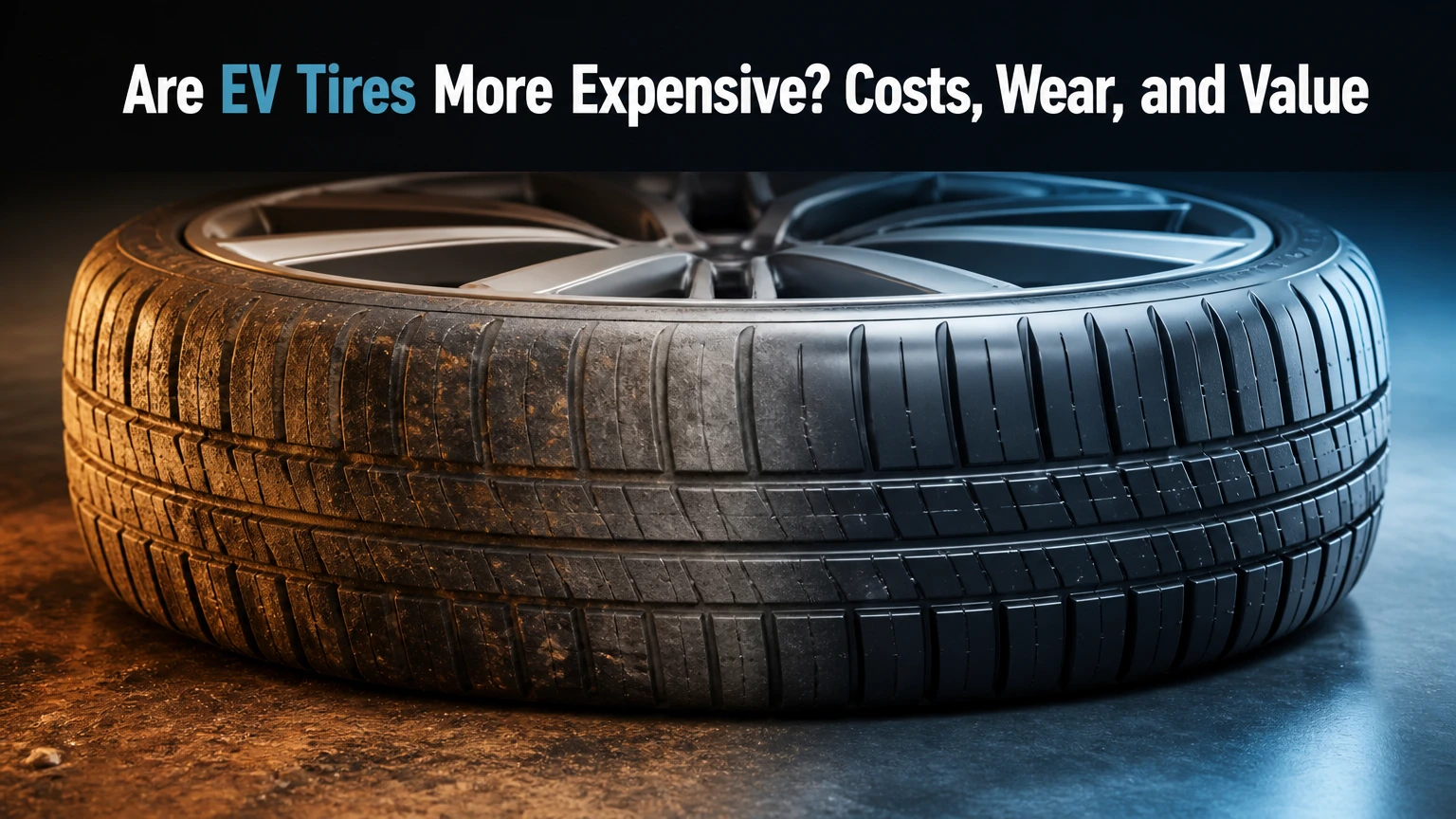
EV tires are often more expensive than comparable gasoline-car tires, but the premium is not automatic. A typical EV replacement tire costs about $150-$400, compared with roughly $100-$250 for a similar mainstream tire, while larger wheels, high load ratings, acoustic foam, low-rolling-resistance compounds, and premium branding can push a four-tire replacement well above $1,500.
Key Facts at a Glance
A typical four-tire EV replacement costs approximately $700-$1,600 installed, depending mainly on tire size, load rating, and wheel diameter.
Electric vehicles do not universally require a tire labeled “EV”; the correct load index, speed rating, dimensions, construction, and manufacturer specification matter more.
EV tires can wear faster because of vehicle mass, instant motor torque, aggressive acceleration, alignment sensitivity, and high-grip compounds.
EV-specific acoustic foam reduces some road noise, but it does not automatically improve safety, tread life, or range.
Low-rolling-resistance tires can improve efficiency, although real-world range gains vary by vehicle, speed, temperature, rain, and tire design.
Tire pressure, rotation, alignment, and acceleration habits usually affect ownership cost more than the letters printed in a tire model name.
Are EV Tires More Expensive Than Regular Tires?
Yes, EV tires are commonly more expensive at the time of purchase, but comparing a premium EV tire with a budget gasoline-car tire exaggerates the difference. The fair comparison is between tires with the same dimensions, load index, speed rating, season category, treadwear warranty, and performance level.
Typical retail prices in the United States illustrate the range:
| Tire category | Typical price per tire | Typical four-tire retail set | Common vehicle example |
|---|---|---|---|
| Mainstream gasoline-car touring tire | $100-$180 | $400-$720 | Compact sedan, 16-inch wheel |
| Premium gasoline-car touring tire | $160-$260 | $640-$1,040 | Midsize sedan, 17-inch wheel |
| EV-compatible touring tire | $150-$300 | $600-$1,200 | Compact or midsize electric crossover |
| Premium EV-specific tire | $220-$400 | $880-$1,600 | Tesla Model Y, Hyundai Ioniq 5 |
| EV performance tire | $280-$500 | $1,120-$2,000 | Porsche Taycan, Tesla Model S |
| EV winter tire | $180-$350 | $720-$1,400 | Electric SUV in a cold climate |
Installation adds about $80-$220 for mounting, balancing, valve service, disposal fees, and local taxes. A wheel alignment can add another $100-$200 when uneven wear or a steering pull indicates that the vehicle needs correction.
The frequently repeated claim that EV tires cost exactly 18%-25% more is not a universal industry rule. The premium can be near zero when an EV uses a common tire size and a standard XL-rated replacement, but it can exceed 30% when the vehicle has 21-inch wheels, staggered fitment, acoustic foam, or an ultra-high-performance compound.
Why Do EV Tires Cost More?
EV tires cost more when their construction must carry higher axle loads, control torque, reduce rolling resistance, or limit noise that would be masked by an internal-combustion engine. Those requirements can require reinforced casing materials, specialized tread compounds, aerodynamic sidewalls, and a narrower design window between efficiency, grip, comfort, and durability.
How does an EV’s weight affect tire construction?
Battery-electric vehicles often weigh more than similarly sized gasoline vehicles because the traction battery can weigh several hundred kilograms. The important specification is not a general EV weight percentage, however, but the actual front and rear axle loads listed by the vehicle manufacturer.
Tires marked XL, meaning Extra Load, use a stronger casing than standard-load versions at approved inflation pressures. Some modern tires use an HL, or High Load, designation for particularly high load capacity. The tire must still match the vehicle’s required load index and pressure; an XL label alone does not prove compatibility.
How does instant torque increase wear?
An electric motor can deliver substantial torque from a standstill, so a driver can apply high force at the tire contact patch before a gasoline engine reaches its most powerful operating range. Repeated hard launches create greater tread shear and can reduce usable tread faster than moderate acceleration.
Traction control prevents much visible wheelspin, but it cannot eliminate the stress created by high torque, vehicle mass, and rapid acceleration. A heavy dual-motor crossover driven gently may preserve its tires better than a lighter sports sedan driven aggressively.
Why do some EV tires contain acoustic foam?
Acoustic foam is a polyurethane layer bonded to the inside of the tire cavity. The foam reduces certain cavity-resonance frequencies that can become more noticeable in an EV because the electric powertrain produces less engine and exhaust noise.
Foam does not make a tire inherently safer. It also does not guarantee a quieter ride on coarse pavement, where tread pattern, suspension tuning, road surface, window glass, and vehicle insulation may dominate. Foam can complicate tire repair or replacement if a technician must work around the bonded insert, although many shops routinely service these tires.
Do low-rolling-resistance tires increase range?
Low-rolling-resistance tires can reduce the energy needed to move an EV, but a fixed 5%-7% range improvement should not be treated as universal. Energy savings depend on tire construction, temperature, speed, road surface, inflation pressure, vehicle aerodynamics, and the comparison tire.
The Hyundai Motor Group has described tire development as a balance among rolling resistance, grip, durability, and noise rather than a single efficiency target. Continental and Michelin likewise identify rolling resistance as one part of EV tire design, not a guarantee of a specific range increase.
At highway speeds, aerodynamic drag often becomes a larger energy factor than tire rolling resistance. In cold weather, battery heating and reduced battery efficiency can overwhelm a modest tire-related improvement.
Do Electric Vehicles Need Special Tires?
Most electric vehicles do not require a tire carrying a dedicated EV logo, but every replacement tire must meet the vehicle’s approved dimensions, load capacity, speed rating, pressure requirement, and seasonal performance needs. An EV-marketed tire is a design option, not a separate legal category that every electric car must use.
Check these items before buying:
- Tire size: Match the complete sidewall size, such as 235/50R19.
- Load index or HL rating: Meet or exceed the vehicle’s required capacity.
- Speed rating: Match the manufacturer’s specified rating.
- Season category: Use all-season, all-weather, or winter tires for the actual climate.
- Fitment: Confirm wheel width, staggered front and rear sizes, and clearance.
- Pressure: Follow the driver-door placard, not the maximum pressure molded into the sidewall.
- Repair compatibility: Confirm that a foam-lined tire can be serviced locally.
The National Highway Traffic Safety Administration requires tire manufacturers to provide standardized sidewall information, including size, load, speed, and construction markings. Those markings are more useful for safe selection than an unregulated marketing phrase such as “made for EVs.”
What Is the Cost per Mile of EV Tires?
The cost per mile depends on both the installed price and the actual service life, so a cheaper tire can cost more over time if it wears quickly. Divide the complete replacement cost by the miles delivered, then add alignment and rotation costs when comparing ownership scenarios.
| Driving scenario | Installed set cost | Usable service life | Tire cost per 10,000 miles |
|---|---|---|---|
| Compact EV, touring tires | $850 | 35,000 miles | $243 |
| Midsize EV crossover, premium tires | $1,150 | 30,000 miles | $383 |
| Heavy electric pickup, all-terrain tires | $1,500 | 25,000 miles | $600 |
| Performance EV, summer tires | $1,700 | 18,000 miles | $944 |
| Gasoline sedan, mainstream touring tires | $750 | 50,000 miles | $150 |
These are typical planning figures, not a universal fleet dataset. Treadwear warranties can extend to 50,000 miles or more for some touring tires, while performance and winter tires often carry shorter warranties or none at all.
A tire’s rated life is not a promise that the tread will remain safe for that distance. Alignment errors, underinflation, repeated full-throttle launches, heavy cargo, road damage, and climate can end service earlier.
How Long Do EV Tires Last?
EV tires commonly last about 25,000-40,000 miles on heavier crossovers when properly maintained, while a moderate-driving compact EV can exceed 40,000 miles with a durable touring tire. Performance EV tires may last only 15,000-25,000 miles, and winter tires often require replacement based on compound age or winter tread depth before their original tread is fully gone.
| Vehicle and use | Typical tire type | Typical replacement interval | Main wear driver |
|---|---|---|---|
| Compact EV commuter | Touring, low rolling resistance | 35,000-55,000 miles | Urban stops and starts |
| Midsize electric crossover | EV touring or XL touring | 25,000-45,000 miles | Mass and rear-axle torque |
| Electric pickup | XL, HL, or all-terrain | 20,000-35,000 miles | Weight, payload, mixed surfaces |
| Performance EV | Max-performance summer | 12,000-25,000 miles | Cornering and acceleration |
| EV in severe winter | Dedicated winter tire | 3-6 seasons | Heat cycles, storage, tread aging |
The claim that every EV wears tires 20%-30% faster than every gasoline car is too broad. Some EVs wear tires faster, but the comparison must control for vehicle mass, drivetrain, tire compound, alignment, wheel size, and driver behavior.
Regenerative braking is not usually the main reason for rapid tread wear. Regeneration can reduce friction-brake use, while tire wear is more strongly connected to longitudinal force, cornering force, pressure, alignment, and surface temperature.
Which Tire Types Work Best on an EV?
The best tire type depends on climate, driving style, wheel size, and whether efficiency or grip has priority. A low-rolling-resistance touring tire suits long-distance commuting, while a dedicated winter tire is safer in sustained freezing conditions and an ultra-high-performance tire suits drivers who accept higher replacement costs for sharper handling.
| Tire type | Typical price per tire | Best temperature range | Main advantage | Main compromise |
|---|---|---|---|---|
| EV touring tire | $180-$350 | Above 45°F | Efficiency and low noise | Moderate cornering feel |
| XL standard touring tire | $150-$300 | Above 45°F | Lower purchase price | May have more cavity noise |
| Ultra-high-performance tire | $250-$500 | Above 45°F | Dry and wet handling | Shorter tread life |
| All-weather tire | $180-$330 | About 15°F-95°F | Snow-rated versatility | More rolling resistance |
| Dedicated winter tire | $180-$350 | Below 45°F | Cold and ice traction | Seasonal storage and swapping |
| All-terrain EV tire | $220-$400 | Variable | Gravel and utility use | Noise, weight, efficiency loss |
A tire with the Three-Peak Mountain Snowflake symbol is certified for severe-snow service, but the symbol does not mean that it performs like a dedicated winter tire on ice. EV owners in northern climates should compare winter traction, stud regulations, storage, and cold-weather range rather than selecting by label alone.
Can You Use Regular Tires on an EV?
You can use a conventional tire on an EV when the tire meets the vehicle’s complete fitment requirements and has adequate load capacity. The safer alternative to a premium EV-labeled tire is often a high-quality XL or HL touring tire with the correct dimensions, speed rating, pressure capability, and a treadwear warranty.
Do not substitute a lower-load tire to reduce cost. A tire that physically fits the wheel can still be unsuitable if its load index is below the placard requirement. Insufficient capacity can increase casing deflection, heat, shoulder wear, and damage risk.
A standard tire may also produce more road noise or slightly lower efficiency than an acoustic, low-rolling-resistance EV tire. Those are comfort and operating trade-offs, not automatic blowout outcomes. The statement that a non-EV tire will “drastically” reduce range or inevitably fail on an EV is unsupported without a specific tire and vehicle comparison.
How Should EV Tires Be Maintained?
EV tires should be inflated to the pressure on the vehicle’s door-jamb placard, inspected monthly, rotated according to the vehicle manual, and checked for alignment after pothole impacts or uneven wear. Many EVs use 38-45 psi, but some require less or more, so a universal EV pressure rule is unsafe.
Use this maintenance routine:
- Check cold pressure at least monthly and before long trips.
- Inspect tread and sidewalls for cuts, bulges, exposed cords, and embedded objects.
- Rotate near 5,000-8,000 miles when the vehicle permits rotation.
- Measure tread depth across the inner, center, and outer grooves.
- Check alignment when the steering wheel is off-center or one shoulder wears faster.
- Reset or verify TPMS after pressure changes and tire replacement.
- Recheck torque after a wheel installation according to the vehicle manual.
The 5,000-mile rotation interval is a useful practitioner rule, not a requirement for every EV. Directional tires, staggered fitments, and some performance vehicles allow only front-to-rear movement or no rotation between axles.
What are the most expensive maintenance mistakes?
Underinflation is often the costliest avoidable error because it increases shoulder wear and rolling resistance at the same time. Aggressive acceleration is another hidden cost: a driver can erase thousands of miles of tread life without seeing obvious wheelspin.
A third mistake is replacing only one tire on an all-wheel-drive EV without checking tread-depth limits. Different tire circumferences can create drivetrain stress or traction-control irregularities, and the manufacturer may require matched tires or a narrow tread-depth difference.
What Should You Check Before Buying Replacement Tires?
Start with the vehicle placard and owner’s manual, then compare at least three tires using total installed cost, treadwear warranty, load rating, noise design, efficiency, and seasonal traction. Tire model names alone are insufficient because the same model can have different sizes, compounds, load indexes, and acoustic constructions.
Use this buying checklist:
- Photograph the current tire sidewall and door placard.
- Confirm front and rear sizes separately.
- Record the load index and speed rating.
- Check whether the original tire is HL, XL, run-flat, self-sealing, or foam-lined.
- Compare the UTQG treadwear rating where applicable.
- Ask for the full installed price, including disposal and taxes.
- Confirm warranty mileage and road-hazard coverage.
- Verify that the retailer can repair and balance the chosen construction.
- Consider a four-wheel alignment if the old set wore unevenly.
- Keep the removed tires if seasonal storage or a future sale requires them.
A tire with a 60,000-mile warranty is not automatically better value than a 45,000-mile tire. Warranty exclusions can cover EV torque, irregular wear, commercial use, winter use, or failure to maintain documented rotations and inflation.
Which EV Tire Choice Fits Each Driver?
The right choice differs by use case because the cost of lost range, lost traction, noise, and early replacement is different for each driver.
High-mileage commuter
Choose a durable touring tire with low rolling resistance, a strong warranty, and a load rating that meets the placard. The purchase premium can make sense when the car travels 20,000 or more miles annually, because efficiency and tread life both influence operating cost.
Budget-focused owner
Choose a reputable XL touring tire rather than the cheapest standard-load tire. A $180 XL tire with a 50,000-mile warranty can be better value than a $130 tire that lacks adequate capacity or wears unevenly.
Performance driver
Choose the manufacturer-approved performance category and accept a higher cost per mile. Reducing launch intensity in daily driving, using a softer drive mode, and keeping pressure correct will preserve the compound without compromising occasional handling performance.
Snow-belt driver
Choose dedicated winter tires when temperatures remain below 45°F and snow or ice is common. All-weather tires simplify ownership, but they generally cannot match a true winter tire on ice and packed snow.
Used-EV buyer
Inspect tire age, tread depth, inner-shoulder wear, and sidewall condition before purchase. A nearly worn $1,200 tire set can turn an apparently good vehicle deal into an immediate maintenance expense.
Are EV Tires Worth the Extra Money?
EV-specific tires are worth the extra money when their noise, efficiency, load, or fitment advantages match the driver’s priorities. They are not worth paying for solely because a tire carries an EV marketing label, especially when a properly rated XL or HL alternative offers comparable durability and traction at a lower price.
Expert insight: compare the axle, not the curb-weight headline
A vehicle’s total curb weight does not tell you whether a tire is suitable. Tire selection depends on the load carried by each axle, the manufacturer’s pressure specification, and the dynamic forces created during cornering and braking.
Expert insight: inner-shoulder wear can hide until replacement is urgent
EVs with aggressive negative camber, wide wheels, or misalignment can wear the inside shoulder while the outer tread still appears acceptable. Measure all grooves with a tread-depth gauge instead of judging the tire from the outside edge.
Expert insight: efficiency gains have a speed ceiling
Low rolling resistance matters across the driving cycle, but highway range is also dominated by aerodynamic drag. A driver who changes from an inefficient tire to an efficient model may see less improvement at 75 mph than in slower mixed driving.
Frequently Asked Questions
Do EV tires have a different tread pattern?
Some EV tires use a tread pattern optimized for low rolling resistance, wet grip, and reduced noise, but there is no single EV tread design. Tread blocks, grooves, compound, casing, and sidewall shape vary by tire model. Correct load capacity and seasonal traction matter more than visual appearance.
Are Tesla tires more expensive than other EV tires?
Tesla tire costs vary by model, wheel diameter, staggered fitment, acoustic foam, and performance category. A Model 3 on 18-inch touring tires can cost substantially less to equip than a Model S or Model Y Performance on 20- or 21-inch tires. Confirm the exact factory size before comparing prices.
Does tire pressure affect EV range?
Yes. Underinflation increases rolling resistance, reduces efficiency, and accelerates shoulder wear. Inflate tires when cold to the pressure shown on the vehicle placard, because the maximum pressure molded on the sidewall is not the recommended operating pressure for that vehicle.
Should EVs use run-flat tires?
An EV can use run-flat tires only when the vehicle manufacturer approves the fitment and the wheel, suspension, TPMS, and handling calibration are compatible. Run-flats may add weight, transmit more road harshness, and cost more, although they can provide limited mobility after a puncture.
When should an EV tire be replaced?
Replace an EV tire when tread reaches the legal or manufacturer limit, when wear indicators are flush, or when the tire has structural damage, deep cracking, a bulge, exposed cords, or repeated air loss. Replace earlier when inner-shoulder wear leaves less usable tread than the visible center suggests.
Can tire choice change EV charging costs?
A more efficient tire can reduce the energy required per mile, but the charging-cost effect depends on electricity price, annual mileage, speed, weather, and the original tire. Calculate the difference from measured vehicle consumption rather than assuming a fixed range percentage from a marketing claim.
The Bottom Line
Are EV tires more expensive? Usually, yes, but the price premium depends on tire size, load rating, construction, performance level, and brand rather than the powertrain alone. A realistic replacement budget is about $700-$1,600 installed for many EVs, with performance models and large electric pickups exceeding that range.
EV owners do not need to buy the most heavily marketed EV tire. They need a tire that meets the vehicle’s load and speed requirements, suits the climate, preserves acceptable efficiency, and provides a service life that makes sense at its installed cost per mile. Correct pressure, alignment, rotation, and moderate acceleration often save more money than choosing a particular EV badge.
Title tag: Are EV Tires More Expensive? Costs, Wear, and Value
Meta description: Compare EV and gasoline-car tire prices, expected mileage, and load ratings. Use real cost-per-mile ranges to choose the right replacement.