Expensive tires are worth the money when wet-road safety, highway comfort, long annual mileage, winter traction, or heavy-duty durability matters more than the lowest purchase price. They are not automatically the best choice for every driver: a reputable mid-tier tire with the correct size and seasonal rating can deliver better value for low-mileage city use.
Key Facts at a Glance
- Premium tires typically cost about $900-$1,600 or more per set in common North American sizes, while budget sets often cost $250-$450.
- A premium tire’s real advantage usually appears in wet braking, cornering control, ride noise, steering precision, or construction quality.
- UTQG treadwear numbers compare tires within a manufacturer’s testing system and do not provide a reliable cross-brand mileage guarantee.
- Premium ultra-high-performance tires can wear faster than premium touring tires because softer compounds prioritize grip over tread life.
- Correct size, load index, speed rating, inflation pressure, and seasonal type matter more than brand prestige.
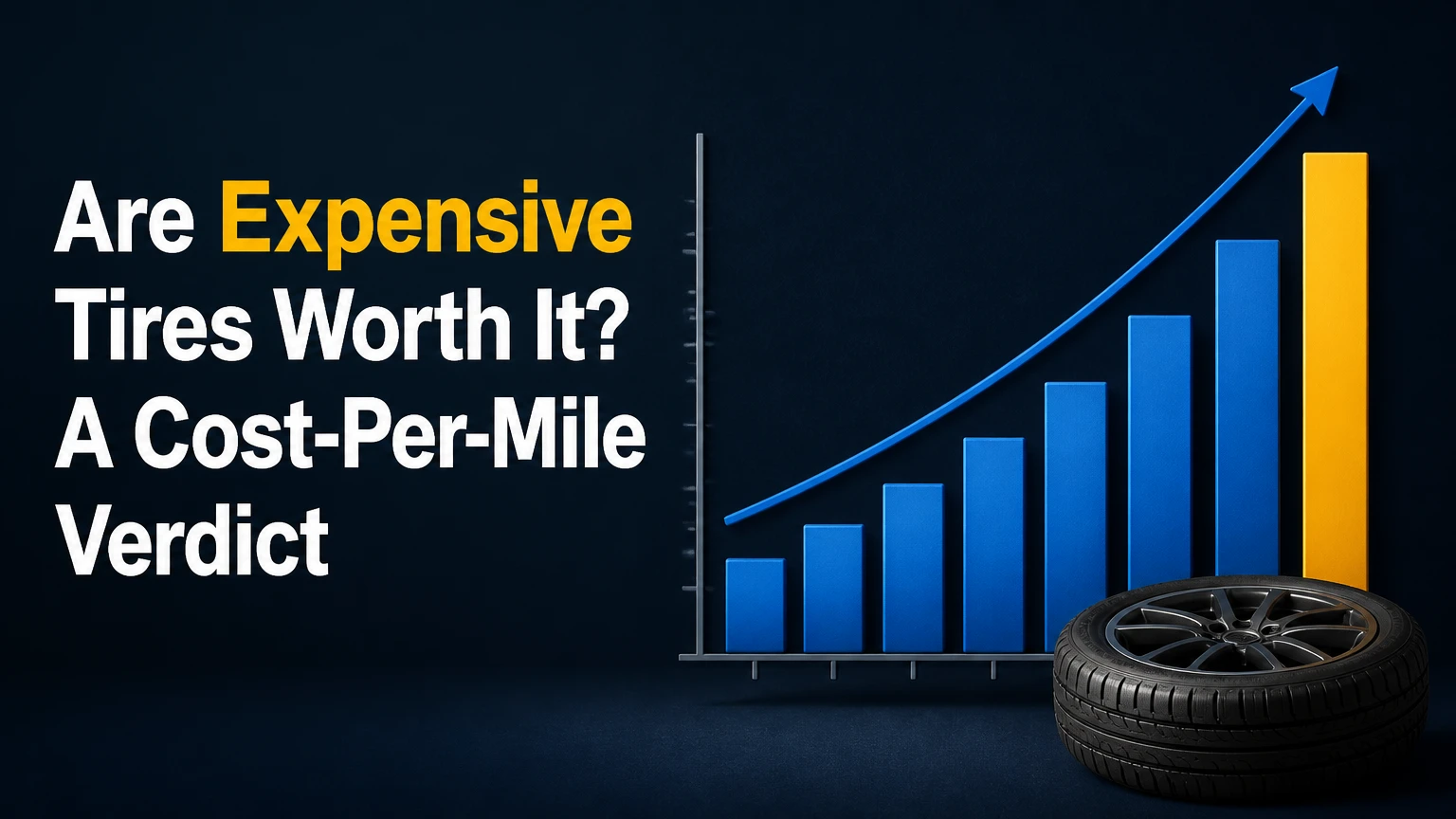
- A tire that costs $1,000 and lasts 60,000 miles costs less per mile than a $600 tire that lasts 25,000 miles, before installation and alignment costs.
What Makes a Tire Expensive?
Expensive tires cost more because manufacturers invest in compound development, vehicle-specific testing, casing construction, quality control, distribution, and warranty support. The price does not represent one feature. It reflects a package of design decisions aimed at particular outcomes, such as wet grip, low noise, high-speed stability, puncture resistance, or long tread life.
Tire engineering combines chemical and mechanical grip. Silica, polymers, plasticizers, and curing chemistry help the tread remain flexible across a wider temperature range, while tread-block geometry controls how rubber deforms against asphalt during braking and cornering. Premium tread patterns also use grooves, sipes, and variable pitch to manage water and reduce repeating road noise.
The tire’s internal structure affects handling and comfort. Steel belts, polyester or nylon plies, bead construction, sidewall stiffness, and the shape of the casing determine how accurately the tire responds to steering input. Run-flat tires, acoustic-foam tires, reinforced truck tires, and electric-vehicle fitments add further material and development costs.
The National Highway Traffic Safety Administration describes tires as “the only part of your vehicle that makes contact with the road.” That contact patch is small, so compound, pressure, temperature, load, and road surface can materially change the result.
Are Premium Tires Safer?
Premium tires can improve safety when their tested wet grip, emergency braking, hydroplaning resistance, and cornering stability exceed the alternatives being considered. The safety gain is conditional, however, because an incorrectly sized premium tire, an old tire, or a severely underinflated tire can perform worse than a correctly maintained mid-tier product.
No universal “premium safety score” exists. Tire performance depends on the exact model, size, vehicle, temperature, road surface, and test method. A grand touring all-season tire may stop more confidently in rain than a cheap all-season tire, while a summer performance tire can lose winter grip when temperatures fall near freezing.
The most meaningful safety priorities are:
- Wet braking and steering control for rain-prone climates.
- Cold-weather traction for snow, ice, and temperatures below approximately 45°F, or 7°C.
- Load capacity and casing strength for trucks, SUVs, trailers, and heavily loaded vehicles.
- Consistent handling between the front and rear axles.
- Fresh manufacture date and adequate tread depth.
Premium branding alone proves none of these qualities. Independent tests of the exact tire size and model provide stronger evidence than a logo.
How Much Do Premium Tires Cost?
A typical set of four premium tires costs $900-$1,600 or more, excluding mounting, balancing, taxes, disposal fees, and alignment. Tire size changes the price substantially: a 16-inch sedan tire may cost half as much as a 21-inch performance SUV tire with a high load index.
| Tire position | Typical set price | Typical tread-life range | Typical best use |
|---|---|---|---|
| Budget economy | $250-$450 | 20,000-40,000 miles | Low-mileage city driving |
| Reputable mid-tier | $500-$800 | 35,000-60,000 miles | Mixed commuting and highway use |
| Premium touring | $900-$1,400 | 50,000-80,000 miles | Long-distance sedans and crossovers |
| Premium UHP summer | $900-$1,600+ | 20,000-35,000 miles | Dry-road performance driving |
| Premium all-terrain | $1,000-$1,800+ | 40,000-60,000 miles | Gravel, towing, and off-road travel |
Installation commonly adds $80-$180 for four tires, depending on wheel size, valve stems, tire-pressure monitoring system service, and local labor rates. A four-wheel alignment may add $100-$200, but alignment is often a better investment than upgrading to a more expensive tire when the vehicle has uneven wear.
How Do You Calculate Tire Cost Per Mile?
Divide the complete installed price by the miles the tire actually delivers before replacement. For example, a $1,100 premium touring set lasting 65,000 miles costs about 1.7 cents per mile, while a $650 mid-tier set lasting 40,000 miles costs about 1.6 cents per mile.
Use this formula:
Cost per mile = installed tire cost ÷ usable service miles
Include installation, road-hazard coverage, rotations, and an alignment if those costs differ between options. Do not treat the warranty mileage as guaranteed life. Driving style, inflation, alignment, vehicle weight, climate, and road surfaces can reduce actual mileage.
A high-mileage driver can recover a premium’s initial cost through fewer replacements. A driver covering 5,000 miles annually may replace tires because of age before reaching the tread warranty, which weakens the financial case for flagship tires.
Do Expensive Tires Last Longer?
Expensive touring tires often last longer than budget tires, but expensive performance tires frequently do not. Longevity depends more on tread compound, tire category, vehicle alignment, rotation, inflation, driving style, and climate than on price alone.
| Tire category | Typical usable mileage | Main trade-off | Common aging concern |
|---|---|---|---|
| Premium grand touring | 50,000-80,000 miles | Less steering sharpness than UHP tires | Hardening before tread is gone |
| Premium UHP summer | 20,000-35,000 miles | Faster wear for stronger grip | Poor cold-weather flexibility |
| Mid-tier all-season | 35,000-60,000 miles | More road noise or softer response | Wet grip declines with age |
| Budget all-season | 20,000-40,000 miles | Lower purchase price | Earlier loss of wet performance |
| Premium all-terrain | 40,000-60,000 miles | More noise and rolling resistance | Chunking or irregular off-road wear |
UTQG treadwear ratings help with comparison but are frequently misunderstood. A 700 rating is not a promise of 70,000 miles, and a 400 rating is not necessarily half as durable as a 800-rated tire. The U.S. Department of Transportation requires the rating system, but manufacturers conduct the comparative government-regulated test and results vary by brand.
Tread depth also fails to tell the entire story. Rubber can harden, develop cracks, or lose wet grip with age. Tire manufacturers, including Michelin and Bridgestone, commonly recommend inspection after five years and replacement around ten years from manufacture, regardless of remaining tread, with local regulations and manufacturer instructions taking priority.
Which Type of Premium Tire Fits Your Driving?
The right premium tire category depends on climate, road surface, vehicle use, and the performance trade-off you accept. Grand touring tires suit most commuters, UHP tires suit drivers who value steering and dry-road grip, and all-terrain tires make sense when pavement is not the only surface.
| Tire type | Typical temperature or surface focus | Typical mileage | Main sacrifice |
|---|---|---|---|
| Summer performance | Warm pavement, rain, dry roads | 20,000-35,000 miles | Weak snow and cold-weather traction |
| Grand touring all-season | Rain, mild cold, highway travel | 50,000-80,000 miles | Less cornering response |
| All-weather | Cold conditions, occasional snow | 40,000-65,000 miles | More noise and rolling resistance |
| All-terrain | Gravel, dirt, towing, mixed surfaces | 40,000-60,000 miles | Fuel economy and pavement quietness |
| Mud-terrain | Deep mud, rocks, severe off-road use | 25,000-45,000 miles | Wet pavement braking and comfort |
Ultra-high-performance tires use softer compounds and larger shoulder blocks to produce stronger lateral grip. They can be worth the price on a sports car, but they are a poor choice for a driver who wants maximum mileage, quiet commuting, or dependable snow traction.
Grand touring tires are usually the strongest premium value for family sedans and crossovers. Their tread designs prioritize noise control, straight-line stability, rain performance, and tread life rather than track-level response.
All-terrain tires add sidewall protection and open tread patterns, but a three-ply sidewall does not make a tire indestructible. Correct load capacity, inflation, speed, and driving technique still determine puncture and heat resistance.
Are Mid-Tier Tires Better Value?
Mid-tier tires are often the best value because they avoid the weakest quality-control and wet-grip compromises of ultra-cheap products without charging for the last increments of noise reduction or handling performance. Brands such as Hankook, Kumho, General Tire, and Falken offer models that can fit this middle ground, but the exact tire remains more important than the brand tier.
A mid-tier tire can beat a premium tire for a specific driver. A commuter in a mild climate may gain little from a flagship UHP tire, while a mid-tier touring tire may provide adequate rain performance, lower replacement cost, and more suitable tread life.
The lowest-priced no-name tire carries greater uncertainty in casing uniformity, balancing, warranty handling, wet braking, and replacement availability. That does not mean every budget tire is unsafe. It means price alone cannot establish performance, and independent testing or retailer-specific model data deserves attention.
Choose mid-tier when annual mileage is moderate, the vehicle is older, driving is mostly urban, and the budget cannot support a premium set without postponing necessary maintenance. Choose premium when the upgrade buys a feature you will use, not simply a higher brand position.
Who Benefits Most From Expensive Tires?
High-mileage highway commuters, drivers in frequent rain, performance enthusiasts, remote-area truck users, and owners of heavy electric vehicles usually receive the clearest benefit from premium tires. Low-mileage city drivers in mild weather often receive better value from reputable mid-tier tires.
High-Mileage Commuters
Premium grand touring tires can be worth it when a driver covers 15,000-25,000 miles annually. Lower noise, stable highway behavior, longer tread life, and stronger wet-road control accumulate over many months, while cost-per-mile can approach or undercut cheaper tires that require earlier replacement.
Enthusiasts and Performance-Car Owners
Premium UHP summer tires are worth the cost when steering response, braking consistency, and cornering grip matter. Budget tires may feel acceptable during gentle driving but can become the limiting component during emergency lane changes or repeated high-load cornering.
The limitation is significant. UHP summer tires are usually a poor winter choice, may last only 20,000-35,000 miles, and can be unnecessarily expensive on a low-powered commuter.
City Drivers With Low Annual Mileage
A reputable mid-tier all-season tire is usually the sensible choice for drivers covering fewer than 8,000 miles annually in a mild climate. Spend first on correct fitment, fresh manufacturing date, balanced wheels, and proper inflation rather than buying a flagship model that may age out before its tread warranty matters.
Truck, SUV, and Off-Road Owners
Premium all-terrain tires justify their price when a puncture could strand the vehicle, when towing loads are frequent, or when gravel and sharp rocks are routine. A highway tire is quieter and more efficient on pavement, so an all-terrain upgrade is wasteful if the vehicle never leaves asphalt.
Electric-Vehicle Owners
EVs place higher demands on tires because battery weight increases vehicle mass and instant motor torque can accelerate tread wear. EV-specific tires may use reinforced construction, sound insulation, low rolling resistance, and load ratings appropriate for the vehicle.
An EV owner should not buy a tire solely because it carries an EV marketing label. Confirm the manufacturer’s load requirement, rim-protection design, rolling-resistance trade-off, noise behavior, and warranty terms.
What Must Match the Original Tire?
Replacement tires must match the vehicle’s required size, load index, speed rating, construction, and approved seasonal category. The driver should read the door-jamb placard and owner’s manual rather than copying only the numbers printed on a worn tire.
Check these specifications:
- Tire size, such as 235/45R18.
- Load index, such as 98, which represents a defined maximum load.
- Speed rating, such as H, V, W, or Y.
- XL or reinforced construction where the vehicle requires it.
- Run-flat capability if the vehicle lacks a spare and was designed for run-flats.
- Winter, all-season, all-weather, or summer suitability.
- Front and rear sizes on staggered vehicles.
- Manufacturer approval for replacement wheel diameter.
Replacing two tires can be acceptable when the remaining pair has sufficient tread and the vehicle manufacturer permits it. On many front-wheel-drive vehicles, the newer pair is installed on the rear axle to reduce oversteer risk on wet roads, but the tire shop should follow the vehicle and tire manufacturers’ instructions.
Do not mix radically different tread patterns or categories across an axle. Matching all four tires remains the most predictable solution for ABS, traction control, steering balance, and emergency handling.
Why Are New Tires Wearing Unevenly?
Uneven tire wear usually indicates incorrect inflation, misalignment, worn suspension, wheel imbalance, or a damaged component rather than a defective premium tire. Diagnosis should occur before buying replacement tires, because a new set can develop the same pattern within a few thousand miles.
| Wear pattern | Likely cause | Corrective action |
|---|---|---|
| Center tread wear | Overinflation | Set cold pressure to the door-placard value |
| Both shoulder edges | Underinflation | Check leaks, valve stems, and pressure monthly |
| One inner or outer edge | Camber or toe misalignment | Obtain a four-wheel alignment |
| Cupped scallops | Worn shocks, imbalance, or looseness | Inspect suspension and rebalance wheels |
| Feathered tread blocks | Incorrect toe setting | Measure and correct alignment |
| Rapid drive-wheel wear | Torque, rotation delay, or aggressive acceleration | Rotate and change driving habits |
The vehicle placard gives the correct cold inflation pressure for normal operation. The maximum pressure molded into the sidewall is not the recommended everyday setting.
Expert maintenance rule: inspect pressure monthly and before long trips, rotate at the interval in the owner’s manual, and measure tread across several points rather than checking one groove. A premium tire cannot compensate for a bent wheel or worn control-arm bushing.
When Are Expensive Tires a Poor Buy?
Expensive tires are a poor buy when the vehicle needs suspension work, the driver rarely uses the tire’s performance advantage, or the tire category conflicts with the climate. Paying for a premium summer tire in a snowy region does not create winter safety.
Avoid the upgrade in these situations:
- The vehicle needs alignment, shocks, wheel bearings, or brake repairs.
- The car will be sold before the tire’s useful life provides value.
- Annual mileage is so low that the tire will age before wearing out.
- The chosen premium tire has the wrong seasonal rating.
- The vehicle’s wheels are damaged or the tire size is nonstandard.
- The buyer cannot replace all required tires or maintain correct pressure.
- The driver expects a long-wearing tire but chooses a soft UHP compound.
A new premium tire also cannot repair poor vehicle dynamics, eliminate hydroplaning at unsafe speeds, or make bald tires safe. Tread depth, road speed, water depth, and vehicle condition remain decisive.
How Should You Decide Before Buying?
Use a five-step decision process that separates the feature you need from the price you notice:
- Identify the risk or benefit. Decide whether the priority is wet braking, snow traction, quietness, tread life, steering response, puncture resistance, or fuel economy.
- Confirm fitment. Record size, load index, speed rating, construction, and seasonal requirements from the vehicle.
- Compare exact models. Review independent tests, warranty mileage, wet-grip results, noise, rolling resistance, and owner-service support.
- Calculate cost per mile. Use installed price and realistic service mileage rather than warranty mileage alone.
- Inspect the vehicle first. Correct alignment, suspension faults, pressure problems, and wheel damage before fitting new tires.
A practical purchase threshold is simple: pay more when the premium model improves a condition you regularly encounter. Rainy highway travel, snow, long-distance mileage, towing, and performance driving meet that threshold more often than occasional short city trips.
Expert Insight: Wet Grip Matters More Than Tread Warranty
A long mileage warranty can distract buyers from wet-road performance. Many drivers replace tires because of age, damage, or declining wet grip before reaching the advertised mileage, especially when annual driving is low.
Expert Insight: The Most Expensive Tire Is Not Always the Safest
A premium UHP tire can be less suitable than a mid-tier all-weather tire in cold rain or snow. Tire category and temperature compatibility determine safety before price tier does.
Expert Insight: Alignment Is Often the Better Upgrade
A $150 alignment that prevents premature wear can save more money than moving from a mid-tier tire to a premium tire. Tire quality matters, but the vehicle must preserve the tread evenly to realize that quality.
Frequently Asked Questions
Are cheap tires dangerous?
Cheap tires are not automatically dangerous, but ultra-low-cost models can involve compromises in wet braking, noise, tread consistency, warranty support, and high-speed stability. Buyers should verify the required safety markings, size, load index, speed rating, manufacturing date, and independent test results instead of judging a tire only by its price.
Do expensive tires improve fuel economy?
Some premium tires reduce rolling resistance and can improve fuel economy, but the effect is usually modest and depends on pressure, vehicle weight, temperature, alignment, and driving style. A low-rolling-resistance tire may save fuel while offering less steering response, shorter tread life, or different wet-grip behavior.
Are premium all-season tires worth it?
Premium all-season tires are often worth the cost for drivers who commute on highways, encounter frequent rain, and want lower noise or longer tread life. They are not a replacement for dedicated winter tires where packed snow, ice, and sustained freezing temperatures are common.
Should I replace all four tires at once?
Replacing all four tires is usually the best handling solution when tread depth differs substantially or the vehicle uses all-wheel drive. Replacing only two may be acceptable when the remaining pair is healthy and the manufacturer permits it, but the newer pair is commonly installed on the rear axle for wet-road stability.
Are expensive tires worth it on an old car?
Expensive tires can be worth it on an old car if the vehicle is mechanically sound and the owner will drive it long enough to use the tire’s life. They are poor value when the car needs major suspension repairs, has little resale life remaining, or will be sold before the benefits accumulate.
The Bottom Line
Are expensive tires worth it? Yes, when the price buys measurable wet grip, winter traction, highway comfort, long service life, high-load durability, or performance that matches your driving. No, when the purchase is based only on brand prestige, when a premium category conflicts with the climate, or when vehicle maintenance is neglected.
For most ordinary commuters, a well-reviewed mid-tier grand touring or all-weather tire is the value benchmark. For high-mileage drivers, enthusiasts, frequent rain or snow users, and truck owners who travel away from pavement, a carefully selected premium tire can reduce risk and cost per mile enough to justify its higher price.