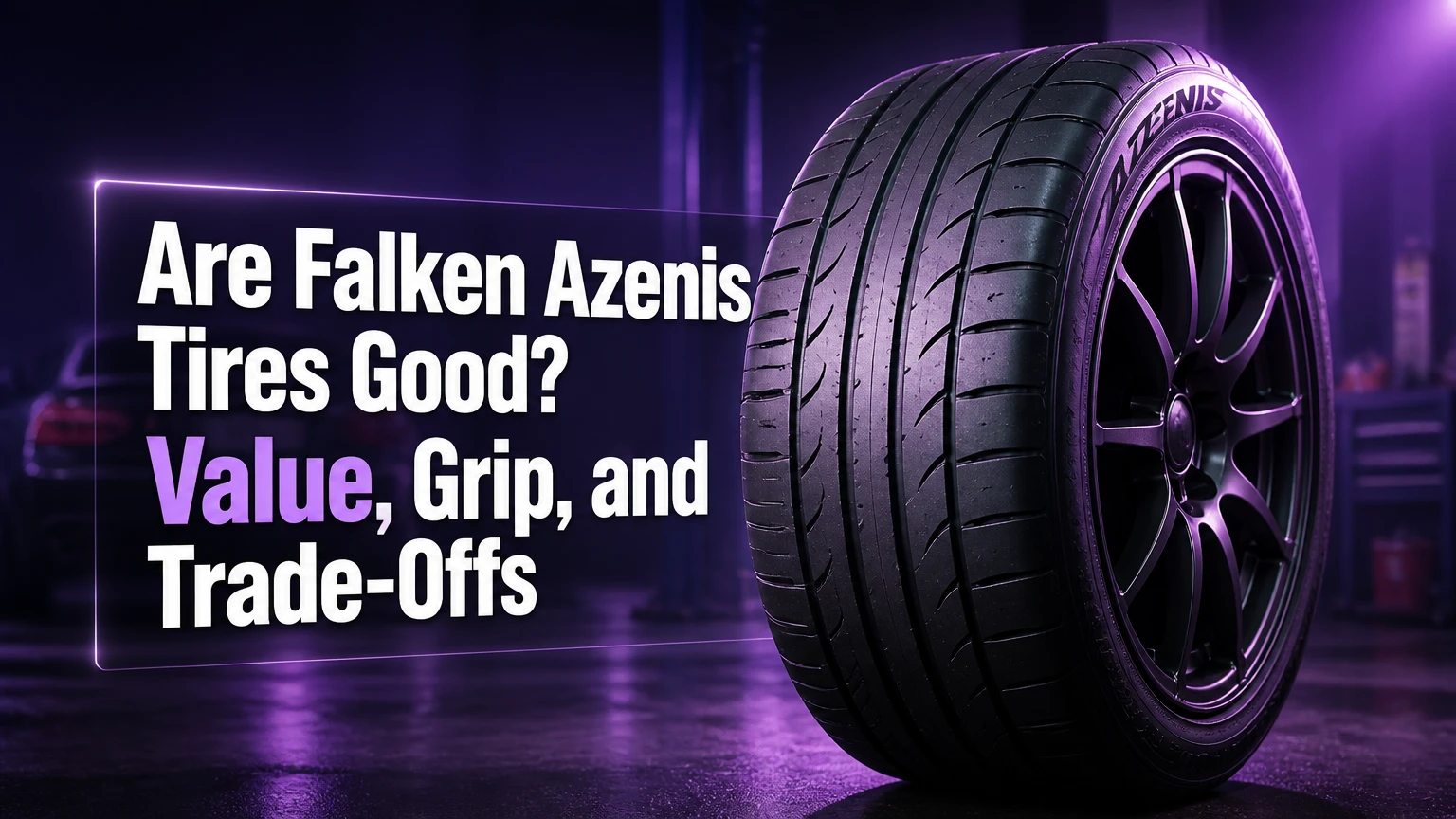
Falken Azenis tires are good when a driver prioritizes dry grip, responsive handling, and performance value over maximum comfort or longest tread life. The Azenis name covers several very different tires, from the street-focused FK520 and FK460 A/S to the competition-oriented RT660, so the right answer depends on weather, mileage, road use, and track frequency.
Key Facts at a Glance
- Falken Azenis is a performance-tire family, not a single tire model.
- FK520 is the modern summer street option for dry handling, wet-road confidence, and daily use.
- FK460 A/S is the most practical Azenis for year-round driving and occasional light snow.
- RT615K+ and RT660 prioritize lap times and cornering grip over noise, rain safety, and tread life.
- Azenis summer and extreme-performance tires are poor choices for regular snow, ice, or freezing-weather use.
- Typical street Azenis prices range from about $160 to $435 per tire, depending on size and specification.
What Are Falken Azenis Tires?
Falken Azenis tires are Falken’s performance range for sports cars, sport sedans, hot hatches, and track-oriented vehicles. The range includes ultra-high-performance summer tires, ultra-high-performance all-season tires, and extreme-performance tires with competition-oriented compounds.
The family name creates a common buying mistake. A FK460 A/S is engineered for broad weather usability, while an RT660 is engineered for short, fast sessions on dry pavement. Treating both as interchangeable “Azenis tires” produces poor recommendations.
Falken applies technologies such as 4D Nano Design, Tension Control Technology, and Adaptive Constant Pressure to different models and sizes. Falken describes 4D Nano Design as a compound-development process that models interactions among rubber, silica, and other materials at a microscopic level. The practical objective is a compound that stays flexible for grip while resisting excessive movement under cornering load.
Tension Control Technology shapes casing stiffness across the sidewall. A compliant central area can absorb road impacts, while a more supported shoulder helps turn-in. Adaptive Constant Pressure, or ACP, aims to keep pressure and load distribution more even across the tread during braking and cornering.
Those technologies do not eliminate the basic trade-off between grip, comfort, noise, and durability. A softer, stickier compound still wears faster than a touring compound, and a broad competition tread still performs worse in standing water than a tire designed around drainage.
Which Azenis Model Is Best for Your Driving?
The best Azenis model depends first on weather and second on whether the car is used on public roads or timed events. FK520 suits most performance-oriented daily drivers, FK460 A/S suits year-round use, and RT660 suits serious autocross or track work.
| Azenis model | Primary category | Best operating environment | Typical treadwear | Typical price |
|---|---|---|---|---|
| FK510 | Summer UHP | Dry and wet public roads | About 300 | $160-$435 |
| FK520 | Modern summer UHP | Daily driving and spirited roads | Size-dependent | $170-$435 |
| FK460 A/S | UHP all-season | Dry roads, rain, light snow | About 500 | $165-$315 |
| RT615K+ | Extreme summer performance | Canyon roads and occasional track days | 200 | $170-$250 |
| RT660 | Extreme competition performance | Autocross and dry track sessions | 200 | $270-$350 or more |
| RS820 | UUHP summer | High-output sports cars and premium sedans | Size-dependent | Market-dependent |
FK520: Best Street Performance Choice
The Falken Azenis FK520 is generally the strongest street-focused choice in the family when summer tires are suitable for the climate. The FK520 replaces or updates the role of the FK510 in many markets, with construction intended to improve steering accuracy, rolling resistance, and high-speed stability.
The FK520 makes sense for a BMW 3 Series, Volkswagen Golf GTI, Honda Civic Type R, or similar car that spends most of its time on pavement but still sees fast back roads. It should provide a sharper response than a comfort-oriented all-season tire, while remaining more civilised than a 200-treadwear competition tire.
Falken’s aramid and nylon reinforcement claims relate to casing control and weight reduction, but results vary by size, load rating, wheel width, alignment, and vehicle calibration. A tire can feel precise on one car and over-soft on another because sidewall deflection depends on the complete wheel-and-suspension system.
Choose the FK520 when summer temperatures remain moderate to warm and rain performance matters. Skip it if regular snow, ice, or near-freezing storage conditions are unavoidable.
FK510: Older Street Value
The Falken Azenis FK510 remains a capable summer street tire where it is still available, particularly for drivers who find it at a substantial discount. Independent user and test summaries commonly place expected service life around 20,000-30,000 miles, although aggressive alignment settings can cut that figure dramatically.
The FK510’s softer response can benefit rough roads because the sidewall absorbs more impact than some sharper competitors. The same characteristic can make steering feel less immediate during rapid transitions. TyreReviews listings and retailer feedback also show that wear, noise, and wet-road impressions differ across sizes and vehicles.
A discounted FK510 can be sensible if its production date is recent and the price is meaningfully lower than the FK520. A small saving is less attractive when the older tire has been stored for years or when the newer model offers the required size and fitment.
FK460 A/S: Best Year-Round Azenis
The Falken Azenis FK460 A/S is the practical choice for drivers who want performance handling without changing tires seasonally. Its 500 treadwear rating and all-season compound target longer service life and broader temperature usability than the summer FK models.
The FK460 A/S is suitable for rain, cool weather, and occasional light snow. It is not a winter tire. Its grooves and compound cannot match a dedicated winter tire’s cold-weather flexibility, packed-snow traction, or ice braking.
Tire Rack testing and product listings identify Silent Core foam on applicable FK460 A/S sizes, a feature intended to reduce cavity noise. Actual cabin noise still depends on tread wear, vehicle insulation, wheel diameter, road surface, and tire pressure.
The FK460 A/S works well for a performance sedan that must operate year-round in a region with infrequent snow. Choose a dedicated winter tire instead when temperatures regularly remain below about 45°F, or when snow and ice are routine rather than occasional.
RT615K+: Best Transition to Track Driving
The Falken Azenis RT615K+ is a 200-treadwear extreme-performance summer tire intended for enthusiastic road use, autocross, and occasional track days. It offers more dry grip and heat tolerance than a normal street UHP tire, but it gives up wet-weather margin, quietness, and longevity.
The RT615K+ can suit a lightweight rear-wheel-drive car used for weekend canyon driving and transported to only a few track events each year. Its predictable breakaway behavior can help a developing driver understand steering, throttle, and braking inputs.
Typical life is roughly 10,000-20,000 miles, but track use can consume a large portion of that life in a single event. Heavy cars, high negative camber, high ambient temperatures, and repeated sessions accelerate shoulder wear.
Use the RT615K+ when communication and heat tolerance matter more than commuting refinement. Do not choose it as a default family-car tire for frequent rain or long highway mileage.
RT660: Best for Autocross and Lap Times
The Falken Azenis RT660 is the most competition-oriented mainstream Azenis option in this group. Its 200 treadwear rating, large tread blocks, and high-grip compound support autocross and dry-track performance, but the design can hydroplane more readily and become loud as it wears.
RT660 owners should monitor tread depth and shoulder temperatures rather than relying only on mileage. A tire with acceptable center tread can still be finished if the outer shoulder has exposed cords, severe feathering, or heat damage.
The RT660+ version, where offered, is intended to improve consistency for demanding applications and heavier vehicles. Availability, sizing, and exact construction can vary by market, so the sidewall markings and current Falken specification sheet matter more than a generic model description.
Buy RT660 for competition results or frequent dry track use. Skip it for a car that must safely handle heavy rain, cold mornings, and thousands of quiet motorway miles.
RS820: High-End UUHP Positioning
The Falken Azenis RS820 is positioned as a higher-tier ultra-ultra-high-performance summer tire for vehicles such as the BMW M3, Porsche 911, and other high-output sports cars. Falken’s European and international announcements describe the model as a product aimed at the premium UUHP segment.
The RS820 may be a credible alternative to tires such as the Michelin Pilot Sport 4 S when its exact size, load rating, and vehicle approval match the application. It should not be assumed to equal every premium competitor in steering feel, wet braking, noise, or track durability without a comparable test in the same size.
RS820 availability is especially market-dependent. Verify the retailer’s production date, speed rating, load index, and original-equipment marking before substituting it for a factory-approved tire.
How Do Azenis Tires Perform in Dry and Wet Weather?
Falken Azenis dry-road performance is usually the family’s strongest attribute, while wet behavior depends heavily on the model. FK520 and FK460 A/S are more appropriate for rain than RT615K+ or RT660, whose wide blocks and sticky compounds favor dry grip.
| Model | Dry cornering | Wet-road confidence | Snow and ice | Noise expectation |
|---|---|---|---|---|
| FK520 | High, sharp response | High for a summer UHP tire | Unsafe for routine use | Moderate |
| FK460 A/S | Moderate-high | High for an all-season tire | Light snow only | Low-moderate |
| RT615K+ | Very high when warm | Moderate-low | Unsafe | High |
| RT660 | Extremely high when warm | Low in standing water | Unsafe | Very high as wear increases |
| RS820 | Very high | High, size and test dependent | Unsafe | Moderate-high |
Summer tires lose flexibility as temperatures approach freezing. Moving or driving a summer Azenis through freezing conditions can reduce traction and, depending on storage and compound exposure, increase the risk of cracking. The familiar 45°F threshold is a practical warning for summer performance tires, not a universal legal cutoff.
In heavy rain, speed matters more than brand reputation. RT660 tread patterns can evacuate ordinary rain acceptably at moderate speed, yet standing water and worn tread create a much smaller safety margin than the FK460 A/S.
How Long Do Falken Azenis Tires Last?
Street Azenis tires typically last about 20,000-50,000 miles, while 200-treadwear RT models may last about 5,000-20,000 miles depending on use. Mileage estimates are not guarantees because alignment, tire pressure, vehicle weight, driving style, temperature, and rotation frequency can change wear by thousands of miles.
| Use pattern | Suitable model | Typical mileage range | Main wear limiter |
|---|---|---|---|
| Commuting and highway use | FK460 A/S | 40,000-50,000 miles | Tread aging and alignment |
| Spirited street driving | FK520 | 20,000-35,000 miles | Shoulder wear |
| Weekend canyon driving | RT615K+ | 10,000-20,000 miles | Heat and outer-edge wear |
| Occasional track events | RT615K+ | 5,000-15,000 miles | Heat cycles and camber |
| Autocross or frequent track use | RT660 | 5,000-15,000 miles | Competition abrasion |
| Mixed luxury-car use | RS820 | Size-dependent | Torque, weight, and alignment |
A 500 treadwear rating does not mean an FK460 A/S lasts exactly 2.5 times longer than a 200-treadwear RT660. Treadwear grades are comparative ratings under a standardized test program, and manufacturers’ ratings are not directly equivalent across brands.
The practitioner rule is simple: inspect the inner and outer shoulders at every oil change, especially on lowered cars. A tire can lose usable cornering performance before the wear bars become obvious.
Are Falken Azenis Tires Worth the Price?
Falken Azenis tires are worth the price when their performance category matches the vehicle’s use. The value is strongest against unknown low-cost brands and against premium tires whose additional refinement is not worth several hundred dollars per set to the buyer.
A four-tire FK520 set can commonly cost about $680-$1,740 before mounting, balancing, taxes, and alignment, because fitments range from compact 17-inch sizes to wide 20-inch applications. A 200-treadwear RT660 set can cost about $1,080-$1,400 before installation, then consume tread faster during events.
Michelin Pilot Sport products generally compete with Azenis on steering communication, wet braking, ride quality, and refinement. Falken often competes more aggressively on purchase price. The real gap is not a universal “90% versus 100%” score, because independent tests use different cars, sizes, temperatures, and scoring weights.
Continental ExtremeContact Sport 02 is another relevant summer comparison, while Continental ExtremeContact DWS06 Plus is a closer all-season comparison to FK460 A/S. The Continental choices may offer a different balance of wet handling, comfort, and tread life, so compare the exact test and size rather than only the brand.
| Alternative | Closest Azenis rival | Common advantage | Common compromise | Best buyer |
|---|---|---|---|---|
| Michelin Pilot Sport 4 S | FK520 or RS820 | Steering refinement and premium feedback | Higher purchase price | Fast road driver seeking refinement |
| Continental Sport 02 | FK520 | Balanced road behavior | Less competition focus | Daily sports-car driver |
| Continental DWS06 Plus | FK460 A/S | All-season versatility | Less extreme dry response | Year-round commuter |
| Bridgestone Potenza Sport | FK520 or RS820 | Strong dry and wet response | Ride and price can be higher | Premium performance buyer |
| Generic low-cost UHP tire | Any street Azenis | Lower initial price | Weaker testing consistency and support | Buyer with severe budget limits |
What Should You Check Before Installing Azenis Tires?
Correct fitment is more important than choosing the highest-rated Azenis model. Confirm the vehicle manufacturer’s tire size, load index, speed rating, wheel width range, rotation direction, and any required OE approval before ordering.
Check these items:
- Load index: The replacement tire must meet or exceed the vehicle requirement. A lower load index can compromise carrying capacity and handling.
- Speed rating: Match the required rating, particularly on turbocharged or high-performance cars.
- Staggered fitment: Front and rear sizes may differ, preventing normal rotation.
- AWD systems: Use closely matched circumference and tread depth across all four positions unless the manufacturer permits otherwise.
- Run-flat equipment: A conventional Azenis replacement may require different roadside support and pressure-monitoring procedures.
- Production date: Inspect the DOT date code and avoid old inventory when the discount does not compensate for storage age.
- Alignment: Measure toe and camber after installation, especially if the vehicle is lowered or has suspension modifications.
Set cold inflation pressure from the vehicle placard, not the maximum pressure molded into the sidewall. Recheck pressure after the tires cool, because a hot reading can mislead the adjustment.
How Should New Azenis Tires Be Broken In?
New Falken Azenis tires should receive approximately 100-500 miles of moderate street driving before aggressive cornering, emergency-style braking, or track use. The exact distance depends on the model and manufacturer guidance, but gradual heat and scrub-in let the driver verify balance, pressure, and installation quality.
Use this process:
- Drive the first 50 miles without hard launches or maximum braking.
- Increase speed and cornering progressively over the next 50-150 miles.
- Check pressure, lug torque, vibration, and steering pull after the first drive.
- Inspect tread and sidewalls before the first spirited session.
- For RT615K+ or RT660, use a controlled warm-up and cool-down rather than immediately attacking the first lap.
A track tire’s heat cycle is not a substitute for inspection. Excessive heat, incorrect pressure, or inadequate alignment can damage a tire even when the break-in procedure was correct.
What Problems Do Azenis Owners Commonly Encounter?
The most common Azenis problems are uneven shoulder wear, road noise, cold-weather traction loss, and excessive hydroplaning risk on competition models. Each problem usually has a controllable cause, but none should be treated as a defect without checking pressure, alignment, use, and tire age.
Uneven Inner-Edge Wear
Negative camber and toe settings can wear the inside shoulder rapidly, particularly on independent rear suspension. Rotate only when the tire pattern and manufacturer direction permit it, then correct the alignment rather than masking severe wear.
Increasing Road Noise
RT models often become louder as tread blocks wear and feather. FK520 and FK460 A/S are better choices when cabin refinement matters, while foam technology can reduce certain frequencies without eliminating coarse-road noise.
Poor Cold-Weather Grip
Summer Azenis compounds are unsuitable for snow, ice, and regular freezing-weather driving. Store them indoors in a cool, dry location, and never treat an all-season FK460 A/S as a substitute for a severe-snow-rated winter tire.
Hydroplaning at Speed
RT660 and similar extreme-performance tires have less wet-weather margin than rain-focused street tires. Slow substantially in standing water, replace tires before the tread reaches the bars, and avoid assuming that a high dry-grip rating predicts wet safety.
Fast Track Wear
Track use can consume a street tire’s useful life quickly. Record session count, hot pressures, shoulder temperature, and tread depth; a simple log is more useful than a mileage estimate alone.
Who Should Buy Falken Azenis Tires?
A daily commuter should choose FK460 A/S for year-round flexibility or FK520 for warm-weather street performance. A weekend canyon driver can consider RT615K+ if noise and short tread life are acceptable, while an autocross competitor should consider RT660 for dry grip and response.
A luxury-car owner should weigh the FK520 or RS820 against premium touring and UUHP alternatives because vehicle isolation makes tread noise more noticeable. A driver in a snowy climate should choose a dedicated winter tire and keep the Azenis summer set for warmer months.
The wrong buyer is someone seeking one tire that combines quiet touring comfort, 50,000-mile longevity, ice traction, and competition-level cornering. No Azenis model provides that combination.
FAQ
Are Falken Azenis tires good for highway driving?
FK520 and FK460 A/S are suitable for highway driving when the size, load rating, pressure, and weather match the vehicle. RT615K+ and RT660 can handle highway travel, but their noise, vibration, wet-weather limitations, and accelerated wear make them poor choices for long-distance commuting.
Are Falken Azenis tires noisy?
Noise varies by model and tread wear. FK460 A/S is the quietest-oriented choice, FK520 is typically more refined than older or competition models, and RT615K+ or RT660 can become loud because stiff tread blocks generate more impact noise and feathering.
Are Azenis tires good in snow?
The FK460 A/S can manage occasional light snow, but summer FK510, FK520, RT615K+, RT660, and RS820 tires are not suitable for snow or ice. Drivers who regularly encounter winter conditions should use severe-snow-rated winter tires with the mountain-and-snowflake symbol.
Are RT660 tires street legal?
RT660 tires are generally sold for highway use where their size carries the required markings, but legality depends on jurisdiction, tread depth, noise rules, and vehicle requirements. Verify the tire’s sidewall markings and local regulations before using a competition tire on public roads.
Do Falken Azenis tires need frequent rotation?
Street Azenis tires should be rotated according to the vehicle and tire direction, often around 5,000-7,500 miles when rotation is possible. Staggered, directional, or track-specific fitments may prevent normal rotation, so inspect every position and follow the manufacturer’s permitted pattern.
What is the best Azenis alternative to Michelin?
FK520 is the closest general street-value alternative, while RS820 targets a higher UUHP category where available. Michelin may offer stronger refinement and feedback, whereas Falken can reduce purchase cost. Compare the exact tire size, test results, warranty, and intended weather before deciding.
The Bottom Line
Are Falken Azenis tires good? Yes, when the model matches the job. FK520 is the strongest all-around summer street recommendation, FK460 A/S is the sensible year-round option, RT615K+ suits occasional track use, and RT660 is for dry competition. Falken Azenis tires deliver convincing performance value, but they are not automatically quiet, long-lasting, winter-safe, or interchangeable across vehicles.