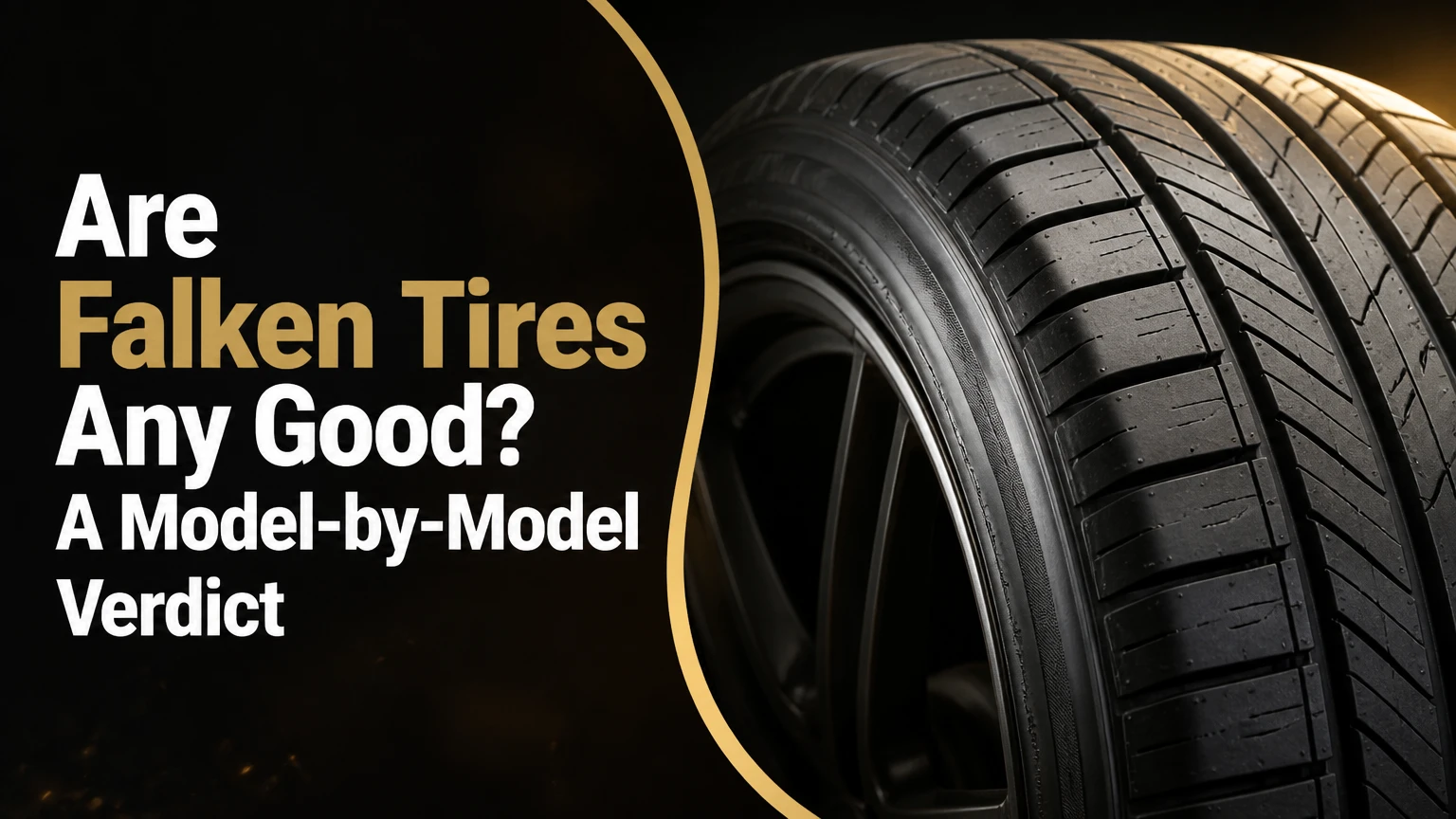
Falken tires are good mid-range tires when the model matches the vehicle and driving conditions. Falken’s Wildpeak all-terrain tires are particularly strong for trucks and SUVs, while Azenis tires suit performance driving and Sincera or Ziex models suit commuting. Falken usually costs less than Michelin or Bridgestone, but model-level testing, winter performance, and tread life vary.
Key Facts at a Glance
- Falken is a Japanese tire brand owned by Sumitomo Rubber Industries, which also owns Dunlop in several markets.
- Falken occupies the upper-mid-range market, between premium brands such as Michelin and lower-cost private-label brands.
- Wildpeak A/T4W tires carry the Three-Peak Mountain Snowflake rating in applicable sizes, but they are not dedicated winter tires.
- Falken Sincera touring tires can carry warranties reaching 80,000 miles, although coverage depends on model, size, market, and service conditions.
- Azenis performance tires prioritize dry and wet grip over long tread life, ride softness, and freezing-weather flexibility.
- A Falken tire’s value depends more on compound, construction, load rating, and use than on the Falken name alone.
Are Falken Tires Any Good for Your Vehicle?
Yes, Falken tires are a sound choice for drivers who want strong wet grip, useful durability, and lower purchase prices than many premium alternatives. Falken is less consistently refined than Michelin in ride quality and tread longevity, but its Wildpeak, Azenis, Sincera, and Ziex families each target a defined driving job.
The important qualification is fitment. A Wildpeak A/T4W can be an excellent truck tire and a poor choice for a small sedan because its weight, rolling resistance, and aggressive tread are unnecessary on pavement. An Azenis FK-series tire can deliver sharp steering and strong braking, yet its summer compound is unsuitable for freezing temperatures.
Falken’s reputation comes from matching specialized designs to realistic budgets. Tire Rack, Discount Tire, and independent retailers commonly position Falken above entry-level brands and below premium products, but retailer impressions are not substitutes for a comparison test in the exact size fitted to your vehicle.
What Does Falken Make?
Falken makes passenger, performance, truck, SUV, commercial, all-season, summer, winter, and competition tires. The major consumer families include Wildpeak for trucks and crossovers, Azenis for performance cars, Sincera for touring use, and Ziex for sport-oriented all-season driving.
| Falken family | Typical vehicle | Primary strength | Main compromise |
|---|---|---|---|
| Wildpeak A/T4W | Pickup, Jeep, SUV | All-terrain traction and 3PMSF snow certification | Heavy construction and higher rolling resistance |
| Wildpeak H/T02 | Pickup and SUV | Highway comfort, hauling, and towing stability | Less off-road bite than an all-terrain tire |
| Wildpeak R/T01 | Truck and SUV | Hybrid rugged-terrain capability | More noise and weight than highway tires |
| Azenis FK520 | Sports sedan and coupe | Dry handling and wet-road braking | Shorter wear life than touring tires |
| Azenis RT660 | Autocross and track car | High lateral grip and response | Poor wet-weather practicality and street comfort |
| Sincera SN250 A/S | Sedan and compact crossover | Quiet commuting and long warranty | Relaxed steering response |
| Ziex ZE960 A/S | Sedan, coupe, crossover | Sportier all-season handling | Usually less efficient or long-lasting than touring designs |
How Does Falken Tire Technology Affect Driving?
Falken’s tire technology improves specific performance trade-offs rather than making every Falken model premium-equivalent. 4D Nano Design supports compound development, 3D Canyon Sipes help tread blocks resist squirm, silica compounds improve cold and wet flexibility, and Silent Core reduces cavity resonance only on selected products.
4D Nano Design is a development method that models interactions within the rubber compound. The practical goal is to balance grip, heat control, and wear rather than simply making rubber softer. A softer compound can improve cornering but may wear quickly or lose consistency under repeated heat.
3D Canyon Sipes use interlocking geometry inside tread blocks. During braking or cornering, the sipe walls support one another; on wet or snowy roads, the grooves create additional edges and evacuation paths. The effect depends on tread depth, temperature, vehicle weight, and alignment.
Silica-rich compounds generally remain more flexible than older carbon-black-heavy formulations at lower temperatures. They do not turn a summer tire into a winter tire. Silent Core is also application-specific, so buyers should verify the product specification instead of assuming that every Falken tire contains acoustic foam.
Does Falken Use the Same Technology in Every Tire?
No, Falken does not use identical construction across its product families. A competition Azenis RT660, a highway Wildpeak H/T02, and a touring Sincera SN250 A/S require different tread patterns, sidewalls, compounds, and carcass designs.
That distinction explains why one owner may describe Falken as quiet and another may describe it as firm or noisy. A highway tire has fewer open tread voids and usually weighs less than an all-terrain tire. Product family, tire size, load range, wheel diameter, and vehicle insulation all affect cabin noise.
Which Falken Tire Is Best for Trucks and SUVs?
The Wildpeak A/T4W is the strongest general-purpose Falken choice for truck and SUV owners who regularly encounter gravel, dirt, rain, light mud, and winter roads. The Wildpeak H/T02 is better for mostly paved driving, while the Wildpeak R/T01 suits drivers who need more sidewall and loose-surface traction than a highway tire provides.
The A/T4W replaced the widely used A/T3W in Falken’s North American lineup. Its Three-Peak Mountain Snowflake certification indicates that the tire passed a standardized severe-snow traction test, not that it performs like a studded or dedicated winter tire. On packed snow and ice, a winter tire remains the safer specialist option.
| Model | Best operating mix | Typical treadwear warranty | Weight and behavior |
|---|---|---|---|
| Wildpeak A/T4W | 60-80% pavement, 20-40% gravel and trails | About 55,000-65,000 miles, size dependent | Heavy, stable, relatively quiet for an all-terrain |
| Wildpeak H/T02 | 90-100% pavement and towing | About 50,000-70,000 miles, size dependent | Lower noise and rolling resistance than A/T tires |
| Wildpeak R/T01 | Pavement, rocks, dirt, and occasional mud | Often about 50,000 miles, size dependent | More aggressive tread, firmer ride, greater noise |
| Dedicated winter tire | Ice, packed snow, and temperatures below 45°F | Often no comparable mileage warranty | Superior cold grip, but seasonal storage and replacement cost |
Should You Choose P-Metric or LT Wildpeaks?
Choose an LT Wildpeak when the truck regularly carries heavy payloads, tows near its rated capacity, or travels on rocky terrain. Choose a P-metric version when the vehicle primarily carries passengers and drives on pavement, because the lighter casing generally produces a more comfortable ride and lower fuel consumption.
Load range is not a styling option. The tire must meet or exceed the vehicle manufacturer’s axle and tire-load requirements shown on the driver-door placard. Increasing tire size without checking load index, wheel width, clearance, and speed rating can create handling and safety problems.
A common practitioner rule is to compare the complete tire weight, not only the price. Four heavier LT tires can add dozens of pounds of unsprung and rotating mass, reducing acceleration, braking efficiency, and fuel economy even when the tread appears similar.
Are Falken Azenis Tires Good for Performance Cars?
Falken Azenis tires are good performance tires for drivers who value steering response, cornering grip, and wet braking more than maximum mileage. The FK520 is the relevant current street-performance option in many markets, while the older FK510 or FK510A may still appear through remaining inventory and regional catalogs.
Azenis summer tires require temperature discipline. Below approximately 45°F, or 7°C, a summer compound becomes less flexible; near freezing, traction can fall sharply and the rubber may suffer damage if the tire is driven hard. Azenis tires are not appropriate for year-round use in a cold climate unless the vehicle is stored during winter.
The RT660 is a different tool. It is DOT legal for road use in the United States, but its competition-oriented tread and compound favor autocross and track sessions. Drivers should expect faster wear, more noise, hydroplaning risk in standing water, and less predictable cold-weather behavior.
How Long Do Azenis Tires Last?
Azenis street tires commonly provide less tread life than touring tires, with typical warranties ranging from no mileage warranty to roughly 25,000 miles depending on the exact model and market. Alignment, tire rotation, driving style, temperature, and track use can reduce that range substantially.
A performance tire with 8/32-inch usable tread may still be the better purchase for an enthusiast who values braking distance and steering accuracy. A commuter covering 15,000 miles per year may prefer a longer-wearing Ziex or Sincera because replacing a performance set every two years can erase the initial price advantage.
Which Falken Tire Is Best for Commuting?
The Sincera SN250 A/S is the most sensible Falken option for ordinary sedan and compact-crossover commuting when low noise, ride comfort, and warranty coverage matter most. The Ziex ZE960 A/S is a better fit for drivers who want more responsive steering and are willing to trade some touring comfort or wear life.
Sincera tires are designed around predictable all-season road use. Their steering may feel less immediate than an Azenis, but that relaxed response can make a family sedan calmer on rough pavement. A warranty advertised as 75,000 or 80,000 miles applies only under stated conditions, such as regular rotation, matching replacement procedures, and adequate remaining tread.
Ziex models occupy the sport-all-season space. They can make a Civic, Corolla, Accord, or crossover feel more responsive without the cold-weather limitation of a summer performance tire, although they still cannot match a dedicated winter tire on ice.
| Commuter priority | Recommended family | Typical choice | Why |
|---|---|---|---|
| Maximum mileage | Sincera | SN250 A/S | Long warranty and touring-oriented tread |
| Quieter ride | Sincera | SN250 A/S | Less aggressive tread pattern than Wildpeak |
| Sharper steering | Ziex | ZE960 A/S | Sportier tread and casing response |
| Cold-climate all-season use | Ziex or Sincera | Size-dependent | More suitable than summer Azenis tires |
| Deep snow and ice | Winterpeak or winter tire | F-Ice 1 where available | Cold-weather compound and winter tread |
How Much Do Falken Tires Cost?
Falken tires typically cost about $100-$160 each for common passenger-car sizes and $180-$300 or more each for larger truck and SUV sizes. A complete set commonly costs $400-$1,200 before mounting, balancing, taxes, disposal fees, alignment, and optional road-hazard coverage.
Actual pricing changes with tire width, wheel diameter, load range, speed rating, inventory, retailer promotions, and seasonal demand. A 215/60R16 Sincera set can be far cheaper than a 275/70R18 LT Wildpeak set, even though both carry the Falken name.
| Purchase example | Typical tire price | Typical installed total for four | Extra service to budget |
|---|---|---|---|
| Sincera, 16-inch sedan size | $100-$150 | $500-$750 | Mounting, balancing, disposal |
| Ziex, 17-inch crossover size | $130-$190 | $650-$900 | Possible alignment |
| Azenis, 19-inch performance size | $180-$280 | $850-$1,250 | Performance alignment |
| Wildpeak A/T4W, 17-inch P or LT size | $190-$300 | $900-$1,350 | TPMS service and alignment |
How Does Falken Compare With Michelin, Bridgestone, and Budget Brands?
Falken usually offers better value than Michelin or Bridgestone when the buyer prioritizes capability per dollar, especially in all-terrain and performance categories. Premium tires generally retain an advantage in refinement, consistency across sizes, wet-braking development, rolling efficiency, and long-term tread performance.
Budget brands may reduce the purchase bill by 20-40%, but lower testing consistency, shorter wear life, weaker wet traction, and less predictable warranty support can increase ownership cost. The comparison should use equivalent tire categories, because a Wildpeak A/T4W should not be compared with a Michelin Defender touring tire solely by brand.
| Decision factor | Falken | Michelin or Bridgestone | Budget brands |
|---|---|---|---|
| Typical passenger tire price | $100-$190 | $150-$260 | $70-$130 |
| Typical truck all-terrain price | $190-$300+ | $240-$380+ | $130-$220 |
| Wet-road performance | Strong on many current models | Usually more consistent across lines | Model-dependent and often weaker |
| Highway refinement | Good on Sincera and H/T02 | Usually class-leading | Frequently noisier |
| Off-road selection | A/T4W, R/T01, H/T02 | Fewer direct equivalents in some sizes | Wider quality variation |
| Treadwear warranty | About 25,000-80,000 miles | About 40,000-90,000 miles | About 40,000-70,000 miles |
| Best purchase logic | Capability at controlled cost | Maximum refinement and consistency | Lowest initial price |
What Problems Should Falken Buyers Watch For?
Falken buyers should watch for incorrect load ratings, inappropriate seasonal compounds, uneven wear, and the assumption that a high mileage warranty guarantees a specific service life. These issues can make a good tire perform badly or invalidate warranty eligibility.
Check the following before installation:
- Verify the tire size and load index. Match the driver-door placard unless a qualified tire professional confirms an alternative.
- Check the DOT date code. Tire age matters even when tread depth is high; inspect older inventory carefully and follow the vehicle and tire maker’s replacement guidance.
- Confirm P, XL, or LT construction. An LT tire may support heavier loads but can ride more firmly and weigh more.
- Use the placard inflation pressure. Do not use the maximum sidewall pressure as the normal setting unless the vehicle manufacturer specifies it.
- Measure alignment and tread wear. Inner-edge wear often points to toe or camber problems rather than defective rubber.
- Rotate on schedule. A typical interval is 5,000-8,000 miles, or the vehicle manufacturer’s stated interval.
- Replace all four when required. AWD systems can be sensitive to differences in rolling circumference.
Are Wildpeak Tires Quiet on the Highway?
Wildpeak tires are relatively quiet for all-terrain tires, but they are not as quiet as comparable highway-terrain or touring tires. The A/T4W’s open tread, heavier casing, and larger voids create more tread noise than a Sincera SN250 A/S, especially as the tread wears or develops heel-and-toe irregularity.
A/T noise also depends on asphalt texture, tire pressure, suspension condition, vehicle insulation, and rotation history. Drivers who spend 95% of their time on pavement may save fuel and reduce noise with the H/T02 instead of selecting an all-terrain tire for appearance alone.
Do Falken Tires Work in Snow?
Falken tires work in snow when the specific model carries the Three-Peak Mountain Snowflake symbol and has adequate tread depth, but severe-snow certification does not equal ice performance from a dedicated winter tire. The A/T4W is suitable for many mixed-use truck and SUV drivers, while a winter tire remains better for repeated ice and subfreezing conditions.
Snow performance declines as tread wears. A tire near the legal minimum tread depth may still be usable in rain but provide substantially less snow evacuation and edge grip. Drivers in mountain or lake-effect regions should plan seasonal tire changes rather than relying on an all-terrain tire year-round.
Which Drivers Should Buy Falken Tires?
Falken suits buyers who want a specific capability without paying the highest premium-brand price. The best match changes by use: Sincera for economical commuting, Ziex for sportier all-season driving, Wildpeak for mixed road and trail use, and Azenis for warm-weather performance.
- Daily commuter: Choose Sincera SN250 A/S when warranty coverage, comfort, and predictable mileage matter most.
- Sporty all-season driver: Choose Ziex ZE960 A/S when steering response matters more than maximum touring mileage.
- Truck or Jeep owner: Choose Wildpeak A/T4W for mixed pavement, gravel, trail, rain, and moderate snow.
- Highway-focused truck owner: Choose Wildpeak H/T02 for lower noise, towing stability, and reduced rolling resistance.
- Performance enthusiast: Choose Azenis FK520 for street use, or RT660 for autocross and track events.
- Ice-belt driver: Choose a dedicated winter tire, including a suitable Winterpeak product where available, rather than treating an all-terrain tire as a full winter substitute.
Falken is not the best choice for every driver. A luxury sedan owner who values the quietest ride may prefer Michelin or Bridgestone, while a driver seeking the lowest possible purchase price may accept the compromises of a budget tire. Fitment decides the result.
FAQ About Falken Tires
Are Falken tires safer than cheap tires?
Falken tires generally provide a more dependable wet-road and handling package than many untested budget tires, but safety depends on the exact model, condition, inflation, tread depth, and vehicle fitment. A correctly installed budget tire can outperform a poorly maintained Falken, so pressure and alignment remain part of the safety decision.
Do Falken tires last 80,000 miles?
Some Falken touring tires carry warranties up to approximately 80,000 miles, but the warranty is not a promise that every driver will reach that mileage. Heavy vehicles, aggressive cornering, poor alignment, underinflation, severe climates, and irregular rotations can reduce actual life considerably.
Are Falken tires made in Japan?
Falken is a Japanese brand owned by Sumitomo Rubber Industries, but Falken tires are produced in multiple manufacturing locations. The country of manufacture can vary by model and size, so buyers should inspect the sidewall and DOT identification rather than assume every Falken tire was made in Japan.
Are Falken tires better than Cooper tires?
Falken and Cooper compete in overlapping mid-range categories, but neither brand wins every comparison. Falken often has a strong advantage in Wildpeak all-terrain reputation and performance-oriented Azenis offerings, while Cooper may offer attractive highway, truck, and value-focused alternatives in particular sizes.
Should I replace Falken tires in pairs or all four?
Replace all four Falken tires when tread-depth differences could affect an AWD system or when the remaining tires are near replacement age. On a two-wheel-drive vehicle, replacing the axle pair may be acceptable if the new tires match size, type, and speed rating, with the deeper tread normally installed on the rear axle.
The Bottom Line: Are Falken Tires Any Good?
Yes, Falken tires are good when their design matches the vehicle and the driver’s conditions. Wildpeak delivers unusually strong all-terrain value, Azenis offers accessible performance, and Sincera or Ziex provide credible commuter options at prices commonly below premium brands. Falken is not automatically superior to Michelin, Bridgestone, Cooper, or a dedicated winter tire, but it is a well-engineered brand with a useful middle-ground position. The correct model, load rating, seasonal compound, inflation pressure, and maintenance schedule matter more than the logo on the sidewall.