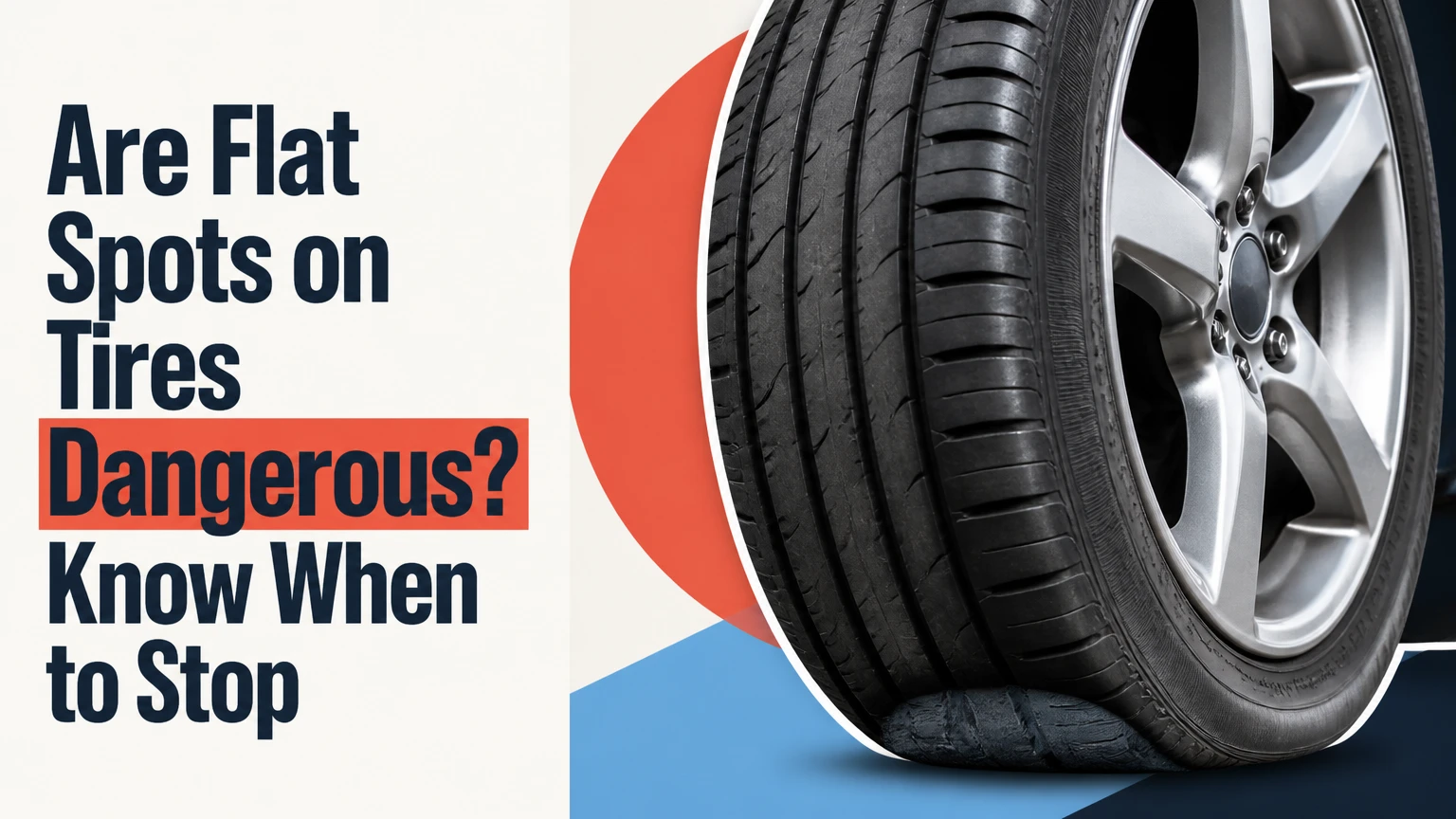
Flat spots on tires are usually harmless when they result from short-term parking and disappear as the tire warms, but a persistent flat spot can make driving unsafe. A locked-wheel skid, exposed cords, severe tread loss, bulging, or continuing vibration requires immediate inspection and may require tire replacement before highway speeds.
Key Facts at a Glance
A temporary storage flat spot commonly causes thumping for the first few miles, especially after cold-weather parking or parking immediately after hard driving.
A flat spot that remains after a cautious warm-up may indicate permanent deformation, uneven wear, wheel damage, or another fault.
A skid-induced flat spot removes tread through abrasion and is more urgent than ordinary overnight storage spotting.
Tire pressure does not repair structural damage, and a TPMS warning may appear only after pressure has already fallen substantially.
Never use aggressive acceleration or high speed to test whether a tire will recover.
Visible cords, a bulge, cracking, a deep abrasion patch, or rapid pressure loss means the vehicle should not be driven.
Are Flat Spots on Tires Dangerous?
Flat spots on tires are dangerous when the tire has permanent casing damage, severe localized tread loss, exposed reinforcement, or a vibration that compromises vehicle control. A temporary flat spot from sitting overnight is generally a drivability nuisance, not proof that the tire is about to blow out.
A tire is built to rotate with a consistent radius. When a loaded vehicle remains stationary, the section touching the ground can deform while the rubber and reinforcing materials cool. Cold temperatures make the tread compound and casing less flexible, so the tire may retain a temporary low section after the vehicle moves again.
The danger depends on the cause and the evidence. Storage-related flat spotting usually produces rhythmic thumping that gradually decreases as the tire flexes. Emergency braking can grind away tread in one location, while driving severely underinflated can generate heat and damage internal components without creating a simple visible flat patch.
The Google overview’s general safety conclusion is sound, but fixed rules such as “permanent after 30 days” or “safe after 10-15 miles” are not universal. Tire design, load, inflation, temperature, parking surface, age, and the severity of the deformation change the outcome.
What Is a Flat Spot?
A tire flat spot is a localized section of tread with a smaller effective rolling radius than the rest of the circumference. The section may be temporarily deformed by stationary loading or permanently worn and distorted by a skid, underinflation, or long-term storage.
A flat spot differs from an ordinary puncture. A puncture lets air escape through a hole; a flat spot changes the tire’s shape or removes tread in one area. A wheel imbalance, bent rim, or misalignment can create similar vibration but does not necessarily produce a flat tread patch.
How Does a Flat Spot Form?
A flat spot forms when stationary load, temperature, tire construction, or sliding friction prevents a tire from maintaining its round shape. A parked vehicle concentrates several hundred pounds of corner load onto a small contact patch, and the effect becomes stronger when the tire is cold or underinflated.
The process usually follows this sequence:
- The vehicle remains parked with one tread section supporting the wheel load.
- The tire cools, reducing rubber flexibility and casing recovery.
- The tread and internal reinforcement temporarily retain the contact-patch shape.
- Rotation creates a once-per-revolution change in rolling radius.
- The driver feels a rhythmic thump that may reduce as heat and flex restore the shape.
A locked-wheel skid works differently. The tire stops rotating while the vehicle continues moving, so asphalt scrubs one tread section repeatedly. That damage is abrasion, not merely a temporary change in shape, and it can expose belt material or create a severe vibration immediately.
An underinflated tire adds a separate risk. Low pressure increases sidewall flex and heat generation, which can damage the casing even when the tread does not show an obvious flat area. The U.S. National Highway Traffic Safety Administration recommends checking tire pressure monthly and before long trips because pressure loss can be gradual and may not be obvious by sight.
Which Type of Flat Spot Is Most Dangerous?
A locked-wheel skid with exposed cords is the most urgent flat-spot condition, followed by suspected casing damage from severe underinflation or a persistent storage deformation. A mild overnight thump that fades during cautious driving is normally the least serious type.
| Type and cause | Typical appearance or symptom | Driving decision |
|---|---|---|
| Overnight or cold storage | Rhythmic thump that decreases within 3-15 miles | Drive slowly only after pressure and condition checks |
| Several weeks of storage | Stronger vibration, possibly slower recovery | Arrange tire-shop inspection if it does not clearly improve |
| Long-term storage | Persistent thump, visible deformation, age-related cracking | Inspect before normal driving; replace if damage remains |
| Locked-wheel skid | One polished or worn tread patch, immediate vibration | Do not use highway speed; inspect promptly |
| Severe underinflation | Shoulder wear, heat damage, pressure loss, casing distortion | Inflate only to placard pressure and seek inspection |
| Curb or pothole impact | Bulge, cut, bent rim, pull, or new vibration | Stop driving if a sidewall bulge or cut is present |
Is a Temporary Flat Spot Different From Permanent Damage?
Temporary flat spotting is elastic deformation that gradually decreases as the tire flexes and warms. Permanent damage involves lasting casing distortion, localized tread destruction, belt separation, or other defects that remain after the tire reaches normal operating temperature.
The distinction cannot be established by elapsed time alone. A warm climate, correctly inflated passenger tire may recover after a short period, while a cold, heavily loaded performance tire may vibrate longer. Michelin identifies cold storage and parking after tires are hot as common contributors to temporary flat spotting, particularly on performance-oriented tires.
A persistent vibration is not automatically a failed tire. Wheel imbalance, a bent wheel, hub runout, a seized brake component, worn suspension parts, and a damaged wheel bearing can all produce vibration. Diagnosis matters because replacing a tire will not correct a bent rim or loose bearing.
Will a Temporary Flat Spot Disappear?
A temporary flat spot often disappears after several miles of ordinary driving, commonly within 3-15 miles, but the range is only a typical field expectation rather than a guaranteed repair interval. Cold weather, tire type, vehicle weight, and storage duration can extend the vibration.
The safest recovery method is gradual normal driving. Check cold pressure against the vehicle door-jamb placard, inspect each tire, avoid heavy loads, and use local roads first. Do not accelerate hard, corner aggressively, or enter a high-speed road while the tire’s condition is uncertain.
You should stop the test if the vibration worsens, steering becomes unstable, the vehicle pulls, pressure drops, or a tire produces a slapping or grinding noise. A flat spot that improves slightly but never disappears still warrants professional evaluation.
How Long Does Parking Create a Flat Spot?
A tire can develop temporary flat spotting after one night of parking, especially when the tire was hot before parking and the temperature falls sharply. There is no reliable universal deadline at which a temporary spot becomes permanent, so manufacturers generally emphasize condition, inflation, and storage practices rather than a fixed day count.
| Parking situation | Typical risk | Recommended response |
|---|---|---|
| 8-12 hours, mild weather | Low, brief vibration possible | Check pressure and drive gently |
| 1-3 days, freezing weather | Moderate temporary deformation | Inspect before driving fast |
| 2-6 weeks, cold storage | Moderate to high persistent vibration | Plan a tire and wheel inspection |
| Several months, loaded vehicle | High risk of lasting deformation | Inspect before road use |
| More than one year, old tires | High age and casing risk | Consider replacement based on age and condition |
The 30-day threshold sometimes repeated online should not be treated as a safety standard. A tire can remain serviceable after longer storage, while an underinflated, aged, or damaged tire can become unsafe much sooner.
Can You Drive on a Flat-Spotted Tire?
You can usually drive a short distance at moderate speed on a tire suspected of temporary storage flat spotting only after checking inflation and finding no visible damage. You should not drive on a tire with exposed cords, a sidewall bulge, a deep cut, rapid air loss, belt separation, or a severe skid patch.
Use this decision sequence:
- Check pressure cold. Compare the reading with the vehicle placard, not the maximum pressure molded on the sidewall.
- Inspect the tread and sidewall. Look for a missing tread section, cords, bulges, cracking, punctures, or a sharp irregular edge.
- Check the wheel. Look for a bent rim, packed mud, missing balance weight, or impact damage.
- Perform a short local test. Keep speed low and avoid a highway while the thump remains unexplained.
- Stop and arrange inspection. Persistent vibration, pressure loss, pulling, or handling change ends the test.
A spare tire or roadside service is safer than a “drive test” when the car has skidded heavily or sat for months with low pressure. The cost of an inspection is usually lower than the consequences of a failed tire or damaged suspension.
Is the Vibration Really a Flat Spot?
A flat spot usually creates a repetitive thump synchronized with wheel rotation, while imbalance often becomes more noticeable at a particular speed and may feel as steering-wheel shake. Because symptoms overlap, a tire technician should verify the tire, wheel, balance, and hub before assigning the cause.
| Possible cause | Common speed pattern | Physical clue | First diagnostic action |
|---|---|---|---|
| Temporary flat spot | Strong at first, improves with distance | Flat-feeling tread section | Check pressure and inspect tread |
| Wheel imbalance | Often strongest at 45-75 mph | Missing weight or uneven balance | Dynamic wheel balance |
| Bent wheel | Speed-related shake, may worsen after impact | Rim runout or visible dent | Measure radial and lateral runout |
| Alignment problem | Pulling and uneven shoulder wear | Steering wheel off-center | Alignment inspection |
| Wheel bearing wear | Humming or growling changes while turning | Play or roughness at hub | Hub and bearing check |
| Belt separation | Rhythmic thump, wobble, or pull | Bulge or tread distortion | Remove tire from service |
A useful practitioner rule is to compare the vibration’s location and timing. Steering-wheel shake often points toward a front wheel or tire, while a seat or floor vibration often originates at the rear, although vehicle design can transmit either symptom through the cabin.
Do not keep balancing a wheel that has a visibly distorted tire. Balance equipment can compensate for small mass differences, but it cannot restore a damaged casing or replace missing tread.
What Should You Do After a Locked-Wheel Skid?
After a locked-wheel skid, inspect the tire immediately and avoid highway driving until a technician confirms that tread depth, casing, and wheel condition remain acceptable. A shallow scuff may be serviceable, but a deep flat patch, vibration, belt exposure, or rubber separation requires replacement.
Record what happened. Note whether the vehicle had ABS intervention, whether one wheel locked, the approximate skid distance, and whether the car developed a pull or vibration afterward. Inspect all four tires because a second tire may have skidded without a dramatic visual mark.
A tire with exposed steel or textile cords cannot be safely repaired with a plug or patch. Puncture repairs address air leaks in the repairable tread area; they do not rebuild structural reinforcement or replace a section worn away by asphalt.
Why Is ABS Relevant?
Anti-lock braking systems rapidly release and reapply brake pressure to help prevent sustained wheel lock during hard braking. ABS reduces the likelihood of a long skid-induced flat spot, but it does not prevent tire damage from underinflation, road debris, or a crash.
A brief ABS event can still leave a minor mark under unusual conditions, such as a faulty sensor, mixed tire sizes, low traction, or a system malfunction. An ABS warning light requires diagnosis because the vehicle may no longer provide the intended anti-lock function.
How Should You Inspect a Suspected Flat Spot?
Inspect a suspected flat spot with the vehicle parked on level ground, the tires cold, and the parking brake applied. A visual inspection can identify obvious tread loss or sidewall damage, but a tire shop must measure runout and inspect internal damage that cannot be seen externally.
Follow these owner-safe checks:
- Compare all tire pressures with the placard specification.
- View the tread from the front and rear for a dip or uneven circumference.
- Rotate the tire slowly only if the wheel is safely supported by approved equipment.
- Feel the tread with a gloved hand for a sudden flat section or raised edge.
- Look for cords, bubbles, cracking, cuts, discoloration, and separated tread.
- Check whether the wheel has a dent or missing balance weight.
Never place any part of your body beneath a vehicle supported only by a jack. Do not spin a driven wheel with the engine running during a driveway inspection.
A technician can use a balancer to identify radial force variation, measure wheel runout, and examine the inner sidewall. Tire appearance alone cannot rule out internal belt damage, particularly after severe underinflation or an impact.
What Role Does Tire Pressure Play?
Correct inflation reduces casing flex and heat, but it cannot reverse a permanent flat spot or repair damaged reinforcement. The correct target is the cold inflation pressure on the vehicle placard or owner’s manual, not the higher maximum pressure printed on the tire sidewall.
Pressure changes with temperature. A typical tire changes approximately 1 psi for every 10 degrees Fahrenheit change in air temperature, although the exact result varies by tire volume and temperature measurement. A cold-weather TPMS warning may therefore reflect normal pressure reduction, but the pressure still needs correction.
Before seasonal storage, some tire manufacturers and storage specialists recommend a modest pressure increase within the tire maker’s limits, while others emphasize tire cradles or removing the load. Follow the tire and vehicle manufacturer instructions rather than automatically inflating to the sidewall maximum.
Which Tires Flat-Spot Most Easily?
Low-profile summer and track-focused tires generally show more temporary flat spotting than conventional touring all-season tires because their compounds and stiff sidewalls recover more slowly after cold storage. Heavy vehicles, wide tires, high load ratings, and low aspect ratios can increase the noticeable vibration.
| Tire or vehicle characteristic | Flat-spot tendency | Why it matters |
|---|---|---|
| Touring all-season, 60-series | Lower | More compliant sidewall and compound |
| Performance summer, 35-45 series | Higher | Stiffer casing and less flexible compound |
| Track-oriented R-compound | High | Racing compound and heat-sensitive construction |
| Heavy SUV or EV | Moderate to high | Greater static load per tire |
| Trailer tire parked loaded | Moderate to high | Long stationary load and limited use |
| Motorcycle tire | Variable | Narrow contact patch and storage position |
Electric vehicles deserve extra attention because battery mass increases static load, while instant torque can magnify damage from aggressive driving. The vehicle’s recommended pressure and load rating remain the controlling specifications.
How Should You Store a Car?
Store a vehicle with clean, correctly inflated tires on a stable surface, and reduce the time each tire remains under the same load. Tire cradles can distribute contact stress, while approved jack stands can remove tire load entirely when the vehicle manufacturer’s lifting points and storage procedures are followed.
For storage lasting weeks or months:
- Inspect the tires for age, damage, and uneven wear.
- Set cold pressure to the vehicle or tire manufacturer’s storage recommendation.
- Park on a firm, dry surface away from solvents and direct sunlight.
- Use purpose-built curved cradles if recommended for the tire size.
- Move the vehicle periodically only when it can be done safely.
- Recheck pressure before returning the vehicle to service.
Moving a car 12-24 inches every couple of weeks changes the contact patch, but it is not a substitute for inspection. Do not move a stored car if its battery, brakes, fuel system, or surrounding conditions make operation unsafe.
Should You Use Jack Stands?
Jack stands can prevent tire flat spotting by removing vehicle weight from the tires, but they must support the vehicle at manufacturer-approved points on a stable surface. Improper support can cause vehicle damage or a fall, making tire cradles the simpler choice for many owners.
When a vehicle remains elevated, suspension components may hang in an unusual position. Follow the service manual, secure the vehicle against rolling, and keep people away from the underside unless the support arrangement has been professionally verified.
What Does Inspection or Replacement Cost?
A basic tire inspection commonly costs $0-$30, a wheel balance often costs $15-$40 per wheel, and mounting a replacement tire commonly costs $20-$50 per wheel. Replacement tires typically range from about $100-$350 each for common passenger vehicles and $200-$600 or more for specialized performance, truck, or EV applications.
| Service or item | Typical U.S. price | When it applies |
|---|---|---|
| Pressure and visual check | $0-$30 | Initial suspected temporary spot |
| Single-wheel balance | $15-$40 | Imbalance suspected |
| Mount and balance | $20-$50 per wheel | New tire installation |
| Standard passenger tire | $100-$250 each | Common sedan or crossover |
| Performance or light-truck tire | $200-$600 each | Specialized size or load rating |
| Four-tire replacement | $450-$2,400 installed | Depends on size, brand, tax, and fees |
Prices vary by region, tire size, vehicle type, and retailer. A tire that has lost tread through a skid cannot be made safe by balancing, and replacing only one tire may be inappropriate on an all-wheel-drive vehicle if tread-depth differences exceed the manufacturer’s limit.
Common Mistakes That Make Flat Spots Worse
Mistake 1: Accelerating Hard to Warm the Tire
Aggressive acceleration adds heat and load before you know whether the casing is sound. Use a short, low-speed test instead, and stop if the vibration increases.
Mistake 2: Inflating to the Sidewall Maximum
The sidewall maximum is a tire limit, not the vehicle’s normal operating target. Excess pressure can reduce the intended contact patch and alter handling, while insufficient pressure creates heat and flex.
Mistake 3: Treating Every Thump as a Flat Spot
A bent wheel or separated belt can mimic storage spotting. If the vibration remains after a cautious drive, obtain a balance and tire inspection instead of repeating the road test.
Mistake 4: Plugging a Skid-Damaged Tire
A repair plug addresses a puncture, not missing tread or exposed reinforcement. Remove a tire from service when structural material is visible.
Mistake 5: Relying Only on TPMS
TPMS monitors air pressure, not tread deformation, wheel balance, belt separation, or sidewall damage. Manual inspection remains necessary after storage, impacts, and skids.
Frequently Asked Questions
Can flat spots cause a blowout?
A mild temporary storage flat spot does not normally cause a blowout. Blowout risk rises when the tire has exposed cords, belt separation, severe underinflation damage, a bulge, advanced cracking, or deep tread loss. Persistent vibration after storage deserves inspection because the symptom may come from a different structural fault.
Can a tire flat spot be repaired?
A temporary storage flat spot usually needs no repair because the tire may recover through ordinary flexing. A permanent deformation, separated belt, exposed cord, or skid-induced tread loss cannot be repaired safely with balancing, plugging, or patching. The correct remedy is professional assessment and replacement when damage is confirmed.
Are flat spots worse on an AWD vehicle?
An all-wheel-drive vehicle does not automatically create more flat spotting, but its heavier curb weight and drivetrain sensitivity can make vibration more noticeable. Replacing one damaged tire may also create excessive tread-depth difference, so the owner’s manual should determine whether one, two, or four tires need replacement.
Can parking on concrete cause flat spots?
Concrete does not cause a dangerous flat spot by itself. A hard surface provides less compliance than soft ground, but temperature, tire pressure, load, tire construction, and storage duration have greater influence. A clean, dry concrete floor is generally suitable when tires are correctly inflated and inspected.
Do flat spots affect wheel alignment?
A flat spot does not directly change alignment angles, but the resulting vibration can stress suspension components and make the vehicle feel unstable. A bent wheel, impact, or uneven tire wear can affect alignment at the same time, so persistent pulling or an off-center steering wheel requires a full chassis check.
Should you replace all four tires after one flat spot?
Replace all four tires only when tread matching, age, drivetrain requirements, or manufacturer instructions justify it. A single temporary storage spot needs no replacement, while one structurally damaged tire may be replaced individually on some vehicles. AWD systems often impose tighter tread-depth limits, so verify the vehicle specification first.
The Bottom Line
Are flat spots on tires dangerous? Usually not when the spot is a temporary result of short-term parking and the thumping steadily fades after a cautious, low-speed drive. The condition becomes dangerous when vibration persists, pressure changes, tread is missing, cords are visible, the sidewall bulges, or the tire suffered a locked-wheel skid or severe underinflation.
Check pressure and tire condition before driving. Keep the test slow and local. Stop using the vehicle and arrange professional inspection when the evidence points to permanent deformation or structural damage, because no mileage rule can guarantee that a damaged tire will recover.