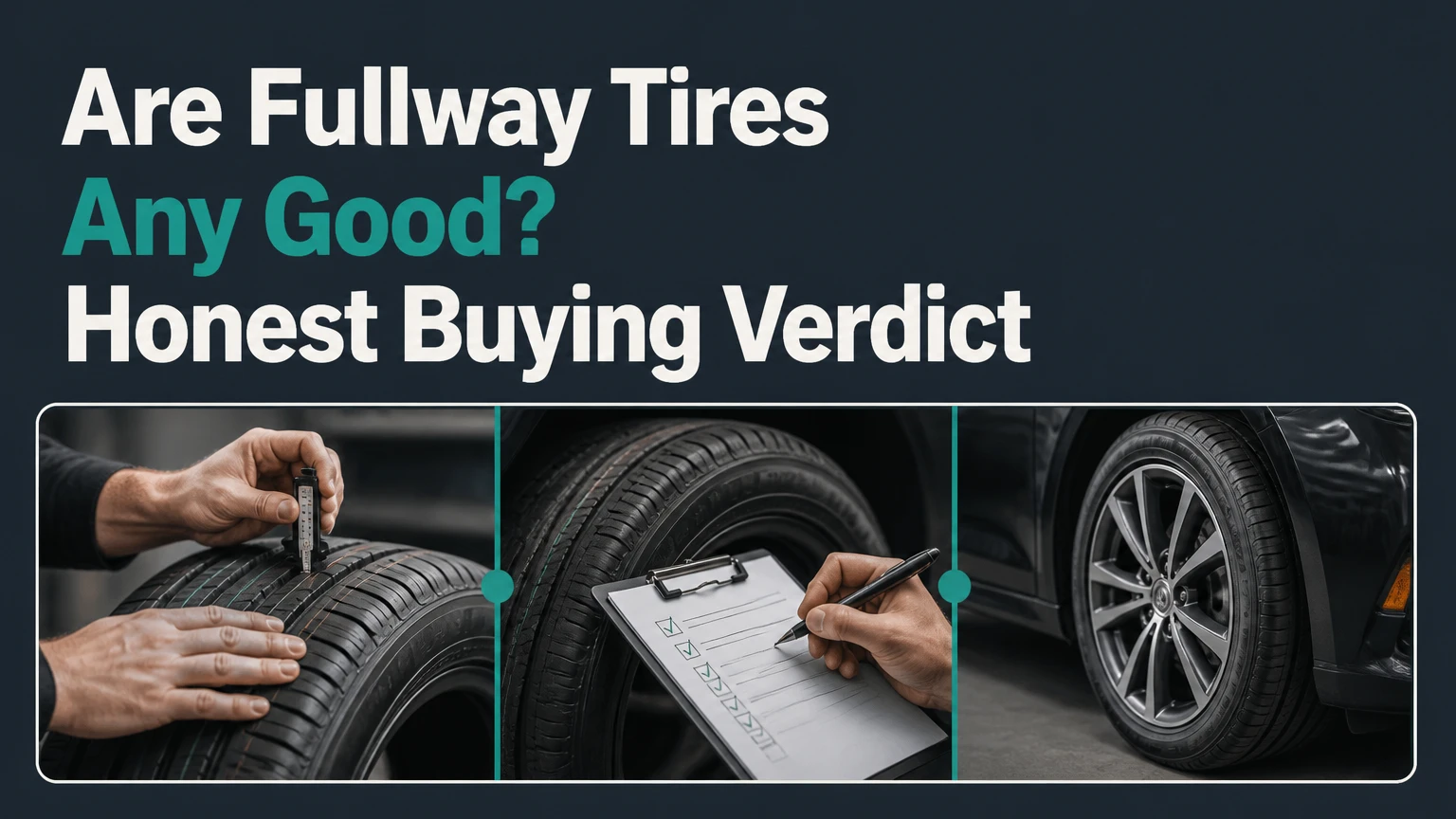
Fullway tires are acceptable low-cost tires for short-to-moderate daily driving in mostly dry conditions, but they are not a strong choice for severe rain, snow, ice, or high annual mileage. Their low purchase price and generally quiet dry-road behavior come with less predictable wet traction, shorter expected tread life, and limited warranty protection.
Key Facts at a Glance
- Fullway is an economy tire brand associated with Qingdao Fullrun Tyre Corp., with product availability and manufacturing details varying by model and market.
- Fullway tires commonly cost about $55-$95 per tire before mounting, balancing, taxes, and disposal fees.
- Retail listings commonly show no manufacturer-backed treadwear mileage warranty, so buyers should verify the exact warranty before ordering.
- A typical practical service life is about 20,000-30,000 miles, although alignment, inflation, rotation, climate, and driving style can change that substantially.
- Fullway tires can be reasonable for dry-weather commuting, but an “all-season” label does not make them suitable for severe winter conditions.
- A UTQG traction grade of A describes a standardized wet-braking category; it does not guarantee strong rain performance or predict tread life.
What Are Fullway Tires?
Fullway is an economy tire brand sold for passenger cars, crossovers, SUVs, light trucks, and performance-style applications. Retailers associate the brand with Qingdao Fullrun Tyre Corp. in China, while individual products may list different manufacturing locations, so the sidewall and DOT identification should be checked on the specific tire.
Fullway competes mainly on purchase price. Its catalog includes high-performance-looking tires such as the HP108 and HP208, touring-oriented PC models, and SUV or crossover products in the HS range. A sporty tread pattern and a high speed symbol do not automatically make a tire equivalent to a premium performance tire because casing construction, compound consistency, wet testing, and quality-control history also affect real-world behavior.
The relevant question is not whether Fullway tires are made overseas. Most major tire companies use global manufacturing. The useful questions are whether the tire has the correct load index and speed rating, whether its date code is recent, whether the seller offers a practical return policy, and whether its wet-weather performance suits your driving.
Is Fullway a premium tire brand?
No. Fullway occupies the entry-level or budget segment rather than the premium tier. Michelin, Continental, Bridgestone, Pirelli, Goodyear, and several established mid-priced brands typically invest more heavily in independent testing, compound development, dealer support, and warranty programs.
Budget status does not mean a tire is automatically defective or illegal. It does mean the buyer accepts a narrower performance margin. A driver who rarely encounters standing water and replaces a low-mileage vehicle soon may value the savings more than a driver who travels 25,000 highway miles annually.
Are Fullway Tires Any Good for Everyday Driving?
Fullway tires can be good enough for a budget commuter when the vehicle is correctly fitted, the roads are mostly dry, speeds are moderate, and the owner maintains pressure and alignment. Fullway tires are a poor value when a failure, weak wet braking, or early replacement would create a larger cost than the original savings.
Dry-road behavior is the strongest case for this brand. Drivers commonly report acceptable steering response, reasonable cabin noise, and adequate straight-line grip during ordinary city travel. Those impressions are useful, but customer reviews are not controlled tests and may describe different sizes, vehicles, production dates, and inflation practices.
Fullway tires should therefore be assessed as transportation equipment, not as a universal performance upgrade. A new budget tire with full tread can outperform a severely aged or damaged premium tire, but a new Fullway tire does not erase the handling advantage of a well-designed premium or mid-tier tire in rain and cold weather.
What are the main strengths and weaknesses?
| Decision factor | Fullway’s typical position | Practical consequence |
|---|---|---|
| Purchase price | $55-$95 per tire | Low initial cost for a complete set |
| Dry commuting | Adequate to good | Suitable for ordinary city and suburban driving |
| Cabin noise | Often reported as moderate to low | Comfortable on smooth asphalt |
| Wet braking | Variable, weaker in heavy rain | Greater caution near standing water |
| Winter traction | No typical 3PMSF designation | Not appropriate for severe snow or ice |
| Tread life | About 20,000-30,000 typical miles | Higher replacement frequency than many alternatives |
| Treadwear warranty | Commonly 0 miles | Owner carries more long-term risk |
| Pothole resistance | Variable by size and casing | Inspect after impacts and avoid overloaded use |
The most important weakness is not noise or cosmetic tread design. It is the smaller reserve of grip when water, cold temperatures, worn tread, poor alignment, or emergency braking enter the situation.
How Do Fullway Models Differ?
Fullway models differ mainly by tread pattern, intended vehicle type, size range, load index, speed rating, and sidewall construction. The correct model is the one that matches the vehicle placard and operating conditions, not necessarily the model with the highest speed symbol.
| Model family | Common orientation | Features commonly listed | Appropriate use |
|---|---|---|---|
| HP108 | High-performance all-season style | Asymmetric tread, directional-looking grooves, H, V, W, or Y applications depending on size | Dry-weather sedans and budget performance use |
| HP208 | Performance passenger tire | Wide circumferential grooves, sporty tread, XL sizes in some fitments | Commuter cars needing a performance-style appearance |
| PC368 | Passenger touring | Symmetrical tread and comfort-oriented block layout | Sedans, hatchbacks, and low-load family vehicles |
| PC369 | Passenger touring | Conventional all-season pattern and broad fitment range | Daily commuting where price is the main constraint |
| HS266 | SUV or crossover | Larger load indexes and water-channel tread design | Crossovers and SUVs within placard requirements |
| HS299 | SUV, CUV, or light-truck application | Reinforced fitments in selected sizes | Heavier vehicles requiring the specified load capacity |
Specifications vary by tire size. A 235/55R17 HP108 and a 205/55R16 HP108 may have different load indexes, speed ratings, UTQG markings, and construction details, so a model name alone is insufficient for approval.
What should you verify on the sidewall?
Verify the complete tire designation before payment. The vehicle door-jamb placard remains the primary reference for the original size and inflation pressure.
Check these markings:
- Size: for example, 225/60R17.
- Load index: the numeric code must meet or exceed the vehicle requirement.
- Speed rating: H, V, W, or another symbol must meet the vehicle requirement.
- XL marking: use Extra Load only when the fitment and pressure instructions support it.
- DOT date code: the final four digits identify the production week and year.
- M+S or 3PMSF marking: M+S is not the same as severe-snow certification.
- UTQG: treadwear, traction, and temperature information applies to that exact tire.
A tire shop should also confirm wheel width, clearance, TPMS compatibility, and whether the tire is approved for the vehicle’s axle load.
How Do Fullway Tires Perform in Rain and Winter?
Fullway tires are usually most limited in heavy rain, cold pavement, packed snow, and ice. Tread grooves can move light surface water, but groove appearance cannot establish hydroplaning resistance, emergency wet braking, or cold-compound flexibility.
A tire’s wet performance changes as tread depth falls. Water evacuation becomes less effective near the wear bars, while higher speed and deeper standing water reduce the available margin further. Drivers who regularly encounter tropical downpours, Pacific Northwest rain, Florida thunderstorms, or poorly drained highways should place wet braking above the cheapest purchase price.
Winter performance requires separate attention. The Three-Peak Mountain Snowflake symbol, or 3PMSF, identifies a tire that meets a defined severe-snow performance test. An M+S marking generally indicates a tread pattern classification and does not prove adequate traction on ice or deep snow.
| Driving condition | Fullway suitability | Safer buying direction |
|---|---|---|
| Dry city streets above 45°F | Reasonable budget use | Fullway can fit a low-mileage commuter |
| Light rain at moderate speed | Usable with reduced following distance avoided | Mid-tier all-season provides more reserve |
| Heavy rain and standing water | Weak risk profile | Choose a tire with strong independent wet testing |
| Temperatures near freezing | Limited confidence | Use a cold-weather-rated all-season or winter tire |
| Packed snow | Poor unless the exact tire has suitable certification | Choose 3PMSF-rated all-season or winter tires |
| Ice and repeated snowstorms | Not recommended | Use dedicated winter tires |
| Hot highway travel | Fitment and inflation dependent | Verify load, speed rating, and pressure carefully |
Fullway tires should not be treated as winter tires merely because a retailer uses the phrase “all-season.” In many parts of the United States and Canada, all-season means three-season compromise, not dependable snow performance.
How Long Do Fullway Tires Last?
Fullway tires typically provide about 20,000-30,000 usable miles in ordinary service, although that is a practical estimate rather than a guaranteed lifespan. Aggressive acceleration, underinflation, misalignment, overloaded operation, infrequent rotation, and hot pavement can reduce that range sharply.
A retailer’s advertised 40,000-50,000-mile expectation, where present, should not be treated as a promise. Fullway listings commonly do not include a treadwear mileage warranty, and UTQG treadwear numbers are comparative ratings produced under specified conditions rather than a direct mileage forecast.
Rotation is particularly important on front-wheel-drive vehicles because the front axle handles steering, braking, and much of the acceleration load. Rotate according to the vehicle manufacturer’s schedule, commonly around 5,000-7,500 miles, and inspect the tread whenever oil service or seasonal maintenance occurs.
What does a UTQG rating of 400A mean?
A 400 treadwear number is a comparative government-regulated rating, while the letter A is the highest traction category in the UTQG system. The traction test concerns straight-line wet braking on specified surfaces; it does not measure cornering, hydroplaning resistance, snow, ice, or total tire life.
The temperature grade also concerns resistance to heat generation under a specified laboratory test. The National Highway Traffic Safety Administration requires UTQG information for many passenger tires, but NHTSA does not treat the number as a universal ranking between brands because manufacturers perform the comparison testing under their own control.
That distinction matters. A 400A Fullway is not automatically safer in rain than a 300AA tire from another brand, and neither rating predicts how a particular driver will wear the tread.
How Much Do Fullway Tires Cost to Own?
A Fullway set commonly costs about $240-$380 before installation, while mounting, balancing, valve service, disposal, taxes, and TPMS work can add roughly $80-$180. The low purchase price becomes less attractive if the tires last 20,000 miles and a mid-tier set costs only moderately more while lasting substantially longer.
| Ownership item | Fullway typical range | Why it matters |
|---|---|---|
| Tire price | $55-$95 each | Model, size, seller, and shipping change the total |
| Four-tire purchase | $240-$380 | Often excludes installation |
| Mounting and balancing | $80-$160 per set | Regional labor and wheel size affect cost |
| Rotation interval | 5,000-7,500 miles | Helps control irregular wear |
| Practical service life | 20,000-30,000 miles | Use inspection, not mileage alone, for replacement |
| Mileage warranty | Commonly none | No prorated treadwear reimbursement |
| Replacement after 3 years at 10,000 miles/year | Possible | Time, weather, and storage still matter |
For a driver covering 10,000 miles per year, a 25,000-mile set may require replacement in approximately two and a half years. A driver covering 20,000 miles annually may reach the wear bars much sooner, making wet-weather performance and replacement scheduling more important than the initial $100-$200 saving.
Fullway Versus Mid-Tier Alternatives
Fullway makes the most sense when the budget is fixed and the vehicle has limited remaining value. Cooper, Kumho, Falken, General, and similar mid-tier brands generally offer stronger dealer networks, broader warranty support, and more consistent wet or cold-weather choices, although the exact model matters more than the logo alone.
| Option | Typical four-tire price | Warranty position | Best fit | Main trade-off |
|---|---|---|---|---|
| Fullway HP or PC | $240-$380 | Often no mileage warranty | Dry-weather, low-mileage commuting | Shorter expected life and weaker wet reserve |
| Cooper all-season | $450-$700 | Model-dependent limited mileage coverage | General commuting and mixed weather | Higher purchase cost |
| Kumho all-season | $400-$650 | Model-dependent coverage | Value-focused daily driving | Performance varies by model |
| Falken all-season | $500-$750 | Model-dependent coverage | Rain, highway, and balanced handling | Usually costs more |
| Used premium tires | $200-$500 | Usually no seller mileage warranty | Temporary budget solution | Age, damage, and history may be unknown |
| Dedicated winter set | $500-$1,000 | Model-dependent | Snow and ice regions | Requires storage and seasonal changeover |
Prices are typical market ranges, not guaranteed quotations. Compare the complete installed price and warranty, not the online tire price alone.
Should you buy Fullway or a used premium tire?
A new Fullway tire is usually preferable to a used premium tire with an unknown history, uneven wear, sidewall damage, or an old DOT date. A carefully inspected premium tire with a recent date, even wear, no repairs in prohibited areas, and documented storage can offer better compound quality, but the inspection burden is high.
Never buy a used tire solely because its tread looks deep. Rubber ages through heat, ultraviolet exposure, ozone, and storage conditions. The Tire Industry Association recommends professional inspection for used tires, particularly when the date, repair history, or previous service is uncertain.
Who Should Buy Fullway Tires?
Fullway tires fit a narrow but legitimate buyer profile: a driver needs a new, correctly sized tire at the lowest immediate price and accepts more frequent replacement and less wet-weather margin. The purchase is more defensible for a second vehicle, a low-mileage commuter, or a car near the end of its ownership period.
A dry-climate commuter
A driver covering 5,000-8,000 miles annually on maintained city roads may find Fullway acceptable if the vehicle is aligned and the owner checks pressure monthly. The decision becomes weaker when the route includes frequent high-speed rain or long mountain descents.
A temporary vehicle owner
Fullway may reduce immediate costs on an older vehicle that needs legal, matching tread for safe short-term use. The owner should still avoid fitting a tire that fails the vehicle’s load requirement or has an old production date.
A track or drifting user
Some drivers use inexpensive performance tires for closed-course drifting because rear tires are consumed quickly. Fullway HP models may reduce consumable cost, but public-road safety, heat management, carcass condition, and event rules remain separate concerns. A tire suitable for controlled sliding is not automatically suitable for emergency wet braking.
Who should avoid them?
Avoid Fullway when you regularly drive through severe snow, freezing rain, torrential rain, remote highways, heavy loads, or high annual mileage. Also avoid them when the vehicle carries children or passengers through conditions where a longer wet-braking margin matters more than the lowest price.
What Problems Can Occur?
The most common ownership problems are irregular wear, vibration, slow leaks, premature cracking, and performance loss as tread depth decreases. None proves a brand-wide defect, but each requires diagnosis rather than continued driving.
| Symptom | Likely causes | Immediate action |
|---|---|---|
| Steering-wheel vibration at 50-70 mph | Wheel imbalance, bent rim, tire uniformity issue | Rebalance and inspect the wheel and tire |
| Cupped or scalloped tread | Misalignment, worn suspension, underinflation | Check alignment, shocks, and pressure |
| Slow air loss | Valve, bead, puncture, or damaged rim | Perform a leak test before driving far |
| Sidewall bulge | Impact damage to internal cords | Replace the tire immediately |
| Cracks between tread blocks | Aging, ozone, heat, or storage exposure | Have a tire professional inspect it |
| Uneven shoulder wear | Incorrect pressure or alignment | Correct the cause before replacing tires |
| Poor wet grip | Worn tread, cold compound, speed, or water depth | Reduce speed and plan replacement |
A bulge is not repairable because it indicates internal structural damage. A puncture outside the repairable tread area, a damaged bead, exposed cords, or tread separation also requires replacement.
How should Fullway tires be installed?
Fullway tires should be mounted by a qualified tire shop using the vehicle’s specified cold inflation pressure and the tire’s maximum pressure limits. Bead seating is a shop procedure, not a reason for a consumer to inflate a tire to an improvised 70-95 PSI.
The correct process is:
- Confirm the tire size, load index, speed rating, and rotation direction.
- Inspect the wheel for cracks, bends, corrosion, and bead-seat damage.
- Lubricate the bead with approved mounting lubricant.
- Seat the bead using the manufacturer’s and machine’s safe limits.
- Confirm the bead line is evenly visible around the rim.
- Inflate to the vehicle placard pressure after installation.
- Balance the assembly and relearn or test the TPMS.
- Recheck pressure and leaks after the first drive.
If a newly mounted tire loses air, returns with a vibration, or has an uneven bead line, stop and return to the installer. Do not keep adding air while assuming the tire will eventually seal.
Expert Buying Rules That Prevent Expensive Mistakes
Rule 1: Compare installed cost per expected mile. A $300 Fullway set lasting 25,000 miles costs about 1.2 cents per tire mile before installation. A $550 set lasting 50,000 miles costs about 1.1 cents per mile, even before considering the better warranty or wet-weather performance.
Rule 2: Inspect the date code before accepting delivery. A discounted tire can be a poor deal if it has spent years in hot storage. The final four DOT digits identify the production week and year, such as 2325 for the 23rd week of 2025.
Rule 3: Match the vehicle, not the advertisement. A high W or Y speed rating does not compensate for an insufficient load index, incorrect diameter, poor wheel-width match, or unsuitable winter capability.
Rule 4: Replace by condition, not the advertised mileage. Wet grip can become unacceptable before the tread reaches the legal wear threshold, especially with uneven wear or repeated heat exposure.
Frequently Asked Questions
Are Fullway tires safe on the highway?
Fullway tires can be used legally on highways when the exact tire meets the vehicle’s size, load, speed, and condition requirements. Highway safety depends heavily on inflation, tread depth, weather, alignment, and speed. Drivers should not treat a budget tire’s speed rating as proof of strong emergency handling or wet braking.
Are Fullway tires noisy?
Fullway passenger tires are often reported as reasonably quiet on smooth asphalt, particularly when new. Noise can increase with cupping, uneven wear, rough concrete, incorrect pressure, or suspension problems. A quiet ride is a comfort characteristic, not evidence that the tire has superior wet traction or long tread life.
Do Fullway tires have a mileage warranty?
Many Fullway retail listings show no manufacturer-backed treadwear mileage warranty, although policies can vary by model, seller, and market. Buyers should request the written warranty before purchase and distinguish defect coverage from mileage coverage. A defect warranty generally does not reimburse normal wear, punctures, misalignment, or road-hazard damage.
Can Fullway tires be used on an SUV?
Fullway SUV and crossover models can be used when the exact size, load index, speed rating, and inflation requirement match the vehicle. SUV fitment alone is not enough. Check the door-jamb placard, because a passenger-car tire with an attractive price may not provide the required load capacity for a heavier crossover or truck.
How often should Fullway tires be rotated?
Rotate Fullway tires at the vehicle manufacturer’s interval, commonly every 5,000-7,500 miles, unless the owner’s manual specifies another schedule. Check pressure monthly and inspect for shoulder wear, cupping, nails, cracks, and bulges. An alignment check is appropriate when wear is uneven or the vehicle pulls to one side.
What is the best alternative to Fullway tires?
The best alternative depends on weather and annual mileage. Cooper or Kumho often suit value-focused all-season buyers, while Falken and comparable mid-tier models may provide a stronger balance for rain and highway use. In snow regions, choose a 3PMSF-rated all-season or dedicated winter tire instead of any ordinary budget all-season model.
The Bottom Line
Fullway tires are a defensible low-cost choice for dry-weather, low-mileage commuting when the tire is fresh, correctly fitted, properly inflated, and professionally installed. They are not the best choice for severe rain, snow, ice, heavy loads, frequent highway travel, or owners who want a documented long-mileage warranty.
The answer to “are Fullway tires any good” is therefore conditional but clear: Fullway is good enough for a narrow budget use case, not a general replacement for a proven mid-tier or premium tire. Compare the installed price, expected 20,000-30,000-mile life, weather exposure, warranty, and vehicle requirements before deciding.