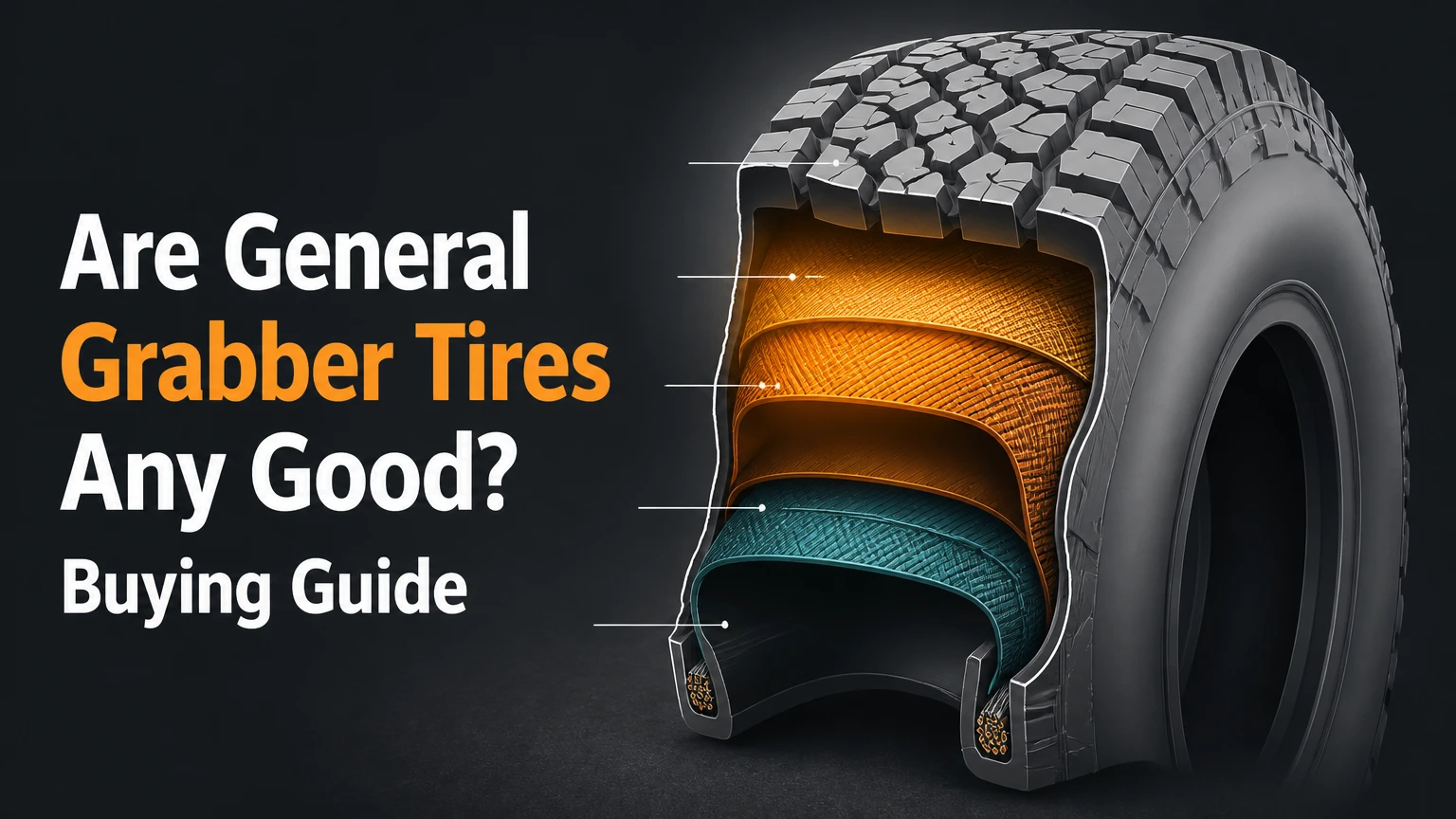
Yes, General Grabber tires are good when the model matches the vehicle and driving conditions. General Tire, a Continental subsidiary, offers durable highway, all-terrain, hybrid, and mud-terrain tires that often cost less than BFGoodrich or Michelin alternatives, but no Grabber combines quiet pavement manners, deep-snow traction, towing capacity, and low fuel consumption equally well.
Key Facts
General Grabber A/TX is a severe-snow-rated all-terrain tire with the 3-Peak Mountain Snowflake symbol in applicable sizes.
Grabber HTS60 is the pavement-focused option, with some fitments carrying a 65,000-mile limited treadwear warranty.
Grabber X3 is designed for mud and technical off-road use, not primarily for wet-road commuting.
Grabber APT is a lighter, more road-oriented all-terrain option for crossovers and light trucks.
Load Range E tires improve load capacity but usually add weight, stiffness, noise, and rolling resistance.
A 3PMSF mark certifies performance against a severe-snow traction threshold; it does not make a tire equivalent to a dedicated winter tire.
Are General Grabber Tires Any Good for Daily Driving?
General Grabber tires are a sound daily-driving choice when the tread design suits the percentage of pavement you drive. The HTS60 and APT generally make more sense for commuters, while the A/TX fits drivers who regularly encounter gravel, snow, construction sites, or unpaved access roads.
General Tire benefits from Continental’s engineering, manufacturing, testing, and distribution resources, although General is positioned below Continental’s flagship passenger-tire branding in many markets. That positioning explains the typical value proposition: useful technology and broad truck fitment at a lower purchase price than some premium competitors.
The trade-off is measurable in the tread. A highway tire has closely spaced ribs and smaller voids, which usually reduce pattern noise and rolling resistance. An all-terrain tire has larger voids and stronger shoulder blocks, which improve loose-surface grip but can increase noise and reduce fuel economy.
A Grabber is not automatically better because it looks tougher. A Honda Pilot that spends 95% of its time on asphalt may be less comfortable and efficient on an aggressive A/TX than on a highway or touring tire.
Which General Grabber Model Should You Choose?
The correct General Grabber model depends primarily on pavement percentage, loose-surface frequency, winter severity, vehicle weight, and towing load. The table below separates the four commonly cross-shopped models by their intended job rather than by appearance.
| Model | Tire category | Best operating mix | Snow or off-road feature | Typical 265/70R17 price |
|---|---|---|---|---|
| Grabber HTS60 | Highway terrain | 90-100% paved roads | Highway tread; not generally 3PMSF-rated | $170-$200 |
| Grabber APT | Mild all-terrain | 75-90% paved roads | Lower-weight hybrid tread | $200-$240 |
| Grabber A/TX | Aggressive all-terrain | 55-85% paved roads | 3PMSF in applicable sizes; studdable in selected fitments | $248-$297 |
| Grabber X3 | Mud terrain | 20-60% paved roads | Large voids, reinforced off-road construction, selected red-letter fitments | $318 or more |
Prices are typical online tire-only ranges, not fixed manufacturer prices. Size, load range, outlined-white-letter styling, retailer promotions, shipping, installation, disposal fees, taxes, and regional supply can move the final bill by several hundred dollars per set.
Grabber HTS60: Best for Highway Commuters
Grabber HTS60 is the most rational choice for a truck, SUV, or commercial vehicle that remains on paved roads. Its closed highway tread typically produces less noise and rolling resistance than the A/TX or X3, and selected sizes carry a limited 65,000-mile treadwear warranty.
Choose the HTS60 for interstate driving, commuting, family travel, and moderate towing on sealed roads. The tread is better suited to stable highway tracking and even wear than to deep mud or rocky trails.
The limitation is traction specialization. The HTS60 is not the model to choose simply because it fits a truck that occasionally sees snow. Check the exact sidewall and product listing for the 3PMSF symbol, because certification varies by model and size.
Grabber APT: Best for Crossovers and Mild Dirt Roads
Grabber APT is the compromise option for drivers who want a tougher appearance and occasional unpaved-road capability without moving to the heavier A/TX. Its lighter construction in comparable applications can reduce the fuel-economy and ride penalties associated with a large LT all-terrain tire.
APT fits crossover owners, suburban pickup drivers, and recreational users who drive maintained gravel roads, grass, packed dirt, and occasional light snow. It is a poor substitute for a mud tire when wheel spin in deep clay or loose rock is routine.
Verify the tire’s load index against the vehicle placard. A visually similar tire with a different load index can change payload capacity, steering response, and recommended inflation pressure.
Grabber A/TX: Best All-Rounder for Mixed Surfaces
Grabber A/TX is the strongest general recommendation for a driver who needs one tire for pavement, gravel, trails, and regular winter weather. Applicable sizes use the 3PMSF severe-snow mark, and selected versions are designed to accept studs where local regulations permit.
The A/TX uses aggressive shoulder blocks and extensive siping to create more edges in snow and loose terrain. General Tire also markets Duragen technology for enhanced casing durability, while Comfort Balance technology targets vibration isolation beneath the tread.
The A/TX still gives up something on pavement. Compared with the HTS60, it may produce more pattern noise, weigh more, roll less efficiently, and feel less precise during emergency lane changes. Those costs are reasonable when the truck actually leaves the road.
Grabber X3: Best for Mud and Technical Trails
Grabber X3 is appropriate for drivers who prioritize deep mud, ruts, rocks, and sidewall protection above highway refinement. Its open tread evacuates mud more effectively than the A/TX, while reinforced construction and large shoulder elements support low-speed off-road use.
X3 is a poor choice for a mostly urban truck. Mud-terrain voids can reduce wet-road braking confidence as the tread wears, and uneven wear becomes especially noticeable when alignment, balance, suspension, or rotation intervals are neglected.
A mud tire’s aggressive appearance does not create grip on wet asphalt. For a daily driver that reaches trails only a few weekends per year, an A/TX usually offers the safer overall compromise.
How Do Grabber Tires Compare With BFGoodrich KO2?
Grabber A/TX and BFGoodrich All-Terrain T/A KO2 occupy the same all-terrain category, but the better purchase depends on price, size availability, winter use, warranty terms, and the vehicle’s load requirement. The A/TX commonly costs less, while KO2 has stronger name recognition and broad aftermarket support.
| Criterion | General Grabber A/TX | BFGoodrich KO2 | Practical consequence |
|---|---|---|---|
| Typical 265/70R17 price | $248-$297 | Often $290-$350 | A/TX may save $40-$60 per tire |
| Severe-snow marking | 3PMSF in applicable sizes | 3PMSF in applicable sizes | Check the exact size, not only the model name |
| Standard-load warranty | Up to 60,000 miles in qualifying fitments | Commonly 50,000 miles | Warranty terms depend on size and service conditions |
| Pavement noise when new | Typically moderate for an aggressive A/T | Typically moderate | Both can become louder with irregular wear |
| Main design emphasis | Mixed road, snow, and trail use | Durability and all-terrain versatility | Choose by actual terrain and load |
| Replacement availability | Broad, size-dependent | Very broad in North America | KO2 may be easier to match while traveling |
The A/TX is often the better value if the tire is available in the correct load index and its warranty covers the chosen fitment. KO2 may be preferable when a driver values familiar dealer inventory, a specific LT size, or an established fitment for a modified truck.
No universal test supports declaring one tire superior in every rain, snow, gravel, and braking condition. Tire Rack’s instrumented comparisons and owner testing can reveal tendencies, but vehicle weight, alignment, temperature, tread depth, and road surface materially change the result.
Are Grabber Tires Quiet on the Highway?
Grabber HTS60 is generally the quietest Grabber choice because its highway tread has smaller voids and more continuous contact. Grabber APT usually occupies the middle ground, A/TX produces more pattern sound, and X3 creates the most noticeable hum on pavement.
| Model | Typical new-tire road-noise position | Ride behavior | Main noise risk |
|---|---|---|---|
| HTS60 | Lowest among these four | Softest highway response | Cupping from alignment or worn suspension |
| APT | Low to moderate | More controlled than aggressive A/T tires | Pressure too high for vehicle load |
| A/TX | Moderate | Firm, stable, trail-capable | Shoulder or heel-toe wear |
| X3 | Highest | Firm and deliberate | Open voids plus irregular wear |
Noise often changes more with maintenance than buyers expect. A/T tread blocks that wear unevenly can create a helicopter-like sound, even when the tire was quiet during its first several thousand miles.
Are Grabber Tires Good in Rain and Snow?
Grabber A/TX is generally the better Grabber model for mixed rain and snow, while HTS60 is usually the better dry-pavement highway tire. A 3PMSF rating supports severe-snow performance, but it does not guarantee short ice braking distances or superior performance below every temperature.
The 3PMSF symbol indicates that the tire met a standardized severe-snow traction requirement under a regulated test procedure. The symbol does not mean the tire uses the same rubber compound, tread flexibility, or ice-focused design as a dedicated winter tire.
For frequent packed-snow and ice driving, a true winter tire remains the more specialized option. For year-round use with periodic snow, A/TX’s siping and 3PMSF marking can be a sensible compromise, especially where changing tires twice a year is impractical.
X3 requires more caution. Its open tread helps in deep loose material, but mud-terrain tread can offer less predictable wet-road behavior as tread blocks lose sharp edges and depth.
How Much Do General Grabber Tires Cost?
General Grabber tires typically cost about $170-$350 per tire before installation, with the model, size, load range, and retailer creating most of the variation. A complete four-tire purchase commonly reaches $800-$1,500 after mounting, balancing, disposal, taxes, and optional protection plans.
| Purchase component | Typical amount | When it changes |
|---|---|---|
| HTS60 tire | $170-$240 | Passenger, LT, and commercial sizes differ |
| APT tire | $200-$280 | Larger SUV and XL sizes cost more |
| A/TX tire | $248-$330 | LT, E-load, and specialty sidewalls increase price |
| X3 tire | $318-$425 | Large diameter and red-letter versions cost more |
| Mount and balance | $20-$45 per tire | Local labor and wheel size determine rate |
| Disposal and shop fees | $3-$10 per tire | State and retailer policies vary |
Compare the installed total, not only the advertised tire price. A discounted tire with a high installation charge may cost more than a regularly priced tire from a retailer offering free mounting or road-hazard coverage.
Does Load Range E Make a Grabber Tire Better?
Load Range E does not make a Grabber tire universally better; it raises the tire’s load capacity and operating pressure for vehicles that need those capabilities. Load Range E tires often ride harder, weigh more, reduce fuel economy, and require careful pressure selection when fitted to a lightly loaded SUV.
“10-ply” is a load-range designation, not a guarantee that the tire contains exactly ten physical plies. The correct choice comes from the vehicle manufacturer’s placard, axle ratings, wheel rating, cargo weight, and trailer tongue weight.
| Application | Common fitment direction | Main benefit | Main penalty |
|---|---|---|---|
| Unloaded crossover | P-metric or XL, vehicle-dependent | Lower weight and softer ride | Lower maximum load than LT |
| Half-ton pickup, light use | SL, XL, or LT by placard | Balanced handling and comfort | Incorrect selection can reduce capacity |
| Heavy trailer towing | LT Load Range E when specified | Higher load and heat reserve | Stiffer ride and greater rolling resistance |
| Sharp-rock trail use | LT construction when compatible | Greater casing protection | More mass and slower steering response |
Never replace the door-placard pressure with a generic internet number. The placard pressure is the starting point for the vehicle and tire combination; an LT tire may require a higher pressure for its rated load, but overinflation can reduce contact patch and wet grip.
How Long Do Grabber Tires Last?
Grabber tire life commonly ranges from 35,000 to 65,000 miles in mixed real-world service, but the range depends on model, alignment, rotation, inflation, axle load, climate, and driving surface. The HTS60 usually offers the strongest mileage case, while X3 can wear quickly on pavement.
A treadwear warranty is not a mileage guarantee. General Tire’s warranty conditions typically require documented rotations, correct inflation, legal tread depth, and a qualifying original purchaser, and the exact mileage varies by product and size.
Use tread depth and condition, not the odometer alone. Replace a tire when it reaches the legal wear indicator, develops cracks or bulges, suffers impact damage, or loses wet-weather security despite having remaining visual tread.
A practical rotation interval is 5,000-6,000 miles for normal highway use. Aggressive A/T and MT tires, four-wheel-drive vehicles, heavy towing, and uneven wear justify checking them every 3,000-5,000 miles.
Why Are My Grabber Tires Cupping?
Grabber tire cupping usually results from a combination of wheel imbalance, misalignment, worn shocks, loose suspension components, incorrect pressure, or delayed rotation. Aggressive tread blocks make the resulting scalloped wear easier to hear and feel, but the tread pattern itself is rarely the only cause.
Run a hand across the tread. Repeating high and low spots around the circumference indicate cupping, while one-sided wear points toward alignment or camber issues.
Use this diagnostic sequence:
- Measure cold pressure against the vehicle placard.
- Inspect shocks, bushings, tie-rod ends, and wheel bearings.
- Check wheel balance and radial or lateral runout.
- Obtain a four-wheel alignment printout.
- Rotate tires according to the vehicle’s approved pattern.
- Replace severely cupped tires if vibration or wet traction has deteriorated.
A chalk test can help identify a pressure issue on an unloaded truck, but it cannot replace the tire manufacturer’s load-and-inflation table. Do not lower pressure below a safe load requirement to chase a softer ride.
What Are the Main Reasons Not to Buy Grabber Tires?
Do not buy a General Grabber model solely for its appearance if your vehicle is almost entirely a quiet commuter. The main disadvantages are model-specific: aggressive versions can consume more fuel, generate more noise, wear unevenly, and deliver less wet-road refinement than highway or touring tires.
General Grabber tires are also a poor choice when the vehicle has a nonstandard lift, oversized wheels, incorrect offset, or insufficient clearance. A tire that rubs at full steering lock or suspension compression can damage the sidewall and compromise control.
Avoid mixing substantially different tread designs on the same axle. Replacing only two tires may alter wet handling and, on some all-wheel-drive vehicles, excessive tread-depth differences can stress the drivetrain. Follow the vehicle manufacturer’s replacement guidance and keep matching tires on the same axle.
Grabbers are not a substitute for tire maintenance. Even a durable casing cannot overcome underinflation, overloaded axles, worn dampers, or an alignment that scrubs the shoulders.
Which Alternatives Should You Compare?
The most relevant alternatives are BFGoodrich KO2, Falken Wildpeak A/T4W, Toyo Open Country A/T III, Michelin Defender LTX M/S, and a dedicated winter tire. Each alternative changes the balance among noise, snow traction, mileage, towing support, price, and road comfort.
| Alternative | Category | Typical strength | Typical compromise | Best comparison with |
|---|---|---|---|---|
| BFGoodrich KO2 | All-terrain | Broad fitment and durable reputation | Often higher purchase price | Grabber A/TX |
| Falken Wildpeak A/T4W | All-terrain | Snow-focused all-season capability | Heavy construction in LT sizes | Grabber A/TX |
| Toyo Open Country A/T III | All-terrain | Balanced highway and trail manners | Price and availability vary | Grabber A/TX |
| Michelin Defender LTX M/S | Highway all-season | Quiet pavement ride and mileage focus | Limited deep-mud capability | Grabber HTS60 |
| Dedicated winter tire | Winter specialty | Ice and cold-weather traction | Seasonal storage and changeover cost | A/TX in severe winter regions |
The best alternative depends on the missing capability in your current tires. Choose a highway tire to reduce noise and rolling resistance, another all-terrain tire to adjust snow or trail behavior, or a winter tire when ice traction matters more than year-round convenience.
Which Grabber Tire Fits Your Situation?
Daily commuter SUV
Choose HTS60 when the vehicle drives paved roads almost exclusively and winter conditions are light or infrequent. Choose APT when maintained gravel roads and a tougher sidewall are regular parts of the route.
Half-ton truck with occasional trails
Choose A/TX in the correct load index when the truck sees gravel, snow, campsites, construction areas, and moderate trails several times each season. Avoid X3 unless mud and technical terrain are frequent rather than occasional.
Heavy towing and work use
Start with the vehicle’s axle and tire ratings, then compare an LT HTS60 or suitable LT all-terrain fitment. Load Range E is appropriate only when the vehicle, cargo, trailer, and wheel combination require its capacity.
Snow-belt driver
Choose a 3PMSF-marked A/TX or another certified severe-snow tire for year-round use, but choose a dedicated winter tire for recurring ice, hard-packed snow, or temperatures consistently below approximately 45°F, where winter compounds remain more flexible.
Commercial van
Favor HTS60 or an approved commercial highway fitment when the van performs repeated urban turns, because aggressive tread can scrub during tight maneuvers. Confirm the tire’s commercial load rating, pressure requirement, and fleet rotation schedule.
FAQ
Are General Grabber tires made by Continental?
General Tire is part of the Continental group, but General Grabber products are sold under the General Tire brand rather than the premium Continental name. Ownership provides corporate engineering and manufacturing resources, yet product performance still depends on the specific Grabber model, size, compound, and construction.
Are General Grabber tires reliable?
General Grabber tires are generally reliable when correctly sized, inflated, rotated, and used within their load and speed ratings. Reliability falls when an aggressive tire is run underinflated, overloaded, misaligned, or primarily on pavement without frequent inspection for cupping and shoulder wear.
Are Grabber tires good for towing?
Grabber tires can be good for towing when the selected size, load index, wheel, axle, and inflation pressure support the combined vehicle and trailer loads. LT construction can provide additional load capacity, but it does not permit exceeding the truck’s gross vehicle or axle ratings.
Can you use Grabber tires on an AWD vehicle?
Grabber tires can be used on many AWD vehicles if the exact size, load index, speed rating, diameter, and rolling circumference meet the vehicle manufacturer’s specifications. Replace tires as an axle set or follow the AWD system’s tread-depth tolerance to avoid driveline stress.
How often should General Grabber tires be inspected?
Inspect General Grabber tires monthly and before long trips, checking cold pressure, tread depth, sidewall damage, stones, and uneven wear. Rotate them at approximately 5,000-6,000 miles for ordinary use, or every 3,000-5,000 miles when aggressive tread, towing, trails, or uneven wear is present.
The Bottom Line
General Grabber tires are any good when the buyer chooses the correct model rather than treating the Grabber name as a single performance category. HTS60 is the pavement and mileage choice, APT suits lighter mixed use, A/TX is the strongest all-purpose truck and SUV option, and X3 belongs to drivers who genuinely need mud and technical-trail traction. Verify size, load index, 3PMSF marking, warranty, installed price, and maintenance requirements before purchasing.